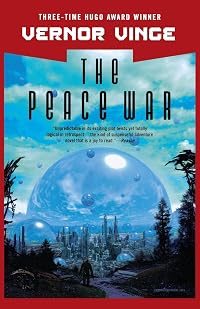
On This Page
Description
The novel that garnered Vinge his first "Best Novel" Hugo Finalist nomination, back in print after thirteen years. With a combination of hard-SF concepts, tight plotting, and appealing characters, Vinge tells a now-classic story of the Few triumphing over the Many. The Peace Authority, wielding a new state-of-the-art weapon, takes over the world, and claims to be "maintaining the peace" while really controlling the scattered survivors of the new world. The inventor of their weapon, which was show more never meant to be a weapon at all, leads a resistance of high-tech "tinkers" who fight to defeat the "Peace." show lessTags
Recommendations




Member Reviews
3/5
An enjoyable if rather light work that crams in a lot of interesting ideas into a narrative that is well paced but thin. In this version of the 1990's, a technology called 'Bobbling' is discovered by researchers at the Laurence Livermore lab, which creates perfectly spherical force fields at range with the help of gigajoules of energy. Under the guise of protecting humanity from itself, a group of power-hungry authoritarian scientists (later referred to as 'The Peace') bobble untold amounts of military installations, government buildings, and other structures of power around the world, seizing control in the ensuing power vacuum and banning any kind of technological research or fabrication. A biochemical plague is then released show more either by the Peace themselves or by a rebelling group of biochemical engineers, which kills billions of people around the world. The story begins 50 years after these events, where the Peace rules over a civilization is threadbare and tiny in size. Local feudal lords rule and squabble over fiefs that leave many in abject poverty, and secretive communities of lingering engineers work on advancing technology past the barriers that surround them. We follow a group of dissenters lead by the man whole created the bobble technology in the first place, and wunderkin child that he finds by chance as they try to overthrow the Peace and restore
The implications of the bobble technology are fully realized, both as burgeoning weapon of war, and as it relates the environment. Some of these bobbles are so large that they create their own weather, causing formerly dry environments to develop into rainforests.
That being said, the prose itself, the narrative, and the characters were lacking in many ways. The whole boy genius trope is so trite that I have a hard time taking it seriously. Wili is so perfect that it grows annoying over the course of the narrative. I found the relationship arc between Lu and Marcos to be far too convenient to the plot, underdeveloped, and unplausible. The institutional sexism and overt segregation don't serve a purpose besides adding baggage and coloring my opinion of Vinge himself, though I do acknowledge that women and minorities serve as some of the strongest leads in the story.
Despite its flaws, The Peace War has good pace and tension that kept me reading even when I found myself annoyed. There's a certain level of popcorn entertainment to the work, similar to an 80's action flick but with better ideas. I'm under the impression that this is not Vinge's best work, and I hope that's the case even though I enjoyed my time with it. show less
An enjoyable if rather light work that crams in a lot of interesting ideas into a narrative that is well paced but thin. In this version of the 1990's, a technology called 'Bobbling' is discovered by researchers at the Laurence Livermore lab, which creates perfectly spherical force fields at range with the help of gigajoules of energy. Under the guise of protecting humanity from itself, a group of power-hungry authoritarian scientists (later referred to as 'The Peace') bobble untold amounts of military installations, government buildings, and other structures of power around the world, seizing control in the ensuing power vacuum and banning any kind of technological research or fabrication. A biochemical plague is then released show more either by the Peace themselves or by a rebelling group of biochemical engineers, which kills billions of people around the world. The story begins 50 years after these events, where the Peace rules over a civilization is threadbare and tiny in size. Local feudal lords rule and squabble over fiefs that leave many in abject poverty, and secretive communities of lingering engineers work on advancing technology past the barriers that surround them. We follow a group of dissenters lead by the man whole created the bobble technology in the first place, and wunderkin child that he finds by chance as they try to overthrow the Peace and restore
The implications of the bobble technology are fully realized, both as burgeoning weapon of war, and as it relates the environment. Some of these bobbles are so large that they create their own weather, causing formerly dry environments to develop into rainforests.
That being said, the prose itself, the narrative, and the characters were lacking in many ways. The whole boy genius trope is so trite that I have a hard time taking it seriously. Wili is so perfect that it grows annoying over the course of the narrative. I found the relationship arc between Lu and Marcos to be far too convenient to the plot, underdeveloped, and unplausible. The institutional sexism and overt segregation don't serve a purpose besides adding baggage and coloring my opinion of Vinge himself, though I do acknowledge that women and minorities serve as some of the strongest leads in the story.
Despite its flaws, The Peace War has good pace and tension that kept me reading even when I found myself annoyed. There's a certain level of popcorn entertainment to the work, similar to an 80's action flick but with better ideas. I'm under the impression that this is not Vinge's best work, and I hope that's the case even though I enjoyed my time with it. show less
This is my first book by Vinge and it's clear he's writing well ahead of his time. The 1984 publication date was neat to see while reading about what he thought the advancement of computers would look like and how well he got on his predictions.
The bobble concept for this story was really interesting and moments and people frozen in time as a weapon is such a great concept. Outside the bobbles, life continues on and there's no penetration able to happen outside. Inside the bobbles, no time has passed and if your bobble pops (which wasn't known to happen until the first events of the story) you continue in the world you had no clue what went on. So things like whole armies being trapped or nuclear explosions contained within these large show more bobbles are frozen in place. The governing authority that exists above the world as some type of NATO dictatorial ruler is made up of some elites and military cabal. Those not with the Peace Authority are ordered to have no governments and no advancement of technology. Elements of anarcho-capitalism pops up (which was personally interesting for me and I wanted more info - which I do hear is part of a follow-up short story from Vinge). The rebellion has been secretly advancing in technology where they can get away with it. Because the Peace Authority has not had to compete in that area, when the events of the story take place they find themselves slightly at a loss as their advancement in tech has become stagnant. Really interesting concepts that pair well with the other elements of the plot.
The story revolves around Paul who is an old but super genius who finds his successor in a young kid named Wili. That is definitely not a name I would choose for a main character to follow. There are similar elements here seen in Ender Wiggins from Ender's Game but with less genetic information. In Wili, Paul finds his successor and the ability to engage in grand scale rebellion and turning the bobbles into smaller, personal weapons with a short lifespan to pop.
The story starts out strong with the beginning and the middle. A friend and I were reading this and we decided that Chapter 22, which was half way through the book was a good part one discussion and boy, does the book split right there. The first half involves character development and growth, unfolding the world, building up good, good-guys and good, bad-guys. However, right after the halfway section, Vinge really fumbles the ball on character and even some of the plot. Vinge fails to have his characters do much other than advance the elements of the plot from a technology and strategy of the rebellion point of view. They are there and they add to the story but there is nothing like that first part of the story with struggling and figuring things out and growing as characters. Leading up to the end, both my friend and I was not sure Vinge would finish the story as the pages were lessening and the pages were growing smaller. Vinge kind of spikes the ball at the end and finish the story but almost as a matter just to end it not really as apart of the story of the characters. Even the final part involving the Peace Authority characters made zero sense in why what happened did so. The thing about it was that if Vinge had worked on the character part of that part of the story just a little more throughout the second half of the book, I can absolutely get behind the ending. This was such a disappointment and both my friend and I were enjoying our independent but collective rage at this.
There are other stories in this series and I would say I am probably going to read them but as far as this book is concerned, I am not impressed with Vinge as a character writer. I do enjoy his science fiction and technology application and sometimes that can push me through. A good read overall but a lot to fumble here that I would understand why others wouldn't enjoy it. Final Grade - B- show less
The bobble concept for this story was really interesting and moments and people frozen in time as a weapon is such a great concept. Outside the bobbles, life continues on and there's no penetration able to happen outside. Inside the bobbles, no time has passed and if your bobble pops (which wasn't known to happen until the first events of the story) you continue in the world you had no clue what went on. So things like whole armies being trapped or nuclear explosions contained within these large show more bobbles are frozen in place. The governing authority that exists above the world as some type of NATO dictatorial ruler is made up of some elites and military cabal. Those not with the Peace Authority are ordered to have no governments and no advancement of technology. Elements of anarcho-capitalism pops up (which was personally interesting for me and I wanted more info - which I do hear is part of a follow-up short story from Vinge). The rebellion has been secretly advancing in technology where they can get away with it. Because the Peace Authority has not had to compete in that area, when the events of the story take place they find themselves slightly at a loss as their advancement in tech has become stagnant. Really interesting concepts that pair well with the other elements of the plot.
The story revolves around Paul who is an old but super genius who finds his successor in a young kid named Wili. That is definitely not a name I would choose for a main character to follow. There are similar elements here seen in Ender Wiggins from Ender's Game but with less genetic information. In Wili, Paul finds his successor and the ability to engage in grand scale rebellion and turning the bobbles into smaller, personal weapons with a short lifespan to pop.
The story starts out strong with the beginning and the middle. A friend and I were reading this and we decided that Chapter 22, which was half way through the book was a good part one discussion and boy, does the book split right there. The first half involves character development and growth, unfolding the world, building up good, good-guys and good, bad-guys. However, right after the halfway section, Vinge really fumbles the ball on character and even some of the plot. Vinge fails to have his characters do much other than advance the elements of the plot from a technology and strategy of the rebellion point of view. They are there and they add to the story but there is nothing like that first part of the story with struggling and figuring things out and growing as characters. Leading up to the end, both my friend and I was not sure Vinge would finish the story as the pages were lessening and the pages were growing smaller. Vinge kind of spikes the ball at the end and finish the story but almost as a matter just to end it not really as apart of the story of the characters. Even the final part involving the Peace Authority characters made zero sense in why what happened did so. The thing about it was that if Vinge had worked on the character part of that part of the story just a little more throughout the second half of the book, I can absolutely get behind the ending. This was such a disappointment and both my friend and I were enjoying our independent but collective rage at this.
There are other stories in this series and I would say I am probably going to read them but as far as this book is concerned, I am not impressed with Vinge as a character writer. I do enjoy his science fiction and technology application and sometimes that can push me through. A good read overall but a lot to fumble here that I would understand why others wouldn't enjoy it. Final Grade - B- show less
Non c'è come gli americani per descrivere la propria maniacale abitudine di occuparsi dei mali del mondo provocando guai peggiori, basandosi su un mix diabolico di malafede, malinteso senso di superiorità morale e ottime intenzioni.
Non fa eccezione questo libro in cui una fantomatica Autorità di Pace tiranneggia il mondo, dopo averlo privato della tecnologia energetica e delle bioscienze, con la scusa di volerlo salvare dalle stesse.
Guarda caso però, uno dei popoli tiranneggiati è proprio quello americano, che non soccombe mai, nemmeno a se stesso.
Molto datato, a tratti lento, ma comunque abbastanza godibile.
Non fa eccezione questo libro in cui una fantomatica Autorità di Pace tiranneggia il mondo, dopo averlo privato della tecnologia energetica e delle bioscienze, con la scusa di volerlo salvare dalle stesse.
Guarda caso però, uno dei popoli tiranneggiati è proprio quello americano, che non soccombe mai, nemmeno a se stesso.
Molto datato, a tratti lento, ma comunque abbastanza godibile.
This was a thought-provoking look at how technology doesn't always make the world better for everyone. I liked the interactions between Wili, Paul and Alison as they work together to defeat the Peace Authority.
Just the title of this book is contradictory, and therefore pretty intriguing. A peace war? Yes, a peace war.
It is 'the future' (1997 and 2047, the book was first published in 1984), and the 'bobble' is invented. It is a forcefield that can encapsule something, killing it in the moment. The Peace, started by the scientists who invented the bobble, has used the bobbles to put an end to war by encapsulating all hostile, explosive elements. The population of the world is greatly diminished by biologically engineered plagues. Because of this, and their quest against war, the Peace has forbidden all biological and electronic development to prevent the rest of the world inventing a solution to the bobbles or different weapons to rekindle show more war. All this leads to a pretty bleak life for most humans, as the Peace is effectively a dictatorship ruling most of the world. The story starts fifty years after the first bobble appeared, with Wili, a math wiz-kid, Paul, an old inventor, and weird things happening to the bobbles. For the people living in hiding of the Peace, this might be their chance to finally offer a real fight.
This book was a Hugo nominee, and based on that I expected a pretty good story, well written with good characters. Instead I felt more like I was reading a young adult novel. There was something like romance (also promised to me by the cover of the book), which wasn't really explored. There was adventure, a trip through the land under the threat of the Peace, but I never really believed the threat. Anytime something difficult came up, anytime the main characters were really under threat, somebody magically had the solution. Something maybe never seen in the past fifty years, and all of a sudden it is there, within less time than anybody ever needed. On top of all that, the ending was pretty confusing, and felt like a set-up for a second book. All in all, pretty disappointing, three out of five stars. show less
It is 'the future' (1997 and 2047, the book was first published in 1984), and the 'bobble' is invented. It is a forcefield that can encapsule something, killing it in the moment. The Peace, started by the scientists who invented the bobble, has used the bobbles to put an end to war by encapsulating all hostile, explosive elements. The population of the world is greatly diminished by biologically engineered plagues. Because of this, and their quest against war, the Peace has forbidden all biological and electronic development to prevent the rest of the world inventing a solution to the bobbles or different weapons to rekindle show more war. All this leads to a pretty bleak life for most humans, as the Peace is effectively a dictatorship ruling most of the world. The story starts fifty years after the first bobble appeared, with Wili, a math wiz-kid, Paul, an old inventor, and weird things happening to the bobbles. For the people living in hiding of the Peace, this might be their chance to finally offer a real fight.
This book was a Hugo nominee, and based on that I expected a pretty good story, well written with good characters. Instead I felt more like I was reading a young adult novel. There was something like romance (also promised to me by the cover of the book), which wasn't really explored. There was adventure, a trip through the land under the threat of the Peace, but I never really believed the threat. Anytime something difficult came up, anytime the main characters were really under threat, somebody magically had the solution. Something maybe never seen in the past fifty years, and all of a sudden it is there, within less time than anybody ever needed. On top of all that, the ending was pretty confusing, and felt like a set-up for a second book. All in all, pretty disappointing, three out of five stars. show less
I almost pushed this one down to a three star rating on my reread, but by the end I got over the mildly racist overtones against hispanics and blacks and got into the actual war effort.
Honestly, even though this is definitely SF with all its discussion of high-tech versus slightly lower-tech population, it actually reads like an OLD STYLE fantasy, complete with old wizard and an underprivileged apprentice siding with the underdog portion of society, the "Tinkers", against the Peace Authority, who holds the high tech "bobbles". I didn't like that so much. It was old had, but this did get released back in 1984, so it might be just dated in my own head.
I liked the idea behind the "bobbles". Stasis bubbles, impenetrable force fields that show more can capture nuclear blasts as they happen and protect the populace. This is what brings our civilization to its knees, oddly enough. Unfortunately, I felt like I had to slog through half the novel before we got to the revolution overthrowing the Peace Authority. That was just fine. Lots of action and battles, heroic deeds and whatnot.
If it hadn't been for the slower pace of the beginning, I would have thought this would have been pretty rip-roaring fun.
It is, unfortunately, my least favorite of Mr. Vinge's works, and because of such high expectations, I wanted to judge this novel on his subsequent delights.
That would be very unfortunate, though, and I will therefore back-off and let this novel stand on its own.
It isn't fantastic, but it is worth reading for the ideas, if not for the somewhat mediocre story. show less
Honestly, even though this is definitely SF with all its discussion of high-tech versus slightly lower-tech population, it actually reads like an OLD STYLE fantasy, complete with old wizard and an underprivileged apprentice siding with the underdog portion of society, the "Tinkers", against the Peace Authority, who holds the high tech "bobbles". I didn't like that so much. It was old had, but this did get released back in 1984, so it might be just dated in my own head.
I liked the idea behind the "bobbles". Stasis bubbles, impenetrable force fields that show more can capture nuclear blasts as they happen and protect the populace. This is what brings our civilization to its knees, oddly enough. Unfortunately, I felt like I had to slog through half the novel before we got to the revolution overthrowing the Peace Authority. That was just fine. Lots of action and battles, heroic deeds and whatnot.
If it hadn't been for the slower pace of the beginning, I would have thought this would have been pretty rip-roaring fun.
It is, unfortunately, my least favorite of Mr. Vinge's works, and because of such high expectations, I wanted to judge this novel on his subsequent delights.
That would be very unfortunate, though, and I will therefore back-off and let this novel stand on its own.
It isn't fantastic, but it is worth reading for the ideas, if not for the somewhat mediocre story. show less
I like Vernor Vinge's style of writing a lot in general. Come up with a new concept, explore the consequences of that concept across a specific time and setting. This book did that pretty well. A whole new take on "peaceful conquest".
My main complaint with this book is that if anything, he almost had too much in it. In other novels, he'll introduce similar amounts of detail, but spend multiple novels exploring all of it. This one book was perhaps too short to really get into his complex worlds. It needs a prequel and a sequel it feels like.
My main complaint with this book is that if anything, he almost had too much in it. In other novels, he'll introduce similar amounts of detail, but spend multiple novels exploring all of it. This one book was perhaps too short to really get into his complex worlds. It needs a prequel and a sequel it feels like.
Members
- Recently Added By
Published Reviews
Verhaal, spelend in het Californië van na de 3e Wereldoorlog. De mensen wonen verspreid in kleine dorpjes en hebben een hoog ontwikkelde micro-techniek. De VN is vervangen door de Vredesmacht, die elke tegenstand "inbobbelt" in energiebellen, een wereldpolitiemacht. Een begaafde tiener en een oude man (van voor de oorlog) proberen de "bobbels" en daarmee de greep van de "Vredesmacht" te show more breken. Een spannend verhaal, goed uitgewerkt scenario. Realistische omschrijving van de "naoorlogse" samenleving en technische apparatuur. Personages goed uitgewerkt. In het begin nog twee verhalen, wordt het later knap in een gevlochten. Slot helaas wat tam. Kleine letter.
(NBD|Biblion recensie, F.Th. de Rijk) show less
(NBD|Biblion recensie, F.Th. de Rijk) show less
added by karnoefel
Lists

Schisms in transhumanity - SF
34 works; 1 member

Books Read in 2021
5,361 works; 114 members

Books Read in 2025
4,128 works; 98 members
Author Information

58+ Works 23,271 Members
Some Editions
Awards and Honors
Awards
Series

Belongs to Publisher Series
Urania [Mondadori] (1012)
Work Relationships
Common Knowledge
- Original title
- The Peace War
- Original publication date
- 1984-08
- People/Characters
- Paul Hoehler; Allison Parker; Wili Wáchendon; Della Lu
- Dedication
- To my parents,
Clarence L. Vinge and Ada Grace Vinge,
with Love - First words
- One hundred kilometers below and nearly two hundred away, the shore of the Beaufort Sea didn't look much like the common image of the arctic: Summer was far advanced in the Northern Hemisphere, and a pale green spread across ... (show all)the land, shading here and there to the darker tones of grass.
- Last words
- (Click to show. Warning: May contain spoilers.)And if Allison's fears about the next few years turned out to be true, he would be around to help out on that, too.
- Original language*
- Engels
*Some information comes from Common Knowledge in other languages. Click "Edit" for more information.
Classifications
Statistics
- Members
- 1,458
- Popularity
- 16,138
- Reviews
- 23
- Rating
- (3.81)
- Languages
- 7 — Dutch, English, Finnish, German, Italian, Portuguese, Spanish
- Media
- Paper, Ebook
- ISBNs
- 15
- ASINs
- 8