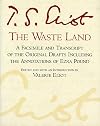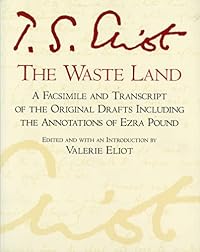
The Waste Land: A Facsimile & Transcript of the Original Drafts, Including the Annotations of Ezra Pound
by T. S. Eliot
On This Page
Description
Biographical material accompanies reproductions of T. S. Eliot's original manuscript and notes.Tags
Recommendations










Member Reviews
The Waste Land is unarguably one of the Western world’s most important poems from the 20th century, and I’ve always loved it - baffling symbolism and strange prose included - even though I can’t claim to truly understand it. I mean, who can say that they do, in all honesty? Eliot was a weird dude by all measures, and sometimes you just have to let the joy of the weird person encompass you without getting caught up in it. In theory, the transcript publication of the original manuscript of the Waste Land (long held in the collection of John Quinn, Eliot’s friend and legal advisor) should shed some light on the poem itself, as readers are able to see edits made by Eliot and notes by Ezra Pound on the poems and fragments that became show more the finished Waste Land poem, but in a sense these drafts seem so far removed from the finished Waste Land that they can almost be considered separate entities themselves. In some cases this is more blatant than others, as Eliot’s second wife (and editor of the book) Valerie notes that certain poems remained unpublished and make no obvious further reference to their influence on the final Waste Land. Regardless of the transcript manuscript’s random contents (and my ongoing lack of interest in any attempt to formally analyse poetic content) the collection was a very interesting read, and I felt like my brain got a good workout in dealing with comprehending the dichotomy of understandable words combined into incomprehensible and strange ways. show less
Clearly the way to read The Waste Land: this includes the first published version, the preceding (often unpublished) poems that ended up being incorporated into The Wasteland, and the heavily edited and annotated text of an early draft of the poem.
The process of crafting the poem is made clear, and that is both eye-opening and unfortunate. It becomes apparent that the original version of the poem was highly personal, expressing Eliot's disillusion and despair after living in London. Many of the references are extremely private, in the sense that they will only be understood by a close circle of friends, and there is no sign that this could turn into a work of general appeal.
The hand of Ezra Pound changes all that, redacting much of the show more poem in order to make it more obscure but also to give it a more general appeal. Apparently it worked, but it does lend an air of chicanery to the whole deal - trading honesty and clarity for omission and obfuscation.
So if you want to understand The Waste Land and what it is about, forget all the essays that get packed into the Norton Critical and read this instead. You may find, though, that is lessens your appreciation of both Eliot and the poem. show less
The process of crafting the poem is made clear, and that is both eye-opening and unfortunate. It becomes apparent that the original version of the poem was highly personal, expressing Eliot's disillusion and despair after living in London. Many of the references are extremely private, in the sense that they will only be understood by a close circle of friends, and there is no sign that this could turn into a work of general appeal.
The hand of Ezra Pound changes all that, redacting much of the show more poem in order to make it more obscure but also to give it a more general appeal. Apparently it worked, but it does lend an air of chicanery to the whole deal - trading honesty and clarity for omission and obfuscation.
So if you want to understand The Waste Land and what it is about, forget all the essays that get packed into the Norton Critical and read this instead. You may find, though, that is lessens your appreciation of both Eliot and the poem. show less
I gotta say this is pretty much essential for fans of The Waste Land. It sheds light on the composition process, parts of the poem that are obscure, and Eliot's own life up to and after the poem's publication. Pound's, Eliot's, and Vivienne Eliot's marginalia are a pleasure to read. In fact, the book fully justifies Eliot's dedication for Pound as "il miglior fabbro." Through his intervention the poem transformed from a very good piece into what many call the greatest poem of the 20th century. I will definitely come back to this book in the future and delve further into what was going on.
Ratings
Members
- Recently Added By
Author Information

500+ Works 47,713 Members
T. S. Eliot is considered by many to be a literary genius and one of the most influential men of letters during the half-century after World War I. He was born on September 26, 1888, in St. Louis, Missouri. Eliot attended Harvard University, with time abroad pursuing graduate studies at the Sorbonne, Marburg, and Oxford. The outbreak of World War show more I prevented his return to the United States, and, persuaded by Ezra Pound to remain in England, he decided to settle there permanently. He published his influential early criticism, much of it written as occasional pieces for literary periodicals. He developed such doctrines as the "dissociation of sensibility" and the "objective correlative" and elaborated his views on wit and on the relation of tradition to the individual talent. Eliot by this time had left his early, derivative verse far behind and had begun to publish avant-garde poetry (including "The Love Song of J. Alfred Prufrock" (1915), which exploited fresh rhythms, abrupt juxtapositions, contemporary subject matter, and witty allusion. This period of creativity also resulted in another collection of verse (including "Gerontian") and culminated in The Waste Land, a masterpiece published in 1922 and produced partly during a period of psychological breakdown while married to his wife, Vivienne Haigh-Wood Eliot. In 1922, Eliot became a director of the Faber & Faber publishing house, and in 1927 he became a British citizen and joined the Church of England. Thereafter, his career underwent a change. With the publication of Ash Wednesday in 1930, his poetry became more overtly Christian. As editor of the influential literary magazine The Criterion, he turned his hand to social as well as literary criticism, with an increasingly conservative orientation. His religious poetry culminated in Four Quartets, published individually from 1936 onward and collectively in 1943. This work is often considered to be his greatest poetic achievement. Eliot also wrote poetry in a much lighter vein, such as Old Possum's Book of Practical Cats (1939), a collection that was used during the early 1980s as the basis for the musical, Cats. In addition to his contributions in poetry and criticism, Eliot is the pivotal verse dramatist of this century. He followed the lead of William Butler Yeats in attempting to revive metrical language in the theater. But, unlike Yeats, Eliot wanted a dramatic verse that would be self-effacing, capable of expressing the most prosaic passages in a play, and an insistent, undetected presence capable of elevating itself at a moment's notice. His progression from the pageant The Rock (1934) and Murder in the Cathedral (1935), written for the Canterbury Festival, through The Family Reunion (1939) and The Cocktail Party (1949), a West End hit, was thus a matter of neutralizing obvious poetic effects and bringing prose passages into the flow of verse. Recent critics have seen Eliot as a divided figure, covertly attracted to the very elements (romanticism, personality, heresy) he overtly condemned. His early attacks on romantic poets, for example, often reveal him as a romantic against the grain. The same divisions carry over into his verse, where violence struggles against restraint, emotion against order, and imagination against ironic detachment. This Eliot is more human and more attractive to contemporary taste. During his lifetime, Eliot received many honors and awards, including the Nobel Prize for literature in 1948. (Bowker Author Biography) show less
All Editions
Common Knowledge
- Canonical title
- The Waste Land: A Facsimile & Transcript of the Original Drafts, Including the Annotations of Ezra Pound
Classifications
Statistics
- Members
- 560
- Popularity
- 52,509
- Reviews
- 3
- Rating
- (4.69)
- Languages
- English
- Media
- Paper, Ebook
- ISBNs
- 9
- ASINs
- 3