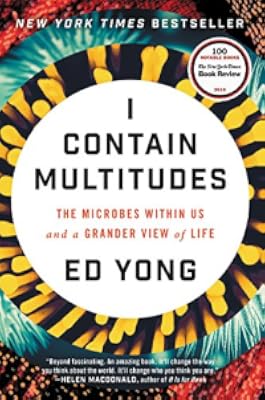
I Contain Multitudes: The Microbes Within Us and a Grander View of Life
by Ed Yong
On This Page
Description
This book lets us peer into the world of microbes -- not as germs to be eradicated, but as invaluable parts of our lives -- allowing us to see how ubiquitous and vital microbes are: they sculpt our organs, defend us from disease, break down our food, educate our immune systems, guide our behavior, bombard our genomes with their genes, and grant us incredible abilities. While much of the prevailing discussion around the microbiome has focused on its implications for human health, Yong show more broadens this focus to the entire animal kingdom, prompting us to look at ourselves and our fellow animals in a new light: less as individuals and more as the interconnected, interdependent multitudes we are. I Contain Multitudes is the story of extraordinary partnerships between the familiar creatures of our world and those we never knew existed. It will change both our view of nature and our sense of where we belong in it. -- show lessTags
Recommendations
Member Reviews
We tend to think about microbes and bacteria about the things that make us sick. But really, all of us have symbiotic relationships with bacteria, whether it be on our skin, or in our mouths. And we're not the only ones - all sorts of animals need bacteria to experience life as we know it. Yong dives into the fascinating, cutting-edge (at least, when this book was published in 2016) science of what we know, and are still wondering, about the microscopic world all around, and in, us.
This was a readable, detailed, and fascinating account. I really enjoyed learning about the wide range of things that bacteria do, whether it's helping animals digest food in various ways or training our immune systems to reject other, more harmful bacteria. show more Yong does a good job of showing symbiosis and the simple truth that bacteria isn't "good" or "bad", it's just surviving and replicating like any other organism. Sometimes that's in ways that is useful for animals, sometimes that's in harmful ways, and sometimes it's something more complicated. And there's a lot we don't know, or are just beginning to find out. I only had two small quibbles. One, he sometimes starts out telling you a fact, and then proceeds to either backtrack or bring up evidence to the contrary, which is fair when you're just at the beginning of testing something and experiments don't agree, but made for a confusing reading experience. Two, there are just so many facts that at the end my head was spinning and I don't think I retained much at all. That aside, I enjoyed the read immensely and appreciated the thorough footnotes. show less
This was a readable, detailed, and fascinating account. I really enjoyed learning about the wide range of things that bacteria do, whether it's helping animals digest food in various ways or training our immune systems to reject other, more harmful bacteria. show more Yong does a good job of showing symbiosis and the simple truth that bacteria isn't "good" or "bad", it's just surviving and replicating like any other organism. Sometimes that's in ways that is useful for animals, sometimes that's in harmful ways, and sometimes it's something more complicated. And there's a lot we don't know, or are just beginning to find out. I only had two small quibbles. One, he sometimes starts out telling you a fact, and then proceeds to either backtrack or bring up evidence to the contrary, which is fair when you're just at the beginning of testing something and experiments don't agree, but made for a confusing reading experience. Two, there are just so many facts that at the end my head was spinning and I don't think I retained much at all. That aside, I enjoyed the read immensely and appreciated the thorough footnotes. show less
Humanity has known about the microbial world of bacteria for centuries. Ever since technology for optical lenses progressed to a certain point, we’ve known that there is a super-small world that populates almost every region on this planet’s surface. What we didn’t know what how well it worked with animal bodies to promote life. The relatively recent development of microbiology taught us that, and ongoing research into the microbiome spills forth clues into how human life functions – and perhaps can be healed – with the help of microbes.
Ed Yong is a Pulitzer Prize-winning science writer who engages the subject of microbes with an acute interest in how life works. Like most sciences, microbiology can appear as a dry subject show more when approached through textbooks. As a good science writer, Yong instead seeks to convey this same material but engages the human heart at the same time. He succeeds in spades.
I learned many things from this book. Life’s origins lie squarely with microbes. Further, the sustenance of today’s life still lies with microbes. That is, without microbes, most of earthly life would fall apart. For some, they supply necessary amino acids to form proteins. As a unit called the microbiome, they populate human guts to aid in digestion. Mixtures in probiotic yogurts may not be refined and targeted yet, but the basic concept makes scientific sense. Retooling this microbiome to promote healthy outcomes (especially with GI diseases) will be a noteworthy advance of the 21st century.
I often look at the plant and animal worlds around me to survey the diversity of life. I see nature all around me. This book taught me to exercise my imagination more to engage the microbial world in this mix, too. Microbes are not evil; many, in fact, are helpful. Killing all microbes will not lead to cleanliness but to death for all. We humans need to learn to work with these lifeforms to promote life, and detailed insights supplied by writers like Yong will do just that. Knowledge of microbial life has recently exploded, and digging into its nuggets of wisdom can enrich your mind, soul, and body. show less
Ed Yong is a Pulitzer Prize-winning science writer who engages the subject of microbes with an acute interest in how life works. Like most sciences, microbiology can appear as a dry subject show more when approached through textbooks. As a good science writer, Yong instead seeks to convey this same material but engages the human heart at the same time. He succeeds in spades.
I learned many things from this book. Life’s origins lie squarely with microbes. Further, the sustenance of today’s life still lies with microbes. That is, without microbes, most of earthly life would fall apart. For some, they supply necessary amino acids to form proteins. As a unit called the microbiome, they populate human guts to aid in digestion. Mixtures in probiotic yogurts may not be refined and targeted yet, but the basic concept makes scientific sense. Retooling this microbiome to promote healthy outcomes (especially with GI diseases) will be a noteworthy advance of the 21st century.
I often look at the plant and animal worlds around me to survey the diversity of life. I see nature all around me. This book taught me to exercise my imagination more to engage the microbial world in this mix, too. Microbes are not evil; many, in fact, are helpful. Killing all microbes will not lead to cleanliness but to death for all. We humans need to learn to work with these lifeforms to promote life, and detailed insights supplied by writers like Yong will do just that. Knowledge of microbial life has recently exploded, and digging into its nuggets of wisdom can enrich your mind, soul, and body. show less
A fascinating look into the world within, the microbes that account for up to ninety percent of the cells in our bodies. Although the focus of this book was on the human microbiome it also covered those of a wide range of animals, insects, and flora. The author included enough humor, personal stories, and anecdotes to make what could have been a very dry subject very interesting. As a bonus the audiobook narrator's enunciation was clear and easy to understand - important in a book that includes as many technical terms as this one.
For my entire nursing career I have worked in oncology, where I have been part of teams taking care of people with cancer. Frequently patients have “neutropenic fevers,” a condition considered to be potentially harmful and almost always requiring admission to the hospital. Neutrophils are those brave little white blood cells that go out into our bodies and do battle with all the nasty things our bodies are exposed to every day. Neutropenia means the patient has none of those cells to speak of (and this is why herd immunity and vaccines are important).
We culture blood and urine, scan lungs, treat with antibiotics, and monitor for a few days to see if any microbes grow out in cultures. We teach people to fastidiously handwash, and show more avoid people who are sick. We make them wear masks in the hallways, in order to filter out airborne viruses. Their rooms have special filtration systems. We encourage them to make safe food choices, avoiding foods that can’t be washed or scrubbed clean, or might be undercooked. And you want to know the kicker? If these patients are infected, it’s usually because of microbes in their own body have run amok and caused infection.
You know what else is in the hospital? Microbes. Tons of antibiotic-resistant microbes, hanging out in patient bodies and everywhere else. Once someone is cultured positive for these microbes, they stay on “isolation” for the duration of the visit--and sometimes for life in the case of microbes resistant to all antibiotics--in the (vain) hopes that staff, visitors and patients won’t go moving those resistant microbes around the hospital. A shift where I don’t where a yellow isolation gown to go into these rooms is pretty unusual.
Yong made my little grey cells stretch and reach, and now I have yet more ways to think about microbes, and I dearly wish he would re-write this book–maybe in magazine form–every couple years so I can keep up with all the interesting research. Like David Quammen, Yong doesn’t just stick to one branch of research science; he wanders around many fields as he explores the impact microbes have made on us. He’ll first have you thinking about their sheer evolutionary weight (literally and figuratively), reminding us that we evolved in context of a microbe landscape, not the other way round (and some thought apes were a stretch). Like living on a planet where most of the water is saltwater, it makes sense that microbes would impact the evolution of life.
Yong walks the reader through some of the science that show how animals evolved to use microbes (and perhaps vice versa?). Some are evolutionary, some genetic, some macro. There’s a lovely experiment where a glowing squid developed a sequestered area for those microbes–can’t set them free in the body, of course, so you have to create a special compartment.
In other words, I highly recommend this book. It’s quite well researched and documented, with extensive citations. There’s a bibliography and index, for those that want to delve further or pick and choose. As a further note, I’ll say that I always appreciate researchers/writers who express appreciation for those they interview and follow, without being fawning, and Yong does a nice job with that as well. There are parts I really liked, parts I liked less, parts where someone should have trimmed his descriptive writing just a tad, but any book that keeps me thinking about it months later is a five star read.
I’m going to put my detailed book report below page break at my wordpress site ( https://clsiewert.wordpress.com/2019/02/03/i-contain-multitudes-by-ed-yong/) with notes heavily on the medical and the ocean science. There’s also some interesting stuff about insects, for those who might lean that way, and trees. show less
We culture blood and urine, scan lungs, treat with antibiotics, and monitor for a few days to see if any microbes grow out in cultures. We teach people to fastidiously handwash, and show more avoid people who are sick. We make them wear masks in the hallways, in order to filter out airborne viruses. Their rooms have special filtration systems. We encourage them to make safe food choices, avoiding foods that can’t be washed or scrubbed clean, or might be undercooked. And you want to know the kicker? If these patients are infected, it’s usually because of microbes in their own body have run amok and caused infection.
You know what else is in the hospital? Microbes. Tons of antibiotic-resistant microbes, hanging out in patient bodies and everywhere else. Once someone is cultured positive for these microbes, they stay on “isolation” for the duration of the visit--and sometimes for life in the case of microbes resistant to all antibiotics--in the (vain) hopes that staff, visitors and patients won’t go moving those resistant microbes around the hospital. A shift where I don’t where a yellow isolation gown to go into these rooms is pretty unusual.
Yong made my little grey cells stretch and reach, and now I have yet more ways to think about microbes, and I dearly wish he would re-write this book–maybe in magazine form–every couple years so I can keep up with all the interesting research. Like David Quammen, Yong doesn’t just stick to one branch of research science; he wanders around many fields as he explores the impact microbes have made on us. He’ll first have you thinking about their sheer evolutionary weight (literally and figuratively), reminding us that we evolved in context of a microbe landscape, not the other way round (and some thought apes were a stretch). Like living on a planet where most of the water is saltwater, it makes sense that microbes would impact the evolution of life.
Yong walks the reader through some of the science that show how animals evolved to use microbes (and perhaps vice versa?). Some are evolutionary, some genetic, some macro. There’s a lovely experiment where a glowing squid developed a sequestered area for those microbes–can’t set them free in the body, of course, so you have to create a special compartment.
In other words, I highly recommend this book. It’s quite well researched and documented, with extensive citations. There’s a bibliography and index, for those that want to delve further or pick and choose. As a further note, I’ll say that I always appreciate researchers/writers who express appreciation for those they interview and follow, without being fawning, and Yong does a nice job with that as well. There are parts I really liked, parts I liked less, parts where someone should have trimmed his descriptive writing just a tad, but any book that keeps me thinking about it months later is a five star read.
I’m going to put my detailed book report below page break at my wordpress site ( https://clsiewert.wordpress.com/2019/02/03/i-contain-multitudes-by-ed-yong/) with notes heavily on the medical and the ocean science. There’s also some interesting stuff about insects, for those who might lean that way, and trees. show less
I wasn't sure what I was going to get when I started this book; obviously microbes, but was it going to be dry and academic, or worse, evangelical 'omg-microbes-are-the-answer-to-everything!'?
Luckily I got neither. Instead Yong's book was, from start to finish, utterly fascinating; never too arcane and never to simplistic, he found the sweet spot of science writing, creating an engaging narrative that never talks down to the reader. Anyone with an average vocabulary and an interest in the symbiotic world can pick up this book without feeling intimidated.
Microbes (bacteria, viruses, etc.) are everywhere. Everywhere. And bad news for the germaphobes: this is a good and necessary thing. Life on Earth simply could not exist without these show more microscopic machines. Plants and animals depend on bacteria for nutrients they can't get from food on their own, for turning on specific and necessary genes in the DNA, even for protecting them from other bacteria gone rogue.
Yong starts at the beginning of humans' awareness that there is life we cannot see. Typically these beginning chapters are the deadliest for me, as I get bored with the 'background' and impatient to get to the 'good stuff', but Yong made sure even the boring background was the 'good stuff'. I was never bored reading this book.
Left to my own devices, this review would go on forever, because there's just so much worth discussing, so I'm going to short-circuit myself and say this: I Contain Multitudes is a great book for learning how microbes help make all life possible; it's a 50/50 split, more or less, of information on microbe/human and microbes/other flora and fauna symbioses. It's easy to read, it's entertaining, and for at least myself, it was laugh out loud funny in one part. I finished with a much better understanding of the microbial world and my own digestive system (for now, I'm going to resist the temptation of probiotic supplements).
A very worth-while read and one I wouldn't hesitate to recommend to anyone with an interest. show less
Luckily I got neither. Instead Yong's book was, from start to finish, utterly fascinating; never too arcane and never to simplistic, he found the sweet spot of science writing, creating an engaging narrative that never talks down to the reader. Anyone with an average vocabulary and an interest in the symbiotic world can pick up this book without feeling intimidated.
Microbes (bacteria, viruses, etc.) are everywhere. Everywhere. And bad news for the germaphobes: this is a good and necessary thing. Life on Earth simply could not exist without these show more microscopic machines. Plants and animals depend on bacteria for nutrients they can't get from food on their own, for turning on specific and necessary genes in the DNA, even for protecting them from other bacteria gone rogue.
Yong starts at the beginning of humans' awareness that there is life we cannot see. Typically these beginning chapters are the deadliest for me, as I get bored with the 'background' and impatient to get to the 'good stuff', but Yong made sure even the boring background was the 'good stuff'. I was never bored reading this book.
Left to my own devices, this review would go on forever, because there's just so much worth discussing, so I'm going to short-circuit myself and say this: I Contain Multitudes is a great book for learning how microbes help make all life possible; it's a 50/50 split, more or less, of information on microbe/human and microbes/other flora and fauna symbioses. It's easy to read, it's entertaining, and for at least myself, it was laugh out loud funny in one part. I finished with a much better understanding of the microbial world and my own digestive system (for now, I'm going to resist the temptation of probiotic supplements).
A very worth-while read and one I wouldn't hesitate to recommend to anyone with an interest. show less
What a ride. I was aware of my microbiome, but knowing Earth life is as interconnected and mutually dependent as I fantasized as a child, staring up through the leaves of whatever tree I was perched in at the time? That is glorious. Science gives that early feeling solid footing and wings to fly - we're starting to manipulate microbiomes, hoping to save reefs, hamper disease-carrying insects, and make buildings healthier, to name just three. Fantastic.
If you want to become more aware of Earth life's smallest members, this book is your ticket in. It's a gentle, thorough ride with visits to different scientists and projects and always, Ed Yong's humor. About 30% of the text is notes and so on, so don't be daunted by the length, either.
If you want to become more aware of Earth life's smallest members, this book is your ticket in. It's a gentle, thorough ride with visits to different scientists and projects and always, Ed Yong's humor. About 30% of the text is notes and so on, so don't be daunted by the length, either.
Years ago, I read Life On Man by Theodor Rosebury. (and also his Microbes and Morals) yet I remember little about them. I remember liking them (why I read two of them). I bring them up because Mr Roseburry is frequently quoted in I Contain Multitudes, a book that is in a very real sense it's predecessor. Interestingly, Rosebury was a scientist and researcher while Ed Yong is a journalist yet Rosebury is the better writer of the two (if I recall my reading experience correctly). I say this because at times Mr. Yong gives too much detail for a lay reader such as myself and I found it hard to follow what I probably didn't need to follow at all.
There is so much I learned from this book. Multitudes, perhaps. Much has been discovered since show more Rosebury's day thanks to advances in genetics technology, primarily gene sequencing and genomics. (The one review I read of Microbes and Morals on Goodreads declared it as "dated" though my guess is that the reviewer was talking more about changes in morals than in our knowledge of microbes)
Still, the most surprising thing about this book is how it changes our view of who we are in the same way Roseburry's did (which didn't last and I needed it to be done again.) Only about 50% of our cells are "human," the remainder belonging to various colonies of microbial life without which we wouldn't be able to survive. For example, they are part of our immune system and our digestive tract. They evolved along side us in cooperation with us (preceding us for millions of years) and yet we tend to think of them as enemies, characterizing them by the tiny percentage of them which cause disease. Even as I sit here typing on a computer keyboard that is swarming with them, there are millions more microbes hanging out on my face and hands, living in the forest of my hair and the tropic beach of my mouth crossing the unpatrolled borders of my lips like undocumented aliens when I breathe in and out. We continually exchange our microbes with strangers, on light switches and doorknobs, and with intimates more directly in other ways.
One of the reasons people become ill in hospitals is not merely because of the proximity to sick people but because the internal environment is over-cleaned removing those microbes that protect us. The same antibiotics that kill the germs that make us ill also make us more vulnerable to an influx of different pathogens from which we previously had been protected. In fact, those toilet seats that are sanitized for our protection soon after have more bacteria than before they were cleaned because they lack the "good" microbes that had been killed of in the sanitizing process. Florence Nightingale, Yong tells us, would open windows in hospitals because she noticed that the health of patients near them would improve. We now know that this is because it allows external bacteria into the oversanitzed environment.
Along with this change in how I view myself (and my cats) I learned about the kinds of research being done, e.g. the effects of gut bacteria on anxiety and depression, the project to eliminate dengue fever, studies investigating the relationship of our microbial partners to hypertension and obesity, how the rise in autoimmune diseases my be related to the eradication of many childhood diseases.
I recently tried to discuss some of these ideas with a germaphobe of my acquaintance but he found what I was saying toxic and refused to listen. Don't be like him. Read this book. show less
There is so much I learned from this book. Multitudes, perhaps. Much has been discovered since show more Rosebury's day thanks to advances in genetics technology, primarily gene sequencing and genomics. (The one review I read of Microbes and Morals on Goodreads declared it as "dated" though my guess is that the reviewer was talking more about changes in morals than in our knowledge of microbes)
Still, the most surprising thing about this book is how it changes our view of who we are in the same way Roseburry's did (which didn't last and I needed it to be done again.) Only about 50% of our cells are "human," the remainder belonging to various colonies of microbial life without which we wouldn't be able to survive. For example, they are part of our immune system and our digestive tract. They evolved along side us in cooperation with us (preceding us for millions of years) and yet we tend to think of them as enemies, characterizing them by the tiny percentage of them which cause disease. Even as I sit here typing on a computer keyboard that is swarming with them, there are millions more microbes hanging out on my face and hands, living in the forest of my hair and the tropic beach of my mouth crossing the unpatrolled borders of my lips like undocumented aliens when I breathe in and out. We continually exchange our microbes with strangers, on light switches and doorknobs, and with intimates more directly in other ways.
One of the reasons people become ill in hospitals is not merely because of the proximity to sick people but because the internal environment is over-cleaned removing those microbes that protect us. The same antibiotics that kill the germs that make us ill also make us more vulnerable to an influx of different pathogens from which we previously had been protected. In fact, those toilet seats that are sanitized for our protection soon after have more bacteria than before they were cleaned because they lack the "good" microbes that had been killed of in the sanitizing process. Florence Nightingale, Yong tells us, would open windows in hospitals because she noticed that the health of patients near them would improve. We now know that this is because it allows external bacteria into the oversanitzed environment.
Along with this change in how I view myself (and my cats) I learned about the kinds of research being done, e.g. the effects of gut bacteria on anxiety and depression, the project to eliminate dengue fever, studies investigating the relationship of our microbial partners to hypertension and obesity, how the rise in autoimmune diseases my be related to the eradication of many childhood diseases.
I recently tried to discuss some of these ideas with a germaphobe of my acquaintance but he found what I was saying toxic and refused to listen. Don't be like him. Read this book. show less
Members
- Recently Added By
Published Reviews
ThingScore 100
Ed Yong is a talented British science writer, a staff writer for The Atlantic and the author of a wonderful blog, Not Exactly Rocket Science, hosted by National Geographic. “I Contain Multitudes,” his first book, covers a huge amount of microscopic territory in clear, strong, often epigrammatic prose. Yong has advanced degrees in biology, and he is remarkably well informed; he includes show more descriptions of many studies that are still unpublished, and even a few original ideas for new experiments. He is infectiously enthusiastic about microbes, and he describes them with verve. show less
added by jimroberts
Lists

Best Science Books for Non-Scientists
113 works; 57 members

Books Read in 2022
5,226 works; 115 members

Books Read in 2023
5,638 works; 147 members

The Venus Project Recommended Books - Contemporary sources
53 works; 2 members

Vlogbrothers Book Recommendations
307 works; 4 members

Books in the Bibliography of Humans: A Monstrous History by Surekha Davies
346 works; 1 member

Books With Complete Sentence Titles
502 works; 17 members
Author Information

8+ Works 4,592 Members
Some Editions
Awards and Honors
Awards
Distinctions
Notable Lists
Common Knowledge
- Canonical title
- I Contain Multitudes: The Microbes Within Us and a Grander View of Life
- Original title
- I Contain Multitudes: The Microbes Within Us and a Grander View of Life
- Original publication date
- 2016
- Dedication
- For Mum
- First words
- Baba does not flinch.
Prologue : A trip to the zoo.
The Earth is 4.54 billion years old.
1. Living islands. - Last words
- (Click to show. Warning: May contain spoilers.)And we learn the secret, invisible, and wondrous biology behind the gutless worms that thrive in an abyssal Eden, the mealybugs that suck the juices of plants, the corals that construct mighty reefs, the small stinging hydras that cling to pondweed, the beetles that bring down forests, the adorable squid that create their own light shows, the pangolin curled around a zoo-keepers waist, and the disease-fighting mosquitoes flying off into a bright Australian dawn.
- Blurbers
- Quammen, David; Kolbert, Elizabeth; Zimmer, Carl; Rutherford, Adam; Knight, Rob; Gilbert, Jack (show all 8); VanderMeer, Jeff; Gates, Bill
- Original language
- English UK
Classifications
Statistics
- Members
- 2,213
- Popularity
- 9,151
- Reviews
- 62
- Rating
- (4.15)
- Languages
- 10 — Dutch, English, French, German, Italian, Portuguese, Russian, Spanish, Swedish, Turkish
- Media
- Paper, Audiobook, Ebook
- ISBNs
- 30
- ASINs
- 9