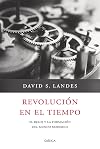
Revolution in Time: Clocks and the Making of the Modern World
by David S. Landes
On This Page
Description
"More than a decade after the publication of his dazzling book on the cultural, technological, and manufacturing aspects of measuring time and making clocks, David Landes has significantly expanded Revolution in Time. In a new preface and scores of updated passages, he explores new findings about medieval and early-modern time keeping, as well as contemporary hi-tech uses of the watch as mini-computer, cellular phone, and even radio receiver or television screen. While commenting on the show more latest research, Landes never loses his focus on the historical meaning of time and its many perceptions and uses, questions that go beyond history and involve philosophers and, possibly, theologians and literary folk as well."--Jacket. show lessTags
Recommendations

























Member Reviews
What keeps one coming back to the same book for years or even decades?
I can think of two books I’ve read and re-read for years; Sunset Song by Lewis Grassic Gibbon and Revolution in Time by David S. Landes. It’s this second book I’ve been thinking about again after reading a blog post about early mechanical clocks
“Frère Jacques, frère Jacques,
Dormez-vous? Dormez-vous
Sonnez les matines! Sonnez les matines!
Ding, daing, dong. Ding, daing, dong.”
I first stumbled across Revolution in Time around 1985 while exploring the nether regions of the Dundee University library. I found the opening of the book fascinating as it explained the need to measure time more precisely in late medieval Europe. Unlike Islam or Judaism, the Roman show more branch of Christianity (particularly the Benedictine rule) held offices at fixed times of day rather than during bands of time around sunrise, noon and sunset that can be assessed without a timekeeper. The monastic day or (Horarium) revolved around the eight canonical hours that would begin at midnight with the service of Matins followed by the morning office of Lauds at 3:00am.
While most of Europe in the middle ages lived an agrarian lifestyle regulated by the natural day, the Religious were subject to fixed times in each day and during the long dark winter nights. Given those conditions one can understand the anxiety about Brother John sleeping-in and not ringing the matins bell. They needed a reliable way to divide up the day.
It’s an interesting diversion to reflect on the fact that methods of telling the time elsewhere in the world don’t work well in Northern Europe. Water (clocks) freezes and sundials work best when one can be more confident of clear skies.
Revolution in Time tells a number of separate, but related, stories:
• The magnificent dead-end that was timekeeping in ancient China.
• The birth of mechanical timekeeping in medieval Europe.
• The race to fing the longitude and the story of John Harrison’s clocks.
• The history of the clock and watchmaking industry — for me, the least interesting part of the book.
I have travelled nearly 30 years with this book and will keep coming back to it because there is so much material to take in and Landes is a good story teller. Since first reading the book I’ve been lucky enough to visit some of the earliest clocks in Europe; theastronomical clock in Exeter CathedraL and the turret clock at Cotehele. It was fascinating to see that these are not precisely-engineered creations butmachines that have run for 500 or 600 years.
This is not just the story of instruments to measure time and break up the day into regular chunks. It’s the story that led to the industrial revolution and the modern world. show less
I can think of two books I’ve read and re-read for years; Sunset Song by Lewis Grassic Gibbon and Revolution in Time by David S. Landes. It’s this second book I’ve been thinking about again after reading a blog post about early mechanical clocks
“Frère Jacques, frère Jacques,
Dormez-vous? Dormez-vous
Sonnez les matines! Sonnez les matines!
Ding, daing, dong. Ding, daing, dong.”
I first stumbled across Revolution in Time around 1985 while exploring the nether regions of the Dundee University library. I found the opening of the book fascinating as it explained the need to measure time more precisely in late medieval Europe. Unlike Islam or Judaism, the Roman show more branch of Christianity (particularly the Benedictine rule) held offices at fixed times of day rather than during bands of time around sunrise, noon and sunset that can be assessed without a timekeeper. The monastic day or (Horarium) revolved around the eight canonical hours that would begin at midnight with the service of Matins followed by the morning office of Lauds at 3:00am.
While most of Europe in the middle ages lived an agrarian lifestyle regulated by the natural day, the Religious were subject to fixed times in each day and during the long dark winter nights. Given those conditions one can understand the anxiety about Brother John sleeping-in and not ringing the matins bell. They needed a reliable way to divide up the day.
It’s an interesting diversion to reflect on the fact that methods of telling the time elsewhere in the world don’t work well in Northern Europe. Water (clocks) freezes and sundials work best when one can be more confident of clear skies.
Revolution in Time tells a number of separate, but related, stories:
• The magnificent dead-end that was timekeeping in ancient China.
• The birth of mechanical timekeeping in medieval Europe.
• The race to fing the longitude and the story of John Harrison’s clocks.
• The history of the clock and watchmaking industry — for me, the least interesting part of the book.
I have travelled nearly 30 years with this book and will keep coming back to it because there is so much material to take in and Landes is a good story teller. Since first reading the book I’ve been lucky enough to visit some of the earliest clocks in Europe; theastronomical clock in Exeter CathedraL and the turret clock at Cotehele. It was fascinating to see that these are not precisely-engineered creations butmachines that have run for 500 or 600 years.
This is not just the story of instruments to measure time and break up the day into regular chunks. It’s the story that led to the industrial revolution and the modern world. show less
Told the Harrison deck watch story before Longitude became popular.
Clocks and timekeeping
Ratings
Members
- Recently Added By
Lists

Books in the Bibliography of The Alchemy of Us by Ainissa Ramirez
181 works; 1 member
Author Information

David S. Landes was born in Brooklyn, New York on April 29, 1924. He graduated from the City College of New York in 1942. He received a master's degree in history in 1943 and a Ph.D. in history in 1953 from Harvard University. During World War II, he was drafted into the Army and was assigned to the Signal Corps because he had been taking show more mail-order courses in cryptanalysis. He worked on deciphering Japanese messages about the atomic bombs dropped on Japan. He later worked on a history of German preparations for the invasion of Normandy. His dissertation, Bankers and Pashas: International Finance and Economic Imperialism in Egypt, became his first book. His other works included Revolution in Time: Clocks and the Making of the Modern World, The Wealth and Poverty of Nations: Why Some Are So Rich and Some So Poor, and Dynasties: Fortunes and Misfortunes of the World's Great Family Businesses. He taught at numerous universities during his lifetime including Columbia University, the University of California at Berkeley, and Harvard University, where he retired in 1996. He died on August 17, 2013 at the age of 89. (Bowker Author Biography) show less
Some Editions
Awards and Honors
Awards
Series
Belongs to Publisher Series
Gallimard, Bibliothèque des histoires (Série illustrée)
Common Knowledge
- Canonical title
- Revolution in Time: Clocks and the Making of the Modern World
- Original title
- Revolution in Time. Clocks and the Making of the Modern World
- Original publication date
- 1983 (1e édition originale américaine) (1e édition originale américaine); 1987-11-24 (1e traduction et édition revue et augmentée française, Bibliothèque des Histoires, Gallimard) (1e traduction et édition revue et augmentée française, Bibliothèque des Histoires, Gallimard); 2017-05-21 (Nouvelle édition française avec illustrations en couleurs, Histoire, Les Belles lettres) (Nouvelle édition française avec illustrations en couleurs, Histoire, Les Belles lettres)
- Epigraph
- Use time, or time will use you. - Old Proverb
- Dedication
- In memory of teachers and mentors: Arthur Harrison Cole, Donald Cope McKay, Sir Michael Moyse Postan, Abbot Payson Usher
- First words
- The question to ask is: Why clocks?
- Last words
- (Click to show. Warning: May contain spoilers.)The timekeeper remains.
- Original language*
- Anglais (Etats-Unis) (Etats-Unis)
*Some information comes from Common Knowledge in other languages. Click "Edit" for more information.
Classifications
- Genres
- History, Nonfiction, Technology, General Nonfiction, Science & Nature
- DDC/MDS
- 681.11309 — Applied science & technology Manufacture for specific uses Precision instruments and other devices Instruments for measuring time, counting and calculating machines and instruments Instruments for measuring time Clocks
- LCC
- TS542 .L24 — Technology Manufacturing engineering. Mass production Manufactures Metal manufactures. Metalworking
- BISAC
Statistics
- Members
- 560
- Popularity
- 52,772
- Reviews
- 3
- Rating
- (3.73)
- Languages
- 5 — English, French, Italian, Portuguese, Spanish
- Media
- Paper, Ebook
- ISBNs
- 12
- ASINs
- 10