On This Page
Description
Chief Inspector Wexford is in China, visiting ancient tombs and palaces with a group of British tourists. After their return to England, one of his fellow tourists is found murdered. As he questions other members of the group, Wexford finds secrets of greed, treachery, theft, and adultery, leading the distressed inspector to ask not who is innocent, but who is least guilty . . .Tags
Recommendations














Member Reviews
Wexford Hallucinates and Rendell brings the Cringe
Review of the Arrow Books/Cornerstone Digital Kindle eBook edition (2010) of the original Hutchinson (UK) hardcover (1983).
I was only a few pages into The Speaker of Mandarin before the cringe began with Rendell’s portrayal of Wexford’s Chinese tour guide. Thankfully it is mostly contained in those early pages. The book has an odd beginning as the first 1/3rd of it tells of Wexford’s trip to China on a show more police investigative procedures exchange mission organized by Wexford’s nephew, & London CID Chief Inspector, Howard Fortune. After the official meetings Wexford takes a solo vacation to various tourist sites before joining his wife Dora in Hong Kong. The tour group trip in Communist China is monitored of course by the authorities, with a full-time guide individually assigned to him. During his travels Wexford consumes an inordinate amount of green tea to combat the heat andsuffers from hallucinations as a result* .
There are other people on the tour and various odd events occur, including one seemingly accidental death of a local Chinese man. On Wexford’s return home there is a murder of one of the other tourists from the journey and the investigation requires that he re-examine those tour events in hindsight to understand the reason for the recent crime. There are of course a few twists along the way and the explanation for the book’s title is also not explained until the end.
The cringe at the front end was brief, but still the overall arc of the book felt unsatisfactory and I just can’t say that I even liked it. It falls into the rare case of a 2 star “it was just ok” rating, compared to my usual 3 to 5 star ratings for Rendell’s books and those of her alter-ego Barbara Vine. Also Wexford's usual references, quotes and allusions to classic literature, which often provide comic relief, were few and far between.
This book continued my 2023 binge read / re-read of Ruth Rendell and this is the 12th of the Inspector Wexford series. I’m trying to read the Wexfords in chronological order, but had to temporarily skip over #11 Put on by Cunning (1981), as it has been difficult to source.
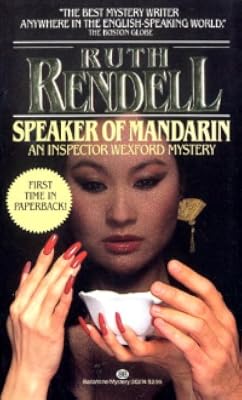
See cover at https://upload.wikimedia.org/wikipedia/en/e/e6/Thespeakerofmandarin.jpg
Cover image for the original Hutchinson (UK) hardcover edition from 1983. Image sourced from Wikipedia. May be found at the following website: http://pictures.abebooks.com/SARAWILLIAMS2/8463207784.jpg., Fair use, Link
Footnote
* The reason for the hallucinations is not revealed until the end of the book by Wexford’s doctor so that is why I’ve spoiler blocked it. Once you read about it you will definitely want to google it though, and you get results likethis .
Other Reviews
The review at The Passing Tramp is based on a 2019 re-read and also mentions the now dated racial stereotyped portrayals. The review goes on to mention Rendell having toured the Far East (which likely provided source material for the book) and her own distant family connection to a Burmese relative.
Trivia and Links
The Speaker of Mandarin was adapted for television as part of the Ruth Rendell / Inspector Wexford Mysteries TV series (1987-2000) as Season 6 Episodes 1 to 3 in 1992 with actor George Baker as Inspector Wexford. You can watch the entire 3 episodes on YouTube here.
While reading The Speaker of Mandarin, I happened to notice a recent CNN March 27, 2023 article about modern day edits of Agatha Christie's books. While I am against censorship in general, as I think it is better to learn from the mistakes of the past, there are certainly cases where it seems warranted, such as the unfortunate original 2 titles of Christie's [book:And Then There Were None|16299] (1939). show less
Review of the Arrow Books/Cornerstone Digital Kindle eBook edition (2010) of the original Hutchinson (UK) hardcover (1983).
‘Velly well. I hope you not leglet,’ said Mr Sung, indignation, as any emotion did, causing acute confusion in the pronunciation of liquids. ‘I aflaid you be solly.’ - Wexford’s Chinese tour guide reacts to his refusal to view the college attended by Chairman Mao Tse-Tung.
I was only a few pages into The Speaker of Mandarin before the cringe began with Rendell’s portrayal of Wexford’s Chinese tour guide. Thankfully it is mostly contained in those early pages. The book has an odd beginning as the first 1/3rd of it tells of Wexford’s trip to China on a show more police investigative procedures exchange mission organized by Wexford’s nephew, & London CID Chief Inspector, Howard Fortune. After the official meetings Wexford takes a solo vacation to various tourist sites before joining his wife Dora in Hong Kong. The tour group trip in Communist China is monitored of course by the authorities, with a full-time guide individually assigned to him. During his travels Wexford consumes an inordinate amount of green tea to combat the heat and
There are other people on the tour and various odd events occur, including one seemingly accidental death of a local Chinese man. On Wexford’s return home there is a murder of one of the other tourists from the journey and the investigation requires that he re-examine those tour events in hindsight to understand the reason for the recent crime. There are of course a few twists along the way and the explanation for the book’s title is also not explained until the end.
The cringe at the front end was brief, but still the overall arc of the book felt unsatisfactory and I just can’t say that I even liked it. It falls into the rare case of a 2 star “it was just ok” rating, compared to my usual 3 to 5 star ratings for Rendell’s books and those of her alter-ego Barbara Vine. Also Wexford's usual references, quotes and allusions to classic literature, which often provide comic relief, were few and far between.
This book continued my 2023 binge read / re-read of Ruth Rendell and this is the 12th of the Inspector Wexford series. I’m trying to read the Wexfords in chronological order, but had to temporarily skip over #11 Put on by Cunning (1981), as it has been difficult to source.
See cover at https://upload.wikimedia.org/wikipedia/en/e/e6/Thespeakerofmandarin.jpg
Cover image for the original Hutchinson (UK) hardcover edition from 1983. Image sourced from Wikipedia. May be found at the following website: http://pictures.abebooks.com/SARAWILLIAMS2/8463207784.jpg., Fair use, Link
Footnote
* The reason for the hallucinations is not revealed until the end of the book by Wexford’s doctor so that is why I’ve spoiler blocked it. Once you read about it you will definitely want to google it though, and you get results like
Other Reviews
The review at The Passing Tramp is based on a 2019 re-read and also mentions the now dated racial stereotyped portrayals. The review goes on to mention Rendell having toured the Far East (which likely provided source material for the book) and her own distant family connection to a Burmese relative.
Trivia and Links
The Speaker of Mandarin was adapted for television as part of the Ruth Rendell / Inspector Wexford Mysteries TV series (1987-2000) as Season 6 Episodes 1 to 3 in 1992 with actor George Baker as Inspector Wexford. You can watch the entire 3 episodes on YouTube here.
While reading The Speaker of Mandarin, I happened to notice a recent CNN March 27, 2023 article about modern day edits of Agatha Christie's books. While I am against censorship in general, as I think it is better to learn from the mistakes of the past, there are certainly cases where it seems warranted, such as the unfortunate original 2 titles of Christie's [book:And Then There Were None|16299] (1939). show less
Another comfort read while I wait for the right time to start my next book group books. Wexford takes an unusual opportunity to join a delegation to China and sort of attach himself to a British tour, and some things happen, of course. Once back home, more things happen. The part in China was a bit slow and long, but once back in England the pace quickens, and the red herrings proliferate. A reasonable resolution.
Warning: the rendering of Chinese English is definitely cringe-inducing. Somehow Rendell seems to think even by 1983 that the Chinese cannot master the 'r' sound. It sounds much too comic in the nastiest sense.
Warning: the rendering of Chinese English is definitely cringe-inducing. Somehow Rendell seems to think even by 1983 that the Chinese cannot master the 'r' sound. It sounds much too comic in the nastiest sense.
(2) This is the 12th book of Rendell's Inspector Wexford's series - Wexford is on vacation in China and meets a group of tourists. It turns out when he gets back to England, one couple lives nearby and he is called to their house as the wife has just been murdered, execution style with a bullet in the back of the head. Could this have anything to do with the China trip? Wexford struggles to recall all his memories from the trip, but he himself was haunted by hallucinations of an old lady with bound feet while on the trip. Or were they hallucinations?
Anyway, the book is different in that there is a great deal of what feels like authentic sight-seeing around China. The heat, the mountains, the birth place of Mao Ze Dung, the show more claustrophobic tour guides and heavy handed government. Definitely not politically correct, not shockingly. The 'cultural appropriation' would be demonized these days. But the mystery itself was humdrum. I really don't think there was much of any clues regarding the actual perpetrator and so many other red herrings that it would be almost impossible to have guessed.
I read it pretty quickly, but it wasn't as engaging as some in the series. A generous 3 stars and I will likely not be back to these for a bit. I am thinking I may abandon for awhile and begin Inspector Poirot instead. show less
Anyway, the book is different in that there is a great deal of what feels like authentic sight-seeing around China. The heat, the mountains, the birth place of Mao Ze Dung, the show more claustrophobic tour guides and heavy handed government. Definitely not politically correct, not shockingly. The 'cultural appropriation' would be demonized these days. But the mystery itself was humdrum. I really don't think there was much of any clues regarding the actual perpetrator and so many other red herrings that it would be almost impossible to have guessed.
I read it pretty quickly, but it wasn't as engaging as some in the series. A generous 3 stars and I will likely not be back to these for a bit. I am thinking I may abandon for awhile and begin Inspector Poirot instead. show less
On holiday in China, Wexford finds himself haunted by the figure of an elderly woman whose feet were bound as a child. Distracted by these hallucinations, he misses clues to the later murder of one of a party of travellers back in England.
The travelogue of Wexford's holiday in China was a bit overlong but once the main story got underway it was all competently done
The travelogue of Wexford's holiday in China was a bit overlong but once the main story got underway it was all competently done
Chief Inspector Wexford has an unusual opportunity to travel to China. On trains and in hotels he meets members of a tour and shares some of their experiences. When he is home again he has reason to call upon this experience.
An older woman is found on the floor of her home, shot to death. Wexford remembers meeting her in China, and thus calls upon the other members of the tour for answers. As is typical of Rendell, the story has twists and complications. Nobody is going to figure it out. It reveals much about people that is not always obvious.
An older woman is found on the floor of her home, shot to death. Wexford remembers meeting her in China, and thus calls upon the other members of the tour for answers. As is typical of Rendell, the story has twists and complications. Nobody is going to figure it out. It reveals much about people that is not always obvious.
This was the first Inspector Wexford mystery that I’ve read, and I plan to seek out more. I picked this one up for the storyline that involved the familiar culture clash between the just post-Cultural Revolution era China and the English speaking west. The main character is a thoughtful and erudite Brtish detective. The book contains all the genre landmarks: several dead bodies, hallucinations, examinations of social class, and a solution that stays convincingly hidden till the last couple pages.
Part one of Speaker of Mandarin (chapters one-through six) is about Inspector Wexford's trip to China. I did feel for the man having a guide who wants him to see parts of modern China when he wants to see its past. Remembering the humidity of a Maryland summer made me sorry for the very high heat and humidity Wexford endures during the trip. Part One does contain a death that could have been an accident or a murder, but Wexford doesn't help the local police with their investigation. He might have offered his services had they spoken English or he Chinese. This section is interesting in itself and some of the cast in part one have important roles in part two, which takes place in England. It's June in part one, while the murder in part show more two happens during October.
As is usual in the Inspector Wexford mysteries I've read so far, what seem to be answers may not be.
I enjoyed finding out the explanation for why Wexford kept seeing an elderly woman with bound feet during his trip, although two aspects of the explanation were disturbing. Two members of a tour with whom Wexford shares part of his Chinese journey aren't speaking to each other by the time he meets them. No one will explain what happened. When he does find out the reason during his investigation of the murder in England, my sympathies were definitely with one man over the other. Wexford's experiences with the possibly-nymphomaniac tour member are the kind that a person might be able to chuckle about later -- quite a bit later.
It's nice that Inspector Burden's second wife is broadening his mind with reading, etc., but I still don't like the guy. Good thing for murder victims that they have Wexford, not Burden, in charge. Yes, Wexford does tend to get obsessed about some of his cases, but since he does find the killer(s), it would be nice if those obsessions would be taken more seriously.
Notes:
If you are curious about foot binding, there are photographs of bare bound feet available online. I first saw one years ago, in an article about how modern high heels deform feet. It was appalling to think about the centuries' worth of Chinese women who had endured a practice that limited their feet to about three to five inches in length and a lifetime of pain, infection, and disability. Worse was just learning that some remote areas carried on that practice after it was officially banned in 1912 and the Communist Party's more effective outlawing in 1949. If you have a weak stomach, don't try to find those photos.
The story that Wexford remembers in chapter 4, 'The Upper Berth' by F. [Francis] Marion Crawford, is indeed unpleasant. I've read it in more than one anthology of ghost stories. You may read it here: http://www.gutenberg.org/files/22246/22246-h/22246-h.htm (Personally, you couldn't have gotten me into that stateroom after the second night.)
J. [Joseph Thomas] Sheridan Le Fanu's 'Carmilla' and 'Green Tea' are both available in In a Glass Darkly. 'Carmilla' is a justly famous vampire novella. It has been anthologized often enough that there was a point in my life when I would groan as I opened a new collection of supernatural stories and saw it listed in the table of contents. 'Green Tea' I had not read before. You may read them both here: http://gutenberg.net.au/ebooks07/0700861h.html#s1
The M. R.[Montague Rhodes] James story that Wexford doesn't finish in chapter six is 'Count Magnus,' available in both Ghost Stories of an Antiquary (the Dover edition includes illustrations) and The Collected Ghost Stories of M. R. James, a book I first encountered the summer after 5th grade. The book frightened me so much that I was 18 before I could bring myself to read all of the stories. I'm glad there's a kindle edition available of of my favorite, the illustrated and annotated A Pleasing Terror: the Complete Supernatural Writings of M. R. James because the Ash Tree Press edition is out of print. I've seen "Count Magnus" in more anthologies than most of his other stories.
You may read it here: https://ebooks.adelaide.edu.au/j/james/mr/antiquary/chapter6.html
The face flannels mentioned in chapter 9 are what we Americans call 'washcloths'. show less
As is usual in the Inspector Wexford mysteries I've read so far, what seem to be answers may not be.
I enjoyed finding out the explanation for why Wexford kept seeing an elderly woman with bound feet during his trip, although two aspects of the explanation were disturbing. Two members of a tour with whom Wexford shares part of his Chinese journey aren't speaking to each other by the time he meets them. No one will explain what happened. When he does find out the reason during his investigation of the murder in England, my sympathies were definitely with one man over the other. Wexford's experiences with the possibly-nymphomaniac tour member are the kind that a person might be able to chuckle about later -- quite a bit later.
It's nice that Inspector Burden's second wife is broadening his mind with reading, etc., but I still don't like the guy. Good thing for murder victims that they have Wexford, not Burden, in charge. Yes, Wexford does tend to get obsessed about some of his cases, but since he does find the killer(s), it would be nice if those obsessions would be taken more seriously.
Notes:
If you are curious about foot binding, there are photographs of bare bound feet available online. I first saw one years ago, in an article about how modern high heels deform feet. It was appalling to think about the centuries' worth of Chinese women who had endured a practice that limited their feet to about three to five inches in length and a lifetime of pain, infection, and disability. Worse was just learning that some remote areas carried on that practice after it was officially banned in 1912 and the Communist Party's more effective outlawing in 1949. If you have a weak stomach, don't try to find those photos.
The story that Wexford remembers in chapter 4, 'The Upper Berth' by F. [Francis] Marion Crawford, is indeed unpleasant. I've read it in more than one anthology of ghost stories. You may read it here: http://www.gutenberg.org/files/22246/22246-h/22246-h.htm (Personally, you couldn't have gotten me into that stateroom after the second night.)
J. [Joseph Thomas] Sheridan Le Fanu's 'Carmilla' and 'Green Tea' are both available in In a Glass Darkly. 'Carmilla' is a justly famous vampire novella. It has been anthologized often enough that there was a point in my life when I would groan as I opened a new collection of supernatural stories and saw it listed in the table of contents. 'Green Tea' I had not read before. You may read them both here: http://gutenberg.net.au/ebooks07/0700861h.html#s1
The M. R.[Montague Rhodes] James story that Wexford doesn't finish in chapter six is 'Count Magnus,' available in both Ghost Stories of an Antiquary (the Dover edition includes illustrations) and The Collected Ghost Stories of M. R. James, a book I first encountered the summer after 5th grade. The book frightened me so much that I was 18 before I could bring myself to read all of the stories. I'm glad there's a kindle edition available of of my favorite, the illustrated and annotated A Pleasing Terror: the Complete Supernatural Writings of M. R. James because the Ash Tree Press edition is out of print. I've seen "Count Magnus" in more anthologies than most of his other stories.
You may read it here: https://ebooks.adelaide.edu.au/j/james/mr/antiquary/chapter6.html
The face flannels mentioned in chapter 9 are what we Americans call 'washcloths'. show less
Members
- Recently Added By
Lists

British Mystery
469 works; 14 members
Author Information

315+ Works 51,390 Members
Ruth Rendell (1930-2015) Ruth Rendell was born in Essex, England on February 17, 1930. She was educated at Loughton County High School. Rendell began her career as a journalist. She wrote six novels before sending her work in to a publisher. She writes crime novels and psychological thrillers, and is best known for her Inspector Wexford books. show more Rendell also writes under the pseudonym Barbara Vine. Rendell has received many awards for her writing, including the Silver, Gold, and Cartier Diamond Daggers from the Crime Writers' Association, three Edgars from the Mystery Writers of America, The Arts Council National Book Awards, and The Sunday Times Literary Award. She is a fellow of the Royal Society of Literature. Many of her titles have been made into films and made-for-tv movies. Rendell died on May 2, 2015. She was 85 years old. (Bowker Author Biography) show less
Some Editions
Awards and Honors
Series

Belongs to Publisher Series
Il giallo Mondadori (1855)
Work Relationships
Common Knowledge
- Canonical title
- The Speaker of Mandarin
- Original title
- The Speaker of Mandarin
- Original publication date
- 1983-02-07
- People/Characters
- Dora Wexford; Reginald Wexford; Mike Burden (Michael, Detective Inspector); Jenny Burden (Mike's 2nd wife); Howard Fortune (Chief Superintendent of Kenbourne Vale CID, son of Wexford's late sister); Mr. Yu (the guide for some Europeans and Americans taking a train tour, fellow alumnus of Mr. Sung) (show all 57); Lewis Fanning (tour guide for the Europeans and Americans on that train tour that started in Calais and will end in Hong Kong); A. H. Purbank ('Tony', a member of Fanning's tour, from Essex, will not speak to Vinald); Lois Knox (Mrs. middle-aged nymphomaniac member of Fanning's tour); Hilda Avery (Mrs., alcoholic member of Fanning's tour); Adam Knighton (retired barrister, a member of Fanning's tour); Adela Knighton (wife of Adam, mother of his four adult children, a member of Fanning's tour); Gordon Vinald (antique dealer, a member of Fanning's tour, will not speak to Purbank); Cyril Bauman (old doctor, a member of Fanning's tour); Lilian Bauman (wife/mother to the Doctors Bauman, a member of Fanning's tour); Margery Bauman (a general practitioner as well as a member of Fanning's tour); Irene Bell (Miss, Mrs. Knighton's friend, godmother to her daughter, 'Aunt Irene' to all her children, a member of Fanning's tour); Mr. T'chung (T'chung Bei Ling, the tour's guide starting in Kweilin); Bruce (Australian traveling in China); Captain Ma (of the boat Wexford and the tour group take on the Li River); Pandora (an extremely beautiful young woman traveling in China); Mr. Lo (Lo Nan Chio, Wexford's new guide when he reaches Canton/Guangzhou); Mrs. Renie Thompson (the cleaner at the Knightons' home, Thatto Hall Farm); Murdoch (Wexford's Scene-of-Crimes Officer); Dr. Crocker (Len); Naughton (Wexford's fingerprint man); Sir Hilary Tremlett (pathologist); Sergeant Martin (Kingsmarkham police officer); Jennifer Knighton Norris (the Knightons' 7-months pregnant only daughter, she & her husband live in Sewingsbury); Angus Norris (solicitor, works for Symonds, O'Brien, & Ames in Kingsmarkham); Rod Knighton (Roderick, barrister with a thriving law practice, the Knightons' 2nd son); Caroline Knighton (Rod's wife has her own employment agency, their youngest child is a daughter with mumps); Julian Knighton (the reason his parents got married, lives in Washington, he & Rod are several years older than Jennifer and Colum); Barbara Knighton (Julian's American wife, daughter of a millionaire); Colum Knighton (the Knightons' youngest, an attaché at the British Embassy in Ankara, Turkey); Dr. Moss (Dr. Crocker's partner and Adam Knighton's general practitioner); Adrian Dobson-Flint (barrister, Adam Knighton's friend who lives in Hyde Park Gardens); Brownrigg (Dobson-Flint's Clerk of Chambers); Mrs. Gordon Vinald (Gordon's very beautiful, but not overly intelligent, wife); Mrs. Lewis Fanning; Donaldson (Wexford's official driver); Milborough Lang (British movie star who married an New Zealander); Peter Kevin Smith (former client of Adam Knighton, lives with his mother); Mrs. Smith (Peter's mother); Sidney Maurice Wills (Adam Knighton prosecuted him for accessory to murder); Silver Perry (Walter, grateful former client of Adam Knighton); Mrs. Perry; Coney Newton (a friend of Silver Perry); Sergeant Johnson of the uniformed branch; Detective Constable Archbold; Thomas Bingley (retired agricultural labourer, poacher and witness); Loring (policeman); Sharon Elf; Hsia Yu-seag; Mrs. Ingram (widow of Ryan, Pandora Vinald's mother); Henry Thomas Chipstead (a former gangster and hit man, brother of a character already met); Charles Griswold (Chief Constable for Mid-Sussex, resembles a former French President, General Charles de Gaulle)
- Important places
- Kingsmarkham, West Sussex, England, UK; Beijing, Hebei Province, China; Chang-sha, Hunan Province, China; Li River, Guangxi, China; Guangzhou, Guangdong, China; Thatto Hall Farm, a mile outside Sewingbury, England, UK
- Related movies
- Ruth Rendell Mysteries: The Speaker of Mandarin (1992 | IMDb)
- Dedication
- For Don
- First words
- The perfectly preserved body of the woman they call the Marquise of Tai lay, sheathed in glass, some feet below them on the lower level.
- Quotations
- [Wexford is tired of his Chinese guide giving him lectures on Chinese political structure.]
In order to get his visa, he had to put down on his application form his religion and politics. He had selected, not without humo... (show all)ur, the most stolid options: Conservative, Church of England. Sometimes he wondered if these reactionary entries had been made known by a form of red grapevine to his guide. (chapter 2)
AUTHOR'S NOTE
For the transcribing of Chinese words and Chinese proper names into English I have used both the Wade-Giles and the Pinyin systems. While Pinyin is the officially endorsed system in the People's R... (show all)epublic, Wade-Giles, which was evolved in the nineteenth century, remains more familiar to Western readers. So I have used each where I have felt it to be more appropriate and acceptable, e.g., the modern Pinyin for Lu Xing She, the Chinese International Travel Service, but Ching rather than Xing for the name of the last imperial dynasty, and I have used Mao Tse Tung in preference to the Pinyin Mao Zedong. (p. 9) - Last words
- (Click to show. Warning: May contain spoilers.)He looked up and smiled as Jenny came back dressed as herself.
Classifications
Statistics
- Members
- 641
- Popularity
- 45,368
- Reviews
- 10
- Rating
- (3.47)
- Languages
- 10 — Danish, Dutch, English, Finnish, French, German, Italian, Portuguese, Spanish, Swedish
- Media
- Paper, Audiobook, Ebook
- ISBNs
- 45
- ASINs
- 11