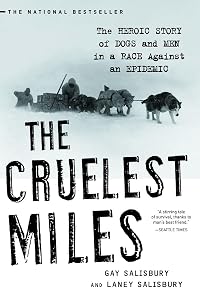
The Cruelest Miles: The Heroic Story of Dogs and Men in a Race Against an Epidemic
by Gay Salisbury, Laney Salisbury (Author)
On This Page
Description
The story of the 1925 Nome, Alaska, diphtheria epidemic describes the plight of the patients, with a blizzard imminent and the much-needed serum seven hundred miles away, as teams of sled dogs and their drivers become the only hope for survival.Tags
Recommendations
























Member Reviews
I just finished reading The Cruelest Miles: The Heroic Story of Dogs and Men in a Race Against an Epidemic
by Gay Salisbury and Laney Salisbury. This book was unexpectedly fascinating on many levels. The book is nominally about the carriage of diphtheria antitoxin from the railhead near Fairbanks, Alaska to the coast at Nome, through some of the coldest temperatures that state has experienced, and in unusually fierce blizzards. Nome had already been decimated by the Spanish Flu pandemic in 1918, described in The Great Influenza: The Story of the Deadliest Pandemic in History by John M. Barry. The book includes in its bibliography another book about the Arctic I read and enjoyed, Arctic Dreams by Barry Lopez.
The story of the race would show more have been exciting on its own. The book paints a vivid picture of early 20th Century Alaska, in the throes of the decline after the Klondike and Alaska Gold Rush of approximately 1897-1901. The book also contained descriptions of the history of the Eskimos (Eskimo, contrary to urban legend apparently refers to snowshoes, not "Eaters of Raw Flesh" and is not a derogatory term). Much of that description was surprisingly familiar; I remember it from Mrs. Boyle's Fourth Grade class in academic 1966-7.
The people behind the heroic rescue of Nome take second fiddle in the book to Man's Best Friend. The book subliminally makes the case that man's development, in Alaska at least, would have been impossible without the domestication of the dog from its ancient lupine ancestors. I have always thought that all human development from mere animals to the species we are would not have occurred without domestication of the dog.
Man could really accomplish things if they didn't have to keep a lookout for predators bigger and stronger than them, chief among those wolves. In the Arctic, dogs fulfill the vital function of providing transportation. Having a "doggedly" loyal and intelligent leader made travel over some very hazardous areas possible.
A solid five stars on Goodreads for this. show less
by Gay Salisbury and Laney Salisbury. This book was unexpectedly fascinating on many levels. The book is nominally about the carriage of diphtheria antitoxin from the railhead near Fairbanks, Alaska to the coast at Nome, through some of the coldest temperatures that state has experienced, and in unusually fierce blizzards. Nome had already been decimated by the Spanish Flu pandemic in 1918, described in The Great Influenza: The Story of the Deadliest Pandemic in History by John M. Barry. The book includes in its bibliography another book about the Arctic I read and enjoyed, Arctic Dreams by Barry Lopez.
The story of the race would show more have been exciting on its own. The book paints a vivid picture of early 20th Century Alaska, in the throes of the decline after the Klondike and Alaska Gold Rush of approximately 1897-1901. The book also contained descriptions of the history of the Eskimos (Eskimo, contrary to urban legend apparently refers to snowshoes, not "Eaters of Raw Flesh" and is not a derogatory term). Much of that description was surprisingly familiar; I remember it from Mrs. Boyle's Fourth Grade class in academic 1966-7.
The people behind the heroic rescue of Nome take second fiddle in the book to Man's Best Friend. The book subliminally makes the case that man's development, in Alaska at least, would have been impossible without the domestication of the dog from its ancient lupine ancestors. I have always thought that all human development from mere animals to the species we are would not have occurred without domestication of the dog.
Man could really accomplish things if they didn't have to keep a lookout for predators bigger and stronger than them, chief among those wolves. In the Arctic, dogs fulfill the vital function of providing transportation. Having a "doggedly" loyal and intelligent leader made travel over some very hazardous areas possible.
A solid five stars on Goodreads for this. show less
A testament to hope, the spirit of the volunteer, teamwork and the nature of man's best friend.
As a dog person through and through, in fact I'm convinced I was not a wolf but a dog in a previous life -a shout out must be done to the dogs (and the riders) if you please:
1. Togo! The Legend! The infant prodigy. You magnificent pooch. Born to lead, born to run. born to save that town of Nome, Alaska in the worst winter of that era. Big facts: Leonard Seppala and all 19 of your pack would have died on that ice without you. I cried so much at your bravery. Hope you get tons of treats and pets over that rainbow.
2. Blackie, Sally, Jimmy, Princess, Jack, Jet, Bear and Bob. This one is bittersweet. You started the relay bright and early and going show more against the rule of -40 you followed "Wild Bill" Shannon all the way and you succeeded even though it cost your pack four lives. Your are my heroes little furballs.
3. Bolto, you did your best in the very last stretch and in the end you sought no praise, to fame and no glory - that was all Gunner Kaasen. You got to the end in conditions that had already killed dogs along the relay. Good Boy!
4. The Relay Riders (Mushers) who could have died on the trail: Leonhard Seppala, Wild Bill Shannon, Edgar Kallands, Charlie Evans, George and Edgar Nollner, Curtis Welch, Titus Nickolai, Johnny Folger, Sam Joseph, Harry Pitka, Tommy Patsy, Myles Gonangnan, Vicktor Anagick, Henry Ivanoff, Dan Green, Charlie Olsen and Gunner Kaasen - such an amazing fete that saved lives.
Alright, in the words of "Wild Bill" Shannon": Hell Weltz, if people are dying ... let's get started.
I can't imagine what our 21st century pandemic would have done to the community of Nome, Alaska. The description of that Diphtheria disease sounded way to close to the past 3 years and that virus that set peoples lives back by about 3 years. And yet, without the resources we have to day - their death toll was actually only 5 in a span of 10 days. The sense of urgency and the work done by Governer Bone, Dr Welch, Emily Morgan and the Health Council of Nome could definitely teach our world a thing or two..
There were so many heroes, I have to single out the first relay team with the 300 000 units of the serum. Faced with this daunting task, some had just returned from a very long mail haul, heard they were needed to save the lives of children in the neighboring sister-town and they just went out, got their sleds ready and did it. Something about being brave in that time hits differently to our time. Maybe it's the overexposure of everything on all media platforms today but in the 1900s, facing all but certain death on the ice, these sledding teams did what was virtually impossible. For that and that alone, I will brave the cold Alaskan weather and come visit some tourist destinations dedicated to them.
Seriously though having just come out of a 3 year pandemic - when is earth going to stop trying to annihilate the 8 billion humans like we're parasites in the bloodstream? I mean it's already heating up like a fever on this surface. Sigh...will they be telling our story in the next 100 years and will it be as inspiring and unbelievable as this one? Or one big cautionary tale of dread, disappointment and warring ideologies?
Yeah if the immortality scientists could get a move on with the fountain of youth I'd be able to hang around until then. show less
As a dog person through and through, in fact I'm convinced I was not a wolf but a dog in a previous life -a shout out must be done to the dogs (and the riders) if you please:
1. Togo! The Legend! The infant prodigy. You magnificent pooch. Born to lead, born to run. born to save that town of Nome, Alaska in the worst winter of that era. Big facts: Leonard Seppala and all 19 of your pack would have died on that ice without you. I cried so much at your bravery. Hope you get tons of treats and pets over that rainbow.
2. Blackie, Sally, Jimmy, Princess, Jack, Jet, Bear and Bob. This one is bittersweet. You started the relay bright and early and going show more against the rule of -40 you followed "Wild Bill" Shannon all the way and you succeeded even though it cost your pack four lives. Your are my heroes little furballs.
3. Bolto, you did your best in the very last stretch and in the end you sought no praise, to fame and no glory - that was all Gunner Kaasen. You got to the end in conditions that had already killed dogs along the relay. Good Boy!
4. The Relay Riders (Mushers) who could have died on the trail: Leonhard Seppala, Wild Bill Shannon, Edgar Kallands, Charlie Evans, George and Edgar Nollner, Curtis Welch, Titus Nickolai, Johnny Folger, Sam Joseph, Harry Pitka, Tommy Patsy, Myles Gonangnan, Vicktor Anagick, Henry Ivanoff, Dan Green, Charlie Olsen and Gunner Kaasen - such an amazing fete that saved lives.
Alright, in the words of "Wild Bill" Shannon": Hell Weltz, if people are dying ... let's get started.
I can't imagine what our 21st century pandemic would have done to the community of Nome, Alaska. The description of that Diphtheria disease sounded way to close to the past 3 years and that virus that set peoples lives back by about 3 years. And yet, without the resources we have to day - their death toll was actually only 5 in a span of 10 days. The sense of urgency and the work done by Governer Bone, Dr Welch, Emily Morgan and the Health Council of Nome could definitely teach our world a thing or two..
There were so many heroes, I have to single out the first relay team with the 300 000 units of the serum. Faced with this daunting task, some had just returned from a very long mail haul, heard they were needed to save the lives of children in the neighboring sister-town and they just went out, got their sleds ready and did it. Something about being brave in that time hits differently to our time. Maybe it's the overexposure of everything on all media platforms today but in the 1900s, facing all but certain death on the ice, these sledding teams did what was virtually impossible. For that and that alone, I will brave the cold Alaskan weather and come visit some tourist destinations dedicated to them.
Seriously though having just come out of a 3 year pandemic - when is earth going to stop trying to annihilate the 8 billion humans like we're parasites in the bloodstream? I mean it's already heating up like a fever on this surface. Sigh...will they be telling our story in the next 100 years and will it be as inspiring and unbelievable as this one? Or one big cautionary tale of dread, disappointment and warring ideologies?
Yeah if the immortality scientists could get a move on with the fountain of youth I'd be able to hang around until then. show less
Sometimes got bogged down with details but overall a good presentation of a historical event in a readable story. In the end I cared as much about the individuals involved as in the whole story
I thought this book was more history of Alaska than story of the dogs and men that helped stop an epidemic. I was looking more for the story of the dogs and sled "race" that saved Nome. Instead I learned a lot about Alaska's history and some about the actual trip. Still a good read.
The harsh winters of Alaska are legendary, but in 1925 a deadly diphtheria epidemic raged through the land and created a crisis like none before. Earlier in the year, the town doctor had realized that his supply of diphtheria antitoxin had expired. Although he ordered more, it failed to arrive on the last ship before the town became icebound. In all his years practicing medicine in Nome, Dr. Welch rarely had call to use the medicine, so he wasn’t worried. Unfortunately soon children were suffering from symptoms of severe sore throats. At first it looked like tonsillitis, but the germs at work proved to be a lot more deadly and fast. With a blizzard rapidly approaching, the only chance to save the people of Nome depended on teams of show more sled dogs. Twenty mushers and their dogs, the most famous of which was Balto, participated in the 1925 Serum Run. This is the thrilling journey that inspired the Iditarod Sled Dog Race in Alaska.
The Bottom Line: While this debut book by two cousins is sometimes repetitive, it is a quick, compelling read that keeps you hanging. With no roads, rails, flights, or boats available, this is a story of courage, survival, and adventure. It became a race against both time and the elements where the slightest miscalculation can cost you your life. Additionally, this book explores the bond between man and dog. Also, included in the book are many fascinating historical tidbits, black and white photos, and a map. Enthusiastically recommended for dog lovers, nonfiction aficionados, and history lovers.
For the complete review, including Book Club Notes, visit the Mini Book Bytes Book Review Blog. show less
The Bottom Line: While this debut book by two cousins is sometimes repetitive, it is a quick, compelling read that keeps you hanging. With no roads, rails, flights, or boats available, this is a story of courage, survival, and adventure. It became a race against both time and the elements where the slightest miscalculation can cost you your life. Additionally, this book explores the bond between man and dog. Also, included in the book are many fascinating historical tidbits, black and white photos, and a map. Enthusiastically recommended for dog lovers, nonfiction aficionados, and history lovers.
For the complete review, including Book Club Notes, visit the Mini Book Bytes Book Review Blog. show less
Great book. So much more than what you see in a Balto or Togo. One of my favorite among my hundreds of books on dogs.
Diphtheria epidemic, 1925 Nome, Alaska
This was the perfect book to read in January. It's hard to feel so sorry for yourself about your 10 degree weather when they're dealing with 60 below! Amazing story. I loved reading about the bond between the dogs and the men. I am so thankful I don't live out there! That isolation is not for me. But what a great story. I couldn't put it down. Also made me thankful that we have vaccines and my kids never had to suffer from diphtheria. Highly recommended, especially for a winter read.
Edit | More
This was the perfect book to read in January. It's hard to feel so sorry for yourself about your 10 degree weather when they're dealing with 60 below! Amazing story. I loved reading about the bond between the dogs and the men. I am so thankful I don't live out there! That isolation is not for me. But what a great story. I couldn't put it down. Also made me thankful that we have vaccines and my kids never had to suffer from diphtheria. Highly recommended, especially for a winter read.
Edit | More
Members
- Recently Added By
Lists

Page Turners
185 works; 11 members
Author Information
2+ Works 555 Members
Some Editions
Awards and Honors
Work Relationships
Common Knowledge
- Original title
- The Cruelest Miles : The Heroic Story of Dogs and Men in a Race Against an Epidemic
- Original publication date
- 2003
- People/Characters
- Leonard Seppala; Togo; Gunnar Kaasen; Balto; Bill Shannon; Blackie (show all 9); Cub; Jet; Jack
- Important places
- Nome, Alaska, USA
- Epigraph
- "He who gives time to the study of the history of Alaska, learns that the dog, next to man, has been the most important factor in its past and present development."
—Alaska Judge James Wickersham, 1903
"There was no line of retreat, no going back and covering the same ground twice."
—Fridtjof Nansen on naming his expedition Fram to mean "Forward"
"Well, all I know about dogs is not much, but when I was up in Alaska . . . their whole existence tangles around dogs . . . the backbone of the arctic is a dog's backbone."
—Will Rogers's last column, recovered from ... (show all)the wreck of his fatal plane crash in Alaska, August 1935 - Dedication
- To Dorothea Boothe
- First words
- Curtis Welch was the only doctor for hundreds of miles along this forgotten edge of the Bering Sea, and for the past eighteen years he had watched winter descend suddenly, as it tends to do up in the far north.
- Last words
- (Click to show. Warning: May contain spoilers.)Others simply come to take in the view and to experience life at the edge of the Bering Sea.
- Publisher's editor
- Lawrence, Starling
- Blurbers
- Junger, Sebastian
- Canonical DDC/MDS
- 614.5123097986
- Canonical LCC
- RA644.D6
Classifications
- Genres
- Nonfiction, General Nonfiction, History
- DDC/MDS
- 614.5123097986 — Applied science & technology Medicine & health Epidemics, Poisons, Alternative Medicine Incidence of and public measures to prevent specific diseases and kinds of diseases Salmonella infections, bacillary diseases, clostridium infections, diphtheria, cholera, dysenteries, influenza Clostridium infections, diphtheria Diphtheria
- LCC
- RA644 .D6 — Medicine Public aspects of medicine Public aspects of medicine Public health. Hygiene. Preventive medicine Disease (Communicable and noninfectious) and public
- BISAC
Statistics
- Members
- 555
- Popularity
- 53,344
- Reviews
- 26
- Rating
- (4.20)
- Languages
- 5 — Dutch, English, German, Portuguese, Swedish
- Media
- Paper, Audiobook, Ebook
- ISBNs
- 14
- ASINs
- 5