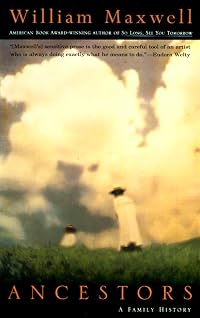
Ancestors: A Family History
by William Maxwell
On This Page
Description
The National Book Award-winning author of So Long, See You Tomorrow offers an astonishing evocation of a vanished world, as he retraces, branch by branch, the history of his family, taking readers into the lives of settlers, itinerant preachers, and small businessmen, examining the way they saw their world and how they imagined the world to come.Tags
Recommendations









Member Reviews
Novelist and long-time New Yorker editor William Maxwell’s family memoir tells of his childhood and his family’s long connection to Lincoln, Illinois. Maxwell and my small town Illinois-born grandmother were contemporaries, so the setting interested me. Several generations of Maxwell’s family belonged to the religious movement now known as the Stone-Campbell Movement, which includes the Christian Church (Disciples of Christ), Churches of Christ, and independent Christian Churches and Churches of Christ. Maxwell digs deep into the history of the Stone-Campbell Movement in order to understand his family and the way that their faith shaped them.
Maxwell’s memoir wouldn’t pass muster as an example of genealogical methodology since show more it’s undocumented. However, this doesn’t mean that it wouldn’t be useful to genealogists and family historians. Maxwell views his ancestors through the lens of a fiction writer and gets to the heart of the personalities, motivations, and individual decisions that make up his family story. Many families with Midwestern roots likely had at least one branch that belonged to the Stone-Campbell Movement. Maxwell’s memoir offers a good starting point for readers with an interest in this movement since he includes references to several standard histories. Maxwell references Haynes’s History of the Disciples of Christ in Illinois, 1819-1914, which I’ve consulted for my own family history research. show less
Maxwell’s memoir wouldn’t pass muster as an example of genealogical methodology since show more it’s undocumented. However, this doesn’t mean that it wouldn’t be useful to genealogists and family historians. Maxwell views his ancestors through the lens of a fiction writer and gets to the heart of the personalities, motivations, and individual decisions that make up his family story. Many families with Midwestern roots likely had at least one branch that belonged to the Stone-Campbell Movement. Maxwell’s memoir offers a good starting point for readers with an interest in this movement since he includes references to several standard histories. Maxwell references Haynes’s History of the Disciples of Christ in Illinois, 1819-1914, which I’ve consulted for my own family history research. show less
ANCESTORS is William Maxwell's deep dive into his own family history. I have read at least a half dozen Maxwell books, all of them compelling, deeply moving, and rendered in his trademark elegant style. This one was a bit dry, especially the first third or so, as he detailed the far-removed "great-greats" and even further back - all that genealogy - but got a lot more interesting when he reached deeply into the lives of his own grandparents and parents and their Illinois roots. His own mother died when he was just seven, a loss which affected, perhaps even scarred, him deeply, and was reflected in many of his stories and novels. There are a number of fascinating skeletons in the Maxwell and Blinn family closets, making for some very show more good reading. I've had this on my shelf for a good ten years, so I'm glad I finally read it. Recommended for all who love Maxwell's work.
- Tim Bazzett, author of the memoir, BOOKLOVER show less
- Tim Bazzett, author of the memoir, BOOKLOVER show less
William Maxwell was born in 1908 in Lincoln, Illinois. When he was fourteen, his father, an insurance executive, moved the family to Chicago. My grandfather James Lyle McCormick was born in the same county of Illinois in 1898. Like Maxwell, his mother also died when he was young, and his father, also an insurance executive, also moved the family to Chicago, where James went to high school in the Austin neighborhood and attended the University of Chicago after serving in WWI. Maxwell's family attended the Christian Church as did the family of McCormick's mother, the Housers. Maxwell is a talented writer and gives an account of his ancestry which closely parallels my own. Particularly, he gives detailed accounts of the formation of the show more Christian Church by Barton Stone which took place near the same place in Kentucky where parts of our family lived.
I'm sure his ancestors and mine knew each other. The writing is beautiful and the feeling of the history is very similar to my own fantasy of how I would like to write a history of our family. show less
I'm sure his ancestors and mine knew each other. The writing is beautiful and the feeling of the history is very similar to my own fantasy of how I would like to write a history of our family. show less
Ratings
Members
- Recently Added By
Lists

Best Autobiographies and Memoirs
370 works; 67 members

Five star books
1,755 works; 108 members
Author Information

28+ Works 5,707 Members
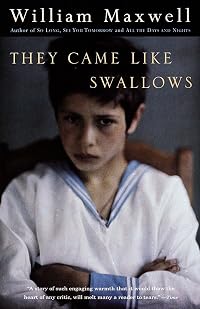
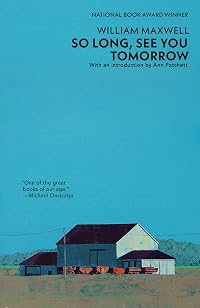
Born in Lincoln, Illinois in 1908, William Maxwell is one of America's more prominent writers. He is the recipient of numerous awards including the National Book Critics Circle Award (1994), and the American Book Award (1982) for his novel "So Long, See You Tomorrow." Maxwell's fiction has been described as nostalgic. Most of his work takes place show more in simpler, gentler times in the small towns of the American Midwest. Two of Maxwell's novels, "They Came Like Swallows" (1937) and "So Long, See You Tomorrow" (1980), deal with characters who lose relatives in the influenza epidemic of 1918. Maxwell's own mother died in the epidemic when he was ten years old. Maxwell published his first novel, "Bright Center of Heaven," in 1934. He moved to New York City in 1936 and was hired by the New Yorker. His years as an editor there, 1936 to 1976, coincided with what many believe are the magazine's finest. This was the era that saw the publication of the works of many accomplished writers, such as J. D. Salinger, Eudora Welty, John Updike, and Mary McCarthy in the New Yorker's pages. Maxwell has published six novels, several collections of short stories, a family history, and numerous book reviews. He served as president of the National Institute of Arts and letters from 1969 to 1972. William Maxwell has been married for over 50 years to the former Emily Noyes. They met at the New Yorker when she applied for a job. The couple has two daughters. (Bowker Author Biography) show less
Awards and Honors
Classifications
Statistics
- Members
- 162
- Popularity
- 201,528
- Reviews
- 3
- Rating
- (4.05)
- Languages
- English
- Media
- Paper, Ebook
- ISBNs
- 4
- ASINs
- 1