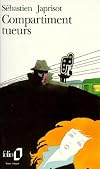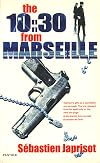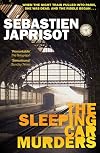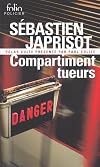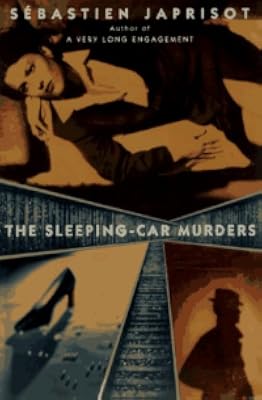
The Sleeping-car Murders
by Sébastien Japrisot
On This Page
Description
A beautiful young woman lies sprawled on her berth in the sleeping car of the night train from Marseilles to Paris. She is not in the embrace of sleep, or even in the arms of one of her many lovers. She is dead. And the unpleasant task of finding her killer is handed to an overworked, crime-weary police detective named Pierre Emile Grazziano, nicknamed Grazzi, who would rather play hide-and-seek with his little son than cat and mouse with a diabolically cunning, savage murderer.Tags
Recommendations




























Member Reviews
This is the first of Japrisot's crime novels, a good solid French policier from the final years of the hat-and-trenchcoat era, opening with a murder in the best Simenon tradition: a woman is found dead at the Gare de Lyon, in a couchette compartment of the overnight train from Marseille. The police need to talk to the other five passengers who shared the compartment, but someone with a very large revolver seems to be getting there first...
The plot is perhaps just a bit too busy, to the extent that we need a full chapter of epilogue to explain it all to us afterwards, and there's too much victim's POV, but there is a lot of nice detail, and a subversive feel that you certainly don't get in Simenon. These are policemen whose first concern show more is to get the case closed and the judge off their backs with a minimum of paperwork - if that involves catching the murderer it's a nice bonus, but finding an excuse to transfer the case to another department would be even better. And we get a sense too that they are aware that history is catching up with them. Sooner or later they are going to have to swap their overcoats for leather jackets and start carrying radios instead of making phone calls from bars, and most of them aren't too happy about that! show less
The plot is perhaps just a bit too busy, to the extent that we need a full chapter of epilogue to explain it all to us afterwards, and there's too much victim's POV, but there is a lot of nice detail, and a subversive feel that you certainly don't get in Simenon. These are policemen whose first concern show more is to get the case closed and the judge off their backs with a minimum of paperwork - if that involves catching the murderer it's a nice bonus, but finding an excuse to transfer the case to another department would be even better. And we get a sense too that they are aware that history is catching up with them. Sooner or later they are going to have to swap their overcoats for leather jackets and start carrying radios instead of making phone calls from bars, and most of them aren't too happy about that! show less
I RECEIVED A DRC FROM THE PUBLISHER VIA EDELWEISS+. THANK YOU.
My Review: This is the first published crime novel from the late monadnock of French thriller writers, seeing the light of day in 1962...sixty years ago! I'd expected to be eye-rollingly impatient with the sexual politics...I was...and to find the motive for the title crime absurd...I sort-of did...and generally to find the read a pleasant time capsule but not one I could recommend.
Wrong on that score.
What Author Japrisot, ably served by Translator Price, achieved was a smartly paced and charmingly observed crime novel. I want to be clear, though, that the attitude towards women and their sexuality isn't within 21st-century best practices. I don't have a positive thing to say show more about that, and no, I don't want to shrug it off by saying "it's of its time." I think the way to frame the attitudes that makes me least irritably impatient is to think of this as a cautionary tale...a dead, or at least dying, set of stupid and wrong-headed ways of seeing people that has very directly contributed to terrible crimes.
What sticks with me the most is the sheer, idiotic nihilism of the crimes committed, and for such idiotic reasons. There are no excuses, of course, but the reason someone deprives another person of life...the one and only thing that can't be made good or replaced when it's taken...should always at least make some twisted kind of sense. Here, though, there is nothing, not a grain of a comprehensible motive. Like those thrill-killing boys, Leopold and Loeb.
I was utterly unable to put this debut crime novel, first published in 1962, down. It's not like a modern crime novel. There's no bloat; there's very little dialogue. The whole story's narrated, in a kind of distancing tactic, a lot like the voiceover narration of Double Indemnity, albeit it isn't the same narrator. Just the strategy, the way of telling that makes it feel like showing. And, in the end, the framing device works very, very well for the final summation of the crime.
Japrisot wasn't a hugely productive writer, having written a dozen fiction works of different lengths between 1950 and 1999. He translated works by Salinger, among others, into French; he worked in the advertising industry; he was, in short, a jobbing writer with a gift for economical storytelling. His strength lay in constructing the angle of repose for his story; he knew the slightest shift in perspective would destroy the equilibrium that a work of fiction relies on. When the shift inevitably occurs, the entire story flows out of its resting state and becomes something entirely other, a new resting state that doesn't resemble the constructed story but is all the same colors and most of the same shapes.
It is a pure pleasure to read this level of craftsmanship. By all means procure it and enjoy it for all its afternoon-filling worth. show less
My Review: This is the first published crime novel from the late monadnock of French thriller writers, seeing the light of day in 1962...sixty years ago! I'd expected to be eye-rollingly impatient with the sexual politics...I was...and to find the motive for the title crime absurd...I sort-of did...and generally to find the read a pleasant time capsule but not one I could recommend.
Wrong on that score.
What Author Japrisot, ably served by Translator Price, achieved was a smartly paced and charmingly observed crime novel. I want to be clear, though, that the attitude towards women and their sexuality isn't within 21st-century best practices. I don't have a positive thing to say show more about that, and no, I don't want to shrug it off by saying "it's of its time." I think the way to frame the attitudes that makes me least irritably impatient is to think of this as a cautionary tale...a dead, or at least dying, set of stupid and wrong-headed ways of seeing people that has very directly contributed to terrible crimes.
What sticks with me the most is the sheer, idiotic nihilism of the crimes committed, and for such idiotic reasons. There are no excuses, of course, but the reason someone deprives another person of life...the one and only thing that can't be made good or replaced when it's taken...should always at least make some twisted kind of sense. Here, though, there is nothing, not a grain of a comprehensible motive. Like those thrill-killing boys, Leopold and Loeb.
I was utterly unable to put this debut crime novel, first published in 1962, down. It's not like a modern crime novel. There's no bloat; there's very little dialogue. The whole story's narrated, in a kind of distancing tactic, a lot like the voiceover narration of Double Indemnity, albeit it isn't the same narrator. Just the strategy, the way of telling that makes it feel like showing. And, in the end, the framing device works very, very well for the final summation of the crime.
Japrisot wasn't a hugely productive writer, having written a dozen fiction works of different lengths between 1950 and 1999. He translated works by Salinger, among others, into French; he worked in the advertising industry; he was, in short, a jobbing writer with a gift for economical storytelling. His strength lay in constructing the angle of repose for his story; he knew the slightest shift in perspective would destroy the equilibrium that a work of fiction relies on. When the shift inevitably occurs, the entire story flows out of its resting state and becomes something entirely other, a new resting state that doesn't resemble the constructed story but is all the same colors and most of the same shapes.
It is a pure pleasure to read this level of craftsmanship. By all means procure it and enjoy it for all its afternoon-filling worth. show less
The inevitable comparison is to Simenon's Maigret series, but this is less an inspector-centered point-of-view mystery than an ensemble presentation. Victim and witness get as much attention as the protagonist detective, as do his superiors and subordinates. The result is a psychological potpourri as interesting as the whodunit itself, though Japrisot also gives the reader a more intricate puzzle to solve than anything I've come across in Simenon. If not for the too neat scramble at the end to tie up every loose end, some of which did not need tying up, I would have given it five stars.
My first by this particular author and I can honestly say that I really enjoyed this French mystery.
Having expanded my reading to authors scattered far and wide, writing about their own countries, and all with their own distinctive style, I was able to quite easily adapt to this author's style of writing. It would be imprudent of the reader to assume that all author's write the same - and much also comes down to the quality of the translation.
I was initially drawn to this particular tome as it put me in mind of Agatha Christie - which is no bad thing. The premise is quite simple - a woman is murdered on an overnight train travelling from Marseille to Paris; the suspects are narrowed down to those who shared the sleeping coach with her; show more the police investigate; a motive and killer are eventually revealed and the mystery is solved. Simple - maybe; interestingly formatted - very much so (see below).
This could fall under the auspices of a "police procedural" novel - as we follow Detective Pierre Grazziano (or "Grazzi" to use the nickname he is often referred by) and his offsider, Gaubert. Each of the passengers is duly investigated to check for connection or motive - and one by one they are .... eliminated. It seems that Grazzi is always that one step behind but eventually there is light at the end of the tunnel.
I really enjoyed the narrative and the format - each chapter heading was the berth number of each of the passengers. We get a real sense of their lives as Grazzi and Gaubert dig into their backgrounds, and discover more about the victim herself.
As I mentioned, I really did enjoy this and love expanding my reading beyond the standard UK and US offerings, exploring how other writers present similar mysteries on their own patch! show less
Having expanded my reading to authors scattered far and wide, writing about their own countries, and all with their own distinctive style, I was able to quite easily adapt to this author's style of writing. It would be imprudent of the reader to assume that all author's write the same - and much also comes down to the quality of the translation.
I was initially drawn to this particular tome as it put me in mind of Agatha Christie - which is no bad thing. The premise is quite simple - a woman is murdered on an overnight train travelling from Marseille to Paris; the suspects are narrowed down to those who shared the sleeping coach with her; show more the police investigate; a motive and killer are eventually revealed and the mystery is solved. Simple - maybe; interestingly formatted - very much so (see below).
This could fall under the auspices of a "police procedural" novel - as we follow Detective Pierre Grazziano (or "Grazzi" to use the nickname he is often referred by) and his offsider, Gaubert. Each of the passengers is duly investigated to check for connection or motive - and one by one they are .... eliminated. It seems that Grazzi is always that one step behind but eventually there is light at the end of the tunnel.
I really enjoyed the narrative and the format - each chapter heading was the berth number of each of the passengers. We get a real sense of their lives as Grazzi and Gaubert dig into their backgrounds, and discover more about the victim herself.
As I mentioned, I really did enjoy this and love expanding my reading beyond the standard UK and US offerings, exploring how other writers present similar mysteries on their own patch! show less
A classic 1960s French detective novel gets a deserved translation and publication in English. Thoroughly enjoyable, with a complicated enough plot to keep you guessing as the body count adds up. And the character of the principal detective 'Grazzi' is one that most readers will find sympathetic. 3.5 stars.
Having really enjoyed the movie "very long engagement, " I thought I'd give this a try.I thought the plot was interesting, though i was not entirely sold on the ending.
The solution to the mystery is very clever and I can see the author wanting to write a story that uses it. But I wish the book had been better.
Members
- Recently Added By
Lists

Best public-transport fiction
72 works; 17 members

501 Must-Read Books
529 works; 72 members
Author Information

21+ Works 3,359 Members
Some Editions
Awards and Honors
Notable Lists
Series
Belongs to Publisher Series
Work Relationships
Is contained in
Has the adaptation
Common Knowledge
- Canonical title
- The Sleeping-car Murders
- Original title
- Compartiment tueurs
- Alternate titles
- The 10:30 from Marseille
- Original publication date
- 1962
- People/Characters
- Antoine "Grazzi" Grazziano (Inspector); Georgette Thomas; René Cabourg; Eliane Darrès; Evelyne Garaudy; Benjamine "Bambi" Bombat (show all 7); Ernest-Georges-Jacques Rivolani
- Important places
- Paris, Île-de-France, France; Marseille, Bouches-du-Rhône, Provence-Alpes-Côte d'Azur, France
- Related movies
- Compartiment tueurs (1965 | IMDb)
- First words
- The train was coming in from Marseille.
- Last words
- (Click to show. Warning: May contain spoilers.)He was saying Bambi, my little Bambi, and without a word, just by the movement of her head, with her blonde hair shining in the light from the lamp, she was saying, yes, yes, yes.
- Original language
- French
Classifications
Statistics
- Members
- 347
- Popularity
- 91,452
- Reviews
- 9
- Rating
- (3.49)
- Languages
- 9 — Catalan, Danish, English, French, German, Hungarian, Norwegian, Polish, Spanish
- Media
- Paper, Ebook
- ISBNs
- 27
- ASINs
- 18