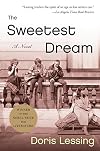
The Sweetest Dream
by Doris Lessing
On This Page
Description
Frances Lennox ladles out dinner every night to the motley, exuberant, youthful crew assembled around her hospitable table--her two sons and their friends, girlfriends, ex-friends, and fresh-off-the-street friends. It's the early 1960s and certainly "everything is for the best in the best of all possible worlds." Except financial circumstances demand that Frances and her sons live with her proper ex-mother-in-law. And her ex-husband, Comrade Johnny, has just dumped his second wife's problem show more child at Frances's feet. And the world's political landscape has suddenly become surreal beyond imagination.... Set against the backdrop of the decade that changed the world forever, The Sweetest Dream is a riveting look at a group of people who dared to dream--and faced the inevitable cleanup afterward--from one of the greatest writers of our time. -- show lessTags
Recommendations


















Member Reviews
I found this perhaps the most purely enjoyable of all of Lessing's books. It covers familiar territory, but does it with a sweep and warmth that is less familiar - it feels looser and less rigorous than some of her books, but is never anything other than sharp and perceptive - she skewers tabloid journalists, the international aid juggernaut, the posturing intellectual superstar and venal African leaders - she writes about AIDS in Africa with truth, love and terribleness - and comes in the end back to a table in a kitchen with a family, interconnected by blood, love, habit or happenstance.
Just finished The Sweetest Dream a big, complex novel by Nobel Prize winner Doris Lessing. The first half of the book takes place in the 1960's and is centered around a large house in Hampstead owned by prim, traditional Julia but shared by her earth-mother ex-daughter-in-law, Frances,her two grandsons and several young people who need a home for various reasons. The interactions of the people in the house plus their individual personalities and challenges kept me turning pages. The second half jumps forward several years and takes place mostly in Africa where one of the residents of the house has become a doctor in a small village. The halves of the book are separate enough that they seem more like a book and its sequel than one book, show more but they are both interesting stories. My only real problem with the book is that the characters from the first half of the book run into each other in the second half in ways and places that seem very contrived. It is a compelling book and worth reading. show less
Well then. When I was a girl I read Doris Lessing as a guidebook for the creative and activist woman. You have to understand that that was in the 60's, and Lessing was a curious guide. I remember even seriously wondering if I ought, like the heroine in the Golden Notebook, to have different colored journals for various aspects of my life.
So she holds in my life the position of a sort of mentor. The Girl Scout Guide to rad feminine life. Though she was never quite so simpatico as many others of my heroes.
And then we come to The Sweetest Dream, an odd novel that is prefaced by her disclosure that she shall not write the 3rd volume of her autobiography (because it would cause harm to others still living), but that...in this novel, she show more hopes to reveal the truth about the 1960's. And so on.
Well, okay then, I'm up for it. I lived through the 1960's, eagerly reading her novels. Of course, I was not in England, and possibly the whole grand dream was different there. I had forgotten how very lacking in a sense of humor Lessing is, how ponderously she loathes the communists (with all the fervour that a fallen away Catholic devotes to the evils of the Papacy), and how she does go on and on and on and on and on and on about the Terrible Failings of Everyone Else.
I suppose a Nobel prize winning novelist is too daunting to be seriously edited? Because I would have slashed this book to ribbons. There is an interesting sub-novel, in the African section, but even that has that ponderous falsity.
And the heroes and villains are set sternly in place from the start, with little cardboard traits and no real sense of...anyone. It is a shadow play, all of it (with the possible exception of the more complex character of Julia).
The best part? A novel in which the house is a main character! show less
So she holds in my life the position of a sort of mentor. The Girl Scout Guide to rad feminine life. Though she was never quite so simpatico as many others of my heroes.
And then we come to The Sweetest Dream, an odd novel that is prefaced by her disclosure that she shall not write the 3rd volume of her autobiography (because it would cause harm to others still living), but that...in this novel, she show more hopes to reveal the truth about the 1960's. And so on.
Well, okay then, I'm up for it. I lived through the 1960's, eagerly reading her novels. Of course, I was not in England, and possibly the whole grand dream was different there. I had forgotten how very lacking in a sense of humor Lessing is, how ponderously she loathes the communists (with all the fervour that a fallen away Catholic devotes to the evils of the Papacy), and how she does go on and on and on and on and on and on about the Terrible Failings of Everyone Else.
I suppose a Nobel prize winning novelist is too daunting to be seriously edited? Because I would have slashed this book to ribbons. There is an interesting sub-novel, in the African section, but even that has that ponderous falsity.
And the heroes and villains are set sternly in place from the start, with little cardboard traits and no real sense of...anyone. It is a shadow play, all of it (with the possible exception of the more complex character of Julia).
The best part? A novel in which the house is a main character! show less
The characters and central focus of this book (life moves, times change, ideologies corrupt) are brilliant, and it is cleverly and carefully written. At times the berating of ideology seems a bit too heavy-handed, even if it is easy to agree with the criticisms from the perspective of the novel. Recommended to politicos (like myself) as a worthy criticism of the danger of collective ideas versus the reality of life.
(#1 in the 2006 book challenge)
I've never read anything by this author before. I liked this book a lot, the first half takes place in the 1960s and centers around a woman whose ex-husband is a Communist activist. She and her teenage children live with her ex-MIL, and the household includes a rotating cast of her children's friends. It's an interesting look at youth culture in England in the 60s. For some reason, every description of this book I've come across ends here. However, the second half of the book is set in the early 80s, and follows some of these teenagers (although now, obviously, adults), to Africa when AIDS is first emerging as an epidemic, and that was the half that I found more intriguing.
Grade: A-
Recommended: To people show more who like novels that are about political philosophies, but not necessarily endorsing any particular political view. This is also a good book about sorts of seemingly trivial yet somehow significant happenings that make up family life, only using an unconventional family model. show less
I've never read anything by this author before. I liked this book a lot, the first half takes place in the 1960s and centers around a woman whose ex-husband is a Communist activist. She and her teenage children live with her ex-MIL, and the household includes a rotating cast of her children's friends. It's an interesting look at youth culture in England in the 60s. For some reason, every description of this book I've come across ends here. However, the second half of the book is set in the early 80s, and follows some of these teenagers (although now, obviously, adults), to Africa when AIDS is first emerging as an epidemic, and that was the half that I found more intriguing.
Grade: A-
Recommended: To people show more who like novels that are about political philosophies, but not necessarily endorsing any particular political view. This is also a good book about sorts of seemingly trivial yet somehow significant happenings that make up family life, only using an unconventional family model. show less
This is a very readable novel, though there are many characters in it so it can be slightly hard to recall who is who. And there isn’t so much about communism in it, as in some of Lessing’s books.
Frances is the main character. She is an actress, writes articles and is also at one point an “agony aunt”.
She lives in Julia’s big house. Julia, a German who escaped Nazi Germany, is the mother of Frances’s ex-husband, Johnny, who is a fanatical communist, always trying to convert people, and who is thus extremely boring.
Frances has two sons, Andrew and Colin.
What is special about the house is that it is filled with youngsters, who come from goodness knows where. Frances makes nutritious meals for them. The youngsters mostly show more can’t live with their parents for some reason or another, some being neglected by them.
Julia has money and pays for some of he youngsters’ upkeep, if Frances does not.
One child in particular, Sylvia, who at the start goes by the name of Tilly because, when a litle girl, she couldn’t pronounce Sylvia properly, is particularly prominent.
Sylvia was looked after by Julia. She hardly ate anything until Andrew began to encourage her to do so.
There was a rather unpleasant girl called Rose.
Later, Sylvia becomes a doctor and goes to Africa to help at a so-called hospital. This is one of the most interesting parts of the book.
Rose becomes a journalist but is still nasty and only writes articles attacking people, including Sylvia and her hospital, though Sylvia is a wonderful doctor and saves many of the natives’ lives. The “hospital” has no beds, and patients, no matter how ill, have to lie outside, even when it rains.
I can highly recommend this book. show less
Frances is the main character. She is an actress, writes articles and is also at one point an “agony aunt”.
She lives in Julia’s big house. Julia, a German who escaped Nazi Germany, is the mother of Frances’s ex-husband, Johnny, who is a fanatical communist, always trying to convert people, and who is thus extremely boring.
Frances has two sons, Andrew and Colin.
What is special about the house is that it is filled with youngsters, who come from goodness knows where. Frances makes nutritious meals for them. The youngsters mostly show more can’t live with their parents for some reason or another, some being neglected by them.
Julia has money and pays for some of he youngsters’ upkeep, if Frances does not.
One child in particular, Sylvia, who at the start goes by the name of Tilly because, when a litle girl, she couldn’t pronounce Sylvia properly, is particularly prominent.
Sylvia was looked after by Julia. She hardly ate anything until Andrew began to encourage her to do so.
There was a rather unpleasant girl called Rose.
Later, Sylvia becomes a doctor and goes to Africa to help at a so-called hospital. This is one of the most interesting parts of the book.
Rose becomes a journalist but is still nasty and only writes articles attacking people, including Sylvia and her hospital, though Sylvia is a wonderful doctor and saves many of the natives’ lives. The “hospital” has no beds, and patients, no matter how ill, have to lie outside, even when it rains.
I can highly recommend this book. show less
I initially got this book to read for The Dead Writers Society Literary Birthday. But it took forever for me to get, and by the time I started/finished October was over. So unfortunately it doesn't count.
That said, I wish I had skipped this book. It was all over the place with too many characters/motivations and just horrible choices of all concerned.
I really don't want to even get too into this book besides the basics. A man named Johnny Lennox raised in the lap of luxury for his times and place eventually rebels against his family and becomes a communist. He marries a woman named Frances and they have two sons. Because of communist teachings, Johnny is loathe to take anything from his father or his mother Julia. The whole book show more really is about all of these people, Johnny's second or maybe third wife, his wife's daughter Sylvia, and the two sons (Andrew and Colin) friends who end up all descending on Julia's home through the years.
The whole book felt very scattered to me and I honestly was bored. I didn't really like anyone save for Julia. A German woman moving to England with her husband and having to deal with the fact that her son becomes a selfish stranger.
I assume there's a larger point to this story, about how those who once were all for communist after World War II eventually fell way to the god of capitalism or something. But seriously, these people felt like cartoon characters after a while. show less
That said, I wish I had skipped this book. It was all over the place with too many characters/motivations and just horrible choices of all concerned.
I really don't want to even get too into this book besides the basics. A man named Johnny Lennox raised in the lap of luxury for his times and place eventually rebels against his family and becomes a communist. He marries a woman named Frances and they have two sons. Because of communist teachings, Johnny is loathe to take anything from his father or his mother Julia. The whole book show more really is about all of these people, Johnny's second or maybe third wife, his wife's daughter Sylvia, and the two sons (Andrew and Colin) friends who end up all descending on Julia's home through the years.
The whole book felt very scattered to me and I honestly was bored. I didn't really like anyone save for Julia. A German woman moving to England with her husband and having to deal with the fact that her son becomes a selfish stranger.
I assume there's a larger point to this story, about how those who once were all for communist after World War II eventually fell way to the god of capitalism or something. But seriously, these people felt like cartoon characters after a while. show less
Members
- Recently Added By
Published Reviews
ThingScore 50
But what emerges is an awkward melange lacking both the realism of great fiction and the truthfulness of history.
added by prosperosbook
Author Information

260+ Works 37,035 Members
Doris Lessing was born in Kermanshah, Persia (later Iran) on October 22, 1919 and grew up in Rhodesia (the present-day Zimbabwe). During her two marriages, she submitted short fiction and poetry for publication. After moving to London in 1949, she published her first novel, The Grass Is Singing, in 1950. She is best known for her 1954 Somerset show more Maugham Award-winning experimental novel The Golden Notebook. Her other works include This Was the Old Chief's Country, the Children of Violence series, the Canopus in Argos - Archives series, and Alfred and Emily. She has received numerous awards for her work including the 2001 Prince of Asturias Prize in Literature, the David Cohen British Literature Prize, and the 2007 Nobel Prize for Literature. She died on November 17, 2013 at the age of 94. (Bowker Author Biography) show less
Some Editions
Awards and Honors
Distinctions
Series
Belongs to Publisher Series
btb (73391)
Common Knowledge
- Canonical title
- The Sweetest Dream
- Original title
- The Sweetest Dream
- Original publication date
- 2001
- Important places
- Zimbabwe; London, England, UK
- Dedication
- With gratitude to my editor at Flamingo, Philip Gwyn Jones, and to my agent, Jonathan Chennells, for help with the Roman Catholic parts of the book.
- First words
- An early evening in autumn, and the street below was a scene of small yellow lights that suggested intimacy, and people already bundled up for winter.
- Quotations
- When the geist speaks, the zeit must obey.
Frances sat at the table, cigarette in hand, a cup of strong tea sending out rumours of hillsides where underpaid women picked leaves for that exotic place, the West.
The spirit of the Sixties, with passionate eyes, a trembling voice, and outstretched pleading hands, was confronting the whole past of the human race.
Classifications
Statistics
- Members
- 673
- Popularity
- 42,509
- Reviews
- 13
- Rating
- (3.64)
- Languages
- 11 — Catalan, Dutch, English, Estonian, French, German, Greek, Italian, Portuguese, Spanish, Swedish
- Media
- Paper, Audiobook, Ebook
- ISBNs
- 38
- ASINs
- 13