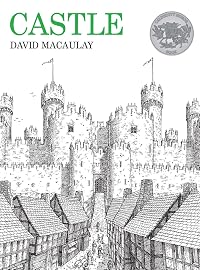
Castle
by David Macaulay
On This Page
Description
Text and detailed drawings follow the planning and construction of a "typical" castle and adjoining town in thirteenth-century Wales.Tags
Recommendations










Member Reviews
Castle tells the story of the construction of a defensive castle and town. Macaulay creates a fictional story surrounding the construction. This helps move the book from a technical article to an engaging story.
In addition to outlining the construction and subtleties of the design of military castles it provides perspective on everyday life in a remote medieval England.
The text is well done, but the illustrations steal the show. The ink drawings are very readable and fun to study.
In addition to outlining the construction and subtleties of the design of military castles it provides perspective on everyday life in a remote medieval England.
The text is well done, but the illustrations steal the show. The ink drawings are very readable and fun to study.
Castle is the story of building a castle and town in late-13th-century England. While I thought Macaulay's Cathedral was excellent on architecture, I wanted more context, and here he includes both. There are fabulous drawings, in perspectives from bird’s-eye to worm’s-eye and everything in between. And there’s background about the purpose of a castle (i.e. military, and not just defensive [to “resist direct attack and withstand a siege”] but also offensive [strategic “placement along important supply and communication routes” e.g. in the conquest of Wales]) and the purpose of the accompanying town (to “provide a variety of previously unavailable social and economic opportunities” that would benefit both the English and show more eventually the Welsh and promote peace). Excellent! show less
Despite the fact the castle and surround community are imaginary, the construction of the castle itself, in 1286 Wales, is a realistic blueprint. A lot of detail went into explaining the process, complete with a layout of all the tools for a carpenter's trade as well as the weapons of war. . As an aside, I loved the little culprit sitting in the dungeon. Equally amusing was how they disposed of human waste. Yes, I have that kind of humor sometimes. I heard that Castle was also made into a documentary.
Macaulay uses detailed illustrations, floor plans, and cut-away pictures to describe the process of building a fictional castle within the historical context of medieval times.The reader learns of the different number and types of laborers hired, how cold temperatures halted the work, which was protected with layers of straw and dung before the workers returned to England for the winter. Macaulay even illustrates the way medieval toilets were built, supported, but protruding beyond the castle wall, connected to a “cesspit” at the base of the wall. A thorough slice of life in medieval times.
I've had this book for years but took it off the shelf for another look. A beautifully drawn - as in architectural illustrations - history of the building of a fictional castle in Wales in the 1200's and the town that grew around it. A joy to re-read.
I reread this book after nearly ten years; it remains a brilliant educational and entertaining book. Macaulay once more uses his plot device of describing a fictional edifice, this being a kind of Platonic ideal of the Crusader-era medieval castle, framed within proper historical conflict of England’s conquest of Wales in the Thirteenth Century. We see the castle itself, the city walls, and a thriving town rise from it’s foundations in these pages with delightful and realistic illustrations. Young readers will enjoy learning how much effort and difficulty goes into the construction, and the details of how it’s inhabitants lived and how the fortress is defended.
If I could find one complaint it is how he speaks of the conflict in show more rather glossy terms, describing the inevitable way the welsh will mix with the English and how both will benefit from the stability the castle and it’s new associated town provide. Reality is far bloodier, but he does do us the favor of depicting the violence of welsh revolts in an exciting way that will draw in young readers. show less
If I could find one complaint it is how he speaks of the conflict in show more rather glossy terms, describing the inevitable way the welsh will mix with the English and how both will benefit from the stability the castle and it’s new associated town provide. Reality is far bloodier, but he does do us the favor of depicting the violence of welsh revolts in an exciting way that will draw in young readers. show less
Castle is an illustrated engineering feat for those who ask, "how did they build those castles, anyhow?" From the how to the why, author/illustrator David Macaulay delivers a blueprint of information that your children (and yourself) can spend hours investigating. This Caldecott Award-winning book details the design and construction of medieval castles using the tools people had access to at the time. Though the name of the castle is fictional, the contexts and engineering is directly from the British countryside. If you've ever marveled at how artists illustrate in perspective in primarily ink, David Macaulay's books will keep you entertained and educated for years.
Members
- Recently Added By
Lists

Top-Rated Children's Books
87 works; 16 members

Caldecott Honor Books
296 works; 23 members
Geek Dad Read to Your Kids Additions List
66 works; 4 members

CCE 1000 Good Books List
1,033 works; 12 members

r/History Recommended Reading List
603 works; 12 members

Mensa for Kids Excellence in Reading Award Program (Nonfiction)
54 works; 4 members

Beautiful Feet Books
304 works; 7 members

Favorite Picture and Board Books
480 works; 1 member

Children's Books About Science and Math
461 works; 12 members

Favorite Kids Science Books
129 works; 1 member

Read Aloud Revival
108 works; 4 members
Author Information

David Macaulay was born on December 2, 1946 in Lancashire, England, but moved to Bloomfield, New Jersey when he was 11. He received a bachelor's degree in architecture from the Rhode Island School of Design (RISD). Before becoming an author and illustrator, he worked as an interior designer, a junior high school teacher, and instructor of interior show more design at RISD from 1969 to 1973. His first book, Cathedral: The Story of Its Construction, was published in 1973. His other books include City, Castle, Pyramid, Mill, Underground, Mosque, The Way Things Work, Rome Antics, Shortcut,and How Machines Work. He has received numerous awards including a Caldecott Honor Medal in 1991 for Black and White and the Washington Children's Book Guild Award for a Body of Non-Fiction Work in 1977. He won the Royal Society young people¿s book prize for the best science books for children for his book How Machines Work. (Bowker Author Biography) show less
Some Editions
Awards and Honors
Awards
Work Relationships
Has the adaptation
Common Knowledge
- Canonical title*
- Borgen, så byggdes den
- Original title
- Castle
- Original publication date
- 1977 (1e édition originale anglaise) (1e édition originale anglaise); 1978 (1e tradution par Roger Hanoune et édition française, Deux coq d'or) (1e tradution par Roger Hanoune et édition française, Deux coq d'or); 2018-05-17 (Nouvelle réédition reformatée traduite par Anne Cohen Beucher, Album, L'école des Loisirs) (Nouvelle réédition reformatée traduite par Anne Cohen Beucher, Album, L'école des Loisirs)
- People/Characters
- Edward I, King of England; Kevin le Strange, Lord of Aberwyvern; Lady Catherine, Lady of Aberwyvern; James of Babbington, Master Engineer; Walter of Ipswich, Lord's Baliff; Thomas of Aberwyvern, Master Shoemaker (show all 11); Oliver of Aberwyvern, Master Tailor; Robert of Aberwyvern, Chaplain; Lionel of Aberwyvern, Barber & Doctor; Master John of Aberwyvern, Cook; Prince Daffyd of Gwynedd
- Important places
- Wales, UK; Wyvern River; Aberwyvern; Aberwyvern Castle
- Dedication
- To the past -- farewell
- First words
- On March 27, 1283, King Edward I of England named Kevin le Strange to be Lord of Aberwyvern -- a rich but rebellious are of northwest Wales.
- Last words
- (Click to show. Warning: May contain spoilers.)By that time Master James's might castle sood partially roofless and completely neglected except as a quarry for new buildings, and his once impressive town wall was now more of a nuisance to the town fathers than a necessity.
- Original language*
- Anglais (Royaume-Uni) (Royaume-Uni)
*Some information comes from Common Knowledge in other languages. Click "Edit" for more information.
Classifications
Statistics
- Members
- 3,800
- Popularity
- 4,171
- Reviews
- 49
- Rating
- (4.23)
- Languages
- 8 — Danish, Dutch, English, French, German, Italian, Spanish, Swedish
- Media
- Paper, Ebook
- ISBNs
- 35
- UPCs
- 3
- ASINs
- 14