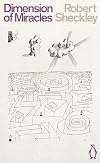
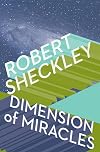
Dimension of Miracles
by Robert Sheckley
On This Page
Description
A hapless Earthling must find his way home through a universe of absurdities in this science fiction romp from a Hugo and Nebula Award–nominated master.New York civil servant Thomas Carmody has never been particularly lucky. Imagine his surprise when he discovers he's won the grand prize in an Intergalactic Lottery he had no idea he'd entered.
Whisked far away to Galactic Central to claim his award, he has two immediate, equally troubling revelations. Not only does his Prize—a show more talkative device that changes shape—serve no practical purpose whatsoever, but now he's expected to find his own way back to Earth.
Of course, Carmody has no idea where, when, or even which universe he's been stranded in. Ignoring the worthless advice and opinions of his increasingly annoying Prize, he embarks on a bizarre odyssey that takes him from alternate Earth to alternate Earth, bringing him into close contact with all manner of strangeness—and even with a bored God Almighty Himself.
But Carmody's sweepstakes "windfall" comes with yet another unexpected drawback. Suddenly, an unrelenting predator is on his tail, determined to eliminate the "glitch" wandering lost through numerous dimensions where he does not belong.
A full decade before Douglas Adams devised TheHitchhiker's Guide to the Galaxy, Robert Sheckley created his Dimension of Miracles, launching one luckless protagonist on a hilarious journey across an alien universe of intelligent dinosaurs and mothering sentient towns. Fans of Kurt Vonnegut, Roger Zelazny, Terry Pratchett's Discworld, and Harry Harrison's Bill the Galactic Hero will delight in Sheckley's biting and brilliant Alice in Wonderland–like outer space adventure.
. show less
Tags
Recommendations




Member Recommendations

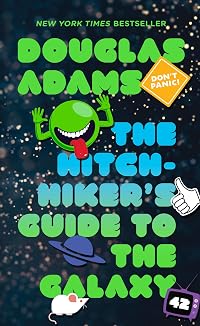
pratchettfan Dimension of Miracles of Miracles and Hitchhiker's Guide to the Galaxy share the same mindset of strange, intelligent and witty sci-fi. If you loved one of them you'll love the other too!
50
Member Reviews
I can see why [b:Dimension of Miracles|668634|Dimension of Miracles (Dimension of Miracles #1)|Robert Sheckley|https://i.gr-assets.com/images/S/compressed.photo.goodreads.com/books/1331708621l/668634._SY75_.jpg|189844], first published in 1968, is referred to as a precursor of [b:The Hitch Hiker's Guide to the Galaxy|161493|The Hitch Hiker's Guide to the Galaxy (Hitchhiker's Guide, #1)|Douglas Adams|https://i.gr-assets.com/images/S/compressed.photo.goodreads.com/books/1454513259l/161493._SY75_.jpg|3078186]. Both feature Some Guy from Earth going on a picaresque and dangerous adventure across outer space, where he meets planetary terraformers, bureaucrats, and chatty AIs. Sheckley's version is weaker on the characterisation than that of show more Douglas Adams, instead featuring more existential musings. Both are very funny, despite [b:Dimension of Miracles|668634|Dimension of Miracles (Dimension of Miracles #1)|Robert Sheckley|https://i.gr-assets.com/images/S/compressed.photo.goodreads.com/books/1331708621l/668634._SY75_.jpg|189844] featuring a genuinely chilling predator hunting the protagonist Carmody. The creepiest moment was when it disguised itself as a subway station. The dialogue is great:
I also appreciated this creation myth:
I found [b:Dimension of Miracles|668634|Dimension of Miracles (Dimension of Miracles #1)|Robert Sheckley|https://i.gr-assets.com/images/S/compressed.photo.goodreads.com/books/1331708621l/668634._SY75_.jpg|189844] a quick, fun read with a philosophical bent. The characters aren't as memorable as [b:The Hitch Hiker's Guide to the Galaxy|161493|The Hitch Hiker's Guide to the Galaxy (Hitchhiker's Guide, #1)|Douglas Adams|https://i.gr-assets.com/images/S/compressed.photo.goodreads.com/books/1454513259l/161493._SY75_.jpg|3078186]'s, but the situations are equally madcap. I'm not convinced about the ending, though. show less
"I never thought of it that way," Carmody said politely enough. But he was beginning to grow annoyed at the glib civil servants of Galactic Centre. They had an answer for everything; but the fact was, they simply didn't do their jobs very well, and they blamed their failures on cosmic conditions.
"Well, yes, that's also true," the Clerk said. "Your point (I took the liberty of reading your mind) is well made."
I also appreciated this creation myth:
A tall bearded old man with piercing eyes had come to me and ordered a planet. (That was how your planet began, Carmody.) Well, I did the job quickly, in six days I believe, and thought that would be the end of it. It was another of those budget planets, and I had cut a few corners here and there. But to hear the owner complain, you'd have thought I'd stolen the eyes out of his head.
"Why are there so many tornadoes?" he asked. "It's part of the atmospheric circulation system," I told him. (Actually, I had been a little rushed at that time; I had forgotten to put in an air-circulation overload valve.)
"Three-quarters of the place is water!" he told me. "And I clearly specified a four-to-one land-to-water ratio!"
"Well, we couldn't do it that way!" I told him. (I had lost his ridiculous specifications; I never can keep track of these absurd little one-planet projects.)
"And you've filled what little land you gave me with deserts and swamps and jungles and mountains."
"It's scenic," I pointed out.
I found [b:Dimension of Miracles|668634|Dimension of Miracles (Dimension of Miracles #1)|Robert Sheckley|https://i.gr-assets.com/images/S/compressed.photo.goodreads.com/books/1331708621l/668634._SY75_.jpg|189844] a quick, fun read with a philosophical bent. The characters aren't as memorable as [b:The Hitch Hiker's Guide to the Galaxy|161493|The Hitch Hiker's Guide to the Galaxy (Hitchhiker's Guide, #1)|Douglas Adams|https://i.gr-assets.com/images/S/compressed.photo.goodreads.com/books/1454513259l/161493._SY75_.jpg|3078186]'s, but the situations are equally madcap. I'm not convinced about the ending, though. show less
This is the first "Neil Gaiman Presents..." audiobook I've heard and it is a winner. John Hodgman was the perfect choice for a narrator that could bring to life Sheckley's particular brand of twisted yet deeply humane humor. This is not a tightly-woven novel, but a series of (mis)adventures and some of the most unique characters you'll find anywhere (Bellwether, the voice of the city; The Prize...trust me). One can definitely see why Sheckley is considered a precursor to Douglas Adams. Do read (or listen to) Sheckley. Though I like Adams' books, I find that I like (and am surprised by) Sheckley even more...
Okay, so, the only reason I read this book was because I heard somewhere that this book references my hometown of Maplewood, New Jersey. The author, Carmody (the main character of this novel), and I all graduated from the same high school! Sweet! Our alma mater is even name-checked in the book. And, indeed, one of the final chapters of this book takes place entirely in the center of the town where I spent my youth. The geography is spot on and was fun to read.
But that was pretty much all of the enjoyment I got out of the book. I'm afraid that this book is too dated to be relevant anymore. I wish I could even appreciate it as a building block of the sci-fi genre, but I don't. The plot was a bit too hokey. The writing was pretty bland. show more The dialogue was clunky. The main character was a complete tool. The book was unforgivably misogynist.
Example of such misogyny:
"The road went past groves of birch, maple, laurel and holly. Each grove had its dozen or so dinosaurs, moving purposefully beneath the branches, digging at the ground or pushing away refuse. Carmody asked what they were doing.
'They're tidying up,' Emie said scornfully. 'That's all that housewives ever do.'" [Chapter 19]
So I understand that this book is supposed to be satirical, but what exactly is this passage supposed to be indicating? That housewives are useless? Give me a break, Sheckley.
No surprise here that there are absolutely no female characters in the book, aside from a fleeting mention of his wife who was "on vacation," and another mention of how he "flirted mildly with Miss Gibbon" (who I imagine is the secretary of his office) (also, you are married, dude). Those two off-screen women, the useless dinosaur housewives, and the scene in Maplewood where Carmody points out the townspeople (or not, it was weird, just go with it) comprise the only mentions of females in the entire damn novel. Carmody tours quit a bit of the galaxy and visits many different dimensions, but apparently there were no women out there.
Maybe this book was thrilling for its time, which was only a mere 36 years ago (an era, I'd like to point out, in which many women writers were crafting fantastic works of speculative fiction), but I doubt it. I think this book just had the luck of having been written in a time when such dreck was acceptable. I think there's plenty of good reasons "Dimension of Miracles" has faded into obscurity. Let's let it stay there. show less
But that was pretty much all of the enjoyment I got out of the book. I'm afraid that this book is too dated to be relevant anymore. I wish I could even appreciate it as a building block of the sci-fi genre, but I don't. The plot was a bit too hokey. The writing was pretty bland. show more The dialogue was clunky. The main character was a complete tool. The book was unforgivably misogynist.
Example of such misogyny:
"The road went past groves of birch, maple, laurel and holly. Each grove had its dozen or so dinosaurs, moving purposefully beneath the branches, digging at the ground or pushing away refuse. Carmody asked what they were doing.
'They're tidying up,' Emie said scornfully. 'That's all that housewives ever do.'" [Chapter 19]
So I understand that this book is supposed to be satirical, but what exactly is this passage supposed to be indicating? That housewives are useless? Give me a break, Sheckley.
No surprise here that there are absolutely no female characters in the book, aside from a fleeting mention of his wife who was "on vacation," and another mention of how he "flirted mildly with Miss Gibbon" (who I imagine is the secretary of his office) (also, you are married, dude). Those two off-screen women, the useless dinosaur housewives, and the scene in Maplewood where Carmody points out the townspeople (or not, it was weird, just go with it) comprise the only mentions of females in the entire damn novel. Carmody tours quit a bit of the galaxy and visits many different dimensions, but apparently there were no women out there.
Maybe this book was thrilling for its time, which was only a mere 36 years ago (an era, I'd like to point out, in which many women writers were crafting fantastic works of speculative fiction), but I doubt it. I think this book just had the luck of having been written in a time when such dreck was acceptable. I think there's plenty of good reasons "Dimension of Miracles" has faded into obscurity. Let's let it stay there. show less
I don't have time to list all the things that were bad about both this novel and this performance of it. But please -- for the love of all that is good -- don't believe *anyone* who claims that this book *remotely* resembles, foreshadows, or is otherwise anything at all like Douglas Adams' _Hitchhiker's_ series, even the horrid and insulting 5th book in the "trilogy".
This book is so steeped in the smug, clueless dark narcissism of '60s scifi that it beggars the imagination how a brilliant writer like Neil Gaiman could even get *through* it, much less praise it. It's a terrible, boring, vapid, predictable, soggy, and ridiculous pastiche of attempts at satire. It's terrible.
But OK. Lots of books are bad. But this performance of it is show more particularly awful, as Hodgman butchers it in ways both unspeakable and uncountable. I literally lost count of the number of times Hodgman's vocal inflection were precisely the opposite of what the book described. Hodgman not only ignores the verbs describing the character's voice ("he shrieked", "he whispered", "he shouted"), but he does them in ways that make exactly no sense at all in the context. It's as though he is reading a language not native to him. I'm amazed that he could be so bad.
I genuinely wanted to like this book. It's simply not possible. I beg of you: save yourself the hours you will never get back listening to Hodgman's mangling of what was already a fairly irredeemable mess. show less
This book is so steeped in the smug, clueless dark narcissism of '60s scifi that it beggars the imagination how a brilliant writer like Neil Gaiman could even get *through* it, much less praise it. It's a terrible, boring, vapid, predictable, soggy, and ridiculous pastiche of attempts at satire. It's terrible.
But OK. Lots of books are bad. But this performance of it is show more particularly awful, as Hodgman butchers it in ways both unspeakable and uncountable. I literally lost count of the number of times Hodgman's vocal inflection were precisely the opposite of what the book described. Hodgman not only ignores the verbs describing the character's voice ("he shrieked", "he whispered", "he shouted"), but he does them in ways that make exactly no sense at all in the context. It's as though he is reading a language not native to him. I'm amazed that he could be so bad.
I genuinely wanted to like this book. It's simply not possible. I beg of you: save yourself the hours you will never get back listening to Hodgman's mangling of what was already a fairly irredeemable mess. show less
Viva la dialecticacacaca! Anyway, on the unitary consciousness and death, here is a very nice excerpt from Robert Sheckley's “Dimension of Miracles”, in which the hero (Carmody) has a chat with a God (Melichrone):
"I abolished them," Melichrone said. "I did away with all life on my
planet, living and otherwise, and I also deleted the Hereafter.
Frankly, I needed time to think."
"Huh," Carmody said, shocked.
"In another sense, though, I didn't destroy anything or anyone,"
Melichrone said hastily. "I simply gathered the fragments of myself
back into myself." Melichrone grinned suddenly. "I had quite a number
of wild-eyed fellows who were always talking about attaining a oneness
with Me. They've attained it now, that's for sure!"
"Perhaps they show more like it that way," Carmody suggested.
"How can they know? Melichrone said. "Oneness with Me means Me; it
necessarily involves loss of the consciousness which examines one's
oneness. It is exactly the same as death, though it sounds much nicer."
I love all that Robert Sheckley kind of stuff.
Except I'd question why oneness with Melichrone would "necessarily" involve "loss of the consciousness which examines one's oneness", rather than the gaining of the consciousness that examines every one's onenesses in turn. There is no proof or evidence of the absolute loss of consciousness from one realm or form of being to another. There is merely the "feeling" or intuitively high "probability" that consciousness is inextricably tied to the only realm that one knows of at a given time. Common sense. Life experience. Observation of others. Nothing that anyone has ever said has _proved_ anything. It has all been assertions trying to support one or other intellectual viewpoint, sometimes with good-humour, sometimes without. Which is fine, as long as we recognise that beyond meeting our basic survival needs, human existence is nothing more than a game. We have intellects and we enjoy exercising them - some of us more than others. At heart we are all Homo Ludens, whether we're watching Celebrity Big Brother or discussing Ultimate Reality; it's all the same thing - looking for something to stimulate and interest us.
Sure, over time we advance human knowledge and some of us benefit from that. But D'Espagnat is not saying that our consciousness survives, nor did Schrödinger. And the idea of a universal consciousness is meaningless without a convincing demonstration of what it is and how it operates. And I suspect that, like God, such proof will be a long time a'coming. And do we live in a dog-eat-dog world of survival of the fittest and individual greed? No, we don't. That's a caricature and not the society that most of us inhabit. Most of us just get on with our lives, working, falling in love, meeting friends and family. We sometimes make mistakes, but few of us are desperate to do down those around us; most of us don't think that we're constantly under attack by other people or The System, and while many of us consume too much, we do so by mistake rather than with greedy intent. show less
"I abolished them," Melichrone said. "I did away with all life on my
planet, living and otherwise, and I also deleted the Hereafter.
Frankly, I needed time to think."
"Huh," Carmody said, shocked.
"In another sense, though, I didn't destroy anything or anyone,"
Melichrone said hastily. "I simply gathered the fragments of myself
back into myself." Melichrone grinned suddenly. "I had quite a number
of wild-eyed fellows who were always talking about attaining a oneness
with Me. They've attained it now, that's for sure!"
"Perhaps they show more like it that way," Carmody suggested.
"How can they know? Melichrone said. "Oneness with Me means Me; it
necessarily involves loss of the consciousness which examines one's
oneness. It is exactly the same as death, though it sounds much nicer."
I love all that Robert Sheckley kind of stuff.
Except I'd question why oneness with Melichrone would "necessarily" involve "loss of the consciousness which examines one's oneness", rather than the gaining of the consciousness that examines every one's onenesses in turn. There is no proof or evidence of the absolute loss of consciousness from one realm or form of being to another. There is merely the "feeling" or intuitively high "probability" that consciousness is inextricably tied to the only realm that one knows of at a given time. Common sense. Life experience. Observation of others. Nothing that anyone has ever said has _proved_ anything. It has all been assertions trying to support one or other intellectual viewpoint, sometimes with good-humour, sometimes without. Which is fine, as long as we recognise that beyond meeting our basic survival needs, human existence is nothing more than a game. We have intellects and we enjoy exercising them - some of us more than others. At heart we are all Homo Ludens, whether we're watching Celebrity Big Brother or discussing Ultimate Reality; it's all the same thing - looking for something to stimulate and interest us.
Sure, over time we advance human knowledge and some of us benefit from that. But D'Espagnat is not saying that our consciousness survives, nor did Schrödinger. And the idea of a universal consciousness is meaningless without a convincing demonstration of what it is and how it operates. And I suspect that, like God, such proof will be a long time a'coming. And do we live in a dog-eat-dog world of survival of the fittest and individual greed? No, we don't. That's a caricature and not the society that most of us inhabit. Most of us just get on with our lives, working, falling in love, meeting friends and family. We sometimes make mistakes, but few of us are desperate to do down those around us; most of us don't think that we're constantly under attack by other people or The System, and while many of us consume too much, we do so by mistake rather than with greedy intent. show less
This is the first "Neil Gaiman Presents..." audiobook I've heard and it is a winner. John Hodgman was the perfect choice for a narrator that could bring to life Sheckley's particular brand of twisted yet deeply humane humor. This is not a tightly-woven novel, but a series of (mis)adventures and some of the most unique characters you'll find anywhere (Bellwether, the voice of the city; The Prize...trust me). One can definitely see why Sheckley is considered a precursor to Douglas Adams. Do read (or listen to) Sheckley. Though I like Adams' books, I find that I like (and am surprised by) Sheckley even more...
Robert Sheckley was arguably science fiction’s greatest satirist and its closest equivalent to the absurdist Flann O’Brien. Dimension of Miracles is his best novel. Carmody, an atheist (“more by rote than conviction”), is whisked off the Earth to collect the prize for a Galactic Sweepstake he had not realised he had entered. He is then stranded without knowing how to return to Earth. On his travels, he meets an ex-god (“a job for a simple-minded egomaniac”), talking dinosaurs and a nagging city. The obvious comparison is The Hitchhiker’s Guide to the Galaxy but this is its much funnier, and darker, precursor.
Members
- Recently Added By
Lists

Reading LIst
648 works; 1 member

Favorite Science Fiction
456 works; 218 members
Author Information

415+ Works 12,798 Members
Some Editions
Awards and Honors
Awards
Notable Lists
Series
Belongs to Publisher Series
Work Relationships
Common Knowledge
- Canonical title
- Dimension of Miracles
- Original title
- Dimension of Miracles
- Original publication date
- 1968-06
- People/Characters
- Thomas Carmody; Miss Gibbon; Seidlitz; Wainbock; George Blackwell; Melichrone (show all 15); Maudsley; Orin; Brookside; Emmi; Borg; Baxley; Clyde Beedle Seethwrigth; Schönwetter; Marundi
- Epigraph
- Ah, I cast indeed my net into their sea, and meant to catch good fish; but always I did draw up the head of some ancient God. -- Nietzsche
- Dedication
- For my sister, Joan.
- First words
- It had been a typically unsatisfactory day.
- Last words
- (Click to show. Warning: May contain spoilers.)'I shall continue to live it,' Carmody said. 'That is what moments are for.'
- Blurbers
- Ballard, J. G.; Gaiman, Neil; Adams, Douglas
- Original language
- English
Classifications
Statistics
- Members
- 683
- Popularity
- 42,070
- Reviews
- 19
- Rating
- (3.78)
- Languages
- 10 — Dutch, English, French, German, Hungarian, Italian, Polish, Russian, Spanish, Swedish
- Media
- Paper, Audiobook, Ebook
- ISBNs
- 29
- ASINs
- 18