On This Page
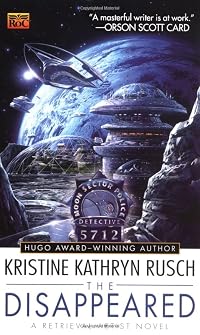
Description
Three cases have collided for Miles Flint: a stolen spaceyacht filled with dead bodies, two kidnapped human children, and a human woman on the run, trying to Disappear to avoid alien prosecution. Flint must enforce the law, but how can he do the right thing in a universe where the right thing is very, very wrong?Tags
Recommendations

















Member Recommendations
Member Reviews
I've been on a serious science fiction binge of late because... reality, but I've been determined not to fall into a genre rut. The Disappeared is the first in The Retrieval Artist series has just made that determination waver. This story was addictive and I mean in that way that not only is it a page turner but also I felt a bit resentful when I had to put it down and do other things. I literally woke up with my tablet in my hand because my body finally got its way in the middle of the night and sleep overtook me. I want to read the entire series straight through.
This is the story of how Miles Flint, a detective, becomes a retrieval artist. In the future, humanity has colonized the Moon and Mars and has interstellar agreements with show more three alien species (Disty, Wignan & Rev). Flint and his partner Noellle DeRicci have cases land in their laps of humans who've run afoul of the aliens laws and are due to be handed over. The problem is that all the offenders are literally the titular Disappeared. They've paid a service to give them new identities as a way to abscond from their sentences. It's a complex legal landscape here where sentence can be levied on the child of an offender, a lawyer who defended a repeat offender is now liable criminally for his crimes & the penalty for teaching one of a particular alien race human language costs the teacher their tongue. The police on the Moon in Armstrong Dome are tasked with following the law as proscribed and handing people over and this proves to be the problem for our detectives here. Basically, the perspective of humans is primary here so all the penalties are seen as excessive & inhumane.
I was invested in the outcome of each situation and I felt the world-building was well done. I do have to say that the offender who was guilty of clearing what she thought were trees to expand her residence of an alien planet only to find that she'd wiped out several sentient beings and thousands of other beings that nested in them was fairly unsympathetic. I just didn't want her child to suffer for her deeds. The writing here just seemed like the lives lost didn't need to be paid for because she was a human being. Not a good look. Still, I liked the resolution.
I only want more of this universe even though its a bit of a grim future. Honestly, unless the aliens are trading the cure to all mankind's physical maladies and also the answer to universal peace and total prosperity, I can't believe whatever is being traded is worth the cost. I look forward to finding out more about the politics & trade situation. Definitely recommended as it was as good a police procedural as it was a science fiction story. Definitely hit a lot of my The Expanse feels. show less
This is the story of how Miles Flint, a detective, becomes a retrieval artist. In the future, humanity has colonized the Moon and Mars and has interstellar agreements with show more three alien species (Disty, Wignan & Rev). Flint and his partner Noellle DeRicci have cases land in their laps of humans who've run afoul of the aliens laws and are due to be handed over. The problem is that all the offenders are literally the titular Disappeared. They've paid a service to give them new identities as a way to abscond from their sentences. It's a complex legal landscape here where sentence can be levied on the child of an offender, a lawyer who defended a repeat offender is now liable criminally for his crimes & the penalty for teaching one of a particular alien race human language costs the teacher their tongue. The police on the Moon in Armstrong Dome are tasked with following the law as proscribed and handing people over and this proves to be the problem for our detectives here. Basically, the perspective of humans is primary here so all the penalties are seen as excessive & inhumane.
I was invested in the outcome of each situation and I felt the world-building was well done. I do have to say that the offender who was guilty of clearing what she thought were trees to expand her residence of an alien planet only to find that she'd wiped out several sentient beings and thousands of other beings that nested in them was fairly unsympathetic. I just didn't want her child to suffer for her deeds. The writing here just seemed like the lives lost didn't need to be paid for because she was a human being. Not a good look. Still, I liked the resolution.
I only want more of this universe even though its a bit of a grim future. Honestly, unless the aliens are trading the cure to all mankind's physical maladies and also the answer to universal peace and total prosperity, I can't believe whatever is being traded is worth the cost. I look forward to finding out more about the politics & trade situation. Definitely recommended as it was as good a police procedural as it was a science fiction story. Definitely hit a lot of my The Expanse feels. show less
Miles Flint and Noelle DeRicci, police detectives in Armstrong Dome on the Moon, have a problem.
They've been assigned to investigate first one, then two, then three ships arrived at the Moon under peculiar circumstances. These are quickly shown to be related to humans convicted of crimes against against alien laws, who have chosen to "disappear" rather than face their sentences.
The first contains three bodies, eviscerated in a Disty revenge killing.
The second carries five Wygnin and two human children, an eight-year-old and an infant, whom the Wygnin claim are lawfully theirs for crimes committed by their parents--but they don't have the proper warrants with them.
The third is clumsily piloted in by a woman who says she's just a tourist, show more a passenger on the ship when a third alien race, the Rev, stopped the ship, boarded, and removed the crew and the other passengers, while she managed to evade them.
Flint and DeRicci, in their different ways, struggle with the moral ambiguities of the most unpleasant part of their jobs as Armstrong Dome detectives: turning over humans to alien justice which often seems unjust or unduly harsh to humans. It isn't a one way arrangement; the interstellar treaties involved say that each race's law applies within its own territory, and everyone, including aliens, within that territory is subject to it.
The cases we see in this book, though, are the humans convicted by intercultural tribunals of violating the laws of non-human cultures, facing punishments that by human standards are harsh, unjust, or downright cruel. We see the agony of the parents whose children the Wygnin want to take, and the fear and anger of the lawyer who faces years of hard labor in a Rev prison colony for, in her mind, properly doing her job as a lawyer.
Armstrong Dome is a gritty, lived-in place, and the major characters as well as some of the minor ones are very nicely developed. The story moves at a good pace, and we even get some glimpses of the greater depths of the alien cultures. An interesting and worthwhile read.
Recommended. show less
They've been assigned to investigate first one, then two, then three ships arrived at the Moon under peculiar circumstances. These are quickly shown to be related to humans convicted of crimes against against alien laws, who have chosen to "disappear" rather than face their sentences.
The first contains three bodies, eviscerated in a Disty revenge killing.
The second carries five Wygnin and two human children, an eight-year-old and an infant, whom the Wygnin claim are lawfully theirs for crimes committed by their parents--but they don't have the proper warrants with them.
The third is clumsily piloted in by a woman who says she's just a tourist, show more a passenger on the ship when a third alien race, the Rev, stopped the ship, boarded, and removed the crew and the other passengers, while she managed to evade them.
Flint and DeRicci, in their different ways, struggle with the moral ambiguities of the most unpleasant part of their jobs as Armstrong Dome detectives: turning over humans to alien justice which often seems unjust or unduly harsh to humans. It isn't a one way arrangement; the interstellar treaties involved say that each race's law applies within its own territory, and everyone, including aliens, within that territory is subject to it.
The cases we see in this book, though, are the humans convicted by intercultural tribunals of violating the laws of non-human cultures, facing punishments that by human standards are harsh, unjust, or downright cruel. We see the agony of the parents whose children the Wygnin want to take, and the fear and anger of the lawyer who faces years of hard labor in a Rev prison colony for, in her mind, properly doing her job as a lawyer.
Armstrong Dome is a gritty, lived-in place, and the major characters as well as some of the minor ones are very nicely developed. The story moves at a good pace, and we even get some glimpses of the greater depths of the alien cultures. An interesting and worthwhile read.
Recommended. show less
Miles Flint has finally been promoted to detective on the Armstrong Lunar Base police force only to find that his first cases involve human fugitives from alien justice.
A great opening to this series. Although the focus is on the humans we do get to understand the aliens' reasoning. I wonder if later in the series we will see aliens fleeing what they see as an unfair human punitive system.
A great opening to this series. Although the focus is on the humans we do get to understand the aliens' reasoning. I wonder if later in the series we will see aliens fleeing what they see as an unfair human punitive system.
Good science fiction mysteries are a rare commodity these days. Few have been able to successfully combine the two genres into some semblance of a decent story. Kristine Kathryn Rusch bucks this trend with The Disappeared, the first of the Retrieval Artist series of books. First introduced in The Retrieval Artist and Other Stories, Miles Flint is a detective with the police force in Armstrong Dome on the Moon. When a series of seemingly unrelated cases appear, Flint quickly puts together the clues to determine just what these cases have in common. Sworn to uphold the law--despite his misgivings--Detective Flint must do everything in his power to ease his conscience, while staying within the strict guidelines of the law. Can he reconcile show more himself in these difficult circumstances, or will he be forced to bend--or even break--the laws he's dedicated his career to?
The Disappeared is a wonder in world-building on a massive scale, yet does an excellent job of keeping readers from being overwhelmed. Set in an undisclosed future timeframe, humanity has spread to the Moon, Mars, and beyond. Most of the action in the novel takes place in Armstrong Dome, which is one of four major cities on the Moon. Miles Flint and his partner, Noelle DeRicci, are called to the scene of a derelict ship that's been towed to the Moon. Aboard the ship are several eviscerated bodies that seem to point to an alien vengeance killing. But what appears to be an open-and-shut case quickly escalates into a conspiracy far larger.
Perhaps what's most unusual about The Disappeared is how little Rusch tries to focus on the science; this novel is very much about the characters and the mystery surrounding the plot. Most science fiction novels work extra hard to describe the background and history of their universes, but Rusch does not--there is no mention of what year the book is set in (hundreds of years in the future, at least), how humanity discovered other races, or how they learned to travel to other planets beyond our solar system. There is so little information about the history of the universe The Disappeared is set in, it actually improves the enjoyment of the story. While readers may be curious about the past, it's not at all important to the events in the novel--at least not in any meaningful way. Still, it's clear that the Retrieval Artist series has a very carefully and well-crafted universe to explore, and fans will reap the benefits in future entries of the series.
The characters in The Disappeared are well-developed, if not fully three-dimensional. The secondary characters have their own pasts, faults, and issues to deal with--in fact, they may be more developed than the main protagonists. Certainly Flint and DeRicci both have their flaws and challenges to overcome, it just seems like some of the changes the characters go through in the novel come about just a little too rapidly. Perhaps the fact that very little of the past is alluded to or described in this novel weakens their development just a bit. It's a minor criticism though, in a book that's difficult to find any faults with.
The alien races that Rusch has brought to life are unique, and, well, alien; it's just what a good science fiction story is supposed to be. The Rev, Wygnin, and Disty cultures appear to be very odd, at least in human terms. Again, the lack of a backstory here provides both intrigue, and provides subtle frustrations--readers will want to know much, much more about these races, but will learn little in the pages of The Disappeared. Hopefully, future installments in the series will shed more light on not only these alien beings, but their tumultuous history with Humans.
What's most astounding about this novel is how accessible it is. This is not some futuristic utopian--or dystopian, for that matter--novel hell-bent on destroying the Establishment. The Disappeared is a mystery first, with a science fictional world wrapped around it. The technology utilized hasn't seemed to advance much farther than that we own today--quite the opposite, in some circumstances. Sure, there are flying cars, spaceships, and cities on the Moon, but at times, readers will be hard pressed to believe they're not on Earth, in some typical city in North America.
The Disappeared is not the world's greatest detective novel--far from it, in fact. It is, however, an excellent science fiction novel that's very much a detective-story. It is certainly well worth the read, if for nothing other than the amazing universe that Rusch has created. With many other novels in the series, it's an excellent entry to the Retrieval Artist saga for any reader.
show less
The Disappeared is a wonder in world-building on a massive scale, yet does an excellent job of keeping readers from being overwhelmed. Set in an undisclosed future timeframe, humanity has spread to the Moon, Mars, and beyond. Most of the action in the novel takes place in Armstrong Dome, which is one of four major cities on the Moon. Miles Flint and his partner, Noelle DeRicci, are called to the scene of a derelict ship that's been towed to the Moon. Aboard the ship are several eviscerated bodies that seem to point to an alien vengeance killing. But what appears to be an open-and-shut case quickly escalates into a conspiracy far larger.
Perhaps what's most unusual about The Disappeared is how little Rusch tries to focus on the science; this novel is very much about the characters and the mystery surrounding the plot. Most science fiction novels work extra hard to describe the background and history of their universes, but Rusch does not--there is no mention of what year the book is set in (hundreds of years in the future, at least), how humanity discovered other races, or how they learned to travel to other planets beyond our solar system. There is so little information about the history of the universe The Disappeared is set in, it actually improves the enjoyment of the story. While readers may be curious about the past, it's not at all important to the events in the novel--at least not in any meaningful way. Still, it's clear that the Retrieval Artist series has a very carefully and well-crafted universe to explore, and fans will reap the benefits in future entries of the series.
The characters in The Disappeared are well-developed, if not fully three-dimensional. The secondary characters have their own pasts, faults, and issues to deal with--in fact, they may be more developed than the main protagonists. Certainly Flint and DeRicci both have their flaws and challenges to overcome, it just seems like some of the changes the characters go through in the novel come about just a little too rapidly. Perhaps the fact that very little of the past is alluded to or described in this novel weakens their development just a bit. It's a minor criticism though, in a book that's difficult to find any faults with.
The alien races that Rusch has brought to life are unique, and, well, alien; it's just what a good science fiction story is supposed to be. The Rev, Wygnin, and Disty cultures appear to be very odd, at least in human terms. Again, the lack of a backstory here provides both intrigue, and provides subtle frustrations--readers will want to know much, much more about these races, but will learn little in the pages of The Disappeared. Hopefully, future installments in the series will shed more light on not only these alien beings, but their tumultuous history with Humans.
What's most astounding about this novel is how accessible it is. This is not some futuristic utopian--or dystopian, for that matter--novel hell-bent on destroying the Establishment. The Disappeared is a mystery first, with a science fictional world wrapped around it. The technology utilized hasn't seemed to advance much farther than that we own today--quite the opposite, in some circumstances. Sure, there are flying cars, spaceships, and cities on the Moon, but at times, readers will be hard pressed to believe they're not on Earth, in some typical city in North America.
The Disappeared is not the world's greatest detective novel--far from it, in fact. It is, however, an excellent science fiction novel that's very much a detective-story. It is certainly well worth the read, if for nothing other than the amazing universe that Rusch has created. With many other novels in the series, it's an excellent entry to the Retrieval Artist saga for any reader.
show less
Satisfying space opera, well thought out world building, excellent aliens. I really liked the ethical dilemmas outlined in this book and how the daily intereactions with aliens is what caused the trouble - not huge intergalactic wars, but simple things like if you practice law in our neck of the woods, you become party to our legal system and outcomes and if we demand the surrender of your first born as punishment for your crimes, then the Earth's political/judicial system has to agree.
This is not the most elegantly written book I've ever read, but it clips along at a great pace, and it feels solid - once you enter Rusch's world, everything makes sense, nothing trips you out of it. We meet Miles Flint, who I suspect will appear in show more other books, as a new detective, recently out of port patrol. He has baggage, who doesn't? and an experienced partner who doesn't rate him. When they get 3 complex alien cases in one week, they know something has gone really wrong, and then they spend the book trying to deal with it and figuring out the best solutions in a very murky world.
I'm definitely looking for more of this series. Happy find. A show less
This is not the most elegantly written book I've ever read, but it clips along at a great pace, and it feels solid - once you enter Rusch's world, everything makes sense, nothing trips you out of it. We meet Miles Flint, who I suspect will appear in show more other books, as a new detective, recently out of port patrol. He has baggage, who doesn't? and an experienced partner who doesn't rate him. When they get 3 complex alien cases in one week, they know something has gone really wrong, and then they spend the book trying to deal with it and figuring out the best solutions in a very murky world.
I'm definitely looking for more of this series. Happy find. A show less
As for the treaties, it'd be nice if we were given some historical background and details... Also, aren't treaties MUTUAL? So the human governments completely kowtow to alien cultures, without negotiating for ANY human-culture-based sub-clauses and exemptions?
For a "what if" novel, it's not very
I really enjoyed the world building in this book. Characters were secondary to me, but the writing and characters were in decent shape (no horrific breaks or unexplained choices).
The world created is a fascinating one. Humanity is now a small interstellar civilization, and has encountered a number of other species, bound together by a loose set of treaties and agreements in a League of Nations style, complete with inter-species courts (called Intercultural Courts).
Each species is allowed to apply its own cultures and traditions and laws to other species, at least regarding events that take place on their own planets. They are then allowed to get warrants from the Intercultural Courts to enforce those judgments on any other planet or show more station.
This means that humans can get in trouble for things that don't seem at all fair or just to humanity, and can be forced to pay for those crimes in ways humanity finds inhumane (one species does life in penal colonies, another does ritual public killings and disembowelment, and yet another takes the first born child of the offender).
Humanity has no option (other than war or ceasing to expand into space) but to go along with, and indeed, help enforce, these rulings.
So organizations called "disappearance companies" get set up. These are quasi-legal, and help people wanted by different alien cultures to disappear and start new lives under new identities elsewhere.
This book focuses on two police investigators on Earth's moon, who must deal with the tension of believing that the aliens' rulings and punishments are morally wrong, while still helping them carry them out where necessary to prevent humanity from failing to uphold its treaty obligations.
All in all, a great dilemma and a fascinating story. show less
The world created is a fascinating one. Humanity is now a small interstellar civilization, and has encountered a number of other species, bound together by a loose set of treaties and agreements in a League of Nations style, complete with inter-species courts (called Intercultural Courts).
Each species is allowed to apply its own cultures and traditions and laws to other species, at least regarding events that take place on their own planets. They are then allowed to get warrants from the Intercultural Courts to enforce those judgments on any other planet or show more station.
This means that humans can get in trouble for things that don't seem at all fair or just to humanity, and can be forced to pay for those crimes in ways humanity finds inhumane (one species does life in penal colonies, another does ritual public killings and disembowelment, and yet another takes the first born child of the offender).
Humanity has no option (other than war or ceasing to expand into space) but to go along with, and indeed, help enforce, these rulings.
So organizations called "disappearance companies" get set up. These are quasi-legal, and help people wanted by different alien cultures to disappear and start new lives under new identities elsewhere.
This book focuses on two police investigators on Earth's moon, who must deal with the tension of believing that the aliens' rulings and punishments are morally wrong, while still helping them carry them out where necessary to prevent humanity from failing to uphold its treaty obligations.
All in all, a great dilemma and a fascinating story. show less
Members
- Recently Added By
Lists

Best Science Fiction Novels
816 works; 426 members

Favorite Science Fiction by Women Authors
741 works; 197 members

Paranormal investigators and space detectives
274 works; 9 members
Author Information

654+ Works 17,609 Members
Awards and Honors
Awards
Series

Belongs to Publisher Series
Bastei Lübbe SF (23303)
Common Knowledge
- Canonical title
- The Disappeared
- Original publication date
- 2002-07
- People/Characters
- Miles Flint; Paloma; Noelle DeRicci
- Dedication
- For Spike,
with love always - First words
- She had to leave everything behind.
- Last words
- (Click to show. Warning: May contain spoilers.)And this time, he knew it.
- Publisher's editor
- Gilman, Laura Anne
- Blurbers
- Card, Orson Scott
Classifications
Statistics
- Members
- 668
- Popularity
- 43,221
- Reviews
- 29
- Rating
- (3.66)
- Languages
- English, German
- Media
- Paper, Audiobook, Ebook
- ISBNs
- 6
- UPCs
- 1
- ASINs
- 4