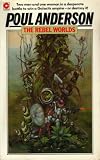
The Rebel Worlds
by Poul Anderson
Saga of Dominic Flandry (3), Terran Empire (Collections and Selections — 1.3)
On This Page
Tags
Recommendations













Member Reviews
Dominic Flandry, the crumbling Terran Empire's dashing agent, is caught in a conflict between a corrupt governor's atrocities, a noble admiral's rebellion, the alien Merseians' looming threat, and navigating a complex love triangle with the admiral's wife, Kathryn.
This chapter of the Dominic Flandry Saga is relatively brief - only 139 pages. The story suffers from its shortness - there are many opportunities where the tale could have been expanded and formed a more fully fleshed out novel. Alas, that is not to be, and the plot feels rushed in some places do that it could dawdle in others - that being said, when it is at its best it deals in surprisingly complexities, and the exploration of the alien society on Dido is peak Anderson.
If anything, one could argue that Flandry's involuntary sojourn on Dido is the entire purpose of the story, a means so Anderson could explore the unique evolution and cultures on an alien planet, everything else being somewhat secondary. The Didonians though are show more extraordinary - at a surface level it shouldn't work - A rhino, a primate, and a bird forming a sophont through a somewhat Avatar-esque mind link. It seems ridiculous, but it works. The interesting twist is that while species-to-species linkages (i.e. primate-to-primate, or avian-to-avian, etc) don't work, the different parts of the tripartite being can form with the parts of other tripartite beings to form different personalities. So if a two beings switch their primates, they become different individuals, and the individuals they were part of cease to exists until they reform. The society then forms individuals as needed, a specialist in an area may only be occasionally needed, but can form when required, bringing with it a portion of the additional experiences its component beings have had since it last formed. Individually, each of these species have only animal-like intelligence, and with only two they are not much improved, it is only the combination of the third that turns it into a sophont-level intelligence. Would have loved to had the cultures and ramifications of it all explored in much greater detail. show less
If anything, one could argue that Flandry's involuntary sojourn on Dido is the entire purpose of the story, a means so Anderson could explore the unique evolution and cultures on an alien planet, everything else being somewhat secondary. The Didonians though are show more extraordinary - at a surface level it shouldn't work - A rhino, a primate, and a bird forming a sophont through a somewhat Avatar-esque mind link. It seems ridiculous, but it works. The interesting twist is that while species-to-species linkages (i.e. primate-to-primate, or avian-to-avian, etc) don't work, the different parts of the tripartite being can form with the parts of other tripartite beings to form different personalities. So if a two beings switch their primates, they become different individuals, and the individuals they were part of cease to exists until they reform. The society then forms individuals as needed, a specialist in an area may only be occasionally needed, but can form when required, bringing with it a portion of the additional experiences its component beings have had since it last formed. Individually, each of these species have only animal-like intelligence, and with only two they are not much improved, it is only the combination of the third that turns it into a sophont-level intelligence. Would have loved to had the cultures and ramifications of it all explored in much greater detail. show less
I've read a fair amount of Poul Anderson, but this was my first Dominic Flandry novel. While there were aspects to it that were far from convincing, all in all I enjoyed it more than it probably deserves. The aliens were interesting if not particularly plausible. The resolutions of key plotlines were satisfying if not particularly plausible. The protagonist turned out to be more nuanced than the James-Bond-in-space pastiche I initially expected.
In tone it reminded me of A. Bertram Chandler's John Grimes series, but Flandry is a more complicated character, and Anderson manages to raise surprisingly substantial issues along the way.
In tone it reminded me of A. Bertram Chandler's John Grimes series, but Flandry is a more complicated character, and Anderson manages to raise surprisingly substantial issues along the way.
Poul Anderson is one of those names that I've heard a lot, but I don't think I've actually read anything by him before. I bought this book on a recommendation from a friend, and it's pretty good, although not having read any of the other Technic Saga books, I feel like I'm missing some context.
The Terran Empire is a vast enterprise, succumbing under the weight of bureaucratic inertia and the personally corruption and stupidity of the Emperor. When a regional governor's sadism inspires a military revolt, it's up to Dominic Flandry, the last competent man in the room, to salvage the situation.
There's some musing on political stability and corruption, great xenobiology with a tripartate symbiotic alien species, and action and adventure. show more Flandry is a decent man in service of a bad cause, and it's fun to watch him wheedle and deal in service of a galactic order that promotes bad men and punishes good ones. There's a long, slow, seduction of a beautiful blond, space battles, aliens of all sorts. It's a big kitchen sink setting, and one thing that struck me was how fast everything moves. The longest story arc is a transcontinental journey from a crashed spaceship across a primitive alien world to get back to the spaceport and hijack a ship. Anderson does this in about 50 pages. David Weber and John Ringo wrote an entire series of doorstoppers (March Up Country etc) on the same subject.
I'm sold enough that I'll read the rest of them, assuming I can work out the best way to get ebook omnibus versions.
***
Okay, so I did pick up an omnibus of Flandry, finally working my way to book three, and this is definitely a step up from the unnecessary and somewhat grotesque Circus of Hells Kathryn is definitely an actual strong female character, even if she's more the Madonna side of the Madonna/Whore dynamic. The explanation of Empire, espionage, and the Mersenian threat really needs book 1, but this might be my favorite, for much of its sheer weirdness and the evil of its villains. show less
The Terran Empire is a vast enterprise, succumbing under the weight of bureaucratic inertia and the personally corruption and stupidity of the Emperor. When a regional governor's sadism inspires a military revolt, it's up to Dominic Flandry, the last competent man in the room, to salvage the situation.
There's some musing on political stability and corruption, great xenobiology with a tripartate symbiotic alien species, and action and adventure. show more Flandry is a decent man in service of a bad cause, and it's fun to watch him wheedle and deal in service of a galactic order that promotes bad men and punishes good ones. There's a long, slow, seduction of a beautiful blond, space battles, aliens of all sorts. It's a big kitchen sink setting, and one thing that struck me was how fast everything moves. The longest story arc is a transcontinental journey from a crashed spaceship across a primitive alien world to get back to the spaceport and hijack a ship. Anderson does this in about 50 pages. David Weber and John Ringo wrote an entire series of doorstoppers (March Up Country etc) on the same subject.
I'm sold enough that I'll read the rest of them, assuming I can work out the best way to get ebook omnibus versions.
***
Okay, so I did pick up an omnibus of Flandry, finally working my way to book three, and this is definitely a step up from the unnecessary and somewhat grotesque Circus of Hells Kathryn is definitely an actual strong female character, even if she's more the Madonna side of the Madonna/Whore dynamic. The explanation of Empire, espionage, and the Mersenian threat really needs book 1, but this might be my favorite, for much of its sheer weirdness and the evil of its villains. show less
Spoiler Warning. This is a still fairly young Flandry sent to investigate a rebellion by a popular Imperial admiral, Hugh McCormac. It turns out the revolt had been provoked by the sector governor, a (gay) favorite of the current weakling emperor, who was brutally exploiting his sector to raise funds to become the power behind the throne.The admiral had protested, the governor Aaron Snelund had arrested him, his loyal men freed the admiral who proclaimed himself emperor. Hugh's wife Kathryn had also been arrested and remained in Aaron's control while he savagely abused her. Flandry manages to get Kathryn transferred to his own ship, but while heading to negotiate with Hugh, his ship is shot down and crashes on Dido, a world whose aliens show more have a unique 3 part physiology (an mentality) one birdlike, one ape-like and one (on which the others ride) rhino-like (an extension of the 2 part aliens in a van Rijn story). Flandry, Kathryn his crew, and some friendly Didonians manage to reach a human scientific base and capture the only spaceship, on which they return to Snelund. Flandry has fallen in love with Kathryn, but she during the trek refuses his offer to switch sides in return for their becoming lovers.When they reach the loyalist base, Flandry is able to give the loyalists the computer codes for the rebel forces, thus winning Snelund's favor. He pretends to be returning Kathryn to Snelund, but instead helps her kill him.He then returns Kathryn to Hugh, after persuading him that the best course (given the loss of his codes) is to flee the empire with those who still follow him. Flandry is heartbroken for the moment to lose Kathryn, but finds consolations later. The head of Imperial Intelligence suspects what happened, but lets it go. show less
This is the third story of Dominic Flandry, a Lieutenant in the Imperial Secret service.
Flandry must stop a revolution on the border caused by a corrupt governor. He rescues a woman named Katheryn and falls in love with her but she remains dedicated to her husband, the leader of the revolt.
The book introduces a new alien species who are 3 part, interchangeable personalities.
Re-read 12/4/2022
Flandry must stop a revolution on the border caused by a corrupt governor. He rescues a woman named Katheryn and falls in love with her but she remains dedicated to her husband, the leader of the revolt.
The book introduces a new alien species who are 3 part, interchangeable personalities.
Re-read 12/4/2022
Ratings
Members
- Recently Added By
Author Information

Poul Anderson, November 25, 1926 - July 31, 2001 Poul Anderson was born on November 25, 1926 in Bristol, Pennsylvania to parents Anton and Astrid. After his father's death, Poul's mother took them first to Denmark and then to Maryland and Minnesota. He earned his degree in Physics from the University of Minnesota, but chose instead to write show more stories for science fiction magazines, such as "Astounding." Anderson is considered a "hard science fiction" writer, meaning that his books have a basis in scientific fact. To attain this high level of scientific realism, Anderson spent many hours researching his topics with scientists and professors. He liked to write about individual liberty and free will, which was a well known theme in many of his books. He also liked to incorporate his love of Norse mythology into his stories, sometimes causing his modern day characters to find themselves in fantastical worlds, such as in "Three Hearts and Three Lions," published in 1961. Anderson has written over a hundred books, his last novel, "Genesis" won the John W. Campbell Award, one of the three major science fiction awards. He is a former president of the Science Fiction and Fantasy Writers of America and won three Nebula awards and nine Hugo Awards. In 1997, Anderson was named a Grandmaster by the Science Fiction and Fantasy Writers of America and was also inducted into the Science Fiction Fantasy Hall of Fame. Poul Anderson died on July 31, 2001 at the age of 74. (Bowker Author Biography) show less
Some Editions
Series


Belongs to Publisher Series
Work Relationships
Common Knowledge
- Canonical title*
- Rebellenwelt; Rebellion auf Alpha Crucis
- Original title
- The Rebel Worlds
- Alternate titles
- Commander Flandry
- Original publication date
- 1969-10
- People/Characters
- Dominic Flandry
*Some information comes from Common Knowledge in other languages. Click "Edit" for more information.
Classifications
Statistics
- Members
- 469
- Popularity
- 65,089
- Reviews
- 6
- Rating
- (3.28)
- Languages
- 5 — Danish, English, German, Portuguese, Swedish
- Media
- Paper
- ISBNs
- 11
- ASINs
- 18