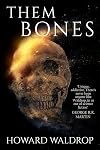
Them Bones
by Howard Waldrop
On This Page
Description
Madison Yazoo Leake, the hero of this science fiction novel, attempts to travel from the 21st century to 1930's Louisiana in a bid to prevent the outbreak of World War III. Instead he is transported to an alternative Earth, where history is twisted, and where he fears he may be stranded.Tags
Recommendations

























Member Reviews
The hardback edition of this book is one of my most treasured possessions (purchased, if I remember correctly, at my first Octocon.) Howard Waldrop's short stories blew me away, but this was my first head-wrecking, brain-buzzing encounter with a writer who bends fiction and time and space and history into equally gonzo shapes.
Them Bones has three separate strands of war, archaeology and adventures amongst the Amerindian Moundbuilders of the Mississipi as refugees from a dying world try to save their own future and instead doom another, while a team tries to save the past and preserve the truth against rising floodwaters. This is a slim book, and the prose is polished til it shines, but it still covers epic ground as the slow scale of show more the tragedy becomes clear. Not quite like anything else you'll ever read. Then find his stories, which are something else again. show less
Them Bones has three separate strands of war, archaeology and adventures amongst the Amerindian Moundbuilders of the Mississipi as refugees from a dying world try to save their own future and instead doom another, while a team tries to save the past and preserve the truth against rising floodwaters. This is a slim book, and the prose is polished til it shines, but it still covers epic ground as the slow scale of show more the tragedy becomes clear. Not quite like anything else you'll ever read. Then find his stories, which are something else again. show less
Howard Waldrop's quirky and off-the-wall short stories have always been a great source of pleasure; 'Them Bones', one of his few novels, is obviously cut from the same cloth but the quirkiness is tempered - perhaps a bit too much - by the sense that Waldrop was setting out here to Write A Novel; and in the course of all the careful work needed to make a novel and to carry it off convincingly, it seems to me that some of the essence of his short stories got lost.
The premise is promising. We start with an archaeologist, working on a dig amongst the remains of the Mound Builder culture in Louisiana, in the 1920s. She comes across something that shouldn't be there; the remains of a horse, in an archaeological layer dating from a time when show more horses were not known on the North American continent. Then she finds what killed it - modern bullets.
We are then switched to the viewpoint of a time traveller, a pathfinder for a larger expeditionary force, stepping out of his portal into pre-Columbian America. Which comes as a bit of a shock, as he was expecting to land in the 1930s. The expedition he was pathfinding for never emerges from the portal. As the time portal is only one-way, he sets out to find civilisation. He meets, and builds a life with, indigenous peoples, and becomes a part of their community. He also finds that not only is he not in the time he expected, but there are other problems as well...
A third strand shows us what happened to the expedition, told through a diary and official documents. The three strands come together in not unexpected ways; but Waldrop manages the process perfectly well. Along the way, we begin to find out the motivation for the time expedition. Where this novel falls down is in the structure and pacing. I found myself fairly ripping through the story, because it gave me a lot of impetus to find out what was going to happen next; I'm certain there were things I missed in that process. And yet, I had the sense towards the end that, having carefully and meticulously planned the novel out, Waldrop painted himself somewhat into a corner. In the last third of the novel, one of our p.o.v. protagonists travels on foot to a neighbouring settlement; he makes his escape pursued by an angry (and armed) mob. He then has to get home; and that sequence becomes quite extended and a bit unbalanced. I got the feeling that Waldrop was a bit taken aback by how far he'd taken his protagonist and how much ground he'd have to cover to get him safely back to his village. Sadly, this dragged a little.
Characterisation, though, is excellent. In particular, there is one secondary character, who I got quite attached to, who sounds to me like Chief Dan George, the First Nation chief who became well known for playing wise but laconic native Americans in films, particularly 'Little Big Man' and Clint Eastwood's 'The Outlaw Josey Wales'. If this be so, his was a good model to emulate. Even the officer filling out the reports in the expeditionary force that is stranded in the past manages to come through as a real person rather than as a mere functionary.
I can recommend Waldrop's writing wholeheartedly; but this novel is likely to be met with indulgence by those who like his work.Those who know him not would be better advised to seek out his short stories. show less
The premise is promising. We start with an archaeologist, working on a dig amongst the remains of the Mound Builder culture in Louisiana, in the 1920s. She comes across something that shouldn't be there; the remains of a horse, in an archaeological layer dating from a time when show more horses were not known on the North American continent. Then she finds what killed it - modern bullets.
We are then switched to the viewpoint of a time traveller, a pathfinder for a larger expeditionary force, stepping out of his portal into pre-Columbian America. Which comes as a bit of a shock, as he was expecting to land in the 1930s. The expedition he was pathfinding for never emerges from the portal. As the time portal is only one-way, he sets out to find civilisation. He meets, and builds a life with, indigenous peoples, and becomes a part of their community. He also finds that not only is he not in the time he expected, but there are other problems as well...
A third strand shows us what happened to the expedition, told through a diary and official documents. The three strands come together in not unexpected ways; but Waldrop manages the process perfectly well. Along the way, we begin to find out the motivation for the time expedition. Where this novel falls down is in the structure and pacing. I found myself fairly ripping through the story, because it gave me a lot of impetus to find out what was going to happen next; I'm certain there were things I missed in that process. And yet, I had the sense towards the end that, having carefully and meticulously planned the novel out, Waldrop painted himself somewhat into a corner. In the last third of the novel, one of our p.o.v. protagonists travels on foot to a neighbouring settlement; he makes his escape pursued by an angry (and armed) mob. He then has to get home; and that sequence becomes quite extended and a bit unbalanced. I got the feeling that Waldrop was a bit taken aback by how far he'd taken his protagonist and how much ground he'd have to cover to get him safely back to his village. Sadly, this dragged a little.
Characterisation, though, is excellent. In particular, there is one secondary character, who I got quite attached to, who sounds to me like Chief Dan George, the First Nation chief who became well known for playing wise but laconic native Americans in films, particularly 'Little Big Man' and Clint Eastwood's 'The Outlaw Josey Wales'. If this be so, his was a good model to emulate. Even the officer filling out the reports in the expeditionary force that is stranded in the past manages to come through as a real person rather than as a mere functionary.
I can recommend Waldrop's writing wholeheartedly; but this novel is likely to be met with indulgence by those who like his work.Those who know him not would be better advised to seek out his short stories. show less
My usual reaction to reading a Waldrop story is yes, it's obvious he did a lot of research, but what was the point, why should I care?
This novel has something usually lacking in Waldrop -- emotion. It's a fast-paced, poignant read of time travelers stranded in two versions of the American Moundbuilder culture: one from our history and one in a world where Rome lost the Second Punic War. Waldrop does his usual thorough research, and here he actually gives us, rather than his usual bizarre juxtapositions of characters, some likeable people whose struggles and joys seem very real -- to us, the reader, but almost invisible to the archeaologists from 1929 who study some odd mounds in Louisiania. This is a look at lives buried by time and show more ultimately, like all lives, capable of being seen and felt only in the imagination.
Waldrop fans will like this.
More importantly, even if you're sometimes annoyed by Waldrop, you'll like this. show less
This novel has something usually lacking in Waldrop -- emotion. It's a fast-paced, poignant read of time travelers stranded in two versions of the American Moundbuilder culture: one from our history and one in a world where Rome lost the Second Punic War. Waldrop does his usual thorough research, and here he actually gives us, rather than his usual bizarre juxtapositions of characters, some likeable people whose struggles and joys seem very real -- to us, the reader, but almost invisible to the archeaologists from 1929 who study some odd mounds in Louisiania. This is a look at lives buried by time and show more ultimately, like all lives, capable of being seen and felt only in the imagination.
Waldrop fans will like this.
More importantly, even if you're sometimes annoyed by Waldrop, you'll like this. show less
First Line: "There's a horse in the small mound," said Bessie.
It's 1929 and archaeologists are digging in a mound in Louisiana when they find something very exciting: the skeleton of a horse. What's so exciting about that? From the skeleton's position in the mound, it was in America a few centuries before it was supposed to be. Then the archaeologists dig a little more and find something even more curious: the cause of the horse's death--a cartridge from a rifle.
Them Bones sticks to the Moundbuilder culture of prehistoric America, but the story is told from differing viewpoints: the 1929 team of archaeologists, a scout sent back to the wrong time to prevent World War III, and the group of soldiers who followed him.
The story moves show more quickly--too quickly--and the chapters involving the group of soldiers tend to be downright confusing. The 1929 group of archaeologists and the scout had the most interesting stories to tell, especially Leake (the scout) who became well-acquainted with the group of Indians he found himself amongst. I've visited Cahokia, the one remaining supreme example of Moundbuilder culture. It is awe-inspiring, so I enjoyed Waldrop's choice of setting and the Indian characters Leake met.
The bones were there for a wonderful book, but they just weren't fleshed out. The setting was a winner, but the pace was too fast and the characters not fully realized. I'm glad that I read the book because it encouraged me to go online and do a bit more research on Cahokia, but Them Bones left me feeling like Oliver Twist. Please sir...couldn't I have had some more? show less
It's 1929 and archaeologists are digging in a mound in Louisiana when they find something very exciting: the skeleton of a horse. What's so exciting about that? From the skeleton's position in the mound, it was in America a few centuries before it was supposed to be. Then the archaeologists dig a little more and find something even more curious: the cause of the horse's death--a cartridge from a rifle.
Them Bones sticks to the Moundbuilder culture of prehistoric America, but the story is told from differing viewpoints: the 1929 team of archaeologists, a scout sent back to the wrong time to prevent World War III, and the group of soldiers who followed him.
The story moves show more quickly--too quickly--and the chapters involving the group of soldiers tend to be downright confusing. The 1929 group of archaeologists and the scout had the most interesting stories to tell, especially Leake (the scout) who became well-acquainted with the group of Indians he found himself amongst. I've visited Cahokia, the one remaining supreme example of Moundbuilder culture. It is awe-inspiring, so I enjoyed Waldrop's choice of setting and the Indian characters Leake met.
The bones were there for a wonderful book, but they just weren't fleshed out. The setting was a winner, but the pace was too fast and the characters not fully realized. I'm glad that I read the book because it encouraged me to go online and do a bit more research on Cahokia, but Them Bones left me feeling like Oliver Twist. Please sir...couldn't I have had some more? show less
In the year 2002 the world is being destroyed (World War 3 time folks) and so a group of scientists come up with a plan to send a group of 140 people back to 1930 Louisiana so that they can fix things to prevent the war from happening. Now, as we all know, going back in time to try and prevent something bad from happening is never a good idea. The first man through, Madison Yazoo Leake whose job was to scout things out for the main team, however finds himself in a world that is most definitely not 1930s Louisiana, or anything like the world according to standard history. The chances of stopping WW3 seem very slim.
It's a long time since I read anything by this author and I think that it may only be a collection of short stories that I show more encountered before. Strange Things in Close Up had a really brilliant cover image but the stories themselves didn't stick in my brain at all. Them Bones is Waldrop's first novel published in 1984 and I am pretty sure it is the only novel of his that I will ever read. It started with a great premise but then lost its way quite badly. There are three different threads. One follows the adventures of Leake, which make up most of the action in the book. Then there are the 1930s archaeologists who discover remains that are anomalous for the period they're digging in and the accounts of the military who pass through the defective time machine. The latter consists of shorter fragments and there aren't any points in the novel where the three elements come together in any
satisfactory manner. Characters are not developed to any degree and the main axis of the plot takes a disappointing nose dive away from the potential that the premise carried. Disappointing. show less
It's a long time since I read anything by this author and I think that it may only be a collection of short stories that I show more encountered before. Strange Things in Close Up had a really brilliant cover image but the stories themselves didn't stick in my brain at all. Them Bones is Waldrop's first novel published in 1984 and I am pretty sure it is the only novel of his that I will ever read. It started with a great premise but then lost its way quite badly. There are three different threads. One follows the adventures of Leake, which make up most of the action in the book. Then there are the 1930s archaeologists who discover remains that are anomalous for the period they're digging in and the accounts of the military who pass through the defective time machine. The latter consists of shorter fragments and there aren't any points in the novel where the three elements come together in any
satisfactory manner. Characters are not developed to any degree and the main axis of the plot takes a disappointing nose dive away from the potential that the premise carried. Disappointing. show less
A rather episodic time travel novel switching between three different time zones/alternative histories. Quite a good idea but I didn't find any of the characters realised apart from the 'hero' in one and the man who befriends him in the pre Colombian type society where he ends up.
Intruiging, and a little weird. But: time travel done right (that is: completely wrong). I got this based on a recommendation, and it's worth it (it's also not that long). Reminded me a bit of R.A. Lafferty, but this is less out there (but it's still out there).
Members
- Recently Added By
Lists

Best Science Fiction Novels
816 works; 430 members

What Makes This Book So Great
102 works; 16 members

Forced Exposure
83 works; 1 member
Author Information

96+ Works 1,939 Members
Some Editions
Awards and Honors
Awards
Series
Belongs to Publisher Series
Work Relationships
Is contained in
Common Knowledge
- Original title
- Them bones
- Original publication date
- 1984-11
- People/Characters
- Dr. Kincaid; Bessie Level; Madison Yazoo Leake; Took-His-Time; Sunflower
- Epigraph
- "Life can only be understood backward but it must be lived forward." — Kierkegaard
"I often think of the millions and millions of the denizens of time who do not share the time I live in."—Claude Ray
"Out of monuments, names, words, proverbs, traditions, private records and evidences, fragments of stories, passages of books, and the like, we do save and recover somewhat from the Deluge of Time."—Francis Bacon
"The Past isn't dead. It ain't even past."—William Faulkner - First words
- "There's a horse in the small mound," said Bessie.
- Last words
- (Click to show. Warning: May contain spoilers.)Toward home, then.
- Blurbers
- Benford, Gregory
- Original language*
- Inglese
*Some information comes from Common Knowledge in other languages. Click "Edit" for more information.
Classifications
Statistics
- Members
- 318
- Popularity
- 99,668
- Reviews
- 11
- Rating
- (3.59)
- Languages
- 5 — English, Finnish, French, German, Italian
- Media
- Paper, Ebook
- ISBNs
- 11
- ASINs
- 1