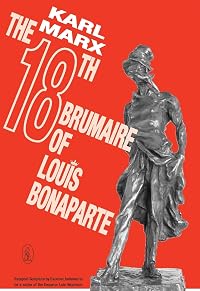
The Eighteenth Brumaire of Louis Bonaparte
by Karl Marx
On This Page
Description
An acclaimed translation of one of Marx's most important texts, along with essays discussing its contemporary relevance.Tags
Recommendations









Member Reviews
A whole lot of the historical background of this long essay went over my head- I must admit that my knowledge of 19th century French politics isn’t exactly broad. I came to this book from a podcast called “The Age of Napoleon” which deals with the subject of this book’s much more famous and consequential uncle. One episode features a discussion of this work by Marx and mentions that it may be a little hard for contemporary readers to “get” because Marx was writing about current events, and assumed that his readers would be up to date on the latest news coming out of France. However, for us, this news has been watered down by an extra century and a half of intervening history.
Even coming in so ignorant, there’s a lot to be show more had from this book. Something I never hear mentioned is how fun Marx is to read. He was a extremely talented writer (or polemicist, depending on your perspective) with great skill for a turn of phrase or an biting piece of wit to draw into contrast the absurdity of the social phenomena he is describing. Its also refreshing to read a brilliant thinker speaking with such confidence and passion about these issues - when reading Marx you feel like the right answer is so clear, so unavoidable, only by deliberate misdirection have we missed the mark. This is partially 19th century intellectual hubris, but I think it does show how impotent modern political discourse has become. It’s still shocking how radical his opinions were, and how so long ago he was presciently able to diagnose many problems we are still struggling to understand today. When you actually read Marx, you realize how misconstrued he has become, and how different the contemporary “left” in the USA is from the agenda he is putting forward. Case in point is his criticisms of taxes towards the back of the essay, which runs totally counter to the depiction of “liberals” in mainstream American discourse as spendthrifts always ready to raise taxes on the hard working people. In this book Marx articulates much the same criticism of big government as an American style conservative might, albeit with a much different endgame in mind. What were these taxes for? What were they going towards supporting? Would they actually improve the status of the working class or only to fund further distractions and misdirections to make it seem like the government was actually doing something? (It is after all the ultimate goal of classic Marxism to dissolve the state after the means of production has been secured by the workers) Always basing his work in hardcore research and study (evinced by the thousands of hours spent researching Das Kapital in the libraries of London), Marx, despite his reputation as an ideologue, always seeks the no bullshit, practical path forward. In this book we see him rail against meaningless political grandstanding in the service of obfuscating revolutionary energy. What Louis Napoleon was able to do, and what sets him directly in Marx’s sights, was skillfully manipulate (or take advantage of) the political winds blowing after the stymied revolutions of 1848. By playing all sides against each other, and using the powers of office to put forward the most pandering political projects that would ultimately do nothing to improve the situation of the working class, Napoleon III was able to enrich himself, his cronies, and the entire bourgeois class that profited from “stability” at any cost. show less
Even coming in so ignorant, there’s a lot to be show more had from this book. Something I never hear mentioned is how fun Marx is to read. He was a extremely talented writer (or polemicist, depending on your perspective) with great skill for a turn of phrase or an biting piece of wit to draw into contrast the absurdity of the social phenomena he is describing. Its also refreshing to read a brilliant thinker speaking with such confidence and passion about these issues - when reading Marx you feel like the right answer is so clear, so unavoidable, only by deliberate misdirection have we missed the mark. This is partially 19th century intellectual hubris, but I think it does show how impotent modern political discourse has become. It’s still shocking how radical his opinions were, and how so long ago he was presciently able to diagnose many problems we are still struggling to understand today. When you actually read Marx, you realize how misconstrued he has become, and how different the contemporary “left” in the USA is from the agenda he is putting forward. Case in point is his criticisms of taxes towards the back of the essay, which runs totally counter to the depiction of “liberals” in mainstream American discourse as spendthrifts always ready to raise taxes on the hard working people. In this book Marx articulates much the same criticism of big government as an American style conservative might, albeit with a much different endgame in mind. What were these taxes for? What were they going towards supporting? Would they actually improve the status of the working class or only to fund further distractions and misdirections to make it seem like the government was actually doing something? (It is after all the ultimate goal of classic Marxism to dissolve the state after the means of production has been secured by the workers) Always basing his work in hardcore research and study (evinced by the thousands of hours spent researching Das Kapital in the libraries of London), Marx, despite his reputation as an ideologue, always seeks the no bullshit, practical path forward. In this book we see him rail against meaningless political grandstanding in the service of obfuscating revolutionary energy. What Louis Napoleon was able to do, and what sets him directly in Marx’s sights, was skillfully manipulate (or take advantage of) the political winds blowing after the stymied revolutions of 1848. By playing all sides against each other, and using the powers of office to put forward the most pandering political projects that would ultimately do nothing to improve the situation of the working class, Napoleon III was able to enrich himself, his cronies, and the entire bourgeois class that profited from “stability” at any cost. show less
Brilliant and beyond comprehensive. Every sentence, every clause is packed with information and revelation in that inexorable Marxist fashion. Not only does Marx portray the [in retrospect, inevitable] self-dissolution of the Parisian bourgeoisie and representative democracy, but he outlines the fundamental factors encouraging such a reflexive abrogation in a way that's eerily prescient. The specter of a class dictatorship outweighed the prospect of dictatorship in one man, and the result was Louis Napoleon (and if one chooses to unravel the ensuing historical thread, the creation of a unified Germany and the two world wars). Solely because the interests of the urban proletariat were deemed disruptive to the interests of the industrial show more bourgeoisie.
The enemies we face today wear new and disorienting masks, but the methods by which they coopt erstwhile allies are far from innovative. For leftists, liberals will inevitably betray them, and thus is as it ever was. Capitalize the "D" in the following passage, and you might as well be describing modern American politics:
Despite the sheer density of prose, the innumerable factors that have led us to the dismal present can be traced back to the revolutions of 1848 and beyond. The common arc of the universe has yet to bend - can it really go without bending for much longer? It is in The Eighteenth Brumaire that Marx coined the idea that history repeats itself, "first as tragedy, then as farce." What does it mean to watch history being made on a daily basis, and to witness the same passages repeated over and over again? Given the nature of our reality, we're all living in a collective insane timeline - reading Marx's timeless insights can be one of the few ways to preserve our sanity. show less
The enemies we face today wear new and disorienting masks, but the methods by which they coopt erstwhile allies are far from innovative. For leftists, liberals will inevitably betray them, and thus is as it ever was. Capitalize the "D" in the following passage, and you might as well be describing modern American politics:
[T]he democrat, because he represents the petty bourgeoisie – that is, a transition class, in which the interests of two classes are simultaneously mutually blunted – imagines himself elevated above class antagonism generally. The democrats concede that a privileged class confronts them, but they, along with all the rest of the nation, form the people. What they represent is the people’s rights; what interests them is the people’s interests. Accordingly, when a struggle is impending they do not need to examine the interests and positions of the different classes. They do not need to weigh their own resources too critically. They have merely to give the signal and the people, with all its inexhaustible resources, will fall upon the oppressors. Now if in the performance their interests prove to be uninteresting and their potency impotence, then either the fault lies with pernicious sophists, who split the indivisible people into different hostile camps, or the army was too brutalized and blinded to comprehend that the pure aims of democracy are the best thing for it, or the whole thing has been wrecked by a detail in its execution, or else an unforeseen accident has this time spoiled the game. In any case, the democrat comes out of the most disgraceful defeat just as immaculate as he was innocent when he went into it, with the newly won conviction that he is bound to win, not that he himself and his party have to give up the old standpoint, but, on the contrary, that conditions have to ripen to suit him.
Despite the sheer density of prose, the innumerable factors that have led us to the dismal present can be traced back to the revolutions of 1848 and beyond. The common arc of the universe has yet to bend - can it really go without bending for much longer? It is in The Eighteenth Brumaire that Marx coined the idea that history repeats itself, "first as tragedy, then as farce." What does it mean to watch history being made on a daily basis, and to witness the same passages repeated over and over again? Given the nature of our reality, we're all living in a collective insane timeline - reading Marx's timeless insights can be one of the few ways to preserve our sanity. show less
This book takes in some matters of great current relevance in its broad conceptual sweep, but--from a current perspective--too often douses them in the minutiae of the moment. Marx the political junkie certainly conveys to us his brilliance and his scorn--the tagline here is "history happens first as tragedy, then again as farce," after all--and he is not gentle in his treatment of the conservative "Party of Order," the liberal grandees, the social-democrat Montagnards, or the social revolutionaries like Louis Blanc. The men of 1848 were not the men of 1789. Unfortunately, all things fade, and our latter-day selves may not appreciate the exquisiteness of some of the finer barbs here.
Nevertheless, the central question is echoic of show more Hitler, who we have kept aliver in the intellectual folk-memory: how does a mediocrity like Louis Bonaparte (seen by his contemporaries largely as a clown after two embarrassing coup attempts, though to be fair also a daring escape from prison) become Napoleon III of France? The basic argument is that each of the competing power blocks thought they were using him as a front to tear down their opponents--a proxy and patsy president to keep their own hands clean--but then he himself was the last man standing who he hadn't been used to tear down, and who in fact had been built up by being the dude to hand out all the bread and sausages. Marx's fear of the lumpenproletariat, which he couches as caution about their counterrevolutionary potential, comes out in a major way here. And in general his class analysis is more sophisticated and more modern than in say the manifesto--our petty bourgeoisie, our magnates of industry and finance and agriculture and the tension between them, our deeply complicit intellectuals/gelded pantomime opposition, all are here. Interesting to me too is how this is certainly still the early Marx, historicist and Hegelian and without a complex economic theory (represented; I dunno to what degree it had been worked out), though with a keen sense of the role of economic crises in causing political crises; but then, compared to Engels's preface to the third edition written thirty years later that talks about things in terms of the historical law and the inevitable victory of socialism, what we have here is Marx the deeply ironical, fascinated and amused by the way a perfectly reasonable, unjust, workaday bourgeois polity can spin off into absurdity, with only a faint tang of social-justice rage bound up in the reminder that all class interests not rooted in the relations of production are illusory (so if you're on a daily wage, for fuck's sake don't think that the dictator is serving you and not the man with the millions, though of course in both cases ultimately serving only himself if the buffoon can get away with it, and again like Hitler Louis-N. B. did). I like this Marx and I'd read his inside-the-Beltway blog and I only wish that the political junkie stacks-of-newspapers-in-the-cafes stuff was easier to unpack after getting on for two centuries. show less
Nevertheless, the central question is echoic of show more Hitler, who we have kept aliver in the intellectual folk-memory: how does a mediocrity like Louis Bonaparte (seen by his contemporaries largely as a clown after two embarrassing coup attempts, though to be fair also a daring escape from prison) become Napoleon III of France? The basic argument is that each of the competing power blocks thought they were using him as a front to tear down their opponents--a proxy and patsy president to keep their own hands clean--but then he himself was the last man standing who he hadn't been used to tear down, and who in fact had been built up by being the dude to hand out all the bread and sausages. Marx's fear of the lumpenproletariat, which he couches as caution about their counterrevolutionary potential, comes out in a major way here. And in general his class analysis is more sophisticated and more modern than in say the manifesto--our petty bourgeoisie, our magnates of industry and finance and agriculture and the tension between them, our deeply complicit intellectuals/gelded pantomime opposition, all are here. Interesting to me too is how this is certainly still the early Marx, historicist and Hegelian and without a complex economic theory (represented; I dunno to what degree it had been worked out), though with a keen sense of the role of economic crises in causing political crises; but then, compared to Engels's preface to the third edition written thirty years later that talks about things in terms of the historical law and the inevitable victory of socialism, what we have here is Marx the deeply ironical, fascinated and amused by the way a perfectly reasonable, unjust, workaday bourgeois polity can spin off into absurdity, with only a faint tang of social-justice rage bound up in the reminder that all class interests not rooted in the relations of production are illusory (so if you're on a daily wage, for fuck's sake don't think that the dictator is serving you and not the man with the millions, though of course in both cases ultimately serving only himself if the buffoon can get away with it, and again like Hitler Louis-N. B. did). I like this Marx and I'd read his inside-the-Beltway blog and I only wish that the political junkie stacks-of-newspapers-in-the-cafes stuff was easier to unpack after getting on for two centuries. show less
Sardonic wit mixed with acute analysis of class interests, throw in a bevy of literary allusions and you get Marx at his best writing.
It is important to remind oneself that this analysis is only relevant to the circumstances that arose in France at this time. It would be tragic for Leftists to assume these class interests and conflicts could be arranged for our benefit in every situation and at any time. One only has to look at the Russian civil war between the Green and Red armies(the urban proletariat and the peasantry) which promulgated the Soviet ideological retreat away from socialism back into state capitalism. If in France the urban proletariat and the small holding peasants had the same oppressor in the bourgeoisie, it does not show more follow they would pursue the same ends as Marx succinctly portrays with the schism within and humiliation of the Party of Order through the socio-political maneuvering of Napoleon.
In both cases the tyrant of the State imposed itself against the civil society in the name of civil society. In other words, one could rewrite Msrx's last sentence as "As soon as Stalin assumed the mantle of General Secretary, the bronze statute of Marx will crash down from atop the Kremlin." show less
It is important to remind oneself that this analysis is only relevant to the circumstances that arose in France at this time. It would be tragic for Leftists to assume these class interests and conflicts could be arranged for our benefit in every situation and at any time. One only has to look at the Russian civil war between the Green and Red armies(the urban proletariat and the peasantry) which promulgated the Soviet ideological retreat away from socialism back into state capitalism. If in France the urban proletariat and the small holding peasants had the same oppressor in the bourgeoisie, it does not show more follow they would pursue the same ends as Marx succinctly portrays with the schism within and humiliation of the Party of Order through the socio-political maneuvering of Napoleon.
In both cases the tyrant of the State imposed itself against the civil society in the name of civil society. In other words, one could rewrite Msrx's last sentence as "As soon as Stalin assumed the mantle of General Secretary, the bronze statute of Marx will crash down from atop the Kremlin." show less
There's a reason why Marx got as big as he did. My man could write. Lots of bangers in this one:
"History weighs on the brains of the living like a nightmare." Amazing. Shivers.
"First as tragedy then as farce." 10/10, classic.
"..make the vacation of the National Assembly permanent, and substitute its inscription—'Liberty, Equality, Fraternity'—by the unequivocal words, 'Infantry, Cavalry, Artillery'." Hilarious.
"Thus the large mass of the French nation is constituted by the simple addition of equal magnitudes—much as a bag with potatoes constitutes a potato-bag." Blamo. Gottem. Hey lumpenproles? You're on notice.
"History weighs on the brains of the living like a nightmare." Amazing. Shivers.
"First as tragedy then as farce." 10/10, classic.
"..make the vacation of the National Assembly permanent, and substitute its inscription—'Liberty, Equality, Fraternity'—by the unequivocal words, 'Infantry, Cavalry, Artillery'." Hilarious.
"Thus the large mass of the French nation is constituted by the simple addition of equal magnitudes—much as a bag with potatoes constitutes a potato-bag." Blamo. Gottem. Hey lumpenproles? You're on notice.
Idiosyncratic and often tough to follow but ultimately valuable as an example of Marx's historical method. Sometimes loses focus or doesn't really make itself clear - there were quite a few sentences that seemed to be missing a clause, a few times he describes a class acting against its class interest as if it's normal, some other stuff I should have noted down. The last couple sections are the best, I think, although I might just have been in a better mood reading them. He often assumes knowledge of events which is a bit annoying.
At the same time, it does give an interesting perspective, gives a useful idea of class analysis and does provide a decent amount of information on the era. It contains a few bits of brilliance too.
It's quite show more possible that my reading of this was terrible, I'll admit I didn't read it under the best of circumstances. I recommend reading if you're a Marxist, anyway. I'll end with one of my favourite Marx quotes which are the opening words.
2 years later: I really really want to read this again sometime. The first chapter has made a massive impact on me and I think of some of the quotes over and over. It's massively influenced how I view a lot of politics and it's inspiring and good. I dunno. I think I underrated it last time show less
At the same time, it does give an interesting perspective, gives a useful idea of class analysis and does provide a decent amount of information on the era. It contains a few bits of brilliance too.
It's quite show more possible that my reading of this was terrible, I'll admit I didn't read it under the best of circumstances. I recommend reading if you're a Marxist, anyway. I'll end with one of my favourite Marx quotes which are the opening words.
Hegel remarks somewhere that all great world-historic facts and personages appear, so to speak, twice. He forgot to add: the first time as tragedy, the second time as farce. Caussidière for Danton, Louis Blanc for Robespierre, the Montagne of 1848 to 1851 for the Montagne of 1793 to 1795, the nephew for the uncle. And the same caricature occurs in the circumstances of the second edition of the Eighteenth Brumaire.
Men make their own history, but they do not make it as they please; they do not make it under self-selected circumstances, but under circumstances existing already, given and transmitted from the past. The tradition of all dead generations weighs like a nightmare on the brains of the living. And just as they seem to be occupied with revolutionizing themselves and things, creating something that did not exist before, precisely in such epochs of revolutionary crisis they anxiously conjure up the spirits of the past to their service, borrowing from them names, battle slogans, and costumes in order to present this new scene in world history in time-honored disguise and borrowed language.
2 years later: I really really want to read this again sometime. The first chapter has made a massive impact on me and I think of some of the quotes over and over. It's massively influenced how I view a lot of politics and it's inspiring and good. I dunno. I think I underrated it last time show less
The course of events in France after the fall of Louis Philippe seemed to confirm the truth of the Communist Manifesto’s definition of the “executive of the modern state” as a “committee for managing the common affairs of the whole bourgeoisie.” Though the Bonapartlst dictatorship after 1851 based itself directly on the army, and indirectly on the peasants, its principal social function plainly was the defense of property against the have-nots. The plaudits showered upon the regime throughout Europe left no doubt that it was precisely this feature which rendered it acceptable even to liberals, despite its militarism and the dubious character of its leading figures.
Marx formulated his doctrine of class conflict in four show more decisive texts: The Communist Manifesto (1847-8), the Class Struggles in France (1850), the Eighteenth Brumaire (1852), and the Civil War in France (1871). All four are based on French experience and French political thinking, yet they aim at something like a general theory of the state.
Basically, Marx regarded the bureaucracy as an artificial “caste” lacking a dynamic of its own -- apart from a tendency to swell in numbers -- and incapable of playing an independent and socially significant role (as would a class). If the state now and then appeared on the scene in the guise of mediator -- e.g., under Bonapartism, that was a temporary anomaly which could not long survive the contest of interests and ideas between the “true” classes of society. Marx’s contemptuous attitude towards the bureaucracy seems to have stemmed from his Rhineland background. Like other radical thinkers of his time he was more profoundly affected than he knew by the outlook of the liberal era, which is no longer very helpful in a post-bourgeois age. [1961] show less
Marx formulated his doctrine of class conflict in four show more decisive texts: The Communist Manifesto (1847-8), the Class Struggles in France (1850), the Eighteenth Brumaire (1852), and the Civil War in France (1871). All four are based on French experience and French political thinking, yet they aim at something like a general theory of the state.
Basically, Marx regarded the bureaucracy as an artificial “caste” lacking a dynamic of its own -- apart from a tendency to swell in numbers -- and incapable of playing an independent and socially significant role (as would a class). If the state now and then appeared on the scene in the guise of mediator -- e.g., under Bonapartism, that was a temporary anomaly which could not long survive the contest of interests and ideas between the “true” classes of society. Marx’s contemptuous attitude towards the bureaucracy seems to have stemmed from his Rhineland background. Like other radical thinkers of his time he was more profoundly affected than he knew by the outlook of the liberal era, which is no longer very helpful in a post-bourgeois age. [1961] show less
Members
- Recently Added By
Lists

Filosofía - Clásicos
217 works; 1 member

One Book, Many Authors
441 works; 40 members

Books Referenced by Said's Orientalism
21 works; 1 member

Books Read in 2022
5,226 works; 115 members

Mustich's 1000 Books to Read Before You Die: A Life Changing List
1,001 works; 19 members
Author Information

1,863+ Works 54,815 Members
Karl Heinrich Marx, one of the fathers of communism, was born on May 5, 1818 in Trier, Germany. He was educated at a variety of German colleges, including the University of Jena. He was an editor of socialist periodicals and a key figure in the Working Man's Association. Marx co-wrote his best-known work, "The Communist Manifesto" (1848), with his show more friend, Friedrich Engels. Marx's most important work, however, may be "Das Kapital" (1867), an analysis of the economics of capitalism. He died on March 14, 1883 in London, England. (Bowker Author Biography) show less
Some Editions
Awards and Honors
Notable Lists
Series
Belongs to Publisher Series
Work Relationships
Common Knowledge
- Canonical title
- The Eighteenth Brumaire of Louis Bonaparte
- Original title
- Der achtzehnte Brumaire des Louis Napoleon
- Original publication date
- 1852
- People/Characters
- Napoleon III
- Important places
- France
- Important events
- 1851 revolution (1851); Second French Empire
- Original language*
- Allemand
*Some information comes from Common Knowledge in other languages. Click "Edit" for more information.
Classifications
- Genres
- History, Nonfiction, General Nonfiction, Sociology, Philosophy, Politics and Government
- DDC/MDS
- 944.07 — History & geography History of Europe France and Monaco France Second republic and second empire 1848-1870
- LCC
- DC274 .M324 — History of Europe, Asia, Africa and Oceania France – Andorra – Monaco History of France Modern, 1515- 19th century February Revolution and Second Republic
- BISAC
Statistics
- Members
- 1,095
- Popularity
- 23,311
- Reviews
- 12
- Rating
- (3.93)
- Languages
- 15 — Czech, Dutch, English, French, German, Hungarian, Italian, Japanese, Polish, Russian, Serbian, Spanish, Swedish, Turkish, Portuguese (Portugal)
- Media
- Paper, Ebook
- ISBNs
- 116
- ASINs
- 35