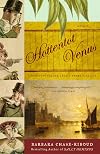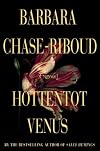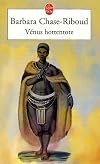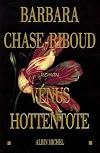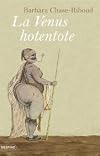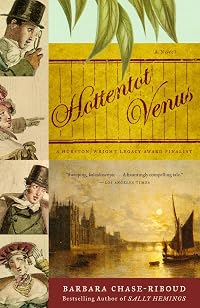
Hottentot Venus
by Barbara Chase-Riboud
On This Page
Description
It is Paris, 1815. An extraordinarily shaped South African girl known as the Hottentot Venus, dressed only in feathers and beads, swings from a crystal chandelier in the duchess of Berry's ballroom. Below her, the audience shouts insults and pornographic obscenities. Among these spectators is Napoleon's physician and the most famous naturalist in Europe, the Baron George Cuvier, whose encounter with her will inspire a theory of race that will change European science forever.Evoking the show more grand tradition of such "monster" tales as Frankenstein and The Hunchback of Notre Dame, Barbara Chase Riboud, prize-winning author of the classic Sally Hemings, again gives voice to an "invisible" of history. In this powerful saga, Sarah Baartman, for more than 200 years known only as the mysterious lady in the glass cage, comes vividly and unforgettably to life.
From the Trade Paperback edition.
. show less
Tags
Recommendations



























Member Reviews
This is a fictionalized account of the life of Sarah Baartman, the so-called Hottentot Venus. Sarah was born into the Khoekhoe people of South Africa, who were misnamed 'Hottentot' due to the sounds of their language by the Boer and English settlers.
In the Khoekhoe culture, steatopygia, or collection of fat on the buttocks of females, is highly desireable. Various techniques are used to encourage the swelling of the buttocks from the curve of the spine--12 inches or more.
Sarah was brought to Europe at about the age of 20 and was exhibited as a freak of nature, or as a sub-species between human and ape, for about 5 years, between 1810 and 1815, when she died. After her death, she was dissected. Her brain and sexual organs were removed show more and put on display, along with her skeleton and a cast made of her body. These remained on display in France until the early 1970's. In 2002, her skeleton and body parts were returned to South Africa where she is now buried.
This book vividly recreates Sarah's life, and psyche. Her pain and heartbreak are real; her conflicted emotions are well-portrayed (Sarah resisted efforts to 'rescue' her).
The only reason I am not rating the book higher is that I have problems with the author's style and manner of presentation of Sarah's story. For example, a large part of the story is told in the first person by Sarah. However, significant portions are narrated by one or the other of Sarah's 'keepers.' In those sections of the novel, the plot awkwardly requires the 'keeper' to overhear conversations between Sarah and her confidante such as 'If we try to get away now, where will we go and what will we do for money?'
Using the 'keepers' as narrators also requires them to be uncharacteristically self-aware. For example, Dunlop, her original exploiter, describes himself as not recognizing 'moral or physical limits,' as being 'blase,' 'cruel,' 'bored.'
In my view, the novel would have been better if narrated solely from Sarah's point of view.
The writer also sometimes uses language that abruptly yanked me from my immersion in the historical period and in Sarah's life, as when her keeper says to Sarah, 'You give me any more lip and I'll smash you one.' There are many other examples of clumsy writing that kept me from living totally in Sarah's world.
Because the subject matter is so important, and for the most part Sarah's character rings true, I can still recommend this book. show less
In the Khoekhoe culture, steatopygia, or collection of fat on the buttocks of females, is highly desireable. Various techniques are used to encourage the swelling of the buttocks from the curve of the spine--12 inches or more.
Sarah was brought to Europe at about the age of 20 and was exhibited as a freak of nature, or as a sub-species between human and ape, for about 5 years, between 1810 and 1815, when she died. After her death, she was dissected. Her brain and sexual organs were removed show more and put on display, along with her skeleton and a cast made of her body. These remained on display in France until the early 1970's. In 2002, her skeleton and body parts were returned to South Africa where she is now buried.
This book vividly recreates Sarah's life, and psyche. Her pain and heartbreak are real; her conflicted emotions are well-portrayed (Sarah resisted efforts to 'rescue' her).
The only reason I am not rating the book higher is that I have problems with the author's style and manner of presentation of Sarah's story. For example, a large part of the story is told in the first person by Sarah. However, significant portions are narrated by one or the other of Sarah's 'keepers.' In those sections of the novel, the plot awkwardly requires the 'keeper' to overhear conversations between Sarah and her confidante such as 'If we try to get away now, where will we go and what will we do for money?'
Using the 'keepers' as narrators also requires them to be uncharacteristically self-aware. For example, Dunlop, her original exploiter, describes himself as not recognizing 'moral or physical limits,' as being 'blase,' 'cruel,' 'bored.'
In my view, the novel would have been better if narrated solely from Sarah's point of view.
The writer also sometimes uses language that abruptly yanked me from my immersion in the historical period and in Sarah's life, as when her keeper says to Sarah, 'You give me any more lip and I'll smash you one.' There are many other examples of clumsy writing that kept me from living totally in Sarah's world.
Because the subject matter is so important, and for the most part Sarah's character rings true, I can still recommend this book. show less
Poignant, disturbing, heart-wrenching novel based upon the real life of Saartjie Baartman, an 18th century South African woman who was displayed in the London freak show circuit as the "Hottentot Venus". Beautiful writing and compelling voices lead us through Saartijie's sad life during the Boer War, Dutch colonialism, Brititsh colonialism, and London after the *official* end of legalized slavery.
Disturbing true tale of a time in history where it was perfectly acceptable to exploit a person publicly for money. Very well written, sympathetic and eye opening.
Based on the true story of Saartje Bartman, a South African woman who was brought to Europe and displayed in freak shows for the amusement of the crowds. Imaginative - the author brings Saartje's sad story to life.
First person narrative isn't my favorite, and it's just not holding me right now. I may try again later.
Ratings
Members
- Recently Added By
Author Information

21+ Works 1,083 Members
Awards and Honors
Awards
Common Knowledge
- Canonical title
- Hottentot Venus
- Original publication date
- 2003-11
- People/Characters
- Sarah Baartman; Alice Unicorn; Sieur Reaux; Hendrick Caesar; Alexander William Dunlop; Georges Leopold Chretien Frederic Dagobert Cuvier (show all 31); Aya Ma; Reverend Cecil James Freehouseland; Kx'au; Aunt Auni; !Naeheta Magahas; Mambu; Mistress Van Loott; Peter Caesar; Alya Caesar; Reverend Joshua Brooks; Caroline Camacini; William Bullock; Zachary Macauley; Robert Weddenburn; Peter Van Wageninge; Lord Ellenborough; Stephen Geelesee; Jane Austen; John Kemble; Lord Grenville; Henry Taylor; Étienne Geoffroy Saint-Hilaire; Henri de Blainville; Nicholas Tiedeman; Charles Darwin [Charles Robert: 1809-1882]
- Important places
- Cape Town, Western Cape, South Africa; London, England, UK; Paris, France; South Africa
- Epigraph
- Men can do nothing without the make-believe of a beginning. Even science, the strict measurer, is obliged to start with a make-believe unit, and must fix on a point in the stars' unceasing journey when his siderea... (show all)l clock shall pretend that time is Nought. No retrospect will take us to the true beginning; and whether our prologue be in heaven or on earth, it is but a fraction of that all presupposing fact with which our story sets out.
George Eliot
Daniel Deronda
Slave, I before reasoned with you but you have proved yourself unworthy of my condescension. Remember that I have power; you believe yourself miserable, but I can make you so wretched that the light of day will be hatef... (show all)ul to you. You are my creator, but I am your master.
Mary Shelley
Frankenstein
All the women you ever metAsk for them, every one!I am not a woman but a worldMy clothes need only fall awayFor you to discover in my personOne continuous mystery.
Gustave Flaubert
"Quidquid Volueris"
To snatch in a moment of courage, from the remorseless rush of time, passing phase of life, is only the beginning of the task. It is to show its vibration, its color, its form; and through its movement, its form, and it... (show all)s color, reveal the substance of its truth--disclose its inspiring secret; the stress and passion within the core of each convincing moment.
Joseph Conrad
Preface to The Nigger of the Narcissus
Sir,They wt to sculpt my bust. But I do not want them to. My nigger ugliness in all its lifeless immobility would pass into immortality . . .
Alexander Sergeyevich Pushkin,
Correspondence - Dedication
- To Nelson Mandela
- First words
- Great Elan, the English month of January, 1816.
- Last words
- (Click to show. Warning: May contain spoilers.)Then all was still.
- Blurbers
- Brown, Elaine; Angelou, Maya; Haley, Alex
Classifications
Statistics
- Members
- 128
- Popularity
- 256,085
- Reviews
- 6
- Rating
- (3.28)
- Languages
- English, French, Spanish
- Media
- Paper, Audiobook, Ebook
- ISBNs
- 10
- ASINs
- 2