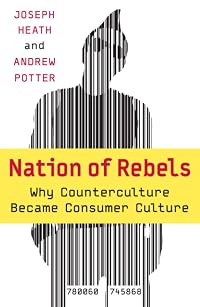
The Rebel Sell: Why the Culture Can't Be Jammed
by Joseph Heath, Andrew Potter
On This Page
Description
"In a lively blend of pop culture, history, and philosophical analysis, Heath and Potter offer a startlingly clear picture of what a concern for social justice might look like without the confusion of the counterculture obsession with being different."--Jacket.Tags
Recommendations


































Member Reviews
Unapologetic and challenging, Nation of Rebels establishes a clear causal link between consumerism and the counterculture that purports to oppose it. Some of the authors' flourishes are annoying and (occasionally) offensive, but the central argument is so brilliant and undeniable it elevates even those peripheral points I would rather deny.
The authors advocate social change through community organizing, coalitions, scientific research and legislative action. This book is not a guide, though, it is a long rambling rant against countercultural protest.
"...we argue that decades of countercultural rebellion have failed to change anything because the theory of society on which the countercultural idea rests is false...The culture cannot be jammed because there is no such thing as 'the culture' or 'the system'... countercultural rebellion is ... counterproductive... Not only does it distract energy and effort away from the sort of initiatives that lead to concrete improvements in people's lives, but it encourages wholesale contempt for such incremental changes."
The heavy show more sarcasm with which the authors presented opposing theories obscured their arguments. I think they said capitalism and a market economy are unavoidable and actually the most effective and efficient way to meet the needs of the largest number of people. I think they argued for a free market, except with subsidies for people whose situations required non-standard goods. Other than these folks (undefined, but presumably anyone needing adaptive products like wheelchairs, eyeglasses, diabetic foods, hypoallergenic products), they said everyone else ought to make do with whatever can be most cheaply mass produced. If consumerism is a problem, they argued, it is fed by people seeking distinction from the masses "...it's the non-conformists, not the conformists, who are driving consumer spending." But do they think consumerism is a problem?
The writing style too frequently devolves into the argumentative hyperbolic style of morning radio hosts, trying to provoke a reaction. (Vegetarianism conflated with bulimia as a form of obsessive neurosis, frequent comparisons with Nazism, etc.) I would recommend the introduction to this book, perhaps with a sedative of choice, but skip the rest of the book unless these ideas are entirely new to you. show less
"...we argue that decades of countercultural rebellion have failed to change anything because the theory of society on which the countercultural idea rests is false...The culture cannot be jammed because there is no such thing as 'the culture' or 'the system'... countercultural rebellion is ... counterproductive... Not only does it distract energy and effort away from the sort of initiatives that lead to concrete improvements in people's lives, but it encourages wholesale contempt for such incremental changes."
The heavy show more sarcasm with which the authors presented opposing theories obscured their arguments. I think they said capitalism and a market economy are unavoidable and actually the most effective and efficient way to meet the needs of the largest number of people. I think they argued for a free market, except with subsidies for people whose situations required non-standard goods. Other than these folks (undefined, but presumably anyone needing adaptive products like wheelchairs, eyeglasses, diabetic foods, hypoallergenic products), they said everyone else ought to make do with whatever can be most cheaply mass produced. If consumerism is a problem, they argued, it is fed by people seeking distinction from the masses "...it's the non-conformists, not the conformists, who are driving consumer spending." But do they think consumerism is a problem?
The writing style too frequently devolves into the argumentative hyperbolic style of morning radio hosts, trying to provoke a reaction. (Vegetarianism conflated with bulimia as a form of obsessive neurosis, frequent comparisons with Nazism, etc.) I would recommend the introduction to this book, perhaps with a sedative of choice, but skip the rest of the book unless these ideas are entirely new to you. show less
A critique of members of the counterculture's attempts to distinguish themselves from the mainstream, this book argues that these attempts actually feed into and reinforce capitalism's fundamental need for consumption.
Heath and Potter bring up some valid points and make interesting arguments, but I feel that they need to make it clear where they would draw the line between 'truly' ethical actions and those that are purely attempts to attain distinction from the masses.
Heath and Potter bring up some valid points and make interesting arguments, but I feel that they need to make it clear where they would draw the line between 'truly' ethical actions and those that are purely attempts to attain distinction from the masses.
This book has been monopolizing all of my time lately. Both in good ways and bad ways. I was only able to get through about a half a chapter at a time before I had to put the book down and walk away for the day in order to absorb everything I had read. I also didn’t want to get involved in another book as it might distract me from this one, because I’ve been meaning to read this book for about a year now and have only gotten around to it now. Le Sigh.
Anyway, it’s co-written by a couple of Canadian university professors, Joseph Heath and Andrew Potter, and is about countercultures – how they aren’t harming the system at all, but are a part of the system, and are actually driving consumerism in our society.
I’ve taken some show more courses at university and college that have talked about a lot of the stuff covered in the book, and I always find it very intriguing. It was good to be able to go over things that I’ve heard before in a bit more depth than I was able to in classes, and they presented some new (to me) ideas that left me thinking for a while.
What I enjoyed reading most about in this book was everything Heath and Potter had to say about advertising and media. I’m going to be graduating from college next week, and so will be starting my life as a Graphic Designer, and so I’ll most likely be doing a lot of advertising in my lifetime. They had a lot of interesting things to say, along how advertising isn’t quite as evil as people think it is, as well as how a lot of time it is not to make you change your habits but to reinforce habits that you already have. One of my favourite passages on that was this:
None of this is to say that advertising is completely harmless, that it has no effect on either our minds or our consumption habits. What we need to realize, though, is that advertising is less like brainwashing and more like seduction. Just as a skillful seduction exploits the fact that on some level you actually want to have sex, so effective advertising can work on needs and desires that you already have. You can’t seduce someone who doesn’t have an interest in sex, and you can’t sell teeth whitener to someone who is not concerned about his appearance. show less
Anyway, it’s co-written by a couple of Canadian university professors, Joseph Heath and Andrew Potter, and is about countercultures – how they aren’t harming the system at all, but are a part of the system, and are actually driving consumerism in our society.
I’ve taken some show more courses at university and college that have talked about a lot of the stuff covered in the book, and I always find it very intriguing. It was good to be able to go over things that I’ve heard before in a bit more depth than I was able to in classes, and they presented some new (to me) ideas that left me thinking for a while.
What I enjoyed reading most about in this book was everything Heath and Potter had to say about advertising and media. I’m going to be graduating from college next week, and so will be starting my life as a Graphic Designer, and so I’ll most likely be doing a lot of advertising in my lifetime. They had a lot of interesting things to say, along how advertising isn’t quite as evil as people think it is, as well as how a lot of time it is not to make you change your habits but to reinforce habits that you already have. One of my favourite passages on that was this:
None of this is to say that advertising is completely harmless, that it has no effect on either our minds or our consumption habits. What we need to realize, though, is that advertising is less like brainwashing and more like seduction. Just as a skillful seduction exploits the fact that on some level you actually want to have sex, so effective advertising can work on needs and desires that you already have. You can’t seduce someone who doesn’t have an interest in sex, and you can’t sell teeth whitener to someone who is not concerned about his appearance. show less
Valuable for its principal argument. Becomes repetitive. Sometimes seemed to miss the mark in its assessments of people's motives. Support for the status quo in rules, law and regulation without much demand that these systems be free of corruption and fair.
In many ways a good critique of so called 'counterculture'. Does a good job when it comes to explaining some of the logic behind the radical counterculture ideology. There are some weak points here and there, and especially the conclusion seems pasted on. Over all a good read though. I read it in one sitting. The language is not very complicated.
I'd recommend it to everyone. Even though it is a bit uneven, there are interesting points and it is a good starting point for discussion.
I'd recommend it to everyone. Even though it is a bit uneven, there are interesting points and it is a good starting point for discussion.
I really enjoyed this book and found it both entertaining and educational. The format is like reading a very clear research paper on consumerism, capitalism and western culture, but which has links to the everyday experience. Read it in one sitting because it was like attending a really good lecture, or watching an intriguing documentary. Felt like reading it again once I put it down, so will return to it again.
Members
- Recently Added By
Lists

culture
320 works; 1 member
Author Information

14+ Works 1,165 Members
Joseph Heath is a Professor in the Department of Philosophy as well as the Munk School of Global Affairs and Public Policy at the University of Toronto. He is the author of numerous scholarly works, including Communicative Action and Rational Choice (2001) and Following the Rules (2008). He is a Fellow of the Royal Society of Canada, as well as show more the Trudeau Foundation. show less

5+ Works 936 Members
Andrew Potter is assistant professor at the McGill Institute for the Study of Canada. Daniel Weinstock is professor in the McGill Faculty of Law, and from 2013 to 2018, he was the director of McGill's Institute for Health and Social Policy.
Awards and Honors
Notable Lists
Common Knowledge
- Canonical title
- The Rebel Sell: Why the Culture Can't Be Jammed
- Original title
- The Rebel Sell: Why the Culture Can't Be Jammed
- Alternate titles
- Nation of Rebels: Why Counterculture Became Consumer Culture
- Original publication date
- 2004-09-02
- Dedication
- For my parents -AP
For Astrid - JH - First words
- September 2003 marked a turning point in the development of Western civilisation. (Introduction)
Classifications
- Genres
- Sociology, Nonfiction, Economics, General Nonfiction, Business
- DDC/MDS
- 306.3 — Society, government, & culture Social sciences, sociology & anthropology Social Behavior - Dating, Marriage, Divorce Economic institutions
- LCC
- HC79 .C6 .H43 — Social sciences Economic history and conditions Economic history and conditions Special topics
- BISAC
Statistics
- Members
- 728
- Popularity
- 39,041
- Reviews
- 15
- Rating
- (3.77)
- Languages
- 7 — Czech, Danish, English, French, German, Polish, Spanish
- Media
- Paper, Ebook
- ISBNs
- 18
- ASINs
- 3