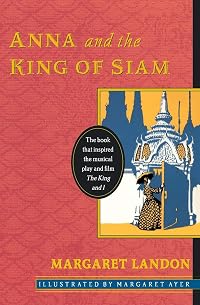
Anna and the King of Siam
by Margaret Landon
On This Page
Description
Fiction. Historical Fiction. Anna Leonowens, a proper Englishwoman, was an unlikely candidate to change the course of Siamese (Thai) history. A young widow and mother, her services were engaged in the 1860's by King Mongkut of Siam to help him communicate with foreign governments and be the tutor to his children and favored concubines. Stepping off the steamer from London, Anna found herself in an exotic land she could have only dreamed. It was a lush landscape of mystic faiths and curious show more people, and king's palace bustling with royal pageantry, ancient custom, and harems. One of her pupils, the young prince Chulalongkorn, was particularly influenced by Leonowens and her Western ideals. He learned about Abraham Lincoln and the tenets of democracy from her, and years later he would become Siam's most progressive king. He guided the country's transformation from a feudal state to a modern society, abolishing slavery and making many other radical reforms.Weaving meticulously researched facts with beautifully imagined scenes, Margret Landon recreates an unforgettable portrait of life in a forgotten exotic land. Written more than fifty years ago, and translated into dozens of languages, Anna and the King of Siam (the inspiration for the magical play and film The King and I)continues to delight and enchant readers around the world. show lessTags
Recommendations





















Member Recommendations



Member Reviews
I wanted to like this book so badly. One of my favorite musicals of all time is The King and I. I love the story, the characters, and Anna's immersion into Siamese culture, which is so vastly different from her own. I wanted desperately to learn the true story behind the story.
However, this book is nothing like the musical (which is often the case), but in a bad way.
The story dragged on and on with nothing happening. The flashbacks to Anna's early life served very little purpose. Anna's reactions to Siamese culture were overdone. Naturally, she had strong opinions and beliefs, and was offended by some of the questions, but she was quite stuck-up about a lot of things. And offended quite often. Not just by slavery or whippings, either, show more but over simple questions, such as how long she'd been married, etc.
The book just didn't resonate with me. I found Anna to be dull, dry, and irritating. show less
However, this book is nothing like the musical (which is often the case), but in a bad way.
The story dragged on and on with nothing happening. The flashbacks to Anna's early life served very little purpose. Anna's reactions to Siamese culture were overdone. Naturally, she had strong opinions and beliefs, and was offended by some of the questions, but she was quite stuck-up about a lot of things. And offended quite often. Not just by slavery or whippings, either, show more but over simple questions, such as how long she'd been married, etc.
The book just didn't resonate with me. I found Anna to be dull, dry, and irritating. show less
"She and the King were more than ...King and governess -. they were friends"
By sally tarbox on 30 November 2016
Format: Kindle Edition
The source of the musical, this biography of Anna Leonowens, governess to the Siamese royal children, was published in 1945. The author states that she worked from Anna's own memoirs; unfortunately more recent research proves that she re-invented herself significantly through these works; thus her girlhood in Wales, her first visit to Bombay aged 15, so well described in Ms Landon's work, are in fact totally fallacious - she was born in India of mixed-race parentage.
This was quite an interesting read if a little two-dimensional. Anna and her son arrive in a totally alien world: a world of wives and show more concubines shut up in a harem, where disobedience can result in torture or death. Over it all rules King Mongkut, last of the old style kings, under whom slavery is a fact of life, and where those approaching him are expected to prostrate themselves.
Anna is throughout a heroic character, able to stand up to her unpredictable and capricious King, as she intercedes for concubines who have fallen foul of him. She doesn't entirely ring true; but I was entertained and educated nonetheless as Ms Landon describes ceremonies and state affairs, amuses with reproductions of the King's distinctive letters in English and keeps us on edge with tales of prisoners awaiting their fate. And her pride in her best pupil, Prince Chulalongkorn, under whose rule later on slavery would be eradicated.
OK but in retrospect I'd probably go for a more factually correct account of Anna Leonowens' life such as 'Bombay Anna'. show less
By sally tarbox on 30 November 2016
Format: Kindle Edition
The source of the musical, this biography of Anna Leonowens, governess to the Siamese royal children, was published in 1945. The author states that she worked from Anna's own memoirs; unfortunately more recent research proves that she re-invented herself significantly through these works; thus her girlhood in Wales, her first visit to Bombay aged 15, so well described in Ms Landon's work, are in fact totally fallacious - she was born in India of mixed-race parentage.
This was quite an interesting read if a little two-dimensional. Anna and her son arrive in a totally alien world: a world of wives and show more concubines shut up in a harem, where disobedience can result in torture or death. Over it all rules King Mongkut, last of the old style kings, under whom slavery is a fact of life, and where those approaching him are expected to prostrate themselves.
Anna is throughout a heroic character, able to stand up to her unpredictable and capricious King, as she intercedes for concubines who have fallen foul of him. She doesn't entirely ring true; but I was entertained and educated nonetheless as Ms Landon describes ceremonies and state affairs, amuses with reproductions of the King's distinctive letters in English and keeps us on edge with tales of prisoners awaiting their fate. And her pride in her best pupil, Prince Chulalongkorn, under whose rule later on slavery would be eradicated.
OK but in retrospect I'd probably go for a more factually correct account of Anna Leonowens' life such as 'Bombay Anna'. show less
Although Landon based her book on autobiographies by Anna Leonowens buttressed by research, she has fictionalized a great deal of dialogue and events.
Further, the musical play & derivative films changed and even invented several key episodes, notably the court production of "The Little House of Uncle Tom" (although one of the ladies did become attached to Stowe's book and added the American's name to her own); and the suggested romance between the King and Anna (although he early on offered to add her to his harem, she declined, and their relationship was a prickly one of alternating respect and anger). Also, Anna had left Siam before the King died, so there was no poignant deathbed scene.
However, Anna's stated goal to influence Prince show more Chulalonghorn as the primary justification for her suffering (interspersed as it was with happier occasions) seems to have been validated by his actions as King.
Landon's final chapter, which is really an historical afterward, asserts that "The English Lady" was still remembered after many years, possibly up to the time of her writing; it would be interesting to see if that still holds true, now that most or all of the Thai principals are deceased.
Mem Anna's "viewpoint" is definitely influenced by the author's early 20th century sensibilities, and she is working from a source that is already having trouble interpreting Siamese culture and psychology.
However, the anecdotes in themselves are interesting as at least a taste of what Mrs. Leonowen's was experiencing.
She has the usual blinders, seeing Thai customs as exotic and barbaric (they were), but blithely sailing past many deplorable European actions and habits (she does mention the particularly vile Frenchmen, but fails to connect their behavior to "vile" Siamese).
Landon has some curious authorial quirks that were irritating, especially her failure to provide timely information. For example, Anna is said to have two children, then she disembarks at Bangkok with only one of them; that the daughter is sailing for England for school is only mentioned many pages later.
Similarly, Anna's faithful maid Beebe is mentioned in almost every chapter, sometimes in a major way, until the end of the book, when she unaccountably disappears completely, without the reader being told when she left or where she went.
As is common in almost every book I have read, with a very few exceptions, many of the places named are not on the maps, which include locations never mentioned in the book.
(reading dates include 3 week hiatus during vacation) show less
Further, the musical play & derivative films changed and even invented several key episodes, notably the court production of "The Little House of Uncle Tom" (although one of the ladies did become attached to Stowe's book and added the American's name to her own); and the suggested romance between the King and Anna (although he early on offered to add her to his harem, she declined, and their relationship was a prickly one of alternating respect and anger). Also, Anna had left Siam before the King died, so there was no poignant deathbed scene.
However, Anna's stated goal to influence Prince show more Chulalonghorn as the primary justification for her suffering (interspersed as it was with happier occasions) seems to have been validated by his actions as King.
Landon's final chapter, which is really an historical afterward, asserts that "The English Lady" was still remembered after many years, possibly up to the time of her writing; it would be interesting to see if that still holds true, now that most or all of the Thai principals are deceased.
Mem Anna's "viewpoint" is definitely influenced by the author's early 20th century sensibilities, and she is working from a source that is already having trouble interpreting Siamese culture and psychology.
However, the anecdotes in themselves are interesting as at least a taste of what Mrs. Leonowen's was experiencing.
She has the usual blinders, seeing Thai customs as exotic and barbaric (they were), but blithely sailing past many deplorable European actions and habits (she does mention the particularly vile Frenchmen, but fails to connect their behavior to "vile" Siamese).
Landon has some curious authorial quirks that were irritating, especially her failure to provide timely information. For example, Anna is said to have two children, then she disembarks at Bangkok with only one of them; that the daughter is sailing for England for school is only mentioned many pages later.
Similarly, Anna's faithful maid Beebe is mentioned in almost every chapter, sometimes in a major way, until the end of the book, when she unaccountably disappears completely, without the reader being told when she left or where she went.
As is common in almost every book I have read, with a very few exceptions, many of the places named are not on the maps, which include locations never mentioned in the book.
(reading dates include 3 week hiatus during vacation) show less
A biographical retelling (with fictional bits to fill in the holes) of Anna Leonowens life. A daughter of a British military man, and spending part of her childhood in India, Anna was acquainted with many customs that may have been deemed exotic to the Western world. After school in England, and reuniting with her mother in India, who had remarried after the death of Anna's father, Anna bucked the controlling step-father and married another British military man whom her step-father felt was beneath her position. Having a few children, (2 died in infancy), and suffering further tragedy with the loss of her mother and then husband, she was hard pressed to provide for her children. Anna decided to open a school for military children out of show more necessity for income, but her success as an educator soon reached the ears of King Mongkut, king of Siam. He corresponded with her to try to secure her to teach his 82 royal children as well as some of his favored harem. Against the advice of her closest friends, she agreed, taking her young son Louis with her, and having to part with her daughter Avis that had to leave to begin her education in England. Upon arriving in Siam, she was hit with tons of culture shock, and the harsh realities of life there, not only for the poor, but women of any class, and the institution of slavery that was very much a part of life. The longer she was there, the more she saw the injustices on many levels, and she felt it was her mission, or "calling" you might say, appointed by God to make a difference for the future of these people through the education of the royal young. The story draws on not only her diaries and journals, but letters from her children, from her to others, from the King to other dignitaries, and even official royal decrees. The down-trodden and even women of the harem would often come to her for help in some injustice because of her close proximity to the king and access to his ear, along with her unwillingness to back down. She had much success and the king was often angry with her, but her drive to make a difference did not go unnoticed-- even years later, when her grandson visited the country and wanted to see where she had lived, all gladly showed him the home of "the white angel". Her efforts did make a tremendous impact too, even though at the time she felt as if no progress was being made, when one of her students, Prince Chulalongkorn, became king. Because of the impact of her teaching on him, he himself said that he desired to abolish slavery in Siam, do away with the custom of prostration and human worship, building schools and hospitals throughout the country..... and much more, so that the Thai consider him their greatest king. I loved this book, and another example of how one person can make a powerful difference. show less
This wonderful little book is a reissued classic first published in 1944, which tells a story made famous by the Rogers & Hammerstein musical The King and I. Having neither heard nor seen that musical, I had no real idea of what to expect from this novel. My vague notions that I’d picked up here and there turned out to be completely mistaken and perhaps the result of confusing The King and I with The Sound of Music (musical governesses, you see). This book is not a love story at all, but something far more interesting: the tale of a confrontation between two worlds, two belief systems and two indomitable personalities. Based on Anna Leonowens’s own letters and other documents, it lures the reader into the exotic world of show more mid-19th-century Siam...
For the rest of the review please see my blog:
https://theidlewoman.net/2016/09/06/anna-and-the-king-of-siam-margaret-landon/ show less
For the rest of the review please see my blog:
https://theidlewoman.net/2016/09/06/anna-and-the-king-of-siam-margaret-landon/ show less
My review is for the abridged version of this book:
I've never seen the musical The King and I in its entirety, but I'm fairly familiar with the story. However, the musical and the book upon which it is supposed based are worlds apart.
Anna is a widow, with two young children, and the opportunity to support herself by teaching the children of the king of Siam. She endeavors to not only instruct the youngsters in the English language and customs as requested by the king, but also tries to instill the concepts of mercy, justice, and freedom for all in those who will someday rule Siam.
This story is based upon the writings of the real Anna, who went to Siam in the 1860s, and faced a society where slavery was accepted, where bribery was the show more norm, and where the whim of an angry ruler could condemn an innocent person with no recourse, and no repercussions. I was fascinated with the insight into Siam of almost two centuries ago, and found myself deep within the story for most of the book. Recommended.
Note: the edition I read was listed as abridged, but perhaps edited would be a better description. show less
I've never seen the musical The King and I in its entirety, but I'm fairly familiar with the story. However, the musical and the book upon which it is supposed based are worlds apart.
Anna is a widow, with two young children, and the opportunity to support herself by teaching the children of the king of Siam. She endeavors to not only instruct the youngsters in the English language and customs as requested by the king, but also tries to instill the concepts of mercy, justice, and freedom for all in those who will someday rule Siam.
This story is based upon the writings of the real Anna, who went to Siam in the 1860s, and faced a society where slavery was accepted, where bribery was the show more norm, and where the whim of an angry ruler could condemn an innocent person with no recourse, and no repercussions. I was fascinated with the insight into Siam of almost two centuries ago, and found myself deep within the story for most of the book. Recommended.
Note: the edition I read was listed as abridged, but perhaps edited would be a better description. show less
I LOVED this story. I thought it was really well written, the author clearly cared a lot about the character.
I wanted to read the novel because I watched the movie and read how many inaccuracies there were. I especially loved the introduction where the author explained how she managed to write this story. As far as the biographies go, I think this book is one of the best ones I've read, even though it's heavily influenced by Anna's own memoirs and, as such, probably not that much historically accurate.
Of course, in 21st century it's really hard to read novel like this one and not be thinking about "white savior complex". It is a story about an Englishwoman in Siam after all. BUT, I loved Siam, I love how it is written, I loved the king show more and his wives and, obviously, I loved Anna. This is kind of story I would love for children to read because it teaches them compassion and how important is to understand other cultures before judging them.
_
I found this book on NetGalley and I offer my honest review. Thanks for sharing, I enjoyed it. show less
I wanted to read the novel because I watched the movie and read how many inaccuracies there were. I especially loved the introduction where the author explained how she managed to write this story. As far as the biographies go, I think this book is one of the best ones I've read, even though it's heavily influenced by Anna's own memoirs and, as such, probably not that much historically accurate.
Of course, in 21st century it's really hard to read novel like this one and not be thinking about "white savior complex". It is a story about an Englishwoman in Siam after all. BUT, I loved Siam, I love how it is written, I loved the king show more and his wives and, obviously, I loved Anna. This is kind of story I would love for children to read because it teaches them compassion and how important is to understand other cultures before judging them.
_
I found this book on NetGalley and I offer my honest review. Thanks for sharing, I enjoyed it. show less
Members
- Recently Added By
Lists

Read the book and saw the movie
1,170 works; 195 members

Sonlight Books
1,487 works; 25 members

CCE 1000 Good Books List
1,033 works; 12 members

Global Reads: Books Set in East Asia
139 works; 12 members

Publisher's Weekly NON-Fiction list - 1912 - 1975
486 works; 4 members
Author Information

12+ Works 1,501 Members
Margaret Landon (1903-1993) lived in the Kingdom of Siam (now Thailand) for ten years. Fluent in Thai, she extensively researched the story of Anna Leonowens and the history of the Siamese government and culture.
Awards and Honors
Distinctions
Series
Belongs to Publisher Series
Work Relationships
Has the adaptation
Is abridged in
Was inspired by
Inspired
Common Knowledge
- Canonical title
- Anna and the King of Siam
- Original publication date
- 1943
- People/Characters
- Anna Leonowens; King Mongkut
- Important places
- Bangkok, Thailand; Thailand
- Important events
- 19th century
- Related movies
- Anna and the King of Siam (1946 | IMDb); The King and I (1956 | IMDb); Anna and the King (1999 | IMDb)
- Dedication
- To the memory of my sister Evangeline Mortenson Welsh
Her spirit burned away the flesh
Until its calm and lovely light
Became a beacon on the way
Where pilgrims warmed their hearts at night. - First words
- The Siamese steamer Chow Phya, most modern of the ships plying between Singapore and Bangkok, came to anchor outside the bar at the mouth of the River Chow Phya.
- Last words
- (Click to show. Warning: May contain spoilers.)Anna looked into the future of the country where she had spent the most difficult years of her life and was content.
- Disambiguation notice
- Anna and the King of Siam is also published in an abridged version with illustrations, and a juvenile work Anna and the King.
Classifications
Statistics
- Members
- 1,102
- Popularity
- 23,104
- Reviews
- 24
- Rating
- (3.54)
- Languages
- 5 — Dutch, English, German, Italian, Spanish
- Media
- Paper, Audiobook, Ebook
- ISBNs
- 28
- ASINs
- 39