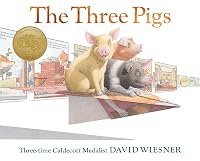
The Three Pigs
by David Wiesner
On This Page
Description
The three pigs escape the wolf by going into another world where they meet the cat and the fiddle, the cow that jumped over the moon, and a dragon.Tags
Recommendations



Member Recommendations
by cmbohn
Member Reviews
I love how this story book gives us a refreshing take on a classic story. Any kind of of book, movie, etc that breaks the 4th wall has a special place in my heart. I love how to solve their problems the pigs just... leave the story. They walk around and make a bunch of new friends. The illustration is absolutely amazing, it changes from scene to scene as they are switching stories. Such a fun and cute way to introduce children to different/more modern versions of classic stories. Hard recommend.
I love the Caldecott and Newbery awards - they generally steer me in the direction of quality books ... just like The Three Pigs. The story deconstructs the original fable in a delightfully fun story. It begins as always: the three pigs build three houses, and the Big Bad Wolf comes along to huff, and puff, and blow the house down. This time, though, the wolf puffs the pig right out of his story. Shocked at his unexpected salvation, the pig follows along with his story and arrives just in time to rescue his brother from the wolf. The two pigs track down their final sibling, and decide to stroll around and peek in other books, which are all represented by corridors of illustrated pages that belong to different stories. They pop in to the show more Hey Fiddle Fiddle rhyme, and the curious cat follows them out, and then the whole gang scoots over to a fairy tale - fortunately for the dragon, who is spared the knight's sword. Now that their party is enlarged by a huge toothsome beast that breathes fire, they deem it safe to return to their comfortable house (the last one standing) and the big bad wolf decides that a dragon is a bit much to chew.
That may be the whole story in a nutshell, but it does not convey the spirit of the book. Wiesner is known for his lavish illustrations, and his skill in this book shines. The story starts out in pictures that resemble old picture books of fairy tales. Once the pig is blown out, though, the art is apparently rendered via computer graphics - it has that densely realistic texture to it. When they visit the nursery rhyme, all the characters, pigs included, take on the look of a pastel painting appropriate for the cow jumping over the moon. And when the join the dragon's story, all turn to black-and-white. I love the use of illustration here! It's not just the colors that change, it's the whole style of illustration, the medium used, that changes for each story. I wish I were an artist to have the terminology to explain it. The effect is incredible.
Also, the way Wiesner plays with the fourth wall is a lot of fun. This idea that storybook characters can exit their story. Where is that blank white area that they find? What is this intriguing corridor of stories. At one point, a pig is illustrated looking straight at the reader and remarks that he thinks someone is out there. That's great. The book presents the dynamic relationship between reader and story in a visually compelling format, and is a fun story, besides. Deserving of the award, and multiple reads. show less
That may be the whole story in a nutshell, but it does not convey the spirit of the book. Wiesner is known for his lavish illustrations, and his skill in this book shines. The story starts out in pictures that resemble old picture books of fairy tales. Once the pig is blown out, though, the art is apparently rendered via computer graphics - it has that densely realistic texture to it. When they visit the nursery rhyme, all the characters, pigs included, take on the look of a pastel painting appropriate for the cow jumping over the moon. And when the join the dragon's story, all turn to black-and-white. I love the use of illustration here! It's not just the colors that change, it's the whole style of illustration, the medium used, that changes for each story. I wish I were an artist to have the terminology to explain it. The effect is incredible.
Also, the way Wiesner plays with the fourth wall is a lot of fun. This idea that storybook characters can exit their story. Where is that blank white area that they find? What is this intriguing corridor of stories. At one point, a pig is illustrated looking straight at the reader and remarks that he thinks someone is out there. That's great. The book presents the dynamic relationship between reader and story in a visually compelling format, and is a fun story, besides. Deserving of the award, and multiple reads. show less
Weisner creates another bizarre & wonderful story that takes you someplace unexpected. The pigs discover they can avoid the wolf by leaving the pages of the book. Together they discover other picture books, like "Hey, Diddle Diddle" and a story about a knight come to slay a dragon. After adding the cat & the fiddle and the dragon join the 3 pigs, they all go back to the 3rd pig's house, evade the wolf in a new way & settle down together, leaving a puzzled wolf on the hillside out the window. This would be a fun book to use with older students before a retold tale writing assignment or to explore the idea of a book within a book. The artwork is amazing & shows a difference visually between the characters inside the images & outside the show more book. How do authors manipulate text in similar ways? show less
This postmodern retelling of The Three Pigs follows the titular characters as they escape the confines of their traditional setting and explore the wider world of children's literature. They interact with panels from other books and pass in and out of other stories, sometimes taking characters with them. They eventually settle on removing the brick house scene from the overall narrative and moving into it, along with some nursery rhyme characters and a giant dragon. One of the pigs can even interact with the letters on the page, and he gathers them up and writes them all a happy ending. I think this book will ask most kids to do a lot of thinking and interpreting, as there really isn't a lot of traditional story written in the book. The show more illustrations portray the characters' actions rewriting the plot as the story goes, so there is a fun sense of discovery as you wait to see what happens next to very familiar characters in an entirely unfamiliar setting. show less
Through the exceptional use of different painting styles and typefaces, Wiesner is able to make metafiction easily accessible and engaging to young readers. When Wiesner’s three pigs begin to question the narrative they are a part of, they are literally transformed by this reflective act, poking their more realistic and three-dimensional piggy heads out of the flat storybook world they used to inhabit. His concept, a metafiction version of a classic and moralistic folktale, is incredibly novel and works to further the theme of questioning the path one is expected to take in life and instead making one’s life one’s own through meaningful experiences and connections with others.
This picture book is unlike any other story I have ever read. At first, you think this will be your typical variation of the classic Three Little Pigs story. But suddenly, the pigs are breaking the fourth wall and are speaking to the reader directly; in fact, the pigs don't get eaten at all. David Wiesner took some pretty big risk with this story, but they paid off because he was awarded the Caldecott Award in 2002. Before reading this to students, I would need to assess if they are aware of the original versions of the stories or they will be completely lost; otherwise, this book is very clever and an extraordinary read.
At first, you start reading and the pictures seem like every other telling of The Three Little Pigs that you've read since you were in pre-school. But then, Wiesner whips out his magic brush and you really see his talents at work. He watercolors his way to an entirely new Three Little Pigs. The wolf starts to huff and puff, and he blows the first pig right out of the story. The pig starts to wander into the other pages, joining the 2nd pig, and then both of them join the third pig. They wander into other stories--at this point, the pages of the stories are smaller than the actual pages of the real book you hold in your hands. The pigs and the friends that the accumulate from other stories and nursery rhymes wander around looking at all show more these pages from a bunch of stories, and then they see the 3rd pig's brick house in one of the pages, so they decide to head back, all of them, including a dragon, the cat, fiddle, and spoon from Hey Diddle Diddle. When the wolf comes a' calling, he's in for a surprise, for sure. More classic, imaginative Wiesner--his stories always have that extra touch of whimsy. I enjoyed the way that he seemed to be saying that there's this kind of connection between stories, and that the victims in fairy tales might just be innocent victims, instead of creatures deserving their violent ends--no more dragon-slaying here. The animals here seemed to almost be forming a union for the protection of fairy-tale and nursery rhyme figures against gratuitous violence. Recommended for all collections! show less
Members
- Recently Added By
Published Reviews
ThingScore 75
The book will intrigue, delight, and puzzle children. (Where did the pig go? What is he standing on? How did the wolf really eat the pig if he goes away? Why does it say so?). Wiesner’s tale turns back on itself to reveal its form, and to show that a story can be protean, metamorphic, and infinitely malleable. We have to co-construct it... But has something been lost? Fear, after all, has show more been drained completely away. show less
added by Shortride
Lists

Caldecott Medal Books
91 works; 15 members

Honey For a Child's Heart
1,152 works; 25 members

Baby's First Postmodernism
52 works; 8 members

Picture books about books
110 works; 6 members

Books Read in 2023
5,547 works; 145 members
Author Information

20+ Works 19,628 Members
American children's book author and illustrator David Wiesner was born in Bridgewater, New Jersey on February 5, 1956. He graduated with a BFA in Illustration from Rhode Island School of Design. Known for his imaginative work, Wiesner is particularly celebrated for using wordless storytelling in his picture books. His latest picture book is about show more two artists; it is entitled, Art & Max. "Sector 7" and "Free Fall" are Caldecott Honor Books, while Wiesner won the prestigious Caldecott Medal for "Tuesday" (1992), "The Three Pigs" (2002), and "Flotsam" (2007). Wiesner is only the second person to have won this award three times. (Bowker Author Biography) show less
Awards and Honors
Awards
Distinctions
Notable Lists
Common Knowledge
- Original publication date
- 2001
- People/Characters
- Three pigs; Wolf; Dragon
- First words
- Once upon a time there were three pigs who went out into the world to seek their fortune.
- Quotations
- The king was determined to own this treasure. So he sent his eldest son to slay the dragon and bring back the golden rose.
Many thanks for rescuing me, O brave and noble swine. - Last words
- (Click to show. Warning: May contain spoilers.)And they all lived happily ever after.
- Publisher's editor
- Stevenson, Dinah
- Original language
- English
Classifications
Statistics
- Members
- 2,586
- Popularity
- 7,327
- Reviews
- 264
- Rating
- (4.22)
- Languages
- 7 — Catalan, Chinese, English, French, German, Italian, Spanish
- Media
- Paper, Ebook
- ISBNs
- 21
- UPCs
- 2
- ASINs
- 5