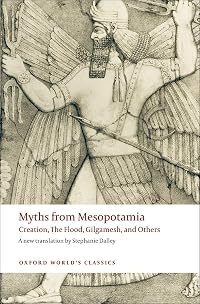
Myths from Mesopotamia : creation, the flood, Gilgamesh, and others
by Stephanie Dalley (Translator)
On This Page
Description
"Between the great rivers Tigris and Euphrates lies the rich alluvial land of Mesopotamia (now in modern Iraq), which supported a complex and prosperous society over 4,000 years ago." "The stories translated here are all of ancient Mesopotamia, and include not only myths about the Creation and stories of the Flood, but also the longest and greatest literary composition, the Epic of Gilgamesh. This is the story of a heroic quest for fame and immortality, pursued by a man of great strength who show more loses a unique opportunity through a moment's weakness." "So much has been discovered in recent years both by way of new tablets and points of grammar and lexicography that these new translations by Stephanie Dalley supersede all previous versions."--Jacket. show lessTags
Recommendations

Member Reviews
It's a middle of the road text, better than most, but far from complete. I'm not just talking about the missing fragments, either, although that's understandable. We've got ranges of over a thousand years of text printed in this volume, ignoring some older texts, like Inanna's descent being ignored in favor of Ishtar's more elaborate, but nonetheless curtailed, descriptions. The tale of Gilgamesh is almost always a required reading, of course, and the genesis story is very interesting, but we're still missing whole texts of Dumuzi or Tammuz which were nonetheless much more important to the people of the times than was even brought up here in this text. At best, I can say that this work is merely a short sampling of three whole show more civilization's written legends. I suppose I'm going to have to keep looking for a single source that collects and breaks down the altered generations of tales, perhaps even dovetailing their metamorphosis into early Greek and Zoroastrian. It would be much too much to ask to see how Inanna became Aphrodite and Isis, or how they became Mary mother of Jesus. I despair to see how Dumuzi the shepherd became the heart of rebirth and how his idea became Jesus. It's just too much of a concept to touch upon this early in our day and age. Quite a shame.
Then again, such concepts were probably too volatile for a mainstream edition and an editor thought it would be best to leave such works undisturbed for fear of shocking the plebs. Of course, nowadays, such a fearless edition would probably be heralded as innovative and bright, but I'm still looking. Perhaps I'd write one if I actually knew how to read the original text. Alas. I'm stuck here. show less
Then again, such concepts were probably too volatile for a mainstream edition and an editor thought it would be best to leave such works undisturbed for fear of shocking the plebs. Of course, nowadays, such a fearless edition would probably be heralded as innovative and bright, but I'm still looking. Perhaps I'd write one if I actually knew how to read the original text. Alas. I'm stuck here. show less
Is this thing difficult? Yes. Is it fragmen[tary? Yes]. But is it rewarding? If you can get on its wavelength and find the rhythm of the poetry, then it's incredibly rewarding. But this isn't entry-level mythology by any means, or even intermediate. This is advanced, if only because the texts are so fragmentary. But the poems here reward patience.
This book has been on my shelf for years waiting patiently for me to be ready to read it. What amazed me is I enjoyed reading this; I was expecting a dry difficult read with poems that I would not be able to connect to, and though it was tough trying keep up with all the characters and what was going on, the most thrilling part is to read something so very old.
I just picked this up to get unembelished accounts of Gilgamesh and Inanan's decent. Had a flip through the other myths, but ultimately I don't have a high enough interest to persevere with them.
This is an invaluable text for those looking for what's on the tablets and nothing else, but for the same reason may be rather tedious for the the casual reader.
This is an invaluable text for those looking for what's on the tablets and nothing else, but for the same reason may be rather tedious for the the casual reader.
A very scholarly edition, however I found the fragmentary nature of the texts very hard to deal with. This is, of course, not the fault of the author but a failing in the archaeological record. Nonetheless, I found it difficult to get a proper handle on the stories and their implications.
Atrahasis, the wise man who built an ark and saved mankind from destruction by a Flood, becoming a quasi-immortal progenitor. His story is delicately (speaking of cannibalism [27a] and slavery [26b]) compiled by Enheduana, daughter of Sargon, 2390-2335 BC, and holder of the most prestigious temple office at Ur, the author of the Temple Hymns [3].
Gilgamesh. Standard and Old Babylonian Version.
Nergal and Ereshkigal, two very different versions. Judge of the Underworld, and consort "Queen of the Great Earth", sister of Istar. In the earlier version, Nergal seizes the throne of the Underworld by force from the Queen. No Sumerian version is known. I like the part where Nergal enters the house, past the curious doors, seals Ereshkigal off, show more and then seizes her by the hair. But she cries out to him "Don't kill me! let me tell you something." And he listens, and weeps. Then she says, "come, you can be my husband, I will put the Tablet of Wisdom in your hand." Then she weeps. He kisses her and wipes away her tears [180]. Oh my brother, my sister, by this time we are all in tears.
Adapa. The first of the antediluvian sages, sent by Ea to bring civilization to mankind. See? Man's folly is reduced to a simple misunderstanding over table manners. Of course Ea then punishes Adapa, tricking him out of immortality.
Etana. A Quasi-historical king of Kush. We are still piecing this together, but the motif of a man's ascent to heaven on an eagle's back has entered Iranian and Islamic legend. Great curse sample: "May the prowling weapon make straight for him".
Anzu, the lion-headed eagle. Two versions, again very different. (!) The hero is Ninurta, whose title is "Bel", "The Lord", equivalent to Biblical Semitic "Ba'al". The epic of cosmic warfare among powerful gods centers around possession of the Tablet of Destinies, with which Anzu has flown off to inaccessible mountains. After a preface, "Pay attention to reliable words!" Deliverance for the despondent Igigi [210], the assembled gods, begins after Ea, the Lord of Intelligence, suggests to the sister of all Gods, Belet-ili, that she offer Ninurta, her powerful son, to capture the soaring Anzu. When this sister says "Yes", "The gods of the land were glad at her utterance" [211]. She instructs her son in a battle plan to conquer Anzu, "and the warrior listened to his mother's words" [212]. Colophon is missing.
Epic of Creation. So named, but a different sort than Gilgamesh. Here, no struggle against fate, no heroes. Marduk overcomes the forces of evil -- with no suspense built up. Mankind created to serve the gods, the males of whom elect their leaders. Goddesses play no part in creating the civilized world [228], and waters are the primeval forces. Mankind's king, surrounded by priests performing the proper rites, receives his mandate from the gods. The subjects kiss the feet of the King. Loyal support is absolute and brooks no rivalry. Only utter chaos is the alternative. Reeks of propaganda but probably not stultifying to the peerage.
Theogony of Dunnu. This was probably a town of importance, and clearly had its own local tradition about "creation". Here the primeval forces are the Plough and Earth, as the parents of the Sea. Clearly Mesopotamians did not have a single specific tradition for creation. Recurrent themes of incest, and murder of parents, contrast with the dignified courtesies in the Creation Epic.
Erra and Ishum. 8th Century BC, the poet speaks in the first person, of his theme. The poetry is filled with blood-lust and war glorification.
The translator reminds us that "all the great temples would have had their own libraries" [xviiia]. show less
Gilgamesh. Standard and Old Babylonian Version.
Nergal and Ereshkigal, two very different versions. Judge of the Underworld, and consort "Queen of the Great Earth", sister of Istar. In the earlier version, Nergal seizes the throne of the Underworld by force from the Queen. No Sumerian version is known. I like the part where Nergal enters the house, past the curious doors, seals Ereshkigal off, show more and then seizes her by the hair. But she cries out to him "Don't kill me! let me tell you something." And he listens, and weeps. Then she says, "come, you can be my husband, I will put the Tablet of Wisdom in your hand." Then she weeps. He kisses her and wipes away her tears [180]. Oh my brother, my sister, by this time we are all in tears.
Adapa. The first of the antediluvian sages, sent by Ea to bring civilization to mankind. See? Man's folly is reduced to a simple misunderstanding over table manners. Of course Ea then punishes Adapa, tricking him out of immortality.
Etana. A Quasi-historical king of Kush. We are still piecing this together, but the motif of a man's ascent to heaven on an eagle's back has entered Iranian and Islamic legend. Great curse sample: "May the prowling weapon make straight for him".
Anzu, the lion-headed eagle. Two versions, again very different. (!) The hero is Ninurta, whose title is "Bel", "The Lord", equivalent to Biblical Semitic "Ba'al". The epic of cosmic warfare among powerful gods centers around possession of the Tablet of Destinies, with which Anzu has flown off to inaccessible mountains. After a preface, "Pay attention to reliable words!" Deliverance for the despondent Igigi [210], the assembled gods, begins after Ea, the Lord of Intelligence, suggests to the sister of all Gods, Belet-ili, that she offer Ninurta, her powerful son, to capture the soaring Anzu. When this sister says "Yes", "The gods of the land were glad at her utterance" [211]. She instructs her son in a battle plan to conquer Anzu, "and the warrior listened to his mother's words" [212]. Colophon is missing.
Epic of Creation. So named, but a different sort than Gilgamesh. Here, no struggle against fate, no heroes. Marduk overcomes the forces of evil -- with no suspense built up. Mankind created to serve the gods, the males of whom elect their leaders. Goddesses play no part in creating the civilized world [228], and waters are the primeval forces. Mankind's king, surrounded by priests performing the proper rites, receives his mandate from the gods. The subjects kiss the feet of the King. Loyal support is absolute and brooks no rivalry. Only utter chaos is the alternative. Reeks of propaganda but probably not stultifying to the peerage.
Theogony of Dunnu. This was probably a town of importance, and clearly had its own local tradition about "creation". Here the primeval forces are the Plough and Earth, as the parents of the Sea. Clearly Mesopotamians did not have a single specific tradition for creation. Recurrent themes of incest, and murder of parents, contrast with the dignified courtesies in the Creation Epic.
Erra and Ishum. 8th Century BC, the poet speaks in the first person, of his theme. The poetry is filled with blood-lust and war glorification.
The translator reminds us that "all the great temples would have had their own libraries" [xviiia]. show less
Ratings
Members
- Recently Added By
Lists

World Literature (pre-contemporary; no living authors)
6 works; 1 member

Top Five Books of 2018
802 works; 265 members


Books in the Bibliography of The Dawn of Everything by Graeber & Wengrow
478 works; 2 members

Books in the Bibliography of The History of Hell by Alice K. Turner
155 works; 1 member
Author Information

Stephanie Dalley is an Honorary Senior Research Fellow of Somerville College at the University of Oxford.
Series
Belongs to Publisher Series
Common Knowledge
- Canonical title
- Myths from Mesopotamia : creation, the flood, Gilgamesh, and others
- Original title
- Myths from Mesopotamia: Creation, the Flood, Gilgamesh, and Others
- Alternate titles
- Myths From Mesopotamia
- Original publication date
- 1700 BC
- People/Characters
- Gilgamesh
- First words
- These stories all concern the deities and people of Mesopotamia, a rich, alluvial country which lies between the great rivers Tigris and Euphrates in modern Iraq.
- Last words
- (Click to show. Warning: May contain spoilers.)Whoever erases my written name and writes his
own name,
May Nabu, the scribe of all, erase his name. - Original language
- Akkadian
- Canonical LCC
- BL1620 .M98 2000
Classifications
- Genres
- Nonfiction, Religion & Spirituality
- DDC/MDS
- 299.21 — Religion Other religions Shintoism/Taoism/Other Mythologies Sumer, Assyria, Mesopotamia Mesopotamian (Sumer, Babylonian, Assyrian)
- LCC
- BL1620 .M98 — Philosophy, Psychology and Religion Religions. Mythology. Rationalism Religions. Mythology. Rationalism History and principles of religions Asian. Oriental By religion Semitic religions Assyro-Babylonian
- BISAC
Statistics
- Members
- 1,618
- Popularity
- 13,942
- Reviews
- 6
- Rating
- (3.84)
- Languages
- English, German
- Media
- Paper, Ebook
- ISBNs
- 6
- UPCs
- 1
- ASINs
- 2