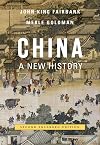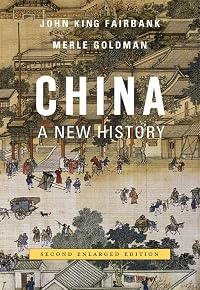
China: A New History
by John King Fairbank
On This Page
Description
Public discussion of our China policy in recent months has emphasized the need for a historical view of the ancient "Middle Kingdom" (the Chinese name for China) and its modern revolution. Fairbank has been a leading witness before Congressional groups such as Senator Fulbright's Committee on Foreign Relations, where his testimony received worldwide attention. This volume presents the major themes of his testimony more fully by bringing together essays first published in various national show more journals, mainly in 1966. The three parts of this book--"China's Revolution in the Light of Her Past," "The Taiwan Problem," and "Communist China and American Policy"--all bring a knowledge of China's long tradition to bear upon her present crisis. China's past still provides the main repertory of themes and styles, assumptions and methods, upon which her leaders draw in trying to meet their problems. Mao and his party are both circumscribed and inspired by the history of their Middle Kingdom. Although this history is by no means the sole determinant of their actions, it is the specific factor least well known, and therefore most illuminating, to Americans. The importance and timeliness of these essays, the urgency of their subject matter, are plain enough. As Fairbank says, "We have to face the fact that the Chinese quarter of mankind live on the other side of a cultural gap, and our effort to bridge this gap in the next decade may make us or break us." show lessTags
Recommendations









Member Recommendations
by anonymous user
Member Reviews
This splendid general history of China is an authoritative guide through millennia, yet it also includes a great amount of material on recent Chinese history, especially in the chapters added by Merle Goldman. The late professor Fairbank is our guide most of the way, and his easy style makes for delightful reading.
The book addresses a number of continuing themes, such as the contrast between state and family, between urban and rural, between ruling elite and the masses. It devotes considerable time to the development and evolution of Confucian thought and the way that philosophical system influenced the government and culture of China. Fairbank also spends some time tracing the development of Mao thought. In addition, the author eases show more the way for the Westerner by comparing developments in China with similar developments in European history.
Two very useful features in this book: 1.) every so often Fairbank will pause to survey areas that should receive further scholarly research; 2.) an extensive guide to further reading for any subject that the reader might find of interest. All in all, this book is a wonderful narrative history and a worthy introduction to an important topic. show less
The book addresses a number of continuing themes, such as the contrast between state and family, between urban and rural, between ruling elite and the masses. It devotes considerable time to the development and evolution of Confucian thought and the way that philosophical system influenced the government and culture of China. Fairbank also spends some time tracing the development of Mao thought. In addition, the author eases show more the way for the Westerner by comparing developments in China with similar developments in European history.
Two very useful features in this book: 1.) every so often Fairbank will pause to survey areas that should receive further scholarly research; 2.) an extensive guide to further reading for any subject that the reader might find of interest. All in all, this book is a wonderful narrative history and a worthy introduction to an important topic. show less
Only Ancient Egypt and India rival the length and development of the four millennia long development of Chinese civilization, one that for centuries was more advanced than other locations on the Eurasian landmass until suddenly it wasn’t and challenged. China: A New History is the last work by noted historian John King Fairbanks with addition from Merle Goldman covering the post-Mao years to the beginning of the 21st century.
Covering a 4000-year-old civilization in a total of 455 pages of text, of which only 405 were written by Fairbanks, is a daunting history however Fairbanks quickly develops the threads and themes he will follow throughout the history of a nation and a culture. Barely over half the book is dedicated to the show more ‘Imperial’ period from the first appearances of the elements that would become then shape Chinese culture to the fall of the Qing dynasty and the rest of the book covering the 20th Century that saw the Republican, Nationalist, and Communist eras. Goldman’s last chapter and epilogue attempts to follow Fairbanks threads and themes though in her own words and style which meshed well. This is not a history the delves into important people until the arrival of Mao, yet those Fairbanks points out and gives significant page space to are connected to the threads and themes. The number of sources and closer we get to our own time means the speed of history slows down, which given the number of pages is understandable but there were some sections of Chinese history I which Fairbanks would have given more time to.
China: A New History is the masterpiece of noted historian John King Fairbanks with a well written addition by Merle Goldman bringing the nation’s history up to the 21st Century. Given the amount of time needed to be covered and the number of pages its down in, it’s a fantastic history. show less
Covering a 4000-year-old civilization in a total of 455 pages of text, of which only 405 were written by Fairbanks, is a daunting history however Fairbanks quickly develops the threads and themes he will follow throughout the history of a nation and a culture. Barely over half the book is dedicated to the show more ‘Imperial’ period from the first appearances of the elements that would become then shape Chinese culture to the fall of the Qing dynasty and the rest of the book covering the 20th Century that saw the Republican, Nationalist, and Communist eras. Goldman’s last chapter and epilogue attempts to follow Fairbanks threads and themes though in her own words and style which meshed well. This is not a history the delves into important people until the arrival of Mao, yet those Fairbanks points out and gives significant page space to are connected to the threads and themes. The number of sources and closer we get to our own time means the speed of history slows down, which given the number of pages is understandable but there were some sections of Chinese history I which Fairbanks would have given more time to.
China: A New History is the masterpiece of noted historian John King Fairbanks with a well written addition by Merle Goldman bringing the nation’s history up to the 21st Century. Given the amount of time needed to be covered and the number of pages its down in, it’s a fantastic history. show less
Excellent summary of China. I liked how it doesn't always go chronologically, but walks through different aspects of Chinese society and history so you can see it as a whole.
I'm only one chapter in, but I like the author's approach. He is reputed to be the go-to scholar for a one-volume China history. He is even-handed and includes all of the classic forces that shape human development: geographic, cultural, economic. political, and religious determinants, etc. He writes clearly, and well, and my hard-bound copy he good maps. Yes!
Fascinating book. I knew next to nothing about China's history before reading it, and I usually have difficulty reading history at all, but Fairbank handles the subject quite well, and adds the occasional dash of dry humor (which I was entirely not expecting).
Quintessential book of the history of the Chinese people and culture. Written without the prejudice born during the Red Scare. Factual and seemingly unbiased. Wonderful read.
There is more of a focus on the Qing dynasty and after. In general, when compared to Hucker and Gernet, Fairbank & Goldman (I abbreviate 'Fairbank' from here on) are more closely interested in mechanisms, both governmental and economic, that predominated during historical times. He gives references to the range of academic studies concerning particular issues without getting bogged down in academic disputes.
However none of the books give a convincing explanation of the decline in wealth that took place in the 18th and 19th century. Fairbank emphasizes the law of diminishing returns, which existed in Europe, as well, so why should it be the primary explanation in this case? More reasonable is his comment that "merchants never broke free show more of official supervision, if not domination" (p. 179).
Note that the coverage of foot-binding here is far superior to that of Gernet and Hucker, who both largely ignore this practice.
Merle Goldsmith's 40-page coverage of the period following the Cultural Revolution is quite useful, although it covers only to 1998. show less
However none of the books give a convincing explanation of the decline in wealth that took place in the 18th and 19th century. Fairbank emphasizes the law of diminishing returns, which existed in Europe, as well, so why should it be the primary explanation in this case? More reasonable is his comment that "merchants never broke free show more of official supervision, if not domination" (p. 179).
Note that the coverage of foot-binding here is far superior to that of Gernet and Hucker, who both largely ignore this practice.
Merle Goldsmith's 40-page coverage of the period following the Cultural Revolution is quite useful, although it covers only to 1998. show less
Members
- Recently Added By
Lists

r/AskHistorians' Recommended Books
1,068 works; 19 members

r/History Recommended Reading List
603 works; 12 members

Books Read in 2023
5,638 works; 147 members

Top Five Books of 2023
767 works; 317 members
Author Information

46+ Works 2,284 Members
Born in South Dakota, John King Fairbank attended local public schools for his early education. From there he went on first to Exeter, then the University of Wisconsin, and ultimately to Harvard, from which he received his B.A. degree summa cum laude in 1929. That year he traveled to Britain as a Rhodes Scholar. In 1932 he went to China as a show more teacher and after extensive travel there received his Ph.D. from Oxford University in 1936. Between 1941 and 1946, he was in government service---as a member of the Office of Strategic Services, as special assistant to the U.S. ambassador to China, and finally as director of the U.S. Information Service in China. Excepting those years, beginning in 1936, Fairbank spent his entire career at Harvard University, where he served in many positions, including Francis Lee Higginson Professor of History and director of Harvard's East Asian Research Center. Fairbank, who came to be considered one of the world's foremost authorities on modern Chinese history and Asian-West relations, was committed to reestablishing diplomatic and cultural relations with China. He was also committed to the idea that Americans had to become more conversant with Asian cultures and languages. In his leadership positions at Harvard and as president of the Association for Asian Studies and the American Historical Association, he sought to broaden the bases of expertise about Asia. At the same time, he wrote fluidly and accessibly, concentrating his work on the nineteenth century and emphasizing the relationship between China and the West. At the same time, his writings placed twentieth-century China within the context of a changed and changing global order. It was precisely this understanding that led him to emphasize the reestablishment of American links with China. More than anyone else, Fairbank helped create the modern fields of Chinese and Asian studies in America. His influence on American understanding of China and Asia has been profound. (Bowker Author Biography) show less
Some Editions
Awards and Honors
Notable Lists
Common Knowledge
- Canonical title
- China: A New History
- Original publication date
- 1992
- Important places
- China
- Quotations
- Modern China's political journalism was generally polemical, aiming to criticize and advocate, not primarily to inform the public as to facts.
- Original language
- English
Classifications
Statistics
- Members
- 802
- Popularity
- 34,605
- Reviews
- 8
- Rating
- (3.93)
- Languages
- 8 — Czech, English, French, German, Italian, Polish, Portuguese, Spanish
- Media
- Paper, Ebook
- ISBNs
- 21
- ASINs
- 12