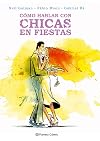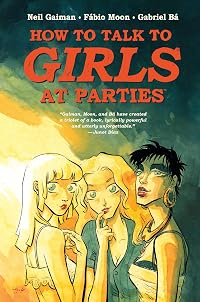
How to Talk to Girls at Parties [Graphic Novel]
by Neil Gaiman (Author), Gabriel Bá (Illustrator), Fábio Moon (Illustrator)
On This Page
Description
"Enn is a fifteen-year-old boy who just doesn't understand girls, while his friend Vic seems to have them all figured out. Both teenagers are in for the shock of their young lives, however, when they crash a local party only to discover that the girls there are far, far more than they appear!"--Tags
Recommendations




Member Reviews
Absolutely love this graphic novel adaptation of Neil Gaiman’s short story! Moon & Ba were definitely the perfect choice of illustrators, since their artistic style is anchored in reality but with serious overtones of whimsy that capture the careful balance between reality and strange happenings in this story. Gaiman’s text presents the adventure of two young boys going to a house party as being relatively straightforward - they go, they talk to girls, and the girls are weird. Obviously the story can be interpreted literally, in that the party really is full of alien tourists in the form of beautiful girls, but speaking from the perspective of a girl we are absolutely as strange as the story portrays without actually being creatures show more from another planet. I’ve had far stranger conversations with boys - whether that strangeness comes from a fundamental difference in how boys and girls communicate or whether I just have weird topics of conversation is a whole other matter. The art style seems to very much support this theory that our hapless narrator just doesn’t quite get girls, so he sees their conversations as being otherworldly and above his comprehension, as all of the girls look very human (even for all their beauty). And yet, the final scene, where the boys exit the party post-haste due to some kind of disagreement with Stella, brings us back to the idea that maybe these girls are not just girls - having the fires of a thousand suns in their eyes (etc) is a typical description of extreme anger, but I get the distinct impression that Stella could be much more than what she seems. Better run for your lives, boys! show less
I had not read the story this graphic novel is based on but even without Gaiman's name on it, I would have probably recognized it as one of his.
Two boys decide to go to a party, the address of which they do not exactly have. So when they find a party, they go in. One of the boys is a ladies man, the other one is shy and cannot speak to girls. And the girls he meets at the party do not exactly help - telling stories of impossible places.
There is more than one way to read the story - you can choose to see it as a fantasy story (which I prefer) or you can think of it as the way a boy sees women. Or something in between.
It is a short and sweet story about that age when everyone wishes to be just a bit older. And if you read it as a show more fantasy story, it is also a story about universes, changes and longing. show less
Two boys decide to go to a party, the address of which they do not exactly have. So when they find a party, they go in. One of the boys is a ladies man, the other one is shy and cannot speak to girls. And the girls he meets at the party do not exactly help - telling stories of impossible places.
There is more than one way to read the story - you can choose to see it as a fantasy story (which I prefer) or you can think of it as the way a boy sees women. Or something in between.
It is a short and sweet story about that age when everyone wishes to be just a bit older. And if you read it as a show more fantasy story, it is also a story about universes, changes and longing. show less
How to Talk to Girls at Parties originally was a Hugo-nominated short story by Neil Gaiman. A decade later he's joined up with Brazilian brothers Gabriel Ba and Fabio Moon to create a delightful and slightly ominous graphic novel version. The brothers illustrated one of my favorite GNs, Daytripper, and obviously have had fun with this tale of two friends who end up at the wrong party. Apparently a film will be released next year.
Two 15-year-old boys, Enn and Vic, gatecrash a party Vic has heard about. Confident Vic wants to kiss the most mesmerizing girl there, while self-doubting Enn expects to end up "in the kitchen listening to somebody's mum going on about politics or poetry or something." There are only young women at the party, show more and they, along with the unusual pulsating music, draw the boys in.
The scenes are well-drawn, many with a celebratory wildness like a bacchanal. The girls are preternaturally pretty, with large light-filled eyes, and they may not be all that they seem.
Gaiman's writing is always a cut above others in this genre, and the combination with the Brazilian brothers makes for a winning, albeit pretty brief, read. show less
Two 15-year-old boys, Enn and Vic, gatecrash a party Vic has heard about. Confident Vic wants to kiss the most mesmerizing girl there, while self-doubting Enn expects to end up "in the kitchen listening to somebody's mum going on about politics or poetry or something." There are only young women at the party, show more and they, along with the unusual pulsating music, draw the boys in.
The scenes are well-drawn, many with a celebratory wildness like a bacchanal. The girls are preternaturally pretty, with large light-filled eyes, and they may not be all that they seem.
Gaiman's writing is always a cut above others in this genre, and the combination with the Brazilian brothers makes for a winning, albeit pretty brief, read. show less
"I will never forget that moment, or forget the expression on Stella's face as she watched Vic hurrying away from her. Even in death I shall remember that. Her clothes were in disarray, and there was makeup smudged across her face, and her eyes-You wouldn't want to make a universe angry. I bet an angry universe would look at you with eyes like that."
In this graphic novel adaption of "How to Talk to Girls at Parties" which was nominated for the 2007 Hugo Award for Best Short Story and won the Locus Award for Best Short Story, Gaiman conjures up an eerie coming of age story that is not only about the differences between the sexes (men viewing women as foreign creatures or "aliens") but could also be read as a parable for how to treat show more girls (i.e. don't take advantage of them because, because after all, you wouldn't want to make the universe angry). It is also a great story that investigates (like so many stories from Gaiman have a tendency to do) childhood memory and the loss of childhood innocence through the lens of the fantastical.
The story is pretty simple. It is about a couple of British 1970s teen-aged boys, Enn and Vic, who go to a party to meet girls, only to find that the girls are very different from the boys' expectations. But the story goes deeper than that. Enn, who doesn't really know how to interact with girls (or so he thinks) encounters three "alien beings" who attempt to express their loneliness, their thirst for knowledge, imperfection, fear of death, and need to communicate their stories. His friend, Vic is a more superficial, takes off upstairs with the girl Stella (Star), and he gets more than he bargained for-as the universe finds him lacking.
Enn's last meeting is with Triolet, who pours her story/poem into his being. This story in the form of a poem changes him. Enn can recognize and access the story inherent in the music playing in the house amidst the stars and the universe. Just then, however, Vic dashes up and says they have to leave. Triolet is disappointed that she doesn’t get to finish her poem, but Vic is insistent. Enn looks up the stairs and sees the disheveled Stella, whose eyes he would never forget
Thirty years later, as Enn is telling the story, he recalls that Stella's eyes looked like an angry universe.
The boys run for a long time, until Vic stops and throws up in the gutter. He begins to sob as he tries to explain what he’s experienced. Enn says he still can’t imagine what Vic saw that night that terrified him so badly. Enn tries to remember the poem Triolet told him, but he cannot.
What is interesting about this story is the fact that both the girls and Enn seem to be travelers and in search of something. Enn seems like he searching for deeper connections and meaning and so are the girls. In contrast, Vic was only concerned with a more primal connection and well, upset a superior being in the process.
The story happens only through the course of a few hours yet encompasses eons of extrapolated human nature. How does Gaiman do it?
I would be remiss if I didn't mention Fabio Moon and Gabriel Ba, the folks who adapted this story into its graphic form, as they manage to create a strangely unique place in the everyday world that Gaiman has created. The artwork manages to highlight some of the stranger but subtle parts of the story well through its playful use of watercolors.
Highly recommended. show less
In this graphic novel adaption of "How to Talk to Girls at Parties" which was nominated for the 2007 Hugo Award for Best Short Story and won the Locus Award for Best Short Story, Gaiman conjures up an eerie coming of age story that is not only about the differences between the sexes (men viewing women as foreign creatures or "aliens") but could also be read as a parable for how to treat show more girls (i.e. don't take advantage of them because, because after all, you wouldn't want to make the universe angry). It is also a great story that investigates (like so many stories from Gaiman have a tendency to do) childhood memory and the loss of childhood innocence through the lens of the fantastical.
The story is pretty simple. It is about a couple of British 1970s teen-aged boys, Enn and Vic, who go to a party to meet girls, only to find that the girls are very different from the boys' expectations. But the story goes deeper than that. Enn, who doesn't really know how to interact with girls (or so he thinks) encounters three "alien beings" who attempt to express their loneliness, their thirst for knowledge, imperfection, fear of death, and need to communicate their stories. His friend, Vic is a more superficial, takes off upstairs with the girl Stella (Star), and he gets more than he bargained for-as the universe finds him lacking.
Enn's last meeting is with Triolet, who pours her story/poem into his being. This story in the form of a poem changes him. Enn can recognize and access the story inherent in the music playing in the house amidst the stars and the universe. Just then, however, Vic dashes up and says they have to leave. Triolet is disappointed that she doesn’t get to finish her poem, but Vic is insistent. Enn looks up the stairs and sees the disheveled Stella, whose eyes he would never forget
Thirty years later, as Enn is telling the story, he recalls that Stella's eyes looked like an angry universe.
The boys run for a long time, until Vic stops and throws up in the gutter. He begins to sob as he tries to explain what he’s experienced. Enn says he still can’t imagine what Vic saw that night that terrified him so badly. Enn tries to remember the poem Triolet told him, but he cannot.
What is interesting about this story is the fact that both the girls and Enn seem to be travelers and in search of something. Enn seems like he searching for deeper connections and meaning and so are the girls. In contrast, Vic was only concerned with a more primal connection and well, upset a superior being in the process.
The story happens only through the course of a few hours yet encompasses eons of extrapolated human nature. How does Gaiman do it?
I would be remiss if I didn't mention Fabio Moon and Gabriel Ba, the folks who adapted this story into its graphic form, as they manage to create a strangely unique place in the everyday world that Gaiman has created. The artwork manages to highlight some of the stranger but subtle parts of the story well through its playful use of watercolors.
Highly recommended. show less
Fifteen-year-old Enn is not nearly as cool or confident as his best friend, Vic, especially where girls are concerned. So when Vic suggests they attend a party with ‘Girls! Girls! Girls!’, Enn only reluctantly agrees. Vic, unfortunately, left the invitation with the address at home but that’s okay because he sure he can find it – just follow the party sounds. And they do find a party only they don’t recognize any of the people or the music. And there are lots of girls but these girls definitely aren’t like the ones they know at school.
How to Talk to Girls at Parties written by Neil Gaiman was originally released as one of the short stories in Fragile Things in 2006. It is now being released as a graphic novel by Dark Horse. show more Neil Gaiman has adapted it to the genre and it is illustrated by Brazilian brothers and award winning artists, Fabio Moon and Gabriel Ba.
This is a relatively short book at just 67 pages and, on the surface, it is a fairly simple albeit smart story. But this is Gaiman and his stories are never quite what they seem and there are layers here. It can be read as straightforward scifi or as a story about how teenaged boys perceive girls – as a completely different universe, beautiful like poetry but, when you get too close, as terrifying and dangerous as the sun. However you read it, it is a beautifully written and drawn tale, witty, humorous in places, creepy in others but always a compelling and fascinating read.
Thanks to Edelweiss and Dark Horse for the opportunity to read this book in exchange for an honest review show less
How to Talk to Girls at Parties written by Neil Gaiman was originally released as one of the short stories in Fragile Things in 2006. It is now being released as a graphic novel by Dark Horse. show more Neil Gaiman has adapted it to the genre and it is illustrated by Brazilian brothers and award winning artists, Fabio Moon and Gabriel Ba.
This is a relatively short book at just 67 pages and, on the surface, it is a fairly simple albeit smart story. But this is Gaiman and his stories are never quite what they seem and there are layers here. It can be read as straightforward scifi or as a story about how teenaged boys perceive girls – as a completely different universe, beautiful like poetry but, when you get too close, as terrifying and dangerous as the sun. However you read it, it is a beautifully written and drawn tale, witty, humorous in places, creepy in others but always a compelling and fascinating read.
Thanks to Edelweiss and Dark Horse for the opportunity to read this book in exchange for an honest review show less
Like so many Gaiman stories, this is going to take up space in my head for waaaay longer than it took to read this graphic novel. What an interesting twist on such a mundane start of “two 15-year-old boys go to a party and try to get some.” What a beautiful, strange mindfuck of a story.
I've never read the short story that this graphic novel is based on, but I think I'm going to have to rectify that soon. This was a beautifully told coming of age story unlike any you may have read before, as two young lads stumble into the wrong party and find themselves discovering more than they bargained for from the girls there. Fábio Moon and Gabriel Bá art is vibrant and stunning and really brings the story to life. Highly recommended for both fans of Neil Gaiman and anyone who loves the graphic novel form.
Members
- Recently Added By
Lists

manga, comics & graphic novels
21 works; 1 member

Books Read in 2021
5,361 works; 114 members
Author Information

Neil Gaiman was born in Portchester, England on November 10, 1960. He worked as a journalist and freelance writer for a time, before deciding to try his hand at comic books. Some of his work has appeared in publications such as Time Out, The Sunday Times, Punch, and The Observer. His first comic endeavor was the graphic novel series The Sandman. show more The series has won every major industry award including nine Will Eisner Comic Industry Awards, three Harvey Awards, and the 1991 World Fantasy Award for best short story, making it the first comic ever to win a literary award. He writes both children and adult books. His adult books include The Ocean at the End of the Lane, which won a British National Book Awards, and the Locus Award for Best Fantasy Novel for 2014; Stardust, which won the Mythopoeic Award as best novel for adults in 1999; American Gods, which won the Hugo, Nebula, Bram Stoker, SFX, and Locus awards; Anansi Boys; Trigger Warning: Short Fictions and Disturbances; and The View from the Cheap Seats: Selected Nonfiction, which is a New York Times Bestseller. His children's books include The Day I Swapped My Dad for Two Goldfish; Coraline, which won the Elizabeth Burr/Worzalla, the BSFA, the Hugo, the Nebula, and the Bram Stoker awards; The Wolves in the Walls; Odd and the Frost Giants; The Graveyard Book, which won the Newbery Award in 2009 and The Sandman: Overture which won the 2016 Hugo Awards Best Graphic Story. (Bowker Author Biography) show less
Series
Belongs to Publisher Series
Work Relationships
Is contained in
Is an adaptation of
Common Knowledge
- Canonical title
- How to Talk to Girls at Parties [Graphic Novel]
- Original title
- How to Talk to Girls at Parties
- Alternate titles
- Neil Gaiman's How to Talk to Girls at Parties
- Original publication date
- 2016-06
- Important places
- London, England, UK
- First words
- Come on. Said Vic. It'll be great.
- Blurbers
- Diaz, Junot; Niffenegger, Audrey; DeConnick, Kelly Sue; Thompson, Craig; Rothfuss, Patrick
- Original language
- English
- Disambiguation notice
- This record is for the graphic novel titled "Neil Gaiman's How to Talk to Girls at Parties," not the short story of the same name which it is an adaption of. Do not combine.
Classifications
- Genres
- Graphic Novels & Comics, Teen
- DDC/MDS
- 741.5 — Arts & recreation Drawing & decorative arts Drawing Comic books, graphic novels, fotonovelas, cartoons, caricatures, comic strips
- LCC
- PN6737 .G3 .H69 — Language and Literature Literature (General) Literature (General) Collections of general literature Comic books, strips, etc.
- BISAC
Statistics
- Members
- 549
- Popularity
- 54,103
- Reviews
- 32
- Rating
- (3.72)
- Languages
- 5 — English, Italian, Portuguese, Spanish, Turkish
- Media
- Paper, Ebook
- ISBNs
- 10
- ASINs
- 3