On This Page
Description
In the midst of spiraling ecological devastation, multispecies feminist theorist Donna J. Haraway offers provocative new ways to reconfigure our relations to the earth and all its inhabitants. She eschews referring to our current epoch as the Anthropocene, preferring to conceptualize it as what she calls the Chthulucene, as it more aptly and fully describes our epoch as one in which the human and nonhuman are inextricably linked in tentacular practices. The Chthulucene, Haraway explains, show more requires sym-poiesis, or making-with, rather than auto-poiesis, or self-making. Learning to stay with the trouble of living and dying together on a damaged earth will prove more conducive to the kind of thinking that would provide the means to building more livable futures. Theoretically and methodologically driven by the signifier SF--string figures, science fact, science fiction, speculative feminism, speculative fabulation, so far--Staying with the Trouble further cements Haraway's reputation as one of the most daring and original thinkers of our time. show lessTags
Recommendations












Member Reviews
Donna Haraway makes a peculiar choice in coining "Chthulucene" for use in this book. The difference in spelling from H.P. Lovecraft's notorious dreaming god is deliberate, and she insists that the etymology is from khthon-; but then why not "Chthonocene?" The fact is that she is deliberately evoking Cthulhu, who "shall soon rule where man rules now," as the Necronomicon admonishes. But her sympathies, unlike those of (the conscious) Lovecraft are not with the "rulers" coded out as Anthropos or Capital or Plantation Owner, or any future value of that function. Her principal slogan for advancing a Chthulucene agenda is "Make kin, not babies," and she proposes a "tentacular" program of what an Anthropocentric thinker might regard as show more species treason--not to mention its profound antagonism to Capital.
Haraway's program of "staying with the trouble" is an imagining of futures that resists utopianism and dismal forecasting. It reminds me more than a little of the anti-capitalist bolo'bolo (by P.M., 1983--whatever happened to my paperback copy?), which was much more sanguine. The chief difference in gravity probably stems from Haraway's attention to the damage already done to human and non-human biomes. The final chapter of the book is an SF narrative implementing these visions over the period 2025-2425. Throughout the various essays, Haraway construes SF multivalently as "speculative feminism," "string figures," "speculative fabulation," "science fantasy," and the more customary "science fiction," and asserts it as part of her resources and method. Previous SF works that receive her special attention include Ursula Le Guin's Always Coming Home (and others), Orson Scott Card's Speaker for the Dead, and Hayao Miyazaki's Nausicaä of the Valley of the Wind.
The species that participate in her Cthulucene imaginings notably include pigeons, squid, orchids, coral, horses, and butterflies. And SF reflections even recruit the Ood from Doctor Who (the subverted Cthulhu again). Some of these are models to overcome the paradigm of organisms, in favor of holobionts. Others illustrate extant and/or possible relationships among "critters" (Haraway's preferred term, embracing and exceeding all biotic kingdoms) including humans.
Staying with the Trouble is a chewy read, full of accounts of activist art and the results of late-breaking scientific inquiry (not capital-S "Science" Haraway hastens to add). The body text is about half of the total book, and many of the sixty pages of small-type end notes are worth investigating for their further discussion of sources and inspiration. There are black-and-white illustrations throughout. I made slow progress through it, but it was worth my effort, and although I read a borrowed copy, I would be willing to make space for it on my own shelves. show less
Haraway's program of "staying with the trouble" is an imagining of futures that resists utopianism and dismal forecasting. It reminds me more than a little of the anti-capitalist bolo'bolo (by P.M., 1983--whatever happened to my paperback copy?), which was much more sanguine. The chief difference in gravity probably stems from Haraway's attention to the damage already done to human and non-human biomes. The final chapter of the book is an SF narrative implementing these visions over the period 2025-2425. Throughout the various essays, Haraway construes SF multivalently as "speculative feminism," "string figures," "speculative fabulation," "science fantasy," and the more customary "science fiction," and asserts it as part of her resources and method. Previous SF works that receive her special attention include Ursula Le Guin's Always Coming Home (and others), Orson Scott Card's Speaker for the Dead, and Hayao Miyazaki's Nausicaä of the Valley of the Wind.
The species that participate in her Cthulucene imaginings notably include pigeons, squid, orchids, coral, horses, and butterflies. And SF reflections even recruit the Ood from Doctor Who (the subverted Cthulhu again). Some of these are models to overcome the paradigm of organisms, in favor of holobionts. Others illustrate extant and/or possible relationships among "critters" (Haraway's preferred term, embracing and exceeding all biotic kingdoms) including humans.
Staying with the Trouble is a chewy read, full of accounts of activist art and the results of late-breaking scientific inquiry (not capital-S "Science" Haraway hastens to add). The body text is about half of the total book, and many of the sixty pages of small-type end notes are worth investigating for their further discussion of sources and inspiration. There are black-and-white illustrations throughout. I made slow progress through it, but it was worth my effort, and although I read a borrowed copy, I would be willing to make space for it on my own shelves. show less
Sobretudo é um livro cujas ideias gerais devem ser levadas a sério. Uma delas é que é preciso valorizar o pensar junto, agir junto, agenciar junto. Porque daí surge a importância de se comportar de um modo a viver e morrer bem junto. O morrer aí é importante; o bordão lembra-nos da importância de pensarmos o legado. E no último capítulo é proposto um exercício imaginativo sobre esse legado. Como viveriam as 5 próximas gerações? Me parece algo essencial a ser trabalhado por todos nós. Porque na imaginação trazemos o simbólico e no exercício de deixar mais consistente o pensado, percebemos que não há tabula rasa ou salvação - é preciso pensar a arte de viver e morrer em um mundo danificado, de um legado "de fim show more de mundos". E entrando em simbiose ou ao menos em relação de parentesco e amizade, não apenas com humanos mas com não-humanos, vamos tecendo uma rede de cuidado e percepções do que é importante que leva em conta mais do que a humanidade. Porque seu pensar capturado pelo capitalismo que fomentaria o excepcionalismo humano. Daí outra ideia: não se trata de antropoceno, mas de capitaloceno, um antropos perdido na grande indústria, grande ciência, grande empresa; perdido no hábito da reprodução. Haraway, pró decrescimento, diz: faça parentes, não bebês. Porque trata-se de fomentar a amizade profunda como o laço do parentesco, que pode incluir cachorros etc. Por fim, a autora traça uma tentativa de roubar o tentacular lovecraftiano do seu autor e da esfera do terror, conectando-o com aranhas e a ideia de sintonia problemática mas possível e necessária entre espécies. Por isso o chtuluceno. Outra jogada nominal é aquela envolvendo SF, que passa a ser não apenas ficção científica, mas feminismo especulativo, fabulação especulativa, e figuras no jogo de cordas (não lembro o nome em português - string figures). De todo modo, é preciso, informadamente, com parcerias diversas, com a arte e ciência e filosofia e o não-humano, conviver com os problemas. Não se colocar fora deles, como se não existissem ou como se fossem forças extreriores avassaladoras, esperando o momento da devastação.
Dito tudo isso, há um grande porém. O livro tem uma introdução bastante empolgante, porque amalgama todas as ideias do livro. Mas ele é repetitivo e parece um pouco mal costurado. Algumas figuras retóricas, como a de evocar e engrandecer personalidades chave, parecem mais prejudicar que ajudar. E, embora calcados em práticas, a autora aposta muito na fabulação, no imaginário e na construção simbólica, rumo a uma transição possível da vida que temos para outra. Mesmo se for pouco, pelo menos é algo, um começo, algumas ideias com um poder persuasivo bom. show less
Dito tudo isso, há um grande porém. O livro tem uma introdução bastante empolgante, porque amalgama todas as ideias do livro. Mas ele é repetitivo e parece um pouco mal costurado. Algumas figuras retóricas, como a de evocar e engrandecer personalidades chave, parecem mais prejudicar que ajudar. E, embora calcados em práticas, a autora aposta muito na fabulação, no imaginário e na construção simbólica, rumo a uma transição possível da vida que temos para outra. Mesmo se for pouco, pelo menos é algo, um começo, algumas ideias com um poder persuasivo bom. show less
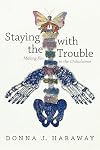
Although it took a little getting used to, Haraway’s writing style was easier to read than I expected. This is the first book of hers I’ve tackled and quotations I’d come across in the past were generally oblique, to say the least. I can’t remember how I discovered the existence of ‘Staying with the Trouble’, but am usually up for commentary on the concept of the Anthropocene. Moreover, it has a distinctive cover and I’m not above being swayed by such things. The book is shorter than it looks, as a good 130 pages of the total are notes, bibliography, and index. The remaining 160-odd consist of meandering chapters on ideas of ecological regeneration through co-operative coexistence between people and other living beings. show more Haraway writes in a lyrical, elliptical style with a conversational tone, playing with words and frequently re-stating phrases. I neither loved nor hated this, so found my interest in the book waxed and waned with the content. The chapters are essentially structured around anecdotes, some of which I found more meaningful than others.
I most enjoyed the longest chapter, ‘Sympoesis’. The titular concept seems vaguely familiar from [b:Austral|33673959|Austral|Paul McAuley|https://images.gr-assets.com/books/1495059075s/33673959.jpg|54549061], an excellent sci-fi novel, and Haraway goes into sufficient detail that the anecdotes become case studies. They are examples of the tentacular, interconnected approach to ecological understanding and regeneration through solidarity and art that she espouses. I wanted to call this a philosophy, but she deliberately describes it more in terms of practice. If I had to situate it philosophically, though, I’d suggest object-oriented ontology as described by Timothy Morton in [b:The Ecological Thought|7722063|The Ecological Thought|Timothy Morton|https://images.gr-assets.com/books/1348985833s/7722063.jpg|10474582]. I didn’t find new insight into the Anthropocene as such. I liked Haraway’s comment that, ‘The Anthropocene marks severe discontinuities; what comes after will not be like what came before. I think our job is to make the Anthropocene as short/thin as possible and to cultivate with each other in every way imaginable epochs to come that can replenish refuge.’ However I was not convinced by her term ‘chthulucene’, which refers both to the Greek name of a spider and to Lovecraft’s cthulu. I believe it is meant to reflect that we’re all part of the same compost heap. (Wasn’t that a line from Fight Club?)
Haraway’s slogan for this era is ‘Make Kin Not Babies’, which I have a certain amount of sympathy for. A couple of my close friends have recently had babies and I like the idea of being their kin. Although I don’t want any children of my own, I’d like to play with and read to the children of my friends. The slogan is also intended to encourage communication and solidarity between groups more generally, beyond nuclear families and narrow interests. I found the string figures concept harder to grasp the usefulness of. Chapter 5 on the unpleasant, often cruel practice of deriving human oestrogen supplements from horse urine was the least satisfactory part of the book for me. Probably because it really was just a personal anecdote and because I thought it was common knowledge. I remember hearing about the practice as a child from an animal rescue charity. Haraway recounts her much more recent discovery of it to highlight how easily information can be overlooked, but doesn’t draw much in the way of lessons from the experience. Her conclusion seems simply to be ‘the world is complicated’, which is true but hardly novel.
On the other hand, I liked the final chapter much more. This consisted of speculative fiction about five generations of people called Camille, all of whom had a symbiotic relationship with monarch butterflies. What a conceptually delightful idea. This fictionalisation also meant that the book concluded on a note of clarity, by depicting Haraway’s vision of a better future. I didn’t find ‘Staying with the Trouble’ revelatory and the length was awkward; it might have been better further compressed or considerably expanded. Nonetheless, there was some vivid and interesting material to be found and Haraway undoubtedly has a distinctive voice. show less
I most enjoyed the longest chapter, ‘Sympoesis’. The titular concept seems vaguely familiar from [b:Austral|33673959|Austral|Paul McAuley|https://images.gr-assets.com/books/1495059075s/33673959.jpg|54549061], an excellent sci-fi novel, and Haraway goes into sufficient detail that the anecdotes become case studies. They are examples of the tentacular, interconnected approach to ecological understanding and regeneration through solidarity and art that she espouses. I wanted to call this a philosophy, but she deliberately describes it more in terms of practice. If I had to situate it philosophically, though, I’d suggest object-oriented ontology as described by Timothy Morton in [b:The Ecological Thought|7722063|The Ecological Thought|Timothy Morton|https://images.gr-assets.com/books/1348985833s/7722063.jpg|10474582]. I didn’t find new insight into the Anthropocene as such. I liked Haraway’s comment that, ‘The Anthropocene marks severe discontinuities; what comes after will not be like what came before. I think our job is to make the Anthropocene as short/thin as possible and to cultivate with each other in every way imaginable epochs to come that can replenish refuge.’ However I was not convinced by her term ‘chthulucene’, which refers both to the Greek name of a spider and to Lovecraft’s cthulu. I believe it is meant to reflect that we’re all part of the same compost heap. (Wasn’t that a line from Fight Club?)
Haraway’s slogan for this era is ‘Make Kin Not Babies’, which I have a certain amount of sympathy for. A couple of my close friends have recently had babies and I like the idea of being their kin. Although I don’t want any children of my own, I’d like to play with and read to the children of my friends. The slogan is also intended to encourage communication and solidarity between groups more generally, beyond nuclear families and narrow interests. I found the string figures concept harder to grasp the usefulness of. Chapter 5 on the unpleasant, often cruel practice of deriving human oestrogen supplements from horse urine was the least satisfactory part of the book for me. Probably because it really was just a personal anecdote and because I thought it was common knowledge. I remember hearing about the practice as a child from an animal rescue charity. Haraway recounts her much more recent discovery of it to highlight how easily information can be overlooked, but doesn’t draw much in the way of lessons from the experience. Her conclusion seems simply to be ‘the world is complicated’, which is true but hardly novel.
On the other hand, I liked the final chapter much more. This consisted of speculative fiction about five generations of people called Camille, all of whom had a symbiotic relationship with monarch butterflies. What a conceptually delightful idea. This fictionalisation also meant that the book concluded on a note of clarity, by depicting Haraway’s vision of a better future. I didn’t find ‘Staying with the Trouble’ revelatory and the length was awkward; it might have been better further compressed or considerably expanded. Nonetheless, there was some vivid and interesting material to be found and Haraway undoubtedly has a distinctive voice. show less
"En medio de una devastación ecológica en aumento constante, la teórica feminista multiespecies Donna J. Haraway ofrece nuevas y provocadoras maneras de reconfigurar nuestras relaciones con la tierra y sus habitantes. Evita referirse a nuestra época actual como el Antropoceno: prefiere el concepto de lo que llama el Chthuluceno, ya que describe más y mejor nuestra época como aquella en la que humanos y no humanos se encuentran inextricablemente ligados en prácticas tentaculares...". (Descripción editorial).
Donna Haraway writes manifestos for now. It's not quite clear how we'll get to some of the states of being she describes, but you'll come away from the book changed for the better. Listen to the audiobook if you can.
It's not that there's nothing here--Haraway is bracing in a way, doesn't flinch from the dark and fearsome aspects of the latter part of the slogan "Make kin, not babies," and yet still insists on it, stressing the central role, the everything role, of a shift in thought and values as opposed to reproductive coercion or the late-capitalist scarcity that withers family (as distinct from that more promising kinship model, the gens) lines. But it's ... it's our same old way of thinking about how to change our way of thinking things, and fairly or unfairly Haraway I look to people in positions like yours to help us really metamorphose as opposed to getting at the same old thing from a new facet. Like, you could trot out your pretty keyword show more "chthulucene" (spelled differently to evoke Cthulhu but also distinguish it from the dark and racially hateful and misogynist aspects of Lovecraft's monster, and if so why bother?) for the chthonic that is also an originary tentacular connectedness--"Naga, Gaia, Tangaroa, [...] Terra, Haniyasu-hime, Spider Woman, Pachamama, Oya, Gorgo, Raven, A'akuluujjusi" by another name. It's, I'm sorry, an effort to be of the moment, to exploit a new conceptual corner. Gaia herself embodied this thinking better, as did, I blush to say it, the rhizome--but these things are played out in rarefied Haraway (harefied Raraway) circles of connection and so Donna of Cyborg Mountain, the Donna who goes to the trouble of disavowing "'posthumanism" for "compostism" here but in what a self-conscious, eye-on-legacy way! But of course this tendentiously named and renamed condition we are talking about also demands legacy thinking. So rather than demonize DH to the (putatively rapidly approaching) ends of the earth let me link to someone I think does this better (why did I review Haraway's essay and not this other one? Who knows?)--Nick Admussen with "Six proposals for the reform of literature in the age of climate change," suggesting a need for new stories that goes so much deeper than what I saw here: http://criticalflame.org/six-proposals-for-the-reform-of-literature-in-the-age-o...
I mean, but I am susceptible too because though I think using Cthulhu was cynical and pointless I did love the other key term she appropriate from Kim Stanley Robinson, who suggests that once we conceive of the Anthropo-/[...]cene as a border event and not an epoch (and the Holocene then as the era in which earthly reserves of life and species were still sufficient for a post-anthropogenic rewilding, oikologically, correspondingly oikonomically the last period of "cheap nature" per Jason Moore--I am bringing in also Haraway's own observations here not just KSR's), then a really good term for our present moment would be "The Dithering." show less
I mean, but I am susceptible too because though I think using Cthulhu was cynical and pointless I did love the other key term she appropriate from Kim Stanley Robinson, who suggests that once we conceive of the Anthropo-/[...]cene as a border event and not an epoch (and the Holocene then as the era in which earthly reserves of life and species were still sufficient for a post-anthropogenic rewilding, oikologically, correspondingly oikonomically the last period of "cheap nature" per Jason Moore--I am bringing in also Haraway's own observations here not just KSR's), then a really good term for our present moment would be "The Dithering." show less
Three short passages from Staying with the Trouble:
I think babies should be rare, nurtured, and precious; and kin should be abundant, unexpected, enduring, and precious.
Good stories reach into rich pasts to sustain thick presents to keep the story going for those who come after.
The Anthropocene marks severe discontinuities; what comes after will not be like what came before. I think our job is to make the Anthropocene as short/thin as possible and to cultivate with each other in every way imaginable epochs to come that can replenish refuge.
I think babies should be rare, nurtured, and precious; and kin should be abundant, unexpected, enduring, and precious.
Good stories reach into rich pasts to sustain thick presents to keep the story going for those who come after.
The Anthropocene marks severe discontinuities; what comes after will not be like what came before. I think our job is to make the Anthropocene as short/thin as possible and to cultivate with each other in every way imaginable epochs to come that can replenish refuge.
Members
- Recently Added By
Lists

Favorite Science Fiction by Women Authors
737 works; 202 members

Favorite Animal Non-Fiction
293 works; 144 members
Author Information

30+ Works 2,917 Members
Donna J. Haraway is Distinguished Professor Emerita in the History of Consciousness Department at the University of California, Santa Cruz, and the authoi of several books, most recently, Manifestly Haraway.
Some Editions
Awards and Honors
Awards
Notable Lists
Series

Common Knowledge
- Canonical title
- Staying with the Trouble: Making Kin in the Chthulucene
Classifications
Statistics
- Members
- 462
- Popularity
- 65,616
- Reviews
- 7
- Rating
- (3.78)
- Languages
- 7 — Danish, English, French, German, Italian, Portuguese, Spanish
- Media
- Paper, Audiobook, Ebook
- ISBNs
- 15
- ASINs
- 3