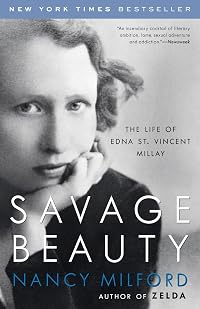
Savage Beauty: The Life of Edna St. Vincent Millay
by Nancy Milford
On This Page
Description
"If F. Scott Fitzgerald was the hero of the Jazz Age, Edna St. Vincent Millay, as audacious in her love affairs as she was in her art, was its heroine. She embodied, in her reckless fancy, the spirit of the New Woman, and gave America its voice." "The first woman to win the Pulitzer Prize for poetry, Millay was dazzling in the performance of her self. Her voice was an instrument of seduction, and her impact on crowds, and on men, was legendary. Young women styled themselves in her image - show more fairylike, taunting, free. Yet beneath her studied act, all was not well." "Nancy Milford was given exclusive access to Millay's papers, and what she found was an unimaginable treasure. Hundreds of letters flew back and forth between the three sisters and their mother - and Millay kept the most intimate diary, one whose ruthless honesty brings to mind the journals of Sylvia Plath."--Jacket. show lessTags
Recommendations











Member Reviews
Per the forward to this long bio, Milford’s the first to have been granted access to the poet Edna St. Vincent Millay’s private letters and journals, long held in keeping by her sister Norma. This helps explain why this narrative is so compelling: having access to the subject’s own journals and letters provides fascinating access to her internal as well as external life. However, this may also explain the frustrating limits of this narrative: basically, if an incident isn’t covered in the letters, it isn’t mentioned here – leading to a biography that feels weirdly limited and insular. Moreover, while letters and diary entries may be revealing, they’re not necessarily complete, and they’re not necessarily trustworthy. In show more this case, it’s necessary to remember that our subject, Millay, wasn’t just a poet – she was also an accomplished actress, an erratic diarist with a tendency to omit unpleasant events, and an expert manipulator (especially of men and older women) with a gift for self-delusion. At the end of 500 pages I guarantee you’ll know a lot more about Millay, her life, and her canon; just don’t expect to have gained much insight into the forces that likely played the greatest role in shaping her life and character, which (based on clues in this text) may have included abandonment issues, bipolar disorder, and childhood sexual trauma.
There’s way too much drama in Millay’s life to try to summarize here, from her oddly heartbreaking childhood to her wild, bohemian adulthood to her early death following increasingly dramatic hospitalizations and staggering drug use. What Milford seems intent upon us understanding is that, as worthy as Millay’s poetry may have been, her fame was also in large part indebted to her ability to create her own “cult of personality.” If it hadn’t been for the willingness of a succession of older women, dazzled by her talent and charm, to smooth her path to and through college; if it hadn’t been for a string of discarded lovers, enchanted by her beauty, intensity, and sexual precocity, to ensure her poems stayed constantly in the public eye; if it hadn’t been for her scores of fans, particularly “sexually liberated young women,” enthralled by her dramatic public readings, her risqué reputation, and her husky contralto voice, flocking to the stores to purchase her poetry – one wonders whether she would have become what she became: the first woman to win a Pulitzer Prize for poetry and the “voice of her era.” For if F. Scott Fitzgerald can be said to have given the “Jazz Age” its voice, then Millay can surely be said to have written the libretto.
Which brings me to the quirks of Milford as a narrator. She has the oddest habit of introducing new characters without any preamble and minimal biographical information, making it very difficult to figure out which characters are “minor” and which “major.” It was frustrating to constantly have to double back to re-read character introductions when the characters suddenly reappeared, 100 pages later, without any helpful reference or context. Even the minimal biographical information she provides sometimes comes chapters after the characters have been introduced, long after it would have been useful to have. Another issue I had was with Milford’s apparent resolve to present information without endeavoring to interpret it. In general I’m grateful when biographers eshew psychobabble – but isn’t there also something a little unhelpful (if not irresponsible) about presenting two fairly significant clues that Millay was the victim of childhood sexual trauma at the hands of one (or more) of her mother’s lovers with as much detachment as she brings to reprinting Millay’s endless letters about fashion? About as far as Milford goes is to acknowledge that when Millay starts using baby talk in her letters to her family, it’s “a bad sign” – though she coyly declines suggest what it’s a bad sign of.
On the other hand, you could argue that this approach, at the least, provides ample fodder for book club discussion! Some of the questions my group wrestled with (and that I’m still wrestling with): What was the root cause of Vincent’s sexual precocity – was it a Jazz Age thing? A poet thing? A Greenwich Village/bohemian thing? A symptom of a childhood sexual trauma? A desperate cry for attention/love? How did regularly society react to her many affairs with women and married men – or, what explains their failure to react? Did the babying she received at the hands of her husband Eugin truly protect her from her mistakes, or merely enable her to continue making them? Were her many illnesses real or psychosomatic? When did she begin using morphine, and what role did it play in hastening her nervous breakdowns? Or do Millay’s alternating episodes of mania and depression provide evidence that she was struggling with bipolar disorder? What exactly were her true feelings towards the mother she outwardly adored, but who in fact abandoned her daughters for long periods of time and seems, throughout this narrative, much more interested in being Vincent’s BFF than protecting her from harm? And finally, the biggest question of all: after reading this 500 page biography, why are we all struggling with the feeling that this narrative omits almost as much valuable insight as it includes? show less
There’s way too much drama in Millay’s life to try to summarize here, from her oddly heartbreaking childhood to her wild, bohemian adulthood to her early death following increasingly dramatic hospitalizations and staggering drug use. What Milford seems intent upon us understanding is that, as worthy as Millay’s poetry may have been, her fame was also in large part indebted to her ability to create her own “cult of personality.” If it hadn’t been for the willingness of a succession of older women, dazzled by her talent and charm, to smooth her path to and through college; if it hadn’t been for a string of discarded lovers, enchanted by her beauty, intensity, and sexual precocity, to ensure her poems stayed constantly in the public eye; if it hadn’t been for her scores of fans, particularly “sexually liberated young women,” enthralled by her dramatic public readings, her risqué reputation, and her husky contralto voice, flocking to the stores to purchase her poetry – one wonders whether she would have become what she became: the first woman to win a Pulitzer Prize for poetry and the “voice of her era.” For if F. Scott Fitzgerald can be said to have given the “Jazz Age” its voice, then Millay can surely be said to have written the libretto.
Which brings me to the quirks of Milford as a narrator. She has the oddest habit of introducing new characters without any preamble and minimal biographical information, making it very difficult to figure out which characters are “minor” and which “major.” It was frustrating to constantly have to double back to re-read character introductions when the characters suddenly reappeared, 100 pages later, without any helpful reference or context. Even the minimal biographical information she provides sometimes comes chapters after the characters have been introduced, long after it would have been useful to have. Another issue I had was with Milford’s apparent resolve to present information without endeavoring to interpret it. In general I’m grateful when biographers eshew psychobabble – but isn’t there also something a little unhelpful (if not irresponsible) about presenting two fairly significant clues that Millay was the victim of childhood sexual trauma at the hands of one (or more) of her mother’s lovers with as much detachment as she brings to reprinting Millay’s endless letters about fashion? About as far as Milford goes is to acknowledge that when Millay starts using baby talk in her letters to her family, it’s “a bad sign” – though she coyly declines suggest what it’s a bad sign of.
On the other hand, you could argue that this approach, at the least, provides ample fodder for book club discussion! Some of the questions my group wrestled with (and that I’m still wrestling with): What was the root cause of Vincent’s sexual precocity – was it a Jazz Age thing? A poet thing? A Greenwich Village/bohemian thing? A symptom of a childhood sexual trauma? A desperate cry for attention/love? How did regularly society react to her many affairs with women and married men – or, what explains their failure to react? Did the babying she received at the hands of her husband Eugin truly protect her from her mistakes, or merely enable her to continue making them? Were her many illnesses real or psychosomatic? When did she begin using morphine, and what role did it play in hastening her nervous breakdowns? Or do Millay’s alternating episodes of mania and depression provide evidence that she was struggling with bipolar disorder? What exactly were her true feelings towards the mother she outwardly adored, but who in fact abandoned her daughters for long periods of time and seems, throughout this narrative, much more interested in being Vincent’s BFF than protecting her from harm? And finally, the biggest question of all: after reading this 500 page biography, why are we all struggling with the feeling that this narrative omits almost as much valuable insight as it includes? show less
“My candle burns at both ends
It will not last the night
But ah my foes and oh my friends
It gives a lovely light!”
Savage Beauty is biographer Nancy Milford’s second book about a Jazz Age heroine. There are similarities between her subjects - Zelda Fitzgerald (subject of the earlier volume, Zelda) and Edna St. Vincent Millay (subject of this one) both had seeming urges toward tragic self-destruction. They both had problematical marriages – but the problems were seemingly opposite; Zelda lived in the shadow of her husband’s success but Scott was afraid of hers (he tried to stop publication of her book, Save Me The Waltz, on the grounds that it would hinder sales of his Tender Is The Night); Millay, on the other hand, had a husband show more (Eugene Boissevain) who treated her like a princess – tolerating her extramarital affairs, managing their household – but also enabling her alcoholism and morphine addiction.
There are fairy-tale aspects to Millay’s life – but it’s the original dark Grimm Brothers, not the Disney versions. She was the oldest of three daughters from a hardscrabble family in Maine. Her mom, Cora, threw her father, Henry, out of the house in 1900, when Edna was eight (she always signed her letters “Edna”, but close friends and family called her “Vincent”) and the family lived in genteel poverty. Edna sent some poems to St. Nicholas magazine and won some prizes. Her poetry eventually attracted the attention of a fairy godmother, Caroline Dow, a wealthy spinster who sponsored her (and later her sister Kathleen) at Vassar. At Vassar, Millay seems to have undergone a personality transplant; you might expect a girl from an impoverished family with inadequate formal education (Millay had to spend a year in a preparatory school, also financed by Miss Dow, to meet the Vassar entrance requirements) to be overwhelmed by the wealth of her classmates and the intellectual atmosphere. Instead Millay blossomed, writing more brilliant poetry; getting rave reviews as an actress in school plays; having Lesbian relationships with several students (maybe – more below); avoiding cliques and remaining popular with all her classmates; and violating school rules with abandon. She was suspended just before graduation – for spending a night off campus – but a petition signed by half her graduating class persuaded the faculty to reinstate her so she could receive her diploma.
After graduation she moved to New York and supported herself – barely – by poetry, acting, and magazine articles. She had a series of lovers and at least one abortion. In 1921 she moved to Paris and continued to write and love (she had a miscarriage that year; the father is unknown); in 1923 she married Boissevain.
Her relationship with her husband, as documented by Milford, was pretty strange. Boissevain was a junior son of a wealthy Dutch banking family and twelve years her elder. Contemporary interviews and articles always described Millay as “childlike”, “fragile”, and/or “a girl poet” (she was 5’1” tall and usually weighed under 100 pounds). This apparently appealed to Boissevain and (when she allowed it) he would treat her as a child – telling her when it was time to go to bed, cooking her meals, and screening her from outside contact. However, her behavior was anything but childlike; she went through a series of lovers (including a year spent away from Boissevain, in Paris, with poet George Dillon, 14 years her junior at the time). Boissevain sent a series of increasingly desperate and strange letters – including requests for her used lingerie – and she finally returned to the US in 1925 when the couple bought a farm (“Steepletop”) in upstate New York and an island off the coast of Maine.
Millay continued to write outstanding poetry (plus some plays and the libretto for an opera) while her health deteriorated. In 1936, the passenger door in their car popped open on a curve and Millay was thrown out and down an embankment; she injured her arm and began taking morphine for the pain. From time to time she kept diaries documenting her drug and alcohol use; an entry for December 31, 1940 has 3/8 grain of morphine (a grain is 64 milligrams) at 7:40 am; a cigarette at 7:45; a bottle of beer at 8:15; a cigarette at 8:45; a cigarette at 9:00; a gin rickey and a cigarette at 9:30; another gin rickey at 11:15; a martini and four cigarettes at 12:15; and a ¼ grain of morphine and a cigarette at 12:45. The record does not continue for that day, but by 1943 she was recording an average of 195 mg of morphine a day, plus codeine, plus Nembutal, plus Benzadrine. Boissevain also began taking morphine – not because he was in any pain, but so he could share Millay’s addiction and see how she felt. Millay began checking into hospitals to try and break her addiction, with varying success. Hospital reports describe her as a bad patient, almost continuously in pain and insisting on various painkillers. Rather astonishingly, her doctors usually allowed her a bottle of wine a day; a nurse reported finding a dozen bottles in her hospital room closet – apparently brought in by visitors and stashed away. Boissevain became increasingly “protective” – intercepting incoming letters and disconnecting the telephone at Steepletop. Edna’s younger sister Kathleen became obstreperous, making increasing demands for money. Kathleen had published some poetry and novels herself, but now began claiming that she had written or at least inspired Edna’s poems. Edna responded with money when the letters got through to her but she had to depend on advances from her publisher to provide it. Kathleen collapsed on a New York street in 1943 and died without regaining consciousness; the cause of death was listed as “acute alcoholism”.
In 1949, Boissevain was hospitalized for lung cancer. He survived an operation for removal of a lung but died of a cerebral hemorrhage later that day. Perhaps significantly, Edna seems to have turned herself around after her husband’s death; visitors reported her looking healthy and her handwriting became neat again, unlike the almost illegible scrawl during her addiction years. In 1950, a little more than a year after her husband’s death, the handyman at Steepletop found her lying at the foot of the stairs, with a broken neck.
Savage Beauty is a fine read, but a little strange in spots. Milford sometimes seems to be straining too hard to illuminate some aspect of Millay’s life. The general form of the book is a narrative with interspersed anecdotes from Millay’s friends, family, and acquaintances; selections from letters to and from her and Boissevain; and poetry. Milford introduces the biography by describing her encounter with Norma Millay, the middle Millay sister and resident at Steepletop after Edna’s death. Milford had to do a considerable amount of persuasion to get Norma to allow her access to Edna’s papers, and Norma continues in the background throughout the narrative, periodically interrupting or commenting, as if she was listening to Milford read the biography to her. The strange thing here is Norma Millay died in 1986, while Savage Beauty wasn’t published until 2001; thus the portrayed immediacy of Norma’s presence is fictional.
Other anecdotes in the book also have a forced feel; Edna’s bisexuality is taken as a given, but the evidence for it seems to be some letters Edna wrote from Vassar, where she reports that some girls came into her room and “unhooked” her; comments from acquaintances from Millay’s Paris days, many years after the fact, and a strange anecdote where an unnamed woman who was hosting Millay and Boissevain for a poetry reading describes Millay coming into her room at that night, dropping her evening gown, and inviting her to make love. Possibly relevant is one of the Norma Millay anecdotes; when the sisters were living together in New York in the Edna apparently picked up a young man, brought him back to their apartment, and lost her virginity. She then went to Norma’s room and told her that there was a little knob of flesh between her legs that she should play with because it was pleasurable. I confess I’m certainly not an expert on the details of lesbian sex, but I imagine that if Edna had had sex with other woman in college she would probably already know where and what her clitoris was. Could be, I suppose.
Some of the things that aren’t said or investigated also seem significant. For one thing, Milford never documents how Millay and Boissevain obtained the prodigious quantities of morphine they used. Milford mentions some of Millay’s doctors from the period but never explicitly accuses any of being a pusher; perhaps the information just isn’t attainable but I would have liked to see some sort of comment to the effect that Milford tried to find medical people who knew the details but just couldn’t come up with any. Finally the matter of Millay’s death is left hanging. I can’t tell from Milford’s description whether Millay’s bedroom was upstairs or downstairs at Steepletop. It seems like it was upstairs; Milford describes her as going upstairs in dressing gown and slippers but for some reason not going to bed and returning to the head of the stairs. Then “she pitched wildly forward, falling, hurtling down the full length of the stairs to the landing”. This almost sounds like Milford is suggesting a suicide; but the coroner’s report on Millays death – as documented by Wikipedia but not mentioned by Milford – says Millay had a heart attack.
Still, though, a good read about a fascinating woman. I don’t know whether you should read Millay’s poetry before or after her biography; it’s really good in any case. This one always makes my hair stand on end and brings tears:
Dirge Without Music
I am not resigned to the shutting away of loving hearts in the hard ground.
So it is, and so it will be, for so it has been, time out of mind:
Into the darkness they go, the wise and the lovely. Crowned
With lilies and with laurel they go; but I am not resigned.
Lovers and thinkers, into the earth with you.
Be one with the dull, the indiscriminate dust.
A fragment of what you felt, of what you knew,
A formula, a phrase remains,—but the best is lost.
The answers quick and keen, the honest look, the laughter, the love,—
They are gone. They are gone to feed the roses. Elegant and curled
Is the blossom. Fragrant is the blossom. I know. But I do not approve.
More precious was the light in your eyes than all the roses in the world.
Down, down, down into the darkness of the grave
Gently they go, the beautiful, the tender, the kind;
Quietly they go, the intelligent, the witty, the brave.
I know. But I do not approve. And I am not resigned.
show less
It will not last the night
But ah my foes and oh my friends
It gives a lovely light!”
Savage Beauty is biographer Nancy Milford’s second book about a Jazz Age heroine. There are similarities between her subjects - Zelda Fitzgerald (subject of the earlier volume, Zelda) and Edna St. Vincent Millay (subject of this one) both had seeming urges toward tragic self-destruction. They both had problematical marriages – but the problems were seemingly opposite; Zelda lived in the shadow of her husband’s success but Scott was afraid of hers (he tried to stop publication of her book, Save Me The Waltz, on the grounds that it would hinder sales of his Tender Is The Night); Millay, on the other hand, had a husband show more (Eugene Boissevain) who treated her like a princess – tolerating her extramarital affairs, managing their household – but also enabling her alcoholism and morphine addiction.
There are fairy-tale aspects to Millay’s life – but it’s the original dark Grimm Brothers, not the Disney versions. She was the oldest of three daughters from a hardscrabble family in Maine. Her mom, Cora, threw her father, Henry, out of the house in 1900, when Edna was eight (she always signed her letters “Edna”, but close friends and family called her “Vincent”) and the family lived in genteel poverty. Edna sent some poems to St. Nicholas magazine and won some prizes. Her poetry eventually attracted the attention of a fairy godmother, Caroline Dow, a wealthy spinster who sponsored her (and later her sister Kathleen) at Vassar. At Vassar, Millay seems to have undergone a personality transplant; you might expect a girl from an impoverished family with inadequate formal education (Millay had to spend a year in a preparatory school, also financed by Miss Dow, to meet the Vassar entrance requirements) to be overwhelmed by the wealth of her classmates and the intellectual atmosphere. Instead Millay blossomed, writing more brilliant poetry; getting rave reviews as an actress in school plays; having Lesbian relationships with several students (maybe – more below); avoiding cliques and remaining popular with all her classmates; and violating school rules with abandon. She was suspended just before graduation – for spending a night off campus – but a petition signed by half her graduating class persuaded the faculty to reinstate her so she could receive her diploma.
After graduation she moved to New York and supported herself – barely – by poetry, acting, and magazine articles. She had a series of lovers and at least one abortion. In 1921 she moved to Paris and continued to write and love (she had a miscarriage that year; the father is unknown); in 1923 she married Boissevain.
Her relationship with her husband, as documented by Milford, was pretty strange. Boissevain was a junior son of a wealthy Dutch banking family and twelve years her elder. Contemporary interviews and articles always described Millay as “childlike”, “fragile”, and/or “a girl poet” (she was 5’1” tall and usually weighed under 100 pounds). This apparently appealed to Boissevain and (when she allowed it) he would treat her as a child – telling her when it was time to go to bed, cooking her meals, and screening her from outside contact. However, her behavior was anything but childlike; she went through a series of lovers (including a year spent away from Boissevain, in Paris, with poet George Dillon, 14 years her junior at the time). Boissevain sent a series of increasingly desperate and strange letters – including requests for her used lingerie – and she finally returned to the US in 1925 when the couple bought a farm (“Steepletop”) in upstate New York and an island off the coast of Maine.
Millay continued to write outstanding poetry (plus some plays and the libretto for an opera) while her health deteriorated. In 1936, the passenger door in their car popped open on a curve and Millay was thrown out and down an embankment; she injured her arm and began taking morphine for the pain. From time to time she kept diaries documenting her drug and alcohol use; an entry for December 31, 1940 has 3/8 grain of morphine (a grain is 64 milligrams) at 7:40 am; a cigarette at 7:45; a bottle of beer at 8:15; a cigarette at 8:45; a cigarette at 9:00; a gin rickey and a cigarette at 9:30; another gin rickey at 11:15; a martini and four cigarettes at 12:15; and a ¼ grain of morphine and a cigarette at 12:45. The record does not continue for that day, but by 1943 she was recording an average of 195 mg of morphine a day, plus codeine, plus Nembutal, plus Benzadrine. Boissevain also began taking morphine – not because he was in any pain, but so he could share Millay’s addiction and see how she felt. Millay began checking into hospitals to try and break her addiction, with varying success. Hospital reports describe her as a bad patient, almost continuously in pain and insisting on various painkillers. Rather astonishingly, her doctors usually allowed her a bottle of wine a day; a nurse reported finding a dozen bottles in her hospital room closet – apparently brought in by visitors and stashed away. Boissevain became increasingly “protective” – intercepting incoming letters and disconnecting the telephone at Steepletop. Edna’s younger sister Kathleen became obstreperous, making increasing demands for money. Kathleen had published some poetry and novels herself, but now began claiming that she had written or at least inspired Edna’s poems. Edna responded with money when the letters got through to her but she had to depend on advances from her publisher to provide it. Kathleen collapsed on a New York street in 1943 and died without regaining consciousness; the cause of death was listed as “acute alcoholism”.
In 1949, Boissevain was hospitalized for lung cancer. He survived an operation for removal of a lung but died of a cerebral hemorrhage later that day. Perhaps significantly, Edna seems to have turned herself around after her husband’s death; visitors reported her looking healthy and her handwriting became neat again, unlike the almost illegible scrawl during her addiction years. In 1950, a little more than a year after her husband’s death, the handyman at Steepletop found her lying at the foot of the stairs, with a broken neck.
Savage Beauty is a fine read, but a little strange in spots. Milford sometimes seems to be straining too hard to illuminate some aspect of Millay’s life. The general form of the book is a narrative with interspersed anecdotes from Millay’s friends, family, and acquaintances; selections from letters to and from her and Boissevain; and poetry. Milford introduces the biography by describing her encounter with Norma Millay, the middle Millay sister and resident at Steepletop after Edna’s death. Milford had to do a considerable amount of persuasion to get Norma to allow her access to Edna’s papers, and Norma continues in the background throughout the narrative, periodically interrupting or commenting, as if she was listening to Milford read the biography to her. The strange thing here is Norma Millay died in 1986, while Savage Beauty wasn’t published until 2001; thus the portrayed immediacy of Norma’s presence is fictional.
Other anecdotes in the book also have a forced feel; Edna’s bisexuality is taken as a given, but the evidence for it seems to be some letters Edna wrote from Vassar, where she reports that some girls came into her room and “unhooked” her; comments from acquaintances from Millay’s Paris days, many years after the fact, and a strange anecdote where an unnamed woman who was hosting Millay and Boissevain for a poetry reading describes Millay coming into her room at that night, dropping her evening gown, and inviting her to make love. Possibly relevant is one of the Norma Millay anecdotes; when the sisters were living together in New York in the Edna apparently picked up a young man, brought him back to their apartment, and lost her virginity. She then went to Norma’s room and told her that there was a little knob of flesh between her legs that she should play with because it was pleasurable. I confess I’m certainly not an expert on the details of lesbian sex, but I imagine that if Edna had had sex with other woman in college she would probably already know where and what her clitoris was. Could be, I suppose.
Some of the things that aren’t said or investigated also seem significant. For one thing, Milford never documents how Millay and Boissevain obtained the prodigious quantities of morphine they used. Milford mentions some of Millay’s doctors from the period but never explicitly accuses any of being a pusher; perhaps the information just isn’t attainable but I would have liked to see some sort of comment to the effect that Milford tried to find medical people who knew the details but just couldn’t come up with any. Finally the matter of Millay’s death is left hanging. I can’t tell from Milford’s description whether Millay’s bedroom was upstairs or downstairs at Steepletop. It seems like it was upstairs; Milford describes her as going upstairs in dressing gown and slippers but for some reason not going to bed and returning to the head of the stairs. Then “she pitched wildly forward, falling, hurtling down the full length of the stairs to the landing”. This almost sounds like Milford is suggesting a suicide; but the coroner’s report on Millays death – as documented by Wikipedia but not mentioned by Milford – says Millay had a heart attack.
Still, though, a good read about a fascinating woman. I don’t know whether you should read Millay’s poetry before or after her biography; it’s really good in any case. This one always makes my hair stand on end and brings tears:
Dirge Without Music
I am not resigned to the shutting away of loving hearts in the hard ground.
So it is, and so it will be, for so it has been, time out of mind:
Into the darkness they go, the wise and the lovely. Crowned
With lilies and with laurel they go; but I am not resigned.
Lovers and thinkers, into the earth with you.
Be one with the dull, the indiscriminate dust.
A fragment of what you felt, of what you knew,
A formula, a phrase remains,—but the best is lost.
The answers quick and keen, the honest look, the laughter, the love,—
They are gone. They are gone to feed the roses. Elegant and curled
Is the blossom. Fragrant is the blossom. I know. But I do not approve.
More precious was the light in your eyes than all the roses in the world.
Down, down, down into the darkness of the grave
Gently they go, the beautiful, the tender, the kind;
Quietly they go, the intelligent, the witty, the brave.
I know. But I do not approve. And I am not resigned.
show less
I've loved Edna St Vincent Millay since I "discovered" her in high school. She saved me from losing all interest in school and she turned me into a poetry lover. I felt I was getting to know her a little in this biography. There is so much detail, so much pain, so much of her soaring spirit and troubled soul in this book. I read and read and read it - and when I finished it, I cried - I was saddened by her death, saddened by losing her, sad to let it go, and close the book. By the way, does anyone know if Steepletop can be found in NY?
Be forewarned, Milford is sexist and heterosexist to an educated modern reader and paternalistic towards her subjects. Furthermore, she seems to be listing what Millay does instead of telling/narrating it.
Biography is the art of making data into a story so the reader can feel they knew the person whose life is told; Milford does not accomplish this. Unsurprising when she sometimes lists such an inspiring documents as lists of repairs to be made to Millay's home. That said, Millay herself is such an interesting person and her poems (quoted abundantly) are sometimes so good, there is something to be taken from this book. Still, wouldn't recommend it.
I was also bothered by the unexplained shift from 'Vincent' to 'Edna' to refer to the show more subject. show less
Biography is the art of making data into a story so the reader can feel they knew the person whose life is told; Milford does not accomplish this. Unsurprising when she sometimes lists such an inspiring documents as lists of repairs to be made to Millay's home. That said, Millay herself is such an interesting person and her poems (quoted abundantly) are sometimes so good, there is something to be taken from this book. Still, wouldn't recommend it.
I was also bothered by the unexplained shift from 'Vincent' to 'Edna' to refer to the show more subject. show less
The author seems to have tip-toed through a minefield without losing any major body parts. Millay burnt her candle at both ends, for sure! There was enough of her poetry here to keep the story grounded. Plus lots of letters. I don't know this whole world at all so whether the books is fair or complete, I can't judge based on any outside knowledge. The book coheres internally. It does a good job of presenting all sorts of wild facts without being judgmental.
http://tinyurl.com/y6r6qs35
I expect my book club is going to hate this book.
There are several reasons for this, but chief among them is its length. I understand that it's difficult to write a biography of a celebrity without including everything about their life - and especially if it's an author so you want to include samples of their writing - but this book just drags on forever. It's a fascinating life at a fascinating time in US history, but Milford makes odd choices at times on what she includes and what she doesn't include.
She doesn't explain a lot about Millay's life. Meaning, she details and describes it, but doesn't provide context and milieu except when absolutely necessary. At times, that leaves us adrift (such as when Millay show more struggles with an illness, we're expected to understand the context with very few clues as to what it was).
However, it is fair to say that what Milford is trying to do here is to write a biography that Millay herself would appreciate - in her style and with her panache. Millay was an outstandingly excellent writer and this shows in every poem and every letter showcased in this book. She was also damn snarky, pushed the feminist and anti-war agendas hard, and lived a pretty wild life. I understand why Milford is trying to match that, but it doesn't always work - it leaves us adrift again.
I admit that I was a bit depressed to read about her struggles in the 1920s-1940s to get her work appreciated as a poet, not as a woman poetess. She struggles with some of the same things we still struggle with today, and it's utterly frustrating that the needle is still moving imperceptibly.
On a happier note, I will definitely be using Scramoodle and Skiddlepins in my conversations with my hubby from now on! show less
I expect my book club is going to hate this book.
There are several reasons for this, but chief among them is its length. I understand that it's difficult to write a biography of a celebrity without including everything about their life - and especially if it's an author so you want to include samples of their writing - but this book just drags on forever. It's a fascinating life at a fascinating time in US history, but Milford makes odd choices at times on what she includes and what she doesn't include.
She doesn't explain a lot about Millay's life. Meaning, she details and describes it, but doesn't provide context and milieu except when absolutely necessary. At times, that leaves us adrift (such as when Millay show more struggles with an illness, we're expected to understand the context with very few clues as to what it was).
However, it is fair to say that what Milford is trying to do here is to write a biography that Millay herself would appreciate - in her style and with her panache. Millay was an outstandingly excellent writer and this shows in every poem and every letter showcased in this book. She was also damn snarky, pushed the feminist and anti-war agendas hard, and lived a pretty wild life. I understand why Milford is trying to match that, but it doesn't always work - it leaves us adrift again.
I admit that I was a bit depressed to read about her struggles in the 1920s-1940s to get her work appreciated as a poet, not as a woman poetess. She struggles with some of the same things we still struggle with today, and it's utterly frustrating that the needle is still moving imperceptibly.
On a happier note, I will definitely be using Scramoodle and Skiddlepins in my conversations with my hubby from now on! show less
I've been a fan of the poetry of Edna St. Vincent Millay for over three decades. All I knew about her personal life was that she lived in Greenwich Village, was bohemian and a bisexual. This well researched biography covers Millay's entire life; from her childhood where she and her sisters basically raised themselves in poverty to the addiction to morphine that took over her life in her last years. Milford paints a picture of Millay as a magnetic genius who easily seduced people into helping her in her career and with her finances. She shows Millay as a selfish child-like woman who manipulated those around her.
There is a lot of information in this book. Sometimes I was confused as to when something happened in relation to other things. show more Milford jumped around a bit. The book is a little long and could have done with some more editing.
Fun fact - Millay's middle name is St. Vincent because her Uncle's life was saved at St. Vincent's Hospital in Greenwich Village right before she was born.
Recommended. show less
There is a lot of information in this book. Sometimes I was confused as to when something happened in relation to other things. show more Milford jumped around a bit. The book is a little long and could have done with some more editing.
Fun fact - Millay's middle name is St. Vincent because her Uncle's life was saved at St. Vincent's Hospital in Greenwich Village right before she was born.
Recommended. show less
Members
- Recently Added By
Lists

100 Biographies and Memoirs to Read in a (Single) Lifetime
98 works; 12 members

Best Biographies
216 works; 26 members

Must-Read Maine
146 works; 91 members

Books Featured on Gilmore Girls
307 works; 21 members

Best Biographies of Notable Women
424 works; 102 members

The Complete Rory Gilmore Reading List
506 works; 5 members

Biographies: Women
112 works; 1 member
Author Information

3+ Works 3,341 Members
Nancy Milford's "Zelda" was translated into twelve languages, sold over 1.4 million copies in five editions, and was a finalist for the Pulitzer Prize, and the National Book Award. She lives in New York and will be teaching at Princeton University in the fall. (Bowker Author Biography)
Awards and Honors
Awards
Distinctions
Common Knowledge
- Original publication date
- 2001
- People/Characters
- Edna St. Vincent Millay; Kathleen Millay; Cora Millay; Norma Millay Ellis; Eugen Boissevain
- Important places
- Camden, Maine, USA
- First words
- Camden, with its ring of mountains rising behind the white clapboard houses facing Penobscot Bay, made the most of its view.
- Last words
- (Click to show. Warning: May contain spoilers.)Edna St. Vincent Millay had survived her beloved cavalier by one year, one month, and twenty days.
- Canonical DDC/MDS
- 811.52
- Canonical LCC
- PS3525.I495
- Disambiguation notice
- The correct author of this books is Nancy MILFORD, not Mitford.
Classifications
Statistics
- Members
- 1,875
- Popularity
- 11,527
- Reviews
- 25
- Rating
- (3.98)
- Languages
- English, Spanish
- Media
- Paper, Audiobook, Ebook
- ISBNs
- 15
- ASINs
- 6