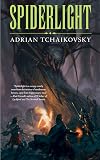
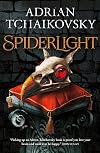
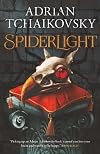
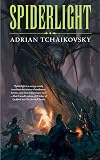
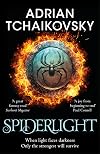
Spiderlight
by Adrian Tchaikovsky
On This Page
Description
The Church of Armes of the Light has battled the forces of Darkness for as long as anyone can remember. The great prophecy has foretold that a band of misfits, led by a high priestess will defeat the Dark Lord Darvezian, armed with their wits, the blessing of the Light and an artifact stolen from the merciless Spider Queen. Their journey will be long, hard and fraught with danger. Allies will become enemies; enemies will become allies. And the Dark Lord will be waiting, always waiting ...Tags
Recommendations





Member Reviews
If you have a heroic band confronting spiders to get the magic they need to fight the Dark Lord, you don’t expect the spiders to be morally superior to the noble band. But then you remember that you are reading Adrian Tchaikovsky. He makes you love spiders as much as he evidently does. A human-spider hybrid named Enth leads the band on the “spider’s path.” They don’t deserve the help they get. But the Dark Lord is no paragon either. No one pulls the rug out from under genre tropes the way Adrian T does.
The book blurb is misleading. It would have you believe that this is just a straight up high fantasy novel about a quest to defeat the typical evil overlord. While it certainly starts out that way, with the familiar collection of D&D characters fighting their way through a forest that is the home to the nest of a terrible spider queen, it's more than that. After that opening, we get to meet the characters and learn more about them. Rather than being the noble sort that one would get from Tolkien, we get a fractious lot prone to jealousy, self-righteousness, hypocrisy, sexism, vanity, and cruelty.
And these are the good guys!
Tchaikovsky, ever the arachnophile, serves up a spider character that is forced to join the group on its quest. I show more don't want to give too much away here, but the character, Enth, serves as a focal point for the group's ethical dilemmas. The way each character interacts with Enth reveals their true nature. Those with a conscience are forced to reconcile their actions and attitudes with the cause they claim to serve. Some succeed; others don't bother.
But it isn't all soul searching in the dark by candlelight. There are some lighter parts.
Usually it's the thief, Lief, that delivers the satirical jabs, but he's also the one who's the most accepting of others who fail to live up to the lofty standards established by the self-righteous.
In the final confrontation with the Dark Lord, Tchaikovsky steers clear of the expected epic fantasy showdown. Sure there's a battle, but Darvezian's monologuing is more savage than his physical attacks, skewering the characters' belief system and self-worth and shredding them to bits.
Spiderlight sets aside the everyday tropes of the epic fantasy tale and opts instead to explore themes that are rarely discussed in the genre. The characters' ethical dilemmas easily translate to the real world: Misguided faith will make people do terrible things, and assuming that everyone of a certain demographic is inherently good/evil, despite actions to the contrary, is fallacy. I found Tchaikovsky's choice to be a refreshing take on the genre.
4.5 stars rounded up to 5 stars because I stopped what I was doing just so I could finish the last 10% of the book. That doesn't happen often. show less
And these are the good guys!
Tchaikovsky, ever the arachnophile, serves up a spider character that is forced to join the group on its quest. I show more don't want to give too much away here, but the character, Enth, serves as a focal point for the group's ethical dilemmas. The way each character interacts with Enth reveals their true nature. Those with a conscience are forced to reconcile their actions and attitudes with the cause they claim to serve. Some succeed; others don't bother.
But it isn't all soul searching in the dark by candlelight. There are some lighter parts.
When Dion considered the world, her chief question was, Is this of Light or Dark? Penthos's main interest was usually, Is this flammable?
-------
"Shut up, Penthos," Haranthes snapped at him, which would earn the man another week of impotence once they got back to civilization, not that he'd ever suspect who was behind his intermittent problem. Oh it's good to be a magus.
-------
"Who would live at the top of a tower? Have you seen how many fucking stairs there are?"
Usually it's the thief, Lief, that delivers the satirical jabs, but he's also the one who's the most accepting of others who fail to live up to the lofty standards established by the self-righteous.
Am I really about to rescue a monstrous servant of evil from the hands of the righteous?
Enth whimpered. It was a human sound. Lief knew it: he himself had once or twice been beaten and broken just enough to make that sound.
Fuck the righteous.
In the final confrontation with the Dark Lord, Tchaikovsky steers clear of the expected epic fantasy showdown. Sure there's a battle, but Darvezian's monologuing is more savage than his physical attacks, skewering the characters' belief system and self-worth and shredding them to bits.
"You go through life doing terrible, terrible things to each other, and to everything else, but you somehow still believe that you're right."
-------
"Let me hear the sad little sound of your hearts breaking."
-------
"My child, it doesn't matter if you do your best, if you don't get anywhere. It's just doubly pathetic that this, only this was your best."
Spiderlight sets aside the everyday tropes of the epic fantasy tale and opts instead to explore themes that are rarely discussed in the genre. The characters' ethical dilemmas easily translate to the real world: Misguided faith will make people do terrible things, and assuming that everyone of a certain demographic is inherently good/evil, despite actions to the contrary, is fallacy. I found Tchaikovsky's choice to be a refreshing take on the genre.
4.5 stars rounded up to 5 stars because I stopped what I was doing just so I could finish the last 10% of the book. That doesn't happen often. show less
It starts out sounding like a D&D campaign but it becomes so much more. It goes gradually from being very light to becoming quite dark.
There is plenty of humor but also depth.
There are some of your typical Tchaikovsky trademarks: a fascination for insects, subverting expectations, playing with tropes, moral relativity, blending magic with science and a somewhat surprising setting.
This was a fantastic read. One of the best books of the year. Expertly narrated by the author himself.
Favourite part: a theological debate on what God might have meant by a prophecy. I never saw anything like that. Simply superb.
There is plenty of humor but also depth.
There are some of your typical Tchaikovsky trademarks: a fascination for insects, subverting expectations, playing with tropes, moral relativity, blending magic with science and a somewhat surprising setting.
This was a fantastic read. One of the best books of the year. Expertly narrated by the author himself.
Favourite part: a theological debate on what God might have meant by a prophecy. I never saw anything like that. Simply superb.
This was bananas.
To be clear, the 'bananas' part is the fact that I ended up in a completely different emotional place than I expected after reading the first three chapters. Not in the 'weird fiction' kind of way, but in the feels. I'm not going to say much without spoiling it, so I'll put the whole review under spoilers and subspoilers.
The quick version: Dungeons and Dragons questing crossed with [b:Ishmael|40611328|Ishmael|Daniel Quinn|https://i.gr-assets.com/images/S/compressed.photo.goodreads.com/books/1529680413l/40611328._SY75_.jpg|1041162].
I'm not one for epic-style fantasy these days; it feels terribly predictable and just isn't where my interest lies. I somewhat reluctantly interrupted my PNR binging because of an Amazon sale, Tchaikovsky's name, and friends at the Oasis. It opens with a chapter from a spider point of view, bringing to mind the sure-to-be-classic [b:Children of Time|25499718|Children of Time (Children of Time, #1)|Adrian Tchaikovsky|https://i.gr-assets.com/images/S/compressed.photo.goodreads.com/books/1431014197l/25499718._SY75_.jpg|45276208], but before long, grows to include the viewpoints of an equally classic adventuring party of cleric, mage, thief, archer and fighter. There's enough humor that I wondered if Tchaikovsky was channeling [a:Terry Pratchett|1654|Terry Pratchett|https://images.gr-assets.com/authors/1235562205p2/1654.jpg].
"She worried about Penthos. Mostly it was the unleashed power and the setting things on fire, but at the moment it was more that his desire to show off could compromise their quest."
Then I remembered that Tchaikovsky isn't a great fan of individual human behavior, recognizing our limitations. The human part of the adventuring party is filled with biases and self-righteousness. The Thief's remarks often draw the reader's attention into their foibles, but their own thoughts also betray them.
"She was constantly tempted to draw forth the disc of Armes and expose the monster to her faith’s holy Light, just to reassure herself that she had power over it."
But I forgot that although Tchaikovsky isn't as showy as some of my favorite authors, he often has a beautifully turned phrase. Granted, it's usually used to tear into my empathy, but still.
"Gone the armored exoskeleton, so that all of him was one great wound waiting to be opened."
Everyone in the party, save one, goes through an ethical crisis in varying degrees. I suppose that's traditional as well, but in this case, we have Enth as the individual standing in for the normal philosophical explorations between party members.
"Everything in this quest had become an exercise in compromise, and every compromise eroded the vaunted purity of her status as a priestess of Armes."
The humor becomes more of a memory as the journey continues, but still makes appearances:
"Then the two of them were out and on the streets of the holiest city in the world: a man-monster and a woman who punched monks."
Then, Tchaikovsky does something quite masterful and quite heart-rending, at least to this reader who has over-developed empathy for the non-human. It was fucking brilliant, and I completely had to take a break.
The rest was a bit of plateau for me; not bad in quality or tension, but certainly not as emotionally impactful. The penultimate conflict was somewhat terrible in its resolution. I'd love to have the insight into Tchaikovsky's thinking as he plotted it.
"And he understood, then, that what he was feeling now—what it was pushing him to do—might be magical compulsion, or it might be a choice made of his own free will, and he had no way of knowing which was which."
Many thanks to Stephen and Nataliya for their buddy read! I realize that a lot of my excited rating had to do with our great discussion, so I tempered down a little bit. Not sure this would meet the re-read category for me. show less
To be clear, the 'bananas' part is the fact that I ended up in a completely different emotional place than I expected after reading the first three chapters. Not in the 'weird fiction' kind of way, but in the feels. I'm not going to say much without spoiling it, so I'll put the whole review under spoilers and subspoilers.
The quick version: Dungeons and Dragons questing crossed with [b:Ishmael|40611328|Ishmael|Daniel Quinn|https://i.gr-assets.com/images/S/compressed.photo.goodreads.com/books/1529680413l/40611328._SY75_.jpg|1041162].
I'm not one for epic-style fantasy these days; it feels terribly predictable and just isn't where my interest lies. I somewhat reluctantly interrupted my PNR binging because of an Amazon
"She worried about Penthos. Mostly it was the unleashed power and the setting things on fire, but at the moment it was more that his desire to show off could compromise their quest."
Then I remembered that Tchaikovsky isn't a great fan of individual human behavior, recognizing our limitations. The human part of the adventuring party is filled with biases and self-righteousness. The Thief's remarks often draw the reader's attention into their foibles, but their own thoughts also betray them.
"She was constantly tempted to draw forth the disc of Armes and expose the monster to her faith’s holy Light, just to reassure herself that she had power over it."
But I forgot that although Tchaikovsky isn't as showy as some of my favorite authors, he often has a beautifully turned phrase. Granted, it's usually used to tear into my empathy, but still.
"Gone the armored exoskeleton, so that all of him was one great wound waiting to be opened."
Everyone in the party, save one, goes through an ethical crisis in varying degrees. I suppose that's traditional as well, but in this case, we have Enth as the individual standing in for the normal philosophical explorations between party members.
"Everything in this quest had become an exercise in compromise, and every compromise eroded the vaunted purity of her status as a priestess of Armes."
The humor becomes more of a memory as the journey continues, but still makes appearances:
"Then the two of them were out and on the streets of the holiest city in the world: a man-monster and a woman who punched monks."
Then, Tchaikovsky does something quite masterful and quite heart-rending, at least to this reader who has over-developed empathy for the non-human. It was fucking brilliant, and I completely had to take a break.
The rest was a bit of plateau for me; not bad in quality or tension, but certainly not as emotionally impactful. The penultimate conflict was somewhat terrible in its resolution. I'd love to have the insight into Tchaikovsky's thinking as he plotted it.
"And he understood, then, that what he was feeling now—what it was pushing him to do—might be magical compulsion, or it might be a choice made of his own free will, and he had no way of knowing which was which."
Many thanks to Stephen and Nataliya for their buddy read! I realize that a lot of my excited rating had to do with our great discussion, so I tempered down a little bit. Not sure this would meet the re-read category for me. show less
Nth, my dear sweet baby, ignore whatever names Penthos is throwing at you!
I finally had the chance to read something by Adrian Tchaikovsky, and he did not disappoint. If I hadn’t been in the middle of packing, unpacking, and living out of boxes when I started Spiderlight, I probably would’ve finished it in under a week. Tchaikovsky’s style is smooth and easy to sink into; the story flows beautifully, making it a great read at the end of long, stressful days.
Now, confession time—and this one’s entirely on me. Imagine me, an arachnophobe, picking up a book literally called Spiderlight. My brain just refused to do basic math. Even so, despite one of the main characters being a literal man-spider, I still found the book incredibly show more engaging. Whenever the word “spider” popped up, my brain did me a favor and translated it into “fluffers", so everything worked out fine.
The plot moves quickly and with purpose, the cast is diverse, chaotic, and entertaining, and my favorite character, if it’s not obvious already, is Nth. His POVs were innocent and refreshing, and a bit miserable, especially when certain characters (looking at you, Penthos) treated him cruelly. He’s easily the emotional center of the story for me.
The drawback for me, aside from certain questionable romance plot lines in the second half of the book, was that the worldbuilding and magic system felt a little underdeveloped. The scope of the characters’ powers didn’t seem to have clear limits, which pulled me out of it now and then. But between the heist elements, side quests, religious views, and sharp banter, I was more than happy to keep turning pages.
Thank you, NetGalley and Pan Macmillan, for the ARC! show less
I finally had the chance to read something by Adrian Tchaikovsky, and he did not disappoint. If I hadn’t been in the middle of packing, unpacking, and living out of boxes when I started Spiderlight, I probably would’ve finished it in under a week. Tchaikovsky’s style is smooth and easy to sink into; the story flows beautifully, making it a great read at the end of long, stressful days.
Now, confession time—and this one’s entirely on me. Imagine me, an arachnophobe, picking up a book literally called Spiderlight. My brain just refused to do basic math. Even so, despite one of the main characters being a literal man-spider, I still found the book incredibly show more engaging. Whenever the word “spider” popped up, my brain did me a favor and translated it into “fluffers", so everything worked out fine.
The plot moves quickly and with purpose, the cast is diverse, chaotic, and entertaining, and my favorite character, if it’s not obvious already, is Nth. His POVs were innocent and refreshing, and a bit miserable, especially when certain characters (looking at you, Penthos) treated him cruelly. He’s easily the emotional center of the story for me.
The drawback for me, aside from certain questionable romance plot lines in the second half of the book, was that the worldbuilding and magic system felt a little underdeveloped. The scope of the characters’ powers didn’t seem to have clear limits, which pulled me out of it now and then. But between the heist elements, side quests, religious views, and sharp banter, I was more than happy to keep turning pages.
Thank you, NetGalley and Pan Macmillan, for the ARC! show less
Great sword and sorcery from Tchaikovsky adding to the genres he writes in. As you might guess fromt he title it features Spiders again, so don't read if you're phobic. Perhaps not quite as bad as the SF version, which is more famous. I don't know which came first.
This is the traditional band of heroes, mage fight thief ranger and lead by a cleric. They have a prophecy to defat the Dark Lord and vow to succeed where many have failed before them. It requires both a Spider Fang and the path of the Spider, and this is where the story opens, with our valiant heroes destroying a horde of giant spiders in order to reach the Brood Mother. Communication is established and she sacrifices Nth to the group so that the rest of her nest may survive. show more The Heroes now have to work out a way to transport a giant spider through the land s of Light to the Dark Lords tower. the mage suggests a transformation, and lacking better alternatives Enth joins the party. At first he can hardly walk let alone speak, but as they progress he becomes more human and less monstrous - to the dismay of the righteous and leaving them with several moral quandaries. There's some nice tongue in cheek homage to Tolkein and Mordor, and more generally at the fantasy worlds with their clearly defined Evil and Good. I much enjoyed this more ambiguous look which is closer to reality.
Fast paced well balanced and carefully crafted it's great fun. Don't take it too seriously, but the underlying message of how we determine a monster remains pertinent to all. show less
This is the traditional band of heroes, mage fight thief ranger and lead by a cleric. They have a prophecy to defat the Dark Lord and vow to succeed where many have failed before them. It requires both a Spider Fang and the path of the Spider, and this is where the story opens, with our valiant heroes destroying a horde of giant spiders in order to reach the Brood Mother. Communication is established and she sacrifices Nth to the group so that the rest of her nest may survive. show more The Heroes now have to work out a way to transport a giant spider through the land s of Light to the Dark Lords tower. the mage suggests a transformation, and lacking better alternatives Enth joins the party. At first he can hardly walk let alone speak, but as they progress he becomes more human and less monstrous - to the dismay of the righteous and leaving them with several moral quandaries. There's some nice tongue in cheek homage to Tolkein and Mordor, and more generally at the fantasy worlds with their clearly defined Evil and Good. I much enjoyed this more ambiguous look which is closer to reality.
Fast paced well balanced and carefully crafted it's great fun. Don't take it too seriously, but the underlying message of how we determine a monster remains pertinent to all. show less
Rating: 4.5 stars
This book’s blurb didn’t sound very interesting, but I’m glad I went ahead with it anyway. Rather than a boring old fantasy quest adventure (yawn), we get a spider turned into a man (of sorts) who allows us to see the hypocrisy of the characters on the side of the Light. The spider, Nth or Enth (depending on whether he’s in spider or human form), is a creature of Darkness who gets dragged into Dion’s mission to defeat the Dark Lord. Dion, a priestess of the Light, would be an admirable character in any other book, but we rapidly see her flaws and the rigidity of her mindset here.
Parts of the book read as a kind of tongue-in-cheek spoof of the typical fantasy adventure, right down the title of the first show more chapter: Mirkwood Blues. Overall it has some very serious themes among the laughs, though, and I recommend it. show less
This book’s blurb didn’t sound very interesting, but I’m glad I went ahead with it anyway. Rather than a boring old fantasy quest adventure (yawn), we get a spider turned into a man (of sorts) who allows us to see the hypocrisy of the characters on the side of the Light. The spider, Nth or Enth (depending on whether he’s in spider or human form), is a creature of Darkness who gets dragged into Dion’s mission to defeat the Dark Lord. Dion, a priestess of the Light, would be an admirable character in any other book, but we rapidly see her flaws and the rigidity of her mindset here.
Parts of the book read as a kind of tongue-in-cheek spoof of the typical fantasy adventure, right down the title of the first show more chapter: Mirkwood Blues. Overall it has some very serious themes among the laughs, though, and I recommend it. show less
Members
- Recently Added By
Lists

Books Read in 2023
5,638 works; 147 members

Kindle Fantasy/Science Fiction Re-Read
152 works; 1 member
Author Information

135+ Works 28,277 Members
Adrian Tchaikovsky is a British fantasy and science fiction author, born on June 14, 1972 in Woodhall Spa, Lincolnshire. He studied Zoology and Psychology at the University of Reading. His career focus changed to law and has worked as a Legal Executive in both Reading and Leeds. He's the author of the Shadows of the Apt series, and his standalone show more novel Children of Time is the winner of the 2016 Arthur C Clarke Award for Best Science Fiction Novel. (Bowker Author Biography) show less
Common Knowledge
- Original publication date
- 2016
- People/Characters
- Dion; Enth
- Quotations
- Lief himself said nothing, because he was thinking about all those powerful men and women of the Light sitting on their hands for decades, knowing that Darvezian was out there, and defeatable, but feeling no particular inclin... (show all)ation to go do it, because they knew that someone else would eventually take up the slack. Which is exactly the problem with prophesies.
-page 86
Classifications
Statistics
- Members
- 283
- Popularity
- 114,395
- Reviews
- 17
- Rating
- (4.03)
- Languages
- English, Hungarian, Spanish
- Media
- Paper, Audiobook, Ebook
- ISBNs
- 13
- ASINs
- 4