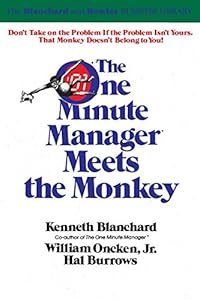
The One Minute Manager Meets the Monkey
by Ken Blanchard, Hal Burrows (Author), William Oncken, Jr.
One Minute
On This Page
Description
Teaches managers how to become effective supervisors of time, energy, and talent.Tags
Recommendations












Member Reviews
The heart of this book is to empower people by not doing their work, e.g. delegate. During meetings there are "monkeys" (e.g. tasks) which will end up on someones back. A fatal mistake made by managers is that they hold onto the "monkeys" when they have their team members wait for the manager to review a plan, provide feedback on a proposal, "clean up" the document, etc. This is fundamentally dis-empowering. I read this book during a time when I felt overwhelmed by work. I was trying to mentor and coach people, but I was regularly blocking people's forward progress by offering to review work (that didn't really need an extra review cycle), etc.
A short book for managers/team leaders on managing the many responsibilities of a team. Really hammers the message that others need to become empowered and responsible. I liked the stories, even if they are a little dated.
One of the best written descriptions of chaotic work environments and why we are all over worked. Should be mandatory reading for all Middle School students on up.
Had some good practical advise about how to avoid letting other people pile their work up on you.
This was required reading for a leadership class.
This was required reading for a leadership class.
The One Minute Manager's symbol -- a one-minute readout from the face of a modern digital watch -- is intended to remind each of us to take a minute out of our day to look into the faces of the people we manage. And to realize that they are our most important resources.
The Monkey Manager's symbol -- a harried manager overwhelmed by a deskful of problems -- is intended to remind us to constantly discipline ourselves to invest our time on the most vital aspects of management rather than dilute our effectiveness by "doing more efficiently those things that shouldn't be done in the first place."
The Monkey Manager's symbol -- a harried manager overwhelmed by a deskful of problems -- is intended to remind us to constantly discipline ourselves to invest our time on the most vital aspects of management rather than dilute our effectiveness by "doing more efficiently those things that shouldn't be done in the first place."
Zwei Zitate zum Anfang: "Warum haben eigentlich Manager nie genug Zeit und ihre Mitarbeiter nie genug Arbeit?" und "was man nicht zu machen braucht, braucht man nicht auch noch gut zu machen". Der ganze Text dreht sich um die "Klammeraffen", hier als Sinnbild für zu lösende Probleme zu sehen. Ein "Affe" ist dabei aber nicht als ganzes Projekt, sondern nur als der nächste Schritt in einem Projekt zu verstehen. Die Kernfrage dabei ist: Wem gehört der Affe? Wer ist dafür verantwortlich, dass es dem Affen gut geht? Und, an erster Stelle: Wie schaffe ich es als Führungskraft, nur meine, aber nicht die Affen meiner Mitarbeiter zu versorgen?
Viele praktische Denkanregungen, gewürzt mit auf den Punkt bringenden Sprüchen, verpackt in show more einen gut lesbaren Text. Dieses Büchlein, entspannt an einem Sonntagvormittag gelesen, zeigt auf, wie es mit dem managen klappen kann - von ersten Schritten, übers Coaching bis hin zur Delegation. So dass am Ende das gute Gefühl nicht mehr vom "Selbermachen" sondern vom managen, also vom "Mitarbeiter waren erfolgreich" kommt. Und der Anteil freier Zeit in der selbstbestimmten Zeit schließlich den der Mitarbeiterzeit überwiegt - dann bleibt genügend Zeit für die Pflege der eigenen "Affen" und die "Affen", die aus der "Systemzeit" oder der "Vorgesetztenzeit" herüberwandern können. show less
Viele praktische Denkanregungen, gewürzt mit auf den Punkt bringenden Sprüchen, verpackt in show more einen gut lesbaren Text. Dieses Büchlein, entspannt an einem Sonntagvormittag gelesen, zeigt auf, wie es mit dem managen klappen kann - von ersten Schritten, übers Coaching bis hin zur Delegation. So dass am Ende das gute Gefühl nicht mehr vom "Selbermachen" sondern vom managen, also vom "Mitarbeiter waren erfolgreich" kommt. Und der Anteil freier Zeit in der selbstbestimmten Zeit schließlich den der Mitarbeiterzeit überwiegt - dann bleibt genügend Zeit für die Pflege der eigenen "Affen" und die "Affen", die aus der "Systemzeit" oder der "Vorgesetztenzeit" herüberwandern können. show less
Feb 6, 2011German
дочитала
Jun 22, 2011Russian
Members
- Recently Added By
Author Information

225+ Works 17,845 Members
Kenneth Hartely Blanchard was born May 6, 1939, in Orange, New Jersey. He married Marjorie McKee, a business consultant, in 1962. He founded Blanchard Training and Development in 1977. Blanchard has cowritten several books on management, including one of the best-selling management books of all time, The One-Minute Manager (1982) with Spencer show more Johnson. In the book, the authors describe effective and efficient management skills. The basics to good management are setting goals, praising, and reprimanding. Blanchard says that these skills can easily be translated to work in the home as well as the office. Blanchard lives in San Diego, California. (Bowker Author Biography) show less
1 Work 795 Members
Series

Common Knowledge
- Canonical title
- The One Minute Manager Meets the Monkey
Classifications
Statistics
- Members
- 795
- Popularity
- 34,770
- Reviews
- 7
- Rating
- (3.93)
- Languages
- 8 — Dutch, English, German, Hungarian, Italian, Norwegian (Bokmål), Spanish, Swedish
- Media
- Paper, Audiobook, Ebook
- ISBNs
- 20
- ASINs
- 7