
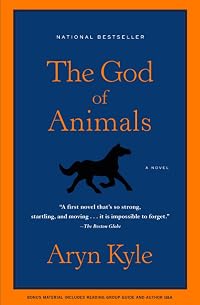
The God of Animals
by Aryn Kyle
On This Page
Description
When her older sister runs away to marry a rodeo cowboy, Alice Winston is left to bear the brunt of her family's troubles -- a depressed, bed-ridden mother, a reticent, overworked father, and a rundown horse ranch. As the hottest summer in fifteen years unfolds and bills pile up, Alice is torn between dreams of escaping the loneliness of her duty-filled life and a longing to help her father mend their family and the ranch...Tags
Recommendations






Member Recommendations

Member Reviews
The God of Animals reminded me a great deal of A Thousand Acres by Jane Smiley, very harsh and Shakespearean. Making your living off the land is a hard way to go, and trying to be a poor horse rancher catering to the rich takes all the vicissitudes of working with nature and mixes it with the crushing burden of the class system. A reverence for life is constantly at war with an indifference to the living. This is a very harsh and very good book.
I consider myself to be an avid and open-minded reader, but probably wouldn't have picked up a title about a young girl and horses, but I thought I would give it a try since The BPP selected it for the book club.
I grew up with friends who raised and showed horses and was taken back to hot summer days hanging out in the horse barn watching the preparations to show these magnificent animals. Little did I know how much really went in to preparing these horses for the show ring? It is indeed a "show."
I really felt that Kyle created an excellent juxtaposition of the illusion of the horse show and the illusion that surrounded so much of Alice's life. Kyle revealed the layers of artifice that created the image of the horses in the show ring show more and the artifice that made up the lives of the characters: Sheila's parent's marriage, Nona and Jerry's marriage, Joe and Marian's marriage, Alice's friendship with Polly and with Mr. Delmar, Marian's appearances downstairs when Ruby and Jack visit, Joe and Patty Jo's relationship and the Catfish themselves and the list goes on. I was particularly moved by the complicated relationship between Alice and her father. Joe was extremely conflicted by his troubled relationship with Nona and Marian and was desperately trying to preserve his relationship with Alice while at the same time threatening to drive her away.
Kyle revealed a great deal about each of the characters as the novel progressed, but she didn't neatly tie-up the characters or their storylines. This made the reading of this even more compelling. I hoped with each page, I would know why Nona ran off with Jerry and why Marian couldn't stay downstairs. Kyle hinted at these things, but never laid them out completely. I appreciated that.
I was particularly moved during Alice's phone conversation with Mr. Delmar when she says, "It just seems like there should be someone, something out there that cares about then, cares that they existed, that they suffered or didn't." "Something out there ought to be watching over them." Alice is seeking The God of Animals. show less
I grew up with friends who raised and showed horses and was taken back to hot summer days hanging out in the horse barn watching the preparations to show these magnificent animals. Little did I know how much really went in to preparing these horses for the show ring? It is indeed a "show."
I really felt that Kyle created an excellent juxtaposition of the illusion of the horse show and the illusion that surrounded so much of Alice's life. Kyle revealed the layers of artifice that created the image of the horses in the show ring show more and the artifice that made up the lives of the characters: Sheila's parent's marriage, Nona and Jerry's marriage, Joe and Marian's marriage, Alice's friendship with Polly and with Mr. Delmar, Marian's appearances downstairs when Ruby and Jack visit, Joe and Patty Jo's relationship and the Catfish themselves and the list goes on. I was particularly moved by the complicated relationship between Alice and her father. Joe was extremely conflicted by his troubled relationship with Nona and Marian and was desperately trying to preserve his relationship with Alice while at the same time threatening to drive her away.
Kyle revealed a great deal about each of the characters as the novel progressed, but she didn't neatly tie-up the characters or their storylines. This made the reading of this even more compelling. I hoped with each page, I would know why Nona ran off with Jerry and why Marian couldn't stay downstairs. Kyle hinted at these things, but never laid them out completely. I appreciated that.
I was particularly moved during Alice's phone conversation with Mr. Delmar when she says, "It just seems like there should be someone, something out there that cares about then, cares that they existed, that they suffered or didn't." "Something out there ought to be watching over them." Alice is seeking The God of Animals. show less
this is a beautiful, bleak story of a young girl growing up on a failing horse ranch. the breaking of the horses and what they all go through to keep afloat sort of mirrors the ups and downs of her coming of age. but really it's just a quiet, well written story about how hard life can be and (maybe) finding the bright spots in it. really gorgeous.
I fully expected this to be a mediocre book, and yet found myself sobbing at the end. Kyle writes her young narrator's voice with style and sensitivity. Her emotions become yours, her loneliness and isolation felt by you. You share her joys and triumphs and her fears. I would highly recommend this book, even if you don't care a fig for horses (and I really don't)!
I liked this a lot. It's coming of age with horses, but not starry-eyed Pony Club horses. This is about the reality of making a living from animals: they're not always predictable, the danger and occasional violence of what it means to wean a foal or break a horse. I was never a horsey girl, but this version of it was interesting to me.
Alice is a great character, 12 years old, not always likeable or nice, but you understand her and why she does what she does. Her family is dysfunctional, but none of the characters are one-note, and they all surprise Alice at some point in the book.
Alice is a great character, 12 years old, not always likeable or nice, but you understand her and why she does what she does. Her family is dysfunctional, but none of the characters are one-note, and they all surprise Alice at some point in the book.
A run-down ranch, a family divided by chasms in close proximity, an immersive, increasingly untenable way of life—"The God of Animals" is the story of a thirteen-year-old girl, but it is also the story of a disappearing lifestyle once crucial to the American narrative: work on the land, the horse and its rider, survival because of, in spite of the natural world.
“The people who lived on our side of town had been born here, and their parents before them. There were no new restaurants, no clean white houses. No one complained of dry skin. As the valley transformed around us, the locals relied on the history of weather to discriminate between those who could be trusted and those who could not.”
In a library of novels driven by show more precocious child-narrators, Aryn Kyle's Alice Winston stands out, not for her gifts, but because she does not posses the right ones. Coming of age in a culture that rewards remarkable riders, Alice is an outsider, a diligent worker, a utilitarian rancher and a child struggling with classic conundrums, textured by context: the strictures of family, the opacity of human relationships, the right-angled road away from home. To earn a livelihood, she and her family must perpetuate their clients’ idea that animals' principle utilities are entertainment and pleasure, while behind the scenes the Winston’s work brings them into daily contact with life’s brutality. Through Alice’s attentive observation, Kyle explores the contradictions that emerge when a way of life is reduced to fetishized culture.
“The boarders whispered and giggled like children, addressing each other as girls—‘Girls, we need more drinky-drinks,’ and, ‘I’ve had the most fabulous idea, girls!’ … And while I didn’t want to pay attention to them, didn’t want to admit that I noticed them at all, they always seemed to be having more fun than anyone else. I couldn’t stop watching.”
In "The God of Animals," readers confront an America in transition, the threat posed by homogeneity, and the loneliness that envelops those who live at its threshold.
~Carlin M. Wragg, Editor, Open Loop Press show less
“The people who lived on our side of town had been born here, and their parents before them. There were no new restaurants, no clean white houses. No one complained of dry skin. As the valley transformed around us, the locals relied on the history of weather to discriminate between those who could be trusted and those who could not.”
In a library of novels driven by show more precocious child-narrators, Aryn Kyle's Alice Winston stands out, not for her gifts, but because she does not posses the right ones. Coming of age in a culture that rewards remarkable riders, Alice is an outsider, a diligent worker, a utilitarian rancher and a child struggling with classic conundrums, textured by context: the strictures of family, the opacity of human relationships, the right-angled road away from home. To earn a livelihood, she and her family must perpetuate their clients’ idea that animals' principle utilities are entertainment and pleasure, while behind the scenes the Winston’s work brings them into daily contact with life’s brutality. Through Alice’s attentive observation, Kyle explores the contradictions that emerge when a way of life is reduced to fetishized culture.
“The boarders whispered and giggled like children, addressing each other as girls—‘Girls, we need more drinky-drinks,’ and, ‘I’ve had the most fabulous idea, girls!’ … And while I didn’t want to pay attention to them, didn’t want to admit that I noticed them at all, they always seemed to be having more fun than anyone else. I couldn’t stop watching.”
In "The God of Animals," readers confront an America in transition, the threat posed by homogeneity, and the loneliness that envelops those who live at its threshold.
~Carlin M. Wragg, Editor, Open Loop Press show less
God of Animals, by Aryn Kyle, is an unflinching, powerful, honest, and achingly beautiful coming-of-age tale set in the American West. The period is most likely the mid-1970s—a time before computers, the Internet, cell-phones, satellite T.V., and antidepressant medications. The story is told entirely from the point of view of Alice Winston, a lonely twelve-year-old growing up on an aging horse ranch in Desert Valley, Colorado. There are two transitions that take place over the course of the novel: one involves the ranch moving in a new direction, and the other involves Alice growing into adolescence. Both are wrought with difficulty and pain.
The ranch has been in the family for three generation, but it’s fallen on hard times and may show more not survive. Rich suburbs are taking root everywhere and the ranchers must adapt or fail. The days of proud horse breeding are over. The new business is catering to the needs of wealthy suburban horse lovers. It’s the direction and reality of modern life. There is nothing they can do to halt it.
Alice’s transition into adolescence is just as inevitable and wrenching, but there’s a twist. At twelve, Alice is already an adult. It’s primarily Alice’s body that’s undergoing change, but naturally the bodily changes induce a flood of emotional and psychological changes as well. It is these that Alice has difficulty understanding, and there is no one in her life to help. Alice’s mother is clinically depressed—she’s barely left her bedroom since Alice was a baby. Once a star horsewoman, now she is a mental invalid incapable of parenting Alice in any meaningful way. Alice’s father, Joe, is overwhelmed keeping his business afloat, and is blind to his daughter’s emotional needs. He fails his daughter at every turn. Alice has had to parent herself—in almost every way, she is mature beyond her years. Alice’s older sister is gone. She ran away a year ago to marry a cowboy. Alice has no friends—she’s different, isolated, not like the other primarily suburban girls that populate her school. Adding to her emotional anguish, a classmate recently drowned. It’s a difficult time, and Alice feels isolated, alone, adrift, and abandoned.
Alice’s father, Joe, treats her like an adult ranch hand. When she’s not at school, she’s expected to do a man’s work. Joe is a rough unsentimental realist, and is obviously trying to raise Alice in the same mold. But Alice is having a hard time remaining unsentimental. Unlike her father, she is acutely aware of the emotional side of life, particularly the emotional needs of animals. She looks at their suffering and feels that the world is as blind to their needs as it is to hers. With practiced detachment, she takes in all the everyday cruelty and abuse that often forms the foundation of ranching. Outwardly, she does not flinch, but inwardly she rails against it. Alice knows all too well that the world can be cruel and unforgiving.
Two adults eventually enter Alice’s life and offer her some degree of emotional support. Unfortunately, she finds out that both are merely using her to achieve their own private agendas.
This is a simple story about everyday realities. I loved both the human and animal characters, as well as the rich acceptance of reality that underscore this humane novel. I also loved the author’s fresh, powerful prose.
Don’t read this novel if you are looking for a strong compelling story leading to a definite conclusion. This is not that type of novel. This is a subtle, unflinchingly honest view of life in all its complexity. It is a book about coming to terms with the reality of human isolation and cruelty. It’s about making peace with the dark core of humanity.
My eyes brimmed with tears when I finished this novel—not with sadness, but with acceptance and truth. show less
The ranch has been in the family for three generation, but it’s fallen on hard times and may show more not survive. Rich suburbs are taking root everywhere and the ranchers must adapt or fail. The days of proud horse breeding are over. The new business is catering to the needs of wealthy suburban horse lovers. It’s the direction and reality of modern life. There is nothing they can do to halt it.
Alice’s transition into adolescence is just as inevitable and wrenching, but there’s a twist. At twelve, Alice is already an adult. It’s primarily Alice’s body that’s undergoing change, but naturally the bodily changes induce a flood of emotional and psychological changes as well. It is these that Alice has difficulty understanding, and there is no one in her life to help. Alice’s mother is clinically depressed—she’s barely left her bedroom since Alice was a baby. Once a star horsewoman, now she is a mental invalid incapable of parenting Alice in any meaningful way. Alice’s father, Joe, is overwhelmed keeping his business afloat, and is blind to his daughter’s emotional needs. He fails his daughter at every turn. Alice has had to parent herself—in almost every way, she is mature beyond her years. Alice’s older sister is gone. She ran away a year ago to marry a cowboy. Alice has no friends—she’s different, isolated, not like the other primarily suburban girls that populate her school. Adding to her emotional anguish, a classmate recently drowned. It’s a difficult time, and Alice feels isolated, alone, adrift, and abandoned.
Alice’s father, Joe, treats her like an adult ranch hand. When she’s not at school, she’s expected to do a man’s work. Joe is a rough unsentimental realist, and is obviously trying to raise Alice in the same mold. But Alice is having a hard time remaining unsentimental. Unlike her father, she is acutely aware of the emotional side of life, particularly the emotional needs of animals. She looks at their suffering and feels that the world is as blind to their needs as it is to hers. With practiced detachment, she takes in all the everyday cruelty and abuse that often forms the foundation of ranching. Outwardly, she does not flinch, but inwardly she rails against it. Alice knows all too well that the world can be cruel and unforgiving.
Two adults eventually enter Alice’s life and offer her some degree of emotional support. Unfortunately, she finds out that both are merely using her to achieve their own private agendas.
This is a simple story about everyday realities. I loved both the human and animal characters, as well as the rich acceptance of reality that underscore this humane novel. I also loved the author’s fresh, powerful prose.
Don’t read this novel if you are looking for a strong compelling story leading to a definite conclusion. This is not that type of novel. This is a subtle, unflinchingly honest view of life in all its complexity. It is a book about coming to terms with the reality of human isolation and cruelty. It’s about making peace with the dark core of humanity.
My eyes brimmed with tears when I finished this novel—not with sadness, but with acceptance and truth. show less
Members
- Recently Added By
Lists

Favorite Animal Fiction
359 works; 156 members

Adult Books for YA Readers
194 works; 6 members

Best Horse Stories or "Back in the Saddle Again"
82 works; 17 members
Author Information

4+ Works 1,181 Members
Aryn Kyle is the author of the bestselling novel The God of Animals and a graduate of the University of Montana writing program. Her short stories have appeared in many publications including Best New American Voices 2005 and Best American Short Stories 2007. Her story Foaling Season won a National Magazine Award for Fiction for The Atlantic show more Monthly. She is also the recipient of the American Library Association's Alex Award, the Rona Jaffe Foundation Writers' Award, and other honors. She lives in New York City. show less
Awards and Honors
Awards
Common Knowledge
- Canonical title
- The God of Animals
- Original title
- The god of animals
- Original publication date
- 2007
- People/Characters
- Alice Winston; Joe (Jody) Winston (Jody); Marian Winston; Nona Winston; Polly Cain; Sheila Altman (show all 10); Patty Jo; Mr. Delmar; Jerry; Jack Winston
- Important places
- USA; Colorado, USA; Desert Valley, Colorado, USA
- Dedication
- for my mother
- First words
- Six months before Polly Cain drowned in the canal, my sister, Nona, ran off and married a cowboy.
- Last words
- (Click to show. Warning: May contain spoilers.)And it is in these moments that I remember him clearly, the sound of his voice as he spoke their names, the gentleness of his touch, and the way that he loved, truly loved, every one of them: each of those broken promises, all those dreams that never came true.
- Blurbers
- Greer, Andrew Sean; Meloy, Maile
Classifications
Statistics
- Members
- 1,067
- Popularity
- 24,012
- Reviews
- 54
- Rating
- (3.75)
- Languages
- 5 — Dutch, English, French, German, Polish
- Media
- Paper, Audiobook, Ebook
- ISBNs
- 26
- ASINs
- 5