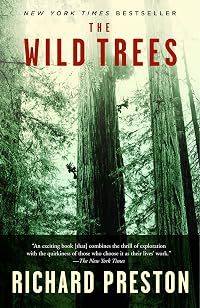
The Wild Trees
by Richard Preston
On This Page
Description
Hidden away in foggy, uncharted rain forest valleys in Northern California are the tallest organisms the world has ever sustained--the coast redwood trees. 96% of the ancient redwood forests have been logged, but the fragments that remain are among the great wonders of nature. The biggest redwoods can rise more than thirty-five stories above the ground, forming cathedral-like structures in the air. Until recently, the canopy at the tops of these majestic trees was undiscovered. Writer show more Preston unfolds the story of the daring botanists and amateur naturalists that found a lost world above California, dangerous, hauntingly beautiful, and unexplored. The deep redwood canopy is a vertical Eden filled with mosses, lichens, spotted salamanders, hanging gardens of ferns, and thickets of huckleberry bushes, all growing out of massive trunk systems, sometimes hollowed out by fire. Thick layers of soil sitting on limbs harbor animal and plant life unknown to science.--From publisher description. show lessTags
Recommendations














Member Recommendations
Member Reviews
A quick read, but vividly told. The first tale of Steve Sillett and Marwood Harriss freeclimbing a redwood to the top made my tummy clench in a vicarious fear of heights. Preston is particularly good at making the experience of climbing immediate and real. He also pulls together the various people who have interacted with these trees and tells their stories. But central to the book is the place of these millennium-old trees. He notes that the ecology of the canopy is one of great biodiversity, but one that becomes more diverse as the whole grove ages, and thus a tree of only 500 years hasn't had a chance to accumulate the full complement of lichens, and ferns, and even epiphytic bushes and trees that a true old-growth forest show more accumulates. This is a window on time as much as the volume of previously unexplored habitat. But the stories of leaping from tree to tree are still scary. Do you see the two climbers pictured on the cover? I didn't for weeks. show less
At some point reading this book I realized it was a story about the people who climb trees for a living and not a book about the ecosystem of tree canopies. I found this story fascinating and the writing excellent, but I can see why people who thought this was going to be a science book about trees might be impatient or disappointed. The book shines a light on what drives people to do this somewhat unappreciated and very dangerous work, and how a casual assumption can cause even scientists to overlook something that is (literally) right in front of them. That said, I would very much welcome a book that WAS an exploration of the tree canopy ecosystem, though it would obviously be a very different kind of book.
This book takes place in my backyard, my office, and among people I already know. More adventure tale than a revealing of the majesty of northwest California's redwood forests, it is, nonetheless, a book for anyone with a passing interest in the timeless mysteries of these ancient forests.
I know (not well, mind you) a couple of the main characters in the book and Richard Preston portrays them mostly as they're known around here. The valiant lead, Steve Sillett, a young, driven, and clever biologist unlocks the mysteries of the redwood canopy while those within his circle learn to live with his drive and ego. I spoke with Sillett a few weeks ago about his reaction to the book. He was clearly uncomfortable with the amount of personal show more information (a failed marriage, his wife's troubled childhood, joining the exclusive 300' club) but says he had no editorial control over the book. But, he acknowledges that if a popular book by a well-known author brings folks to a better understanding of the endangered redwood forests, then perhaps those personal revelations may serve a greater good.
Preston focuses less on the wonder of the redwoods, however, than on the adventure of climbing up and into the tallest trees on earth. The uniqueness and timelessness of the redwood ecosystem is lost in the emotional and technical thrill of climbing into (and occasionally falling out of) the 360-foot canopy.
Many of us who live and work in the redwood forests know instinctively that this book will encourage others to attempt dangerous climbs into the delicate, untouched world that Sillett and cohorts, through Preston, have unveiled. Others will follow - guerilla climbing is part of the game, Preston reveals - and find their way into the highest branches of these ancient trees seeking only the recreational thrill of great height and athletic accomplishment. Worse still, is the thought of finding their broken bodies lying the bottom of these forever-living giants. This possibility, once generally unconsidered, feels greater now than it did several weeks ago before this book was on the shelves.
Read this book, anyway. It is well-written and Preston carries you along for the adventure. Preston's story is engaging, as are his main characters. Though I know some of the story behind the scenes, I was still compelled by his prose to read through to its conclusion. In the end, however, it's unfortunate that the mighty redwoods are a mere backdrop for those daring and curious enough to climb their awesome heights, rather than the centerpiece of this story. show less
I know (not well, mind you) a couple of the main characters in the book and Richard Preston portrays them mostly as they're known around here. The valiant lead, Steve Sillett, a young, driven, and clever biologist unlocks the mysteries of the redwood canopy while those within his circle learn to live with his drive and ego. I spoke with Sillett a few weeks ago about his reaction to the book. He was clearly uncomfortable with the amount of personal show more information (a failed marriage, his wife's troubled childhood, joining the exclusive 300' club) but says he had no editorial control over the book. But, he acknowledges that if a popular book by a well-known author brings folks to a better understanding of the endangered redwood forests, then perhaps those personal revelations may serve a greater good.
Preston focuses less on the wonder of the redwoods, however, than on the adventure of climbing up and into the tallest trees on earth. The uniqueness and timelessness of the redwood ecosystem is lost in the emotional and technical thrill of climbing into (and occasionally falling out of) the 360-foot canopy.
Many of us who live and work in the redwood forests know instinctively that this book will encourage others to attempt dangerous climbs into the delicate, untouched world that Sillett and cohorts, through Preston, have unveiled. Others will follow - guerilla climbing is part of the game, Preston reveals - and find their way into the highest branches of these ancient trees seeking only the recreational thrill of great height and athletic accomplishment. Worse still, is the thought of finding their broken bodies lying the bottom of these forever-living giants. This possibility, once generally unconsidered, feels greater now than it did several weeks ago before this book was on the shelves.
Read this book, anyway. It is well-written and Preston carries you along for the adventure. Preston's story is engaging, as are his main characters. Though I know some of the story behind the scenes, I was still compelled by his prose to read through to its conclusion. In the end, however, it's unfortunate that the mighty redwoods are a mere backdrop for those daring and curious enough to climb their awesome heights, rather than the centerpiece of this story. show less
In 2013, my husband and I took a lazy drive across the US to Washington state and south down the coast highway to California. We zigzagged through Six Rivers National Forest when traveling to and from a friend's home in Arcata and were suitably amazed by the trees we passed. Unfortunately, most of the trees we saw were viewed only through our car windows and in no way did them justice. Knowing this, we've been eager to make a return trip--this time, we'll be visiting the trees themselves.
Since our trip, I've been fascinated by the redwoods. After reading Richard Preston's "The Wild Trees: A Story of Passion and Daring" I am filled with admiration for and envious of the people who love and climb them, too. Initially, I thought this book show more would be about the trees themselves. In actuality, it is really a story about the people who know these trees best--the botanists and naturalists and just-plain-tree fanciers who spend their free time in the redwood's world. In light of that, I feel it may be mistitled, but I am willing to forgive that mistake!
Although at times this story is more about the people searching for, researching, and climbing redwoods than it is about the trees themselves, wonderful details about the trees can be found in every chapter. I admit I would have liked to know even more about the trees, but not at the expense of losing the personal stories which I found quite charming.
The book is peppered with illustrations of the trees, a few scientific diagrams, and even some random lichens. All are interesting, but I wish there had been many more. I found myself searching online for pictures of the people themselves, the lichens, birds, salamanders, and detailed maps of the area.
I finished the book a little sad that it was over and I think that's the sign of a well-appreciated book. I also finished with a keen interest in tree climbing, botany, and tree canopies--all things I have not thought a great deal about in the past. All in all, I loved it and would recommend it to anyone interested in nature or science-y non-fiction. show less
Since our trip, I've been fascinated by the redwoods. After reading Richard Preston's "The Wild Trees: A Story of Passion and Daring" I am filled with admiration for and envious of the people who love and climb them, too. Initially, I thought this book show more would be about the trees themselves. In actuality, it is really a story about the people who know these trees best--the botanists and naturalists and just-plain-tree fanciers who spend their free time in the redwood's world. In light of that, I feel it may be mistitled, but I am willing to forgive that mistake!
Although at times this story is more about the people searching for, researching, and climbing redwoods than it is about the trees themselves, wonderful details about the trees can be found in every chapter. I admit I would have liked to know even more about the trees, but not at the expense of losing the personal stories which I found quite charming.
The book is peppered with illustrations of the trees, a few scientific diagrams, and even some random lichens. All are interesting, but I wish there had been many more. I found myself searching online for pictures of the people themselves, the lichens, birds, salamanders, and detailed maps of the area.
I finished the book a little sad that it was over and I think that's the sign of a well-appreciated book. I also finished with a keen interest in tree climbing, botany, and tree canopies--all things I have not thought a great deal about in the past. All in all, I loved it and would recommend it to anyone interested in nature or science-y non-fiction. show less
3.5***
The book is subtitled: A Story of Passion and Daring and that is the best description. It reminds me of Krakauer’s book Into the Wild in that Preston describes young men who are brilliant and singular in pursuing their chosen field of study (tree botany), but awkward and distant from most personal relationships.
Steve Sillett and Michael Taylor begin their studies completely independent of one another, but share the wonder and awe for the magnificent California redwoods and a determination to discover the world’s tallest tree. Along the way they discover entire ecosystems and new realms in biodiversity. Known among their peers in the field, they nevertheless shun the spotlight and are obsessively protective of the hidden show more groves where these giants live. That Preston gained their trust and wrote so eloquently about their quest (without revealing the details of the locations of these trees) is a testament to his skill and character as a journalist and writer.
He writes a nonfiction account that is fascinating and compelling. There were a few parts that dragged – mostly when Preston got involved in the story and outlined his own attempts (and that of his family) to learn tree-climbing techniques. Still, while I didn’t think this was as good as his earlier works (The Hot Zone and Demon in the Freezer), I was entertained and interested from beginning to end. show less
The book is subtitled: A Story of Passion and Daring and that is the best description. It reminds me of Krakauer’s book Into the Wild in that Preston describes young men who are brilliant and singular in pursuing their chosen field of study (tree botany), but awkward and distant from most personal relationships.
Steve Sillett and Michael Taylor begin their studies completely independent of one another, but share the wonder and awe for the magnificent California redwoods and a determination to discover the world’s tallest tree. Along the way they discover entire ecosystems and new realms in biodiversity. Known among their peers in the field, they nevertheless shun the spotlight and are obsessively protective of the hidden show more groves where these giants live. That Preston gained their trust and wrote so eloquently about their quest (without revealing the details of the locations of these trees) is a testament to his skill and character as a journalist and writer.
He writes a nonfiction account that is fascinating and compelling. There were a few parts that dragged – mostly when Preston got involved in the story and outlined his own attempts (and that of his family) to learn tree-climbing techniques. Still, while I didn’t think this was as good as his earlier works (The Hot Zone and Demon in the Freezer), I was entertained and interested from beginning to end. show less
I lived in a public housing project until I was eight years old. There were no trees in the project. When I was eight, my family moved to a free standing house on the south-west side of Chicago. The house was quite small, but it had at least 5 trees on the property. On my first day in the new house, I could hardly contain my joy at the prospect of climbing trees. Within a week or two, I had climbed the three smallest trees to the highest branches that would support my weight. The three trees may have been young birches because they had clean white bark and a ladder like formation of branches. I could shinny up any trunk I could get my arms around, and so I did not have to be able to reach the first branch to climb a tree.
After a couple show more of months, I was able to try the second largest tree on the property. It was probably a catalpa, judging by the cigar-shaped pods that grew on it. It was quite a bit larger than the other three, and its bark would shed onto the clothes of anyone who would climb it. Because the first branches were much higher than I could reach, I had to shinny up the trunk abut ten feet to find a comfortable resting place, by which time my clothes would be filthy from the bark. Once I reached the first branch, however, it was a fairly easy climb to other sturdy branches about 50 feet in the air, a point that was well above any of the surrounding roof tops. Since the terrain in Chicago is as flat as a pancake, it seemed that I could see forever from my perch.
The fifth tree was a huge old oak whose trunk was simply too wide for my eight year old arms to circumscribe, and so I was never able to climb that tree.
Having been defeated in my efforts to climb a mature oak that might have been 80 feet tall, imagine how impressed I was to learn that a small group of intrepid climbers had learned to scale 360 foot California redwoods and Douglas firs to the very top. Richard Preston’s Wild Trees is the story of a quirky collection of botanists, arborists, and amateur tree climbers who embarked on a quest to discover and climb the tallest trees in the world. The term and title of the book, wild tree, refers to a previously unclimbed tree.
The heroes and heroine of the story are all archetypical “granola” types one finds in rural California and Oregon. Except for the author, the people in the book appear to be more interested in trees than in other people. In fact, I too found myself more interested in learning about the trees and the techniques of climbing them than about the interactions of the human characters.
The trees themselves, however, are thoroughly interesting. They are the largest living things on earth. Well, maybe their cousins, the sequoias, are a bit more massive, but the redwoods are taller. They are also the oldest living things. Some may have been saplings when Plato was lecturing in the Academy.
Determining which tree is actually the tallest turns out to be easier said than done. One reason is that logging companies cut down the tallest trees in accessible areas. The tallest remaining trees are in truly inaccessible areas where there are no roads and which require long bushwhacking hikes to reach. Another problem is that the tops are usually not visible to anyone standing near them—you have to be quite a distance away to see which tree rises above its neighbors.
The redwoods have a remarkable structure. The tallest ones have no significant branches (i.e., sturdy enough to hold a climber) below 100+ feet above the ground. But once you reach those branches, many of them are larger than mature oak trees. Redwoods often form multiple trunks at great heights. In fact, full grown trees of different species have been found sprouting from redwood trunks high above the ground. Those large branches or other trees can be extremely dangerous because they sometimes fall or are broken off by lightening. Think of the impact an 80+ foot long, multi-ton branch makes when it hits the ground after falling 150 or 200 feet!
Redwoods are remarkably resistant to fire. Even when they burn, their remains provide very fertile space for new growth.
The first climbers into the canopy (the collection of high branches) found a previously undiscovered mini ecosystem of its own. It is home to many forms of lichen and smaller plants as well as some species of animals found nowhere else. The climbers encountered flying squirrels that had no fear of humans, never having encountered them. The canopies can be so thick and maze-like that the climbers occasionally had difficulty finding one another when they were in the same tree at about the same elevation. Old trees usually have substantial amounts of dead matter and often have large hollow spaces, which add to the perils faced by climbers.
The climbers had to develop new techniques and new equipment for their activities. They learned to shoot an arrow tied to a climbing rope over a large stable branch in order to obtain purchase for the climb. Other techniques are difficult to describe — I had trouble envisioning several procedures and tactics the author used. In fact, the author himself referred the reader to several Youtube posts where the methods were demonstrated.
This book opened up an exotic and fascinating world I didn’t even know existed. If I were much younger, I’d be tempted try my luck in the trees.
Rating: 4.5/5 for description of the trees and climbing technique and equipment.
2/5 for the interpersonal interactions of the characters.
(JAB) show less
After a couple show more of months, I was able to try the second largest tree on the property. It was probably a catalpa, judging by the cigar-shaped pods that grew on it. It was quite a bit larger than the other three, and its bark would shed onto the clothes of anyone who would climb it. Because the first branches were much higher than I could reach, I had to shinny up the trunk abut ten feet to find a comfortable resting place, by which time my clothes would be filthy from the bark. Once I reached the first branch, however, it was a fairly easy climb to other sturdy branches about 50 feet in the air, a point that was well above any of the surrounding roof tops. Since the terrain in Chicago is as flat as a pancake, it seemed that I could see forever from my perch.
The fifth tree was a huge old oak whose trunk was simply too wide for my eight year old arms to circumscribe, and so I was never able to climb that tree.
Having been defeated in my efforts to climb a mature oak that might have been 80 feet tall, imagine how impressed I was to learn that a small group of intrepid climbers had learned to scale 360 foot California redwoods and Douglas firs to the very top. Richard Preston’s Wild Trees is the story of a quirky collection of botanists, arborists, and amateur tree climbers who embarked on a quest to discover and climb the tallest trees in the world. The term and title of the book, wild tree, refers to a previously unclimbed tree.
The heroes and heroine of the story are all archetypical “granola” types one finds in rural California and Oregon. Except for the author, the people in the book appear to be more interested in trees than in other people. In fact, I too found myself more interested in learning about the trees and the techniques of climbing them than about the interactions of the human characters.
The trees themselves, however, are thoroughly interesting. They are the largest living things on earth. Well, maybe their cousins, the sequoias, are a bit more massive, but the redwoods are taller. They are also the oldest living things. Some may have been saplings when Plato was lecturing in the Academy.
Determining which tree is actually the tallest turns out to be easier said than done. One reason is that logging companies cut down the tallest trees in accessible areas. The tallest remaining trees are in truly inaccessible areas where there are no roads and which require long bushwhacking hikes to reach. Another problem is that the tops are usually not visible to anyone standing near them—you have to be quite a distance away to see which tree rises above its neighbors.
The redwoods have a remarkable structure. The tallest ones have no significant branches (i.e., sturdy enough to hold a climber) below 100+ feet above the ground. But once you reach those branches, many of them are larger than mature oak trees. Redwoods often form multiple trunks at great heights. In fact, full grown trees of different species have been found sprouting from redwood trunks high above the ground. Those large branches or other trees can be extremely dangerous because they sometimes fall or are broken off by lightening. Think of the impact an 80+ foot long, multi-ton branch makes when it hits the ground after falling 150 or 200 feet!
Redwoods are remarkably resistant to fire. Even when they burn, their remains provide very fertile space for new growth.
The first climbers into the canopy (the collection of high branches) found a previously undiscovered mini ecosystem of its own. It is home to many forms of lichen and smaller plants as well as some species of animals found nowhere else. The climbers encountered flying squirrels that had no fear of humans, never having encountered them. The canopies can be so thick and maze-like that the climbers occasionally had difficulty finding one another when they were in the same tree at about the same elevation. Old trees usually have substantial amounts of dead matter and often have large hollow spaces, which add to the perils faced by climbers.
The climbers had to develop new techniques and new equipment for their activities. They learned to shoot an arrow tied to a climbing rope over a large stable branch in order to obtain purchase for the climb. Other techniques are difficult to describe — I had trouble envisioning several procedures and tactics the author used. In fact, the author himself referred the reader to several Youtube posts where the methods were demonstrated.
This book opened up an exotic and fascinating world I didn’t even know existed. If I were much younger, I’d be tempted try my luck in the trees.
Rating: 4.5/5 for description of the trees and climbing technique and equipment.
2/5 for the interpersonal interactions of the characters.
(JAB) show less
In "The Wild Trees," Richard Preston transports the reader into the realm of the giant Redwood trees of Northern California. Some of these giants reach more than 300 feet into the sky. Up in the canopy among these massive, living behemoths there are entire ecosystems and unique species that flourish right there atop these majestic living monuments.
Preston accounts both his initial curiosity and how his quest was launched, as well as his adventures up to the top of these great trees in vivid detail. Not only does he paint wonderful word pictures, he educates and advocates for these increasingly rare living giants. There is adventure, science, environmental advocacy, powerful story-telling, and even intrigue all right within the pages of show more this excellent book. Highly recommended! show less
Preston accounts both his initial curiosity and how his quest was launched, as well as his adventures up to the top of these great trees in vivid detail. Not only does he paint wonderful word pictures, he educates and advocates for these increasingly rare living giants. There is adventure, science, environmental advocacy, powerful story-telling, and even intrigue all right within the pages of show more this excellent book. Highly recommended! show less
Members
- Recently Added By
Lists

Recommended Nature Writing
346 works; 180 members

Best Science Books for Non-Scientists
113 works; 57 members
Author Information

12+ Works 13,611 Members
Richard Preston graduated summa cum laude from Pomona College in California and received a Ph.D. in English from Princeton University. He began his career as a journalist writing for the New York Times, Washington Post, National Geographic Traveler and Blair & Ketchum's Country Journal. He has also been a contributor to The New Yorker since 1985. show more One of Preston's earlier novels, "First Light," was a book on astronomy that won him the American Institute of Physics Award, and he has an asteroid the size of Mount Everest named after him. He also wrote "The Hot Zone," which is a true story about an outbreak of the Ebola virus near Washington, D.C. and inspired the movie Outbreak that starred Dustin Hoffman. "The Cobra Event" is a thriller about biological weapons and terrorism. He spent three years researching biological weapons and his sources included high-ranking government officials, and the scientists who invented and tested these weapons. The story tells of a medical doctor who works with the FBI to stop an act of bio-terrorism in New York City. Preston is now considered an expert in the areas of disease and biotechnology; and the FBI and President Clinton, in regards to disease and bio-warfare, have sought out his opinion. Preston has won several awards that include the McDermott Award in the Arts from the Massachusetts Institute of Technology, and the Overseas Press Club of America's Whitman Basso Award for the best reporting in any medium on environmental issues for "The Hot Zone." His title Micro with Michael Crichton made the New York Times Best Seller list for 2011. (Bowker Author Biography) show less
Awards and Honors
Awards
Distinctions
Common Knowledge
- Canonical title
- The Wild Trees: A Story of Passion and Daring; The Wild Trees
- Original publication date
- 2007
- People/Characters
- Steve Sillett; Marie Antoine; Kevin Hillery
- Important places
- California, USA; Redwood National Forest, California, USA; Hume Plateau, Australia; Humboldt County, California, USA
- Epigraph
- Those who shall dwell among the beauties and mysteries of the earth are never alone or weary of life. Rachel Carson
- Dedication
- To my brother Douglas Preston. Remember that tree we used to climb when we were boys?
- First words
- One day in the middle of October, 1987, a baby-blue Honda Civic with Alaska license plates, a battered relic of the seventies, sped along the Oregon Coast Highway, moving south on the headlands. Below the road, surf broke ar... (show all)ound sea stacks, filling the air with haze. The car turned in to a deserted parking lot near a beach and stopped.
- Last words
- (Click to show. Warning: May contain spoilers.)I put a descender on the rope and went slowl down through Hyperion until I reached the bottom surface of the canopy, twenty stories above the ground. Then I took a last look around, and cast off. I kicked away from the tree as hard as I could and opened the brake on the descender full wide. The rope began to rush through the descender, and I fell out of the canopy on a fast rappel. Huge columns appeared, the trunks of Hyperion Grove, and I floated weightless down through redwood space.
Classifications
Statistics
- Members
- 1,323
- Popularity
- 18,185
- Reviews
- 57
- Rating
- (4.00)
- Languages
- English, German
- Media
- Paper, Audiobook, Ebook
- ISBNs
- 18
- ASINs
- 4