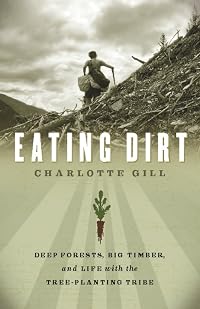
Eating Dirt: Deep Forests, Big Timber, and Life with the Tree-Planting Tribe
by Charlotte Gill
On This Page
Description
-
Winner of the BC National Award for Non-Fiction
• Nominated for the Charles Taylor Prize for Literary Non-Fiction and the 2011 Hilary Weston Writer's Trust Award.
During Charlotte Gill's 20 years working as a tree planter she encountered hundreds of clear-cuts, each one a collision site between human civilization and the natural world, a complicated landscape presenting geographic evidence of our appetites. Charged with sowing the new forest in these clear-cuts, tree planters are a tribe
In Eating Dirt, Gill offers up a slice of tree-planting life in all of its soggy, gritty exuberance while questioning the ability of conifer plantations to replace original forests, which evolved over millennia into intricate, complex ecosystems. Among other topics, she also touches on the boom-and-bust history of logging and the versatility of wood, from which we have devised countless creations as diverse as textiles and airplane parts. She also eloquently evokes the wonder of trees, our slowest-growing “renewable" resource and joyously celebrates the priceless value of forests and the ancient, ever-changing relationship between humans and trees. . show less
Tags
Recommendations










Member Recommendations
Member Reviews
Eating Dirt: Deep Forests, Big Timber, and Life with the Tree-Planting Tribe by Charlotte Gill is a fascinating look at both her 20 year career as a tree planter in the clear cut forests of B.C. and an overall look at trees, forestry and the land and people that sustain this industry.
I expected someone who had spent twenty years of “bending, planting, standing up and moving on” over some of the roughest terrain on the earth to be a woman who is strong, independent and tenacious. What I wasn’t expecting was that this woman would write in such a gentle, poetic, literary style. This book strikes the perfect balance between well researched facts and an unflinching, at times humoress description of life as a migrant worker doing a hard show more and dirty job. As a native of Vancouver Island I particularly loved her wonderful descriptions of the flora and fauna of this unique place, as the following excerpt illustrates:
“We skim along as if on the surface of a plasmatic skin. Flocks of cormorants putter across the surface and dive under the prow of our boat. Islets dot the water. Trees crowd their shores. On lucky days we’ll see orcas and minke whales or whiskered sea lions lazing on knobs of rock, warming their brown blubber in the hazy sun.“
Eating Dirt sheds light on a corner of the logging industry that isn’t well known and manages to do this while walking a fine line between denouncing or glorifying the business. Entertaining and informative, this is a book I relished. show less
I expected someone who had spent twenty years of “bending, planting, standing up and moving on” over some of the roughest terrain on the earth to be a woman who is strong, independent and tenacious. What I wasn’t expecting was that this woman would write in such a gentle, poetic, literary style. This book strikes the perfect balance between well researched facts and an unflinching, at times humoress description of life as a migrant worker doing a hard show more and dirty job. As a native of Vancouver Island I particularly loved her wonderful descriptions of the flora and fauna of this unique place, as the following excerpt illustrates:
“We skim along as if on the surface of a plasmatic skin. Flocks of cormorants putter across the surface and dive under the prow of our boat. Islets dot the water. Trees crowd their shores. On lucky days we’ll see orcas and minke whales or whiskered sea lions lazing on knobs of rock, warming their brown blubber in the hazy sun.“
Eating Dirt sheds light on a corner of the logging industry that isn’t well known and manages to do this while walking a fine line between denouncing or glorifying the business. Entertaining and informative, this is a book I relished. show less
This is Charlotte Gill's memoir of her twenty-year career as a tree planter. Beginning each February, she replanted forests, following the spring weather as it moved thousands of miles through British Columbia, and ending her work year in October. This is an insider's view of the life of one of the most physically grueling and dirtiest jobs around--so dirty, that she refers to being "earth-stained" with "permadirt," and wears disposable clothes. This is also a job that required her to eat 4,000 calories a day just so she could get up and do it again the next day. I found this look at her life absolutely fascinating. In between her stories of bears, solitude, blistering heat, camaraderie, bruises, bugs, rain, helicopters, lousy motels, show more and bending over thousands of times a day, she talks about the history of humans and forests, and the importance of forests to our planet. She weaves these pieces together with some beautiful, poetic writing, lush with similes and metaphors that she creates through keen observation.
This will definitely go on the list of my top books of the year. I'm not the only one who enjoyed it--lots of rave reviews around the internet, nominations for literary non-fiction prizes, and it won the British Columbia National Award for Canadian Non-fiction, which awarded the author with $40,000. I think she well-earned it. show less
This will definitely go on the list of my top books of the year. I'm not the only one who enjoyed it--lots of rave reviews around the internet, nominations for literary non-fiction prizes, and it won the British Columbia National Award for Canadian Non-fiction, which awarded the author with $40,000. I think she well-earned it. show less
An excellent book about the intrepid tree-planters of British Columbia who spend most of the year in the clear-cut forests. My image of a clear-cut was of a grim area bereft of beauty, yet Gill saw beauty everywhere despite the "permadirt" ingrained in a tree-planter's skin. In addition to describing the people who take on this relentlessly back-breaking work, she talks about forests and forestry with expertise. Her writing is beautifully poetic in places and deserving of all the accolades received.
Gill describes, in vivid and poetic detail, the life of a tree planter. It's grueling, punishing work, but she revels in the hardships. Her writing is wonderful: lyrical and vivid, and really not the kind of writing you would expect to come from this kind of work.
Gill also details the history of logging, from ancient Mesopotamia to the present day. She talks about the ecology of forests, and how little we understand even today about all of the creatures that make up the forest ecosystem.
I enjoyed the book thoroughly, but I did have a few complaints. When she is talking about her work as a tree planter, she skips around in time a lot, from her first summer of tree planting to more recent ones, in no particular order and often without show more much context. Her writing in these sections was so gorgeous that I enjoyed reading it just for the sheer pleasure of language, but there wasn't much by way of story, and I often wasn't sure why she was talking about certain episodes, other than the joy of describing them. As much as I enjoyed the writing, the purposelessness of it got a little frustrating.
I also wished she had devoted more time to history and ecology. I was particularly interested in these parts of the book, and she throws out some really fascinating information, but doesn't delve into it very deeply.
I live in the Pacific Northwest, so I often drive past newly-logged forests and trucks loaded with newly-cut trees, and I am never quite sure how to feel about it... Humans need wood, but the devastation caused by logging is heartbreaking. I was hoping that this book would give me a little more clarity about this issue, but instead it just muddled it more and made me even more uncertain and ambivalent. That's more a criticism of me than of her: I can't blame Gill for not writing the book I hoped I was about to read.
Overall, though, this was a fascinating book, and worth reading for the writing alone. show less
Gill also details the history of logging, from ancient Mesopotamia to the present day. She talks about the ecology of forests, and how little we understand even today about all of the creatures that make up the forest ecosystem.
I enjoyed the book thoroughly, but I did have a few complaints. When she is talking about her work as a tree planter, she skips around in time a lot, from her first summer of tree planting to more recent ones, in no particular order and often without show more much context. Her writing in these sections was so gorgeous that I enjoyed reading it just for the sheer pleasure of language, but there wasn't much by way of story, and I often wasn't sure why she was talking about certain episodes, other than the joy of describing them. As much as I enjoyed the writing, the purposelessness of it got a little frustrating.
I also wished she had devoted more time to history and ecology. I was particularly interested in these parts of the book, and she throws out some really fascinating information, but doesn't delve into it very deeply.
I live in the Pacific Northwest, so I often drive past newly-logged forests and trucks loaded with newly-cut trees, and I am never quite sure how to feel about it... Humans need wood, but the devastation caused by logging is heartbreaking. I was hoping that this book would give me a little more clarity about this issue, but instead it just muddled it more and made me even more uncertain and ambivalent. That's more a criticism of me than of her: I can't blame Gill for not writing the book I hoped I was about to read.
Overall, though, this was a fascinating book, and worth reading for the writing alone. show less
Charlotte Gill, whose earlier work had been nominated for a Governor General’s award in Canada, writes about her twenty years’ experience as a tree planter in the clear-cut forests of British Columbia. There is a marked contrast between the quality of her writing, which is poetic at times, and the rugged, gritty and back-breaking work that she describes. Gill talks about the history, the science and the environmental issues related to the cutting down and replanting of trees. However, the book is mostly about the subculture of tree planters, and like the best books of this type, it offers a fascinating view into what exactly these people do and what drives them to do it.
http://absentlibrarian.blogspot.ca/
I truly did not expect to like this book. I picked it up with a sigh, thinking that here I go again, starting another book I probably didn't want to read in the first place. The story of tree planters held almost no appeal to me. So, I began the first page ready to be disappointed. By the third page I knew I liked the author's writing style. By the tenth page I found myself enjoying the descriptions of Vancouver island and the almost alien landscape the tree planters were traveling through.
Her writing is tangible, the words enveloping me as a reader. I can feel the dirt under my fingernails, the sweat clinging to the back of my neck. As I turn the pages I feel like I should be looking around to make show more eye contact with the people Gill is talking about.
I keep asking myself who would want to do this kind of work? The conditions, the filth, the isolation, the hours and the alienness of the terrain has it permanently removed it from every conceivable list of jobs I could ever fathom.
I told myself that I'm not interested in this book it's not a topic I have any interest in. Still, I keep turning the pages and continuing on. I can see why this book was nominated for an award - the topic is unique and the writing itself draws the reader into the story.
The drawback for me was the immense amount of information about the history of trees and forestry industry in the book. At first it felt like it was handed out in bits and peppered through stories, and that was fine as I found it quite interesting. Yet as the book continued I found myself drowning in the information and details. As a result it took me almost a full week to read this 250 page book.
The author,Charlotte Gill, has a much different take on this lifestyle than I do. Where I would find the filth, exhaustion and repetition overwhelming and not something that I would want to spend a career doing, never mind a single season, she finds that she has a love for it.
"Some people think planting trees is as boring and crazy making at stuffing envelopes or at climbing a StairMaster. I love my job for exactly the opposite reason because it is so full of things. There are so many living creatures to touch and smell and look at in the field that it's often a little intoxicating. A setting so full of all-enveloping sensation that it just sweeps you up and spirits you anyway like Vegas does to gamblers or Mount Everest to climbers."
Tree planting sounds like one of those jobs you would need to have a calling to. It sounds as though it may be one of the last frontier style ways of life that can be experienced in today's world. For me, this book has been interesting and illuminating. And I am quite happy (and thankful) to leave it to those who have been called. show less
I truly did not expect to like this book. I picked it up with a sigh, thinking that here I go again, starting another book I probably didn't want to read in the first place. The story of tree planters held almost no appeal to me. So, I began the first page ready to be disappointed. By the third page I knew I liked the author's writing style. By the tenth page I found myself enjoying the descriptions of Vancouver island and the almost alien landscape the tree planters were traveling through.
Her writing is tangible, the words enveloping me as a reader. I can feel the dirt under my fingernails, the sweat clinging to the back of my neck. As I turn the pages I feel like I should be looking around to make show more eye contact with the people Gill is talking about.
I keep asking myself who would want to do this kind of work? The conditions, the filth, the isolation, the hours and the alienness of the terrain has it permanently removed it from every conceivable list of jobs I could ever fathom.
I told myself that I'm not interested in this book it's not a topic I have any interest in. Still, I keep turning the pages and continuing on. I can see why this book was nominated for an award - the topic is unique and the writing itself draws the reader into the story.
The drawback for me was the immense amount of information about the history of trees and forestry industry in the book. At first it felt like it was handed out in bits and peppered through stories, and that was fine as I found it quite interesting. Yet as the book continued I found myself drowning in the information and details. As a result it took me almost a full week to read this 250 page book.
The author,Charlotte Gill, has a much different take on this lifestyle than I do. Where I would find the filth, exhaustion and repetition overwhelming and not something that I would want to spend a career doing, never mind a single season, she finds that she has a love for it.
"Some people think planting trees is as boring and crazy making at stuffing envelopes or at climbing a StairMaster. I love my job for exactly the opposite reason because it is so full of things. There are so many living creatures to touch and smell and look at in the field that it's often a little intoxicating. A setting so full of all-enveloping sensation that it just sweeps you up and spirits you anyway like Vegas does to gamblers or Mount Everest to climbers."
Tree planting sounds like one of those jobs you would need to have a calling to. It sounds as though it may be one of the last frontier style ways of life that can be experienced in today's world. For me, this book has been interesting and illuminating. And I am quite happy (and thankful) to leave it to those who have been called. show less
Charlotte Gill describes her many years of tree planting in the temperate rain forest in British Columbia in her book "Eating Dirt." The book appealed to me immediately due to my brief experience volunteering with the US Forest Service in southeast Alaska. My work was on the other end of the process from Charlotte's, as I was assisting with logging road layout.
The physically strenuous work of tree planting comes through in Charlotte's writing. I can feel the pain of bruised shins; taste the dirt, insects, and sweat; smell the moist soil. Between the slips and trips encountered in a clear-cut, Charlotte clearly explains the science of trees and their surroundings. Most satisfying of all is the author's unsentimental description of the show more philosophy of harvesting trees, the work, and her colleagues. I recommend this book to all readers of natural history, particularly those with an interest in logging or the Pacific Northwest. show less
The physically strenuous work of tree planting comes through in Charlotte's writing. I can feel the pain of bruised shins; taste the dirt, insects, and sweat; smell the moist soil. Between the slips and trips encountered in a clear-cut, Charlotte clearly explains the science of trees and their surroundings. Most satisfying of all is the author's unsentimental description of the show more philosophy of harvesting trees, the work, and her colleagues. I recommend this book to all readers of natural history, particularly those with an interest in logging or the Pacific Northwest. show less
Members
- Recently Added By
Published Reviews
ThingScore 75
Eating Dirt is at its most fascinating when Gill considers not only the human relationship with forests (the removal of which has gone hand in hand with the growth of human civilization since its beginning, with the now-dwindling North American timber supply representing the last large-scale wood source on the planet), but the relationship between trees and the environments in which they live.
added by Nickelini
Lists

Top Five Books of 2013
1,562 works; 721 members

Favorite Memoirs
64 works; 13 members

CBC's 100 True Stories
100 works; 6 members

Evergreen Award™ Winners and Nominees 2005–2024
200 works; 3 members
Awards and Honors
Awards
Distinctions
Common Knowledge
- Important places
- British Columbia, Canada; Vancouver Island, British Columbia, Canada
- Epigraph
- I made a shift to go forward, till I came to a part of the field where the corn had been laid by the rain and wind. Here it was impossible for me to advance a step, for the stalks were so interwoven, that I could not creep th... (show all)rough, and the beards of the fallen ears so strong and pointed, that they pierced through my clothes into my flesh. At the same time I heard the reapers not a hundred yards behind me.
Jonathan Swift, Gulliver's Travels, "A Voyage to Brobdingnag" - First words
- We'd fall out of bed and into our rags, still crusted with the grime of yesterday.
- Blurbers
- Davis, Wade
Classifications
- Genres
- Science & Nature, Nonfiction, General Nonfiction, Biography & Memoir
- DDC/MDS
- 333.75 — Society, government, & culture Economics Economics of land and energy Conservation, Alternative Energy Sources Forests & Rainforests
- LCC
- SD409 .G54 — Agriculture Forestry. Arboriculture. Silviculture Forestry Sylviculture
- BISAC
Statistics
- Members
- 183
- Popularity
- 179,007
- Reviews
- 12
- Rating
- (3.84)
- Languages
- English
- Media
- Paper, Audiobook, Ebook
- ISBNs
- 6
- ASINs
- 1