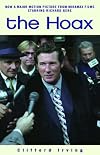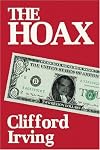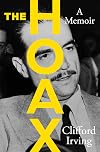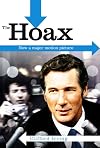
The Hoax
by Clifford Irving
On This Page
Description
The ultimate caper story, novelist Clifford Irving's no-holds-barred account of the literary hoax of our time, his autobiography of Howard Hughes was published in Great Britain in 1997, where it became a best-seller. But no American hardcover house would touch The Hoax until now. One major publisher offered a $500,000 advance when the book was nearing completion, drew up the contract then abruptly bowed out. Why? The answer is implicit in this classic tale of daring, treachery, and show more corruption. As fast-paced and exciting as any spy novel, it involves the reader at every devilish turn. Irving details how the hoax developed, like a Chinese puzzle, from its madcap beginning to the final startling confession, a witty and nail-biting story of international intrigue and beautiful women, of powerful corporate executives and jet-set rogues, of cover-ups and headlines. show lessTags
Recommendations





Member Reviews
Stupendously entertaining account of their attempted fraud. Two obviously intelligent men doing the stupidest things possible. If they’d been morons they could never have attempted anything on this scale, but their intelligence gave them the ability to encompass their own doom.
It’s a confession, but there’s a catch. It’s written like a novel. It has direct reported speech, pacing, tension etc. The book appears to be the same text that was previously published as ‘What Really Happened: His Untold Story of the Hughes Affair’ and ‘Project Octavio: The Story of the Howard Hughes Hoax’. There it’s credited to ‘Clifford Irving with Richard Suskind’. Suskind’s name has been removed from this edition for reasons that are show more unclear to me, but Irving mentions him in the Author’s Note, saying “many of the passages in this book which deal with shared experiences have been written by him from my point of view.” Well, we call that fiction, don’t we? I think this may technically be a novel. I think Irving is playing a game with the reader. He comes off rather badly and makes no attempt to justify himself or portray himself in a good light. Or rather, there are no passages that do so transparently. He talks about the Autobiography (which I haven’t read) as being a mixture of facts and also lies made of ‘whole cloth’. If the lies here are also made of whole cloth then it’s very difficult to tell where they begin and end. show less
It’s a confession, but there’s a catch. It’s written like a novel. It has direct reported speech, pacing, tension etc. The book appears to be the same text that was previously published as ‘What Really Happened: His Untold Story of the Hughes Affair’ and ‘Project Octavio: The Story of the Howard Hughes Hoax’. There it’s credited to ‘Clifford Irving with Richard Suskind’. Suskind’s name has been removed from this edition for reasons that are show more unclear to me, but Irving mentions him in the Author’s Note, saying “many of the passages in this book which deal with shared experiences have been written by him from my point of view.” Well, we call that fiction, don’t we? I think this may technically be a novel. I think Irving is playing a game with the reader. He comes off rather badly and makes no attempt to justify himself or portray himself in a good light. Or rather, there are no passages that do so transparently. He talks about the Autobiography (which I haven’t read) as being a mixture of facts and also lies made of ‘whole cloth’. If the lies here are also made of whole cloth then it’s very difficult to tell where they begin and end. show less
In one of the most bizarre publishing schemes ever, an author convinced a publisher that the rich recluse Howard Hughes had designated him his agent to negotiate the publication of his autobiography. Over the next few months, the author produced signed documents from Hughes and secured a contract and a large advance. The problem was that Clifford Irving, the author turned purported agent, had never met Howard Hughes.
Irving delivered a manuscript that he himself had written. From material about Hughes that Irving was able to gather, much of it public but obscure, other from private sources, Irving wrote the so-called autobiography and pocketed the publisher's money. In the end, as is widely known, Irving was caught and found guilty of show more fraud.
After serving his prison sentence, Irving published his first person account surrounding the fake Hughes' autobiography, "The Hoax." In it, he describes the audacious, and frequently preposterous, story of deluding the publisher, crafting the book, and pocketing the money.
The book is extremely entertaining. Irving's chutzpah is at once endearing and terrifying. His accomplices, his co-author/researcher Richard Suskind and his wife (now ex-wife) Edith, seem drawn in to the plot by Irving's charm and determination as much as by their own greed.
It should be noted that I question the veracity of Irving's account. Frequently, it struck me as implicitly self-serving, glossing over some rough edges. I also thought that it was designed to cover whatever roles other people had in the hoax, relocating most of the blame on Irving's own shoulders. Irving claims he is telling the truth; I believe that the title, "The Hoax," is likely applicable to both the Hughes' autobiography and this book.
This opinion in no way diminished my enjoyment in reading the account. Irving is clearly a talented author, with a knack for developing characters and constructing a gripping and dramatic narrative. After reading this book, I really wanted to read Irving's manuscript "The Autobiography of Howard Hughes"; I'm sure it's a gripping page-turner as well. Like "The Hoax," I wouldn't believe most of it, but I'd enjoy it. show less
Irving delivered a manuscript that he himself had written. From material about Hughes that Irving was able to gather, much of it public but obscure, other from private sources, Irving wrote the so-called autobiography and pocketed the publisher's money. In the end, as is widely known, Irving was caught and found guilty of show more fraud.
After serving his prison sentence, Irving published his first person account surrounding the fake Hughes' autobiography, "The Hoax." In it, he describes the audacious, and frequently preposterous, story of deluding the publisher, crafting the book, and pocketing the money.
The book is extremely entertaining. Irving's chutzpah is at once endearing and terrifying. His accomplices, his co-author/researcher Richard Suskind and his wife (now ex-wife) Edith, seem drawn in to the plot by Irving's charm and determination as much as by their own greed.
It should be noted that I question the veracity of Irving's account. Frequently, it struck me as implicitly self-serving, glossing over some rough edges. I also thought that it was designed to cover whatever roles other people had in the hoax, relocating most of the blame on Irving's own shoulders. Irving claims he is telling the truth; I believe that the title, "The Hoax," is likely applicable to both the Hughes' autobiography and this book.
This opinion in no way diminished my enjoyment in reading the account. Irving is clearly a talented author, with a knack for developing characters and constructing a gripping and dramatic narrative. After reading this book, I really wanted to read Irving's manuscript "The Autobiography of Howard Hughes"; I'm sure it's a gripping page-turner as well. Like "The Hoax," I wouldn't believe most of it, but I'd enjoy it. show less
This is really engrossing for the details of the hoax perpetrated and how Irving and Suskind became passengers on a runaway train of their own invention. Along the way, some amazing luck happened for them (I suppose, can I trust the admitted hoaxter?) but one amazing thing was the proof of the old adage about criminals that they often seem to have the drive and energy to be legitimately successful, if only the put their energies to legal ventures. In this case, the pair could have done a very good unauthorized biography, if it wasn't for greed and vanity, that is hubris. The nemesis of American and Swiss law eventually comes down on them and in all Irving seems modestly contrite for his betrayals and lies, but he really seems to over no show more self-analysis on why decided to burn so many bridges and why he went so far... show less
Interesting but the hoax is dated for anyone under 40. Can't imagine the movie being a success because the mystery of Howard Hughes has not survived over the years. The author is rich and unsympathetic. His naive wife unfairly received a greater punishment for her part in the affair.
Ratings
Members
- Recently Added By
Lists

Literary Forgeries
212 works; 4 members

Pants on fire
27 works; 4 members
Author Information

35+ Works 1,047 Members
Clifford Michael Irving was born in Manhattan, New York on November 5, 1930. He received a degree in English from Cornell University. He became an author and his early novels included On a Darkling Plain, The Losers, and The Valley. He also wrote an as-told-to memoir, Fake!: The Story of Elmyr de Hory, the Greatest Art Forger of Our Time. In early show more 1971, Irving decided to write an authorized autobiography of Howard Hughes based on meetings and interviews that never took place. He received an advance from McGraw-Hill and sold rights to Life magazine and Dell. He fooled editors, lawyers, handwriting experts, and journalists who had interviewed Hughes in the past. The book was about to go to press at the end of 1971, when Hughes went public and denied knowing Irving. In March 1972, Irving and his wife pleaded guilty to conspiracy in federal court. In state court, they along with Irving's research assistant, Richard Suskind pleaded guilty to conspiracy and grand larceny. Irving was given a prison sentence of two and a half years and served 17 months. Irving and Suskind wrote about the incident in Clifford Irving: What Really Happened, which was published in 1972. It was reissued in 1981 as The Hoax. After serving his prison sentence, Irving wrote several novels and true-crime books including Daddy's Girl: The Campbell Murder Case, Trial, and Final Argument. In 2012, the fake Hughes autobiography was published as an e-book under the title Clifford Irving's Autobiography of Howard Hughes. He also published Jailing: The Prison Memoirs of 0040, aka Clifford Irving as an e-book. He died from pancreatic cancer on December 19, 2017 at the age of 87. (Bowker Author Biography) show less
Some Editions
Common Knowledge
- Canonical title*
- The hoax. La vera storia della più grande truffa editoriale
- Original title
- The Hoax
- Original publication date
- 1981
- Related movies
- The Hoax (2006 | IMDb)
- First words
- A great deal has been written about the Hughes hoax, including a few truths culled from documents and indictments.
- Last words
- (Click to show. Warning: May contain spoilers.)We both tried to laugh; but it was difficult.
*Some information comes from Common Knowledge in other languages. Click "Edit" for more information.
Classifications
- Genres
- Biography & Memoir, Fiction and Literature, Literature Studies and Criticism
- DDC/MDS
- 813.54 — Literature & rhetoric American literature in English American fiction in English 1900-1999 1945-1999
- LCC
- PS3559 .R79 .Z462 — Language and Literature American literature American literature Individual authors 1961-
- BISAC
Statistics
- Members
- 94
- Popularity
- 342,861
- Reviews
- 5
- Rating
- (3.53)
- Languages
- English, Italian
- Media
- Paper, Audiobook, Ebook
- ISBNs
- 20
- ASINs
- 3