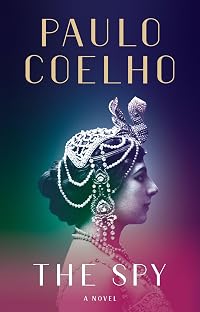
The Spy: A novel
by Paulo Coelho
On This Page
Description
In his new novel, Paulo Coelho, bestselling author of The Alchemist and Adultery, brings to life one of history's most enigmatic women: Mata Hari.HER ONLY CRIME WAS TO BE AN INDEPENDENT WOMAN
When Mata Hari arrived in Paris she was penniless. Within months she was the most celebrated woman in the city.
As a dancer, she shocked and delighted audiences; as a courtesan, she bewitched the era’s richest and most powerful men.
But as paranoia consumed a country at war, Mata show more Hari’s lifestyle brought her under suspicion. In 1917, she was arrested in her hotel room on the Champs Elysees, and accused of espionage.
Told in Mata Hari’s voice through her final letter, The Spy is the unforgettable story of a woman who dared to defy convention and who paid the ultimate price. show less
Tags
Recommendations









Member Reviews
I’m not even exaggerating when I say I felt straight up angry after finishing The Spy by Paulo Coelho. I read the Gramedia Indonesian translation and honestly, shoutout to the translator because it carries the same emotional weight as the English version I skimmed in EPUB. It really lands.
What happened to Mata Hari just feels unreal. She was painted as this huge villain, but years later it became clear she was basically innocent, blamed for things that barely made sense. And the plot twist, the prosecutor who pushed the case against her was later accused of the same double agent situation. The hypocrisy is crazy.
Nobody stepped in to defend her because that would have exposed too many important people. She became the perfect show more distraction while the war was taking countless lives. Germany moved on from her because they were focused on the battlefield. The Netherlands kept their distance to protect their neutral image during World War I. Even her so called friends vanished when things got messy. And the most painful part, the only man she truly loved, the blind Russian soldier, testified against her. Turns out he was just using her to deal with his own trauma. That part really stings.
The book is beautiful but heavy. It feels like reading about the kind of injustice that builds up before revolutions, and even after them, when power just finds new ways to silence people who are already suffering. It leaves you thinking about how easily one person can be sacrificed to protect an entire system. show less
What happened to Mata Hari just feels unreal. She was painted as this huge villain, but years later it became clear she was basically innocent, blamed for things that barely made sense. And the plot twist, the prosecutor who pushed the case against her was later accused of the same double agent situation. The hypocrisy is crazy.
Nobody stepped in to defend her because that would have exposed too many important people. She became the perfect show more distraction while the war was taking countless lives. Germany moved on from her because they were focused on the battlefield. The Netherlands kept their distance to protect their neutral image during World War I. Even her so called friends vanished when things got messy. And the most painful part, the only man she truly loved, the blind Russian soldier, testified against her. Turns out he was just using her to deal with his own trauma. That part really stings.
The book is beautiful but heavy. It feels like reading about the kind of injustice that builds up before revolutions, and even after them, when power just finds new ways to silence people who are already suffering. It leaves you thinking about how easily one person can be sacrificed to protect an entire system. show less
Well, I will say this with certainty: the cover photo of Margaretha Geertruida MacLeod (née Zelle) aka Mata Hari is absolutely stunning.
"Her only crime was to be an independent woman." Yeah, I didn't get that.
This was a short, fast read; a story told by Coelho the way he wanted it to be told. I believe that he tried to be faithful to the information available, but to me it still comes off as revisionist history. I don't know what to make of it as what clearly comes across is that Mata Hari's life was a fiction so it seems like there is no way to ever know the absolute truth. Any retelling can be presented in any way any author wants.
There is no escaping the fact that Mata Hari told lies and embellished her life at every turn, Coelho show more reiterates that time and again. In fact the last part of the book, the words written by her lawyer seem to sum everything up, and that is that she dug her own grave. It was her lifelong sense of entitlement that no matter what she ever did, nothing bad could ever happen to her. She was born into privilege and never let go. No man had ever said "no" to her so she was supremely confident the French President would pardon her because she was, after all, Mata Hari. It is as simple as that.
Mata Hari was a manipulator of men starting at an early age, at least beginning in her teenage years. She tells of being raped as soon as she was sent off to boarding school, but there is no way to know if that was true or not. That is questionable because her whole life she sees herself as a victim, and never misses an opportunity at self-pity. Truth or fiction, she always had an excuse at hand, and was quick to justify any and all of her actions.
Being a citizen of a neutral country - The Netherlands - she had every chance to stay out of harm's way. But her misfortune was that WWI got in the way of her fabulous life. Not satisfied to be normal and boring and, well, maybe actually getting a job and doing something, she agrees to spy for Germany for profit and agrees to spy for France for profit and, well, maybe agreed to spy for other countries for profit as well. All of which fed her self-importance.
Again, Mata Hari spent her life using everyone around her; everyone craved her attentions; particularly men, and mostly men with great wealth. She was hardly the first to manipulate men for fame, wealth, and profit, but she may have been one of the very best. I don't see her being a gold digger in the classical sense, but more as a means to maintain her position as the center of attention (versus needing the security of money). Nowadays we might call her an "attention whore," someone forever seeking approval from all of those around her. She needed to be the most liked, the most beautiful, and so on. She used her body and womanly charms to ensure that every man on the planet fell in love with her, that no man could ever resist her. Had she lived in the 21st century, at very least she would be an Instagram model and TikTok "star," however, more likely she would have millions of OnlyFans and raking in making millions.
That's what I got out of the letters. I have not read the originals nor do I intend to. It seems like most authors now consider her innocent of being a spy, but that still appears to be an ambiguous assumption and no one will ever know. A firing squad does sound extreme although common for the times. (Okay, very extreme since these days it would seem that treason can put you in high office.)
I also didn't get anything about Mata Hari being a strong or independent woman; another seemingly illogical assumption. She spent her life dependent upon the riches and help of others. Not that being wholly independent of men cannot mean a woman cannot be strong and independent, but in Mata Hari’s case that would seem to be the case. I would say a maid or washer-woman, some female who raises children and a family, basically anyone that ever had to work as a strong (and most likely independent) woman before I jumped to the conclusion that a woman born into wealth and relied on the riches of others was the person deserving such a title. At the end of the day, what comes across is that Mata Hari was someone that always took the easy way out. And then one day her luck ran out. show less
"Her only crime was to be an independent woman." Yeah, I didn't get that.
This was a short, fast read; a story told by Coelho the way he wanted it to be told. I believe that he tried to be faithful to the information available, but to me it still comes off as revisionist history. I don't know what to make of it as what clearly comes across is that Mata Hari's life was a fiction so it seems like there is no way to ever know the absolute truth. Any retelling can be presented in any way any author wants.
There is no escaping the fact that Mata Hari told lies and embellished her life at every turn, Coelho show more reiterates that time and again. In fact the last part of the book, the words written by her lawyer seem to sum everything up, and that is that she dug her own grave. It was her lifelong sense of entitlement that no matter what she ever did, nothing bad could ever happen to her. She was born into privilege and never let go. No man had ever said "no" to her so she was supremely confident the French President would pardon her because she was, after all, Mata Hari. It is as simple as that.
Mata Hari was a manipulator of men starting at an early age, at least beginning in her teenage years. She tells of being raped as soon as she was sent off to boarding school, but there is no way to know if that was true or not. That is questionable because her whole life she sees herself as a victim, and never misses an opportunity at self-pity. Truth or fiction, she always had an excuse at hand, and was quick to justify any and all of her actions.
Being a citizen of a neutral country - The Netherlands - she had every chance to stay out of harm's way. But her misfortune was that WWI got in the way of her fabulous life. Not satisfied to be normal and boring and, well, maybe actually getting a job and doing something, she agrees to spy for Germany for profit and agrees to spy for France for profit and, well, maybe agreed to spy for other countries for profit as well. All of which fed her self-importance.
Again, Mata Hari spent her life using everyone around her; everyone craved her attentions; particularly men, and mostly men with great wealth. She was hardly the first to manipulate men for fame, wealth, and profit, but she may have been one of the very best. I don't see her being a gold digger in the classical sense, but more as a means to maintain her position as the center of attention (versus needing the security of money). Nowadays we might call her an "attention whore," someone forever seeking approval from all of those around her. She needed to be the most liked, the most beautiful, and so on. She used her body and womanly charms to ensure that every man on the planet fell in love with her, that no man could ever resist her. Had she lived in the 21st century, at very least she would be an Instagram model and TikTok "star," however, more likely she would have millions of OnlyFans and raking in making millions.
That's what I got out of the letters. I have not read the originals nor do I intend to. It seems like most authors now consider her innocent of being a spy, but that still appears to be an ambiguous assumption and no one will ever know. A firing squad does sound extreme although common for the times. (Okay, very extreme since these days it would seem that treason can put you in high office.)
I also didn't get anything about Mata Hari being a strong or independent woman; another seemingly illogical assumption. She spent her life dependent upon the riches and help of others. Not that being wholly independent of men cannot mean a woman cannot be strong and independent, but in Mata Hari’s case that would seem to be the case. I would say a maid or washer-woman, some female who raises children and a family, basically anyone that ever had to work as a strong (and most likely independent) woman before I jumped to the conclusion that a woman born into wealth and relied on the riches of others was the person deserving such a title. At the end of the day, what comes across is that Mata Hari was someone that always took the easy way out. And then one day her luck ran out. show less
Mata Hari really deserves better than she has been getting in the literary department. First there was Mata Hari’s Last Dance by Michelle Moran that made her inexplicably obtuse and naive considering her accomplishments. Now Paulo Coelho gives us The Spy which seems to be nothing more than a contrivance for some New Age aphorisms. He sees her as someone who was an emancipated woman, that freedom was her crime, but ignores the reality that made her “free”.
The real Mata Hari is more interesting. Margaretha Zelle MacLeod was a brave woman who fled sexual abuse and rape by a school headmaster by marrying a man she met by answering an ad. She moved with her husband to Indonesia and discovered that she went from the frying pan to the show more fire.
He was an abusive man whose gave her syphilis and nearly killed her on more than one occasion. His syphilis likely infected their two children. Their son died, and their daughter, Non, survived. They alleged that a nanny poisoned the children, but historians think it was a cover story as no one was charged. They divorced and she got custody but he refused to pay child support and she eventually gave her daughter back to her ex-husband because he could afford to care for her. Coelho reveals the abuse and the cheating, but ignores that she tried many “respectable” careers for women, trying to support herself and her daughter, before becoming Mata Hari. She did not leave her daughter lightly or ever forget her. She wrote to his cousin confessing that she slept with men for money, “Don’t think that I’m bad at heart, I have done it only out of poverty.”
From this desperation, she forged a career as a dancer and as woman who slept with men for money and favors. Coelho presents her as a libertine, a free-love free spirit, emancipated. She was not. In reality, she wrote, “My own husband has given me a distaste for matters sexual such as I cannot forget,” That of course is not in this book because it contradicts his story of a free woman. Reality was more complicated, a woman who did not so much choose her profession as accept it, and once accepting it, pursued it to the heights of fame and celebrity. To me it seems that using men for fame, wealth, and power came from rage at how they had used her, not vanity and greed. If greed were her motivation, she would not have tried many other occupations first.
It’s been ninety-nine years since Mata Hari was executed. As confidential documents have been declassified, the evidence make clear she was innocent, convicted as a scapegoat for military failures. World War I was a bloodbath, a war of attrition that slaughtered 60% of the men of a generation. Those who made the decisions could not pay, but a foreigner, a prostitute, a nude dancer, she could pay, and pay with her life. Her story is dramatic and oh-so-very moral. A woman transgresses and climbs high but then is brought low, punished for her transgressions, punished for being independent and greedy and vain and for sleeping around. The story of Mata Hari is pure slut-shaming.
Unless the story is real and tells the truth about where she came from, what her motivations were, and how determinedly she dragged herself up from poverty and desperation. Coelho does not do that at all. He makes it sound like she did it easily, she goes to Paris, meets the right people and she’s rich. She never misses her daughter or agonizes over her loss. She’s shallow and stupid, meeting Freud and Stravinsky and others and forgetting their first names, a name dropper who can’t remember the name…pathetic.
With her recently released letters that reveal her own thoughts about her career and her daughter, it seems inexcusable to me that she is still presented as a sexual libertine seeking fame and money, rather than the far more nuanced and complicated woman she really was. Worse, to have her struggle exploited as a vehicle for pabulum like “when we don’t know where life is taking us, we are never lost” or “an artist who desires very little and achieves it has failed in life”
Part One of the book is a letter written by Mata Hari to her lawyer and it does not feel authentic, but it is tolerable next to the histrionic letter written by her lawyer that makes up Part Two. It was only because the book is short, closer to a novella than a novel, and I was so close to finishing, that I kept reading through Part Two. Consider this gem when speaking of the injustice of her fate, “it will continue to happen until the end of time, or until man finds out he is not only what he thinks, but mostly what he feels. The body tires easily, but the spirit is always free and will help us get out, one day, from this infernal cycle of repeating the same mistakes every generation.”
I don’t recommend this book. It’s an inauthentic story by a writer who prefers to push his own philosophy rather than seek the real woman hiding behind the myth. It seems unjust that this woman who was abused her school, her husband, many men and her adopted country, used and betrayed and executed as a scapegoat continues to be exploited and abused by writers who deny her complexity and the very real grit and courage she had.
https://tonstantweaderreviews.wordpress.com/2016/12/06/the-spy-by-paulo-coelho/ show less
The real Mata Hari is more interesting. Margaretha Zelle MacLeod was a brave woman who fled sexual abuse and rape by a school headmaster by marrying a man she met by answering an ad. She moved with her husband to Indonesia and discovered that she went from the frying pan to the show more fire.
He was an abusive man whose gave her syphilis and nearly killed her on more than one occasion. His syphilis likely infected their two children. Their son died, and their daughter, Non, survived. They alleged that a nanny poisoned the children, but historians think it was a cover story as no one was charged. They divorced and she got custody but he refused to pay child support and she eventually gave her daughter back to her ex-husband because he could afford to care for her. Coelho reveals the abuse and the cheating, but ignores that she tried many “respectable” careers for women, trying to support herself and her daughter, before becoming Mata Hari. She did not leave her daughter lightly or ever forget her. She wrote to his cousin confessing that she slept with men for money, “Don’t think that I’m bad at heart, I have done it only out of poverty.”
From this desperation, she forged a career as a dancer and as woman who slept with men for money and favors. Coelho presents her as a libertine, a free-love free spirit, emancipated. She was not. In reality, she wrote, “My own husband has given me a distaste for matters sexual such as I cannot forget,” That of course is not in this book because it contradicts his story of a free woman. Reality was more complicated, a woman who did not so much choose her profession as accept it, and once accepting it, pursued it to the heights of fame and celebrity. To me it seems that using men for fame, wealth, and power came from rage at how they had used her, not vanity and greed. If greed were her motivation, she would not have tried many other occupations first.
It’s been ninety-nine years since Mata Hari was executed. As confidential documents have been declassified, the evidence make clear she was innocent, convicted as a scapegoat for military failures. World War I was a bloodbath, a war of attrition that slaughtered 60% of the men of a generation. Those who made the decisions could not pay, but a foreigner, a prostitute, a nude dancer, she could pay, and pay with her life. Her story is dramatic and oh-so-very moral. A woman transgresses and climbs high but then is brought low, punished for her transgressions, punished for being independent and greedy and vain and for sleeping around. The story of Mata Hari is pure slut-shaming.
Unless the story is real and tells the truth about where she came from, what her motivations were, and how determinedly she dragged herself up from poverty and desperation. Coelho does not do that at all. He makes it sound like she did it easily, she goes to Paris, meets the right people and she’s rich. She never misses her daughter or agonizes over her loss. She’s shallow and stupid, meeting Freud and Stravinsky and others and forgetting their first names, a name dropper who can’t remember the name…pathetic.
With her recently released letters that reveal her own thoughts about her career and her daughter, it seems inexcusable to me that she is still presented as a sexual libertine seeking fame and money, rather than the far more nuanced and complicated woman she really was. Worse, to have her struggle exploited as a vehicle for pabulum like “when we don’t know where life is taking us, we are never lost” or “an artist who desires very little and achieves it has failed in life”
Part One of the book is a letter written by Mata Hari to her lawyer and it does not feel authentic, but it is tolerable next to the histrionic letter written by her lawyer that makes up Part Two. It was only because the book is short, closer to a novella than a novel, and I was so close to finishing, that I kept reading through Part Two. Consider this gem when speaking of the injustice of her fate, “it will continue to happen until the end of time, or until man finds out he is not only what he thinks, but mostly what he feels. The body tires easily, but the spirit is always free and will help us get out, one day, from this infernal cycle of repeating the same mistakes every generation.”
I don’t recommend this book. It’s an inauthentic story by a writer who prefers to push his own philosophy rather than seek the real woman hiding behind the myth. It seems unjust that this woman who was abused her school, her husband, many men and her adopted country, used and betrayed and executed as a scapegoat continues to be exploited and abused by writers who deny her complexity and the very real grit and courage she had.
https://tonstantweaderreviews.wordpress.com/2016/12/06/the-spy-by-paulo-coelho/ show less
The Spy, Paulo Coelho, author; Zoe Perry, translator; Hillary Huber, Paul Boehmer, narrators
This novel based on Mata Hari, is creative and captivating, as the real Mata Hari, executed as a spy on October 15th, 1917, most certainly was as well. Margaretha Geertruida Zelle was born on August 7, 1876, at a time when women had little freedom or independence. They were dependent upon their family or husband for their livelihood and, indeed, their lives.
After being raped by the principal of her boarding school at age 16, Mata Hari no longer believed that sex was an act of love between two people, as her mother had told her. In order to escape her life, she became the wife of a Dutch army officer, Rudolof Campbell MacLoed, an older man who show more drank too much, engaged in unsafe sex and physically abused her. She went from the frying pan into the fire.
When she left MacLoed, she reinvented herself as Mata Hari, an Oriental dancer. In truth, she was a stripper, but she performed the striptease with class. She did the Dance of the Seven Veils which brought her fame and fortune. Men were enchanted by her, and she survived using her feminine wiles.
When World War I broke out, she was at loose ends. Her career short-circuited, and she was in desperate need of money. When the German government approached her to spy on France, she accepted, although she insisted that she did not intend to pass any worthwhile information to them and had informed the French government immediately so that she could work for France. Still, she was arrested and, accused of being a double agent for Germany. She was found guilty of espionage and sentenced to death.
Making use of supposed letters that Mata Hari is said to have written shortly before her death, to her lawyer and her daughter, Coehlo has reimagined the end of her life. As Mata Hari reads her letters, the reader learns the story of her life. It is in this way that plausible doubts are cast about her being guilty of espionage, as charged. The author has done an excellent job of suggesting that she was innocent and was merely a victim of herself and her era, in much the same way as Alfred Dreyfus became a victim of his times.
In this novel, Mata Hari’s lawyer, Maitre Clunet, believed in her innocence. He believed she was convicted even though the accusations were unproven and there was little evidence of her being a double agent. Her accuser, Captain Georges Ladoux, was actually himself accused of being a German spy, a few days after her execution, but he was cleared of any wrongdoing. Although it may not have been widely known, Margaretha Zelle was Jewish at a time when anti-Semitism was widespread.
The mark of a good book is that it makes you think, and this one will surely encourage the reader to find out more about this woman who has either been maligned by history or has been justly convicted and punished. The book made me wonder if she was another victim of her own or other’s stupidity, or of petty vengeance, or possibly, even anti-Semitism? Was she condemned for her erotic and alluring talents, were women’s jealousy of her a factor, was she abandoned by those men who had curried favor with her because they feared the discovery of their own indiscretions, or was she truly a spy?
She lived in the time of the Paris World’s Fair, Pablo Picasso and Emile Zola, and she knew and had had relationships with many people in high places. She did not expect to be forsaken by all who knew her, many of whom she could bring down with the mere hint of gossip. She admitted that she was a prostitute because she provided affection for gifts. She admitted that she was a liar because she said what was necessary to support herself. However, she never admitted that she was a spy and protested her innocence until the end, when legend has it that she died with dignity. Through her supposed words and the words of her lawyer, a new light is shone upon the life of Mata Hari that bears little resemblance to the one most people have come to believe and have witnessed in film and books. When she left home, her mother gave her tulip seeds to prove to her that life goes on, that there is rebirth even after death. When she died, were the seeds really still in her possession? In a sense, Coelho has brought her back to life with a bit of honor rather than ignominy.
The narrators of this book did an incredible job reading it. Their tone of voice, accent and emotional interpretation were spot-on. The translator did an excellent job, as well, making the words flow easily and even giving it a spiritual undertone, at times. With the combined effort of the author, narrators and translator, the reader is taken into the world of Mata Hari’s life and last days and will view her calm persona and her legendary poise, even in the face of her violent end in front of a firing squad. Marguerite Gertrude Zeller died at the age of 41. Was she framed? The author has presented an alternate verdict on Mata Hari’s life which seems quite credible. The reader is left to make the final judgment. show less
This novel based on Mata Hari, is creative and captivating, as the real Mata Hari, executed as a spy on October 15th, 1917, most certainly was as well. Margaretha Geertruida Zelle was born on August 7, 1876, at a time when women had little freedom or independence. They were dependent upon their family or husband for their livelihood and, indeed, their lives.
After being raped by the principal of her boarding school at age 16, Mata Hari no longer believed that sex was an act of love between two people, as her mother had told her. In order to escape her life, she became the wife of a Dutch army officer, Rudolof Campbell MacLoed, an older man who show more drank too much, engaged in unsafe sex and physically abused her. She went from the frying pan into the fire.
When she left MacLoed, she reinvented herself as Mata Hari, an Oriental dancer. In truth, she was a stripper, but she performed the striptease with class. She did the Dance of the Seven Veils which brought her fame and fortune. Men were enchanted by her, and she survived using her feminine wiles.
When World War I broke out, she was at loose ends. Her career short-circuited, and she was in desperate need of money. When the German government approached her to spy on France, she accepted, although she insisted that she did not intend to pass any worthwhile information to them and had informed the French government immediately so that she could work for France. Still, she was arrested and, accused of being a double agent for Germany. She was found guilty of espionage and sentenced to death.
Making use of supposed letters that Mata Hari is said to have written shortly before her death, to her lawyer and her daughter, Coehlo has reimagined the end of her life. As Mata Hari reads her letters, the reader learns the story of her life. It is in this way that plausible doubts are cast about her being guilty of espionage, as charged. The author has done an excellent job of suggesting that she was innocent and was merely a victim of herself and her era, in much the same way as Alfred Dreyfus became a victim of his times.
In this novel, Mata Hari’s lawyer, Maitre Clunet, believed in her innocence. He believed she was convicted even though the accusations were unproven and there was little evidence of her being a double agent. Her accuser, Captain Georges Ladoux, was actually himself accused of being a German spy, a few days after her execution, but he was cleared of any wrongdoing. Although it may not have been widely known, Margaretha Zelle was Jewish at a time when anti-Semitism was widespread.
The mark of a good book is that it makes you think, and this one will surely encourage the reader to find out more about this woman who has either been maligned by history or has been justly convicted and punished. The book made me wonder if she was another victim of her own or other’s stupidity, or of petty vengeance, or possibly, even anti-Semitism? Was she condemned for her erotic and alluring talents, were women’s jealousy of her a factor, was she abandoned by those men who had curried favor with her because they feared the discovery of their own indiscretions, or was she truly a spy?
She lived in the time of the Paris World’s Fair, Pablo Picasso and Emile Zola, and she knew and had had relationships with many people in high places. She did not expect to be forsaken by all who knew her, many of whom she could bring down with the mere hint of gossip. She admitted that she was a prostitute because she provided affection for gifts. She admitted that she was a liar because she said what was necessary to support herself. However, she never admitted that she was a spy and protested her innocence until the end, when legend has it that she died with dignity. Through her supposed words and the words of her lawyer, a new light is shone upon the life of Mata Hari that bears little resemblance to the one most people have come to believe and have witnessed in film and books. When she left home, her mother gave her tulip seeds to prove to her that life goes on, that there is rebirth even after death. When she died, were the seeds really still in her possession? In a sense, Coelho has brought her back to life with a bit of honor rather than ignominy.
The narrators of this book did an incredible job reading it. Their tone of voice, accent and emotional interpretation were spot-on. The translator did an excellent job, as well, making the words flow easily and even giving it a spiritual undertone, at times. With the combined effort of the author, narrators and translator, the reader is taken into the world of Mata Hari’s life and last days and will view her calm persona and her legendary poise, even in the face of her violent end in front of a firing squad. Marguerite Gertrude Zeller died at the age of 41. Was she framed? The author has presented an alternate verdict on Mata Hari’s life which seems quite credible. The reader is left to make the final judgment. show less
HER ONLY CRIME WAS TO BE AN INDEPENDENT WOMAN
Margaretha Zelle, aka Mata Hari, was a famous "exotic" dancer who shocked and dazzled audiences; as a prostitute, she entertained the most richest and powerful men.
But unfortunately this lifestyle also brought her under suspicion. In 1917, Mata Hari was arrested in Paris, and accused of espionage. She then was put on trial and executed for treason, and in all likelihood was innocent.
Mata Hari would be considered a feminist hero in today's world, a woman who overcame a difficult childhood-raped at 16 by her headmaster at school, escaped an abusive marriage, and suffered the loss of her infant son-who was poisoned, to revamp herself as an artist who clearly made a name for herself.
This short show more novel left me wanting to learn more about Mata Hari, a woman who lived outside-the-box, even if it ultimately cost her her life.
"Innocent? Perhaps that is not the right word. I was never innocent, not since I first set foot in this city I love so dearly. I thought I could manipulate those who wanted state secrets. I thought the Germans, French, English, Spanish would never be able to resist me—and yet, in the end, I was the one manipulated. The crimes I did commit, I escaped, the greatest of which was being an emancipated and independent woman in a world ruled by men." show less
Margaretha Zelle, aka Mata Hari, was a famous "exotic" dancer who shocked and dazzled audiences; as a prostitute, she entertained the most richest and powerful men.
But unfortunately this lifestyle also brought her under suspicion. In 1917, Mata Hari was arrested in Paris, and accused of espionage. She then was put on trial and executed for treason, and in all likelihood was innocent.
Mata Hari would be considered a feminist hero in today's world, a woman who overcame a difficult childhood-raped at 16 by her headmaster at school, escaped an abusive marriage, and suffered the loss of her infant son-who was poisoned, to revamp herself as an artist who clearly made a name for herself.
This short show more novel left me wanting to learn more about Mata Hari, a woman who lived outside-the-box, even if it ultimately cost her her life.
"Innocent? Perhaps that is not the right word. I was never innocent, not since I first set foot in this city I love so dearly. I thought I could manipulate those who wanted state secrets. I thought the Germans, French, English, Spanish would never be able to resist me—and yet, in the end, I was the one manipulated. The crimes I did commit, I escaped, the greatest of which was being an emancipated and independent woman in a world ruled by men." show less
If you are looking for a biography of Mata Hari - that is not it. Coelho says that he had been faithful to the historical record but considering the times and the scandals, that does not constitute a history by itself.
The novel is built in three parts - an execution and 2 letters. The execution is of course that of Mata Hari, the letters are by her and by her lawyer. And both of the letters are there to tell a story - hers in her own words until the day she is arrested and the lawyer's about the trial and the end of a woman.
It's readable, scandalous in places, heart-breaking in others. The chosen media, the letters, allows Coelho to skip the character development and just tell a story and not to worry too much about logic in places - show more when one writes their death bed confession, they can lie if that helps them after all. It is a short novel but that also works well with the selected style. And the form serves the known end as well - you do not feel that you are missing out on the lack of suspense - because you know you are reading the letter of a dead woman.
And from it emerges a woman that probably was not exactly like that but that is also believable. It is a novel, not a historical narrative and the author even explains that he had to change things. Which is ok. As it is, it made me want to read more about her (and there is a nice list for further reading in the book) so the novel apparently worked on some level.
It is not a great novel but if it is read for what it is, it is readable and enjoyable. show less
The novel is built in three parts - an execution and 2 letters. The execution is of course that of Mata Hari, the letters are by her and by her lawyer. And both of the letters are there to tell a story - hers in her own words until the day she is arrested and the lawyer's about the trial and the end of a woman.
It's readable, scandalous in places, heart-breaking in others. The chosen media, the letters, allows Coelho to skip the character development and just tell a story and not to worry too much about logic in places - show more when one writes their death bed confession, they can lie if that helps them after all. It is a short novel but that also works well with the selected style. And the form serves the known end as well - you do not feel that you are missing out on the lack of suspense - because you know you are reading the letter of a dead woman.
And from it emerges a woman that probably was not exactly like that but that is also believable. It is a novel, not a historical narrative and the author even explains that he had to change things. Which is ok. As it is, it made me want to read more about her (and there is a nice list for further reading in the book) so the novel apparently worked on some level.
It is not a great novel but if it is read for what it is, it is readable and enjoyable. show less
I still remember my father speaking about the spy / exotic dancer Mata Hari when I was a child. That being said, in asking most people today to tell you who Mata Hari was, they will say, who? Mata Hari, born Margaretha Zelle, recreated herself as a world-renowned exotic dancer in the late 19th century, early 20th century. She was a liar, exotic, deceitful, sensual, independent and erroneously convicted of espionage because of who she was in a time of international turmoil and war. The French needed a high profile execution to get people's minds of the real trouble that they were in. Paulo Coelho, as always, writes succinctly and interestingly.
Members
- Recently Added By
Lists

Lit Lattes Ep 004
13 works; 1 member

To Read
617 works; 7 members

Women of Intelligence
27 works; 1 member
Author Information

216+ Works 100,709 Members
Paulo Coelho was born in Rio de Janeiro, Brazil on August 24, 1947. As a teenager, he wanted to become a writer, but his parents wanted him to pursue a more substantial and secure career. At the age of 17, his introversion and opposition to his parents led them to commit him to a mental institution. He escaped three times before being released at show more the age of 20. Once released, he abandoned his ideas of becoming a writer and enrolled in law school to please his parents. He stayed in law school for one year. In 1986, Coelho walked the 500-plus mile Road of Santiago de Compostela in northwestern Spain, a turning point in his life. On the path, he had a spiritual awakening, which he described in his book The Pilgrimage. Before becoming a full-time author, he worked as theatre director and actor, lyricist, and journalist. He wrote song lyrics for many famous performers in Brazilian music including Elis Regina, Rita Lee, and Raul Seixas. His first book, Hell Archives, was published in 1982. He has written over 25 books since then including The Alchemist, Brida, The Fifth Mountain, The Devil and Miss Prym, Eleven Minutes, The Zahir, The Witch of Portobello, Like a Flowing River, and Adultery. He received numerous awards including Las Pergolas Prize, The Budapest Prize, Nielsen Gold Book Award, and the Grand Prix Litteraire Elle. In 1996, he founded the Paulo Coelho Institute, which provides aid to children and elderly people with financial problems. In 2007, Coelho was named a Messenger of Peace to the United Nations. (Bowker Author Biography) show less
Some Editions
Awards and Honors
Distinctions
Common Knowledge
- Canonical title*
- Spionen
- Original title
- A espiã
- People/Characters
- Mata Hari
- Important events
- World War I
- First words
- Dear Mr. Clunet, I do not know what will happen at the end of this week.
Prologue: PARIS, OCTOBER 15, 1917 – ANTON FISHERMAN AND HENRY WALES, FOR THE INTERNATIONAL NEWS SERVICE
Shortly before 5 a.m., a party of eighteen men--most of them officers of the French army--climbed to the second floo... (show all)r of Saint-Lazare, the women's prison in Paris. - Last words
- (Click to show. Warning: May contain spoilers.)"Between us, the evidence we had was so poor that it wouldn't have been fit to punish a cat."
- Canonical LCC
- PQ9698.13.O3546
*Some information comes from Common Knowledge in other languages. Click "Edit" for more information.
Classifications
- Genres
- Fiction and Literature, General Fiction, Historical Fiction
- DDC/MDS
- 869.3 — Literature & rhetoric Spanish Literature Literatures of Portuguese and Galician languages Portuguese fiction
- LCC
- PQ9698.13 .O3546 — Language and Literature French, Italian, Spanish and Portuguese literatures Portuguese literature Provincial, local, colonial, etc. Brazil
- BISAC
Statistics
- Members
- 1,032
- Popularity
- 25,097
- Reviews
- 44
- Rating
- (3.25)
- Languages
- 22 — Arabic, Czech, Danish, Dutch, English, Estonian, Finnish, French, German, Gujarati, Hebrew, Hungarian, Italian, Malayalam, Norwegian (Bokmål), Polish, Portuguese, Romanian, Russian, Spanish, Swedish, Ukrainian
- Media
- Paper, Audiobook, Ebook
- ISBNs
- 83
- ASINs
- 13