The Survival of the Pagan Gods: The Mythological Tradition and Its Place in Renaissance Humanism and Art
by Jean Seznec
On This Page
Description
The gods of Olympus died with the advent of Christianity--or so we have been taught to believe. But how are we to account for their tremendous popularity during the Renaissance? This illustrated book, now reprinted in a new, larger paperback format, offers the general reader first a discussion of mythology in late antiquity and the Middle Ages, and then a multifaceted look at the far-reaching role played by mythology in Renaissance intellectual and emotional life.Tags
Recommendations














Member Reviews
While The Survival of the Pagan Gods is not a book for everyone, it is perhaps the most scholarly attempt we have available in English to explain the time line or progression of the role played by the ancient mythologies in the literature, art, philosophy and theology of the West from Plato up to the sixteenth century.
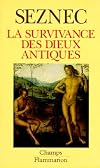
Originally written in French as La Survivance des Dieux Antiques in 1940, it was translated into English and published by the Bollingen Foundation in 1953. Author Jean Seznec was a world-renowned scholar who taught for many years at Harvard and later at Oxford.
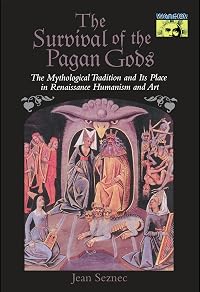
The main point of the book is to say that while it is a commonplace that the Olympian gods died with the rise of Christianity, to be resurrected during the show more Renaissance, the fact is that they did not completely disappear but merely assumed different forms and identities, and that medieval writers used them allegorically to further their own theological positions. Then during the Renaissance, with the fresh availability of ancient sources, few writers and artists actually relied on primary sources but instead turned to reference manuals compiled largely from medieval sources to describe and list the attributes of the ancient deities. This in large part accounts for the sometimes bizarre inconsistencies that are found in descriptions and depictions of these gods. (See above, Bernini vis-à-vis the book cover illustration from a medieval manuscript.)
This is all a very specialized subject, and as an American whose familiarity with Latin and the living European languages is limited to vague recollections of high school exposure and also as someone who has no pretenses to scholarly erudition, I found this book to be somewhat annoying to read. And that annoyance, let me hasten to say, is a function of my own lack of fluency in languages other than English. The author Seznec has cited countless ancient medieval and Renaissance sources and quoted liberally from them. The quotations that were in Latin are thankfully translated in footnotes, but modern language quotations are not given the same treatment. The net effect is that the book, while otherwise fairly easy to follow, is a source of some frustration when one would like to know what the passages in French and Italian actually said.
Aside from this, I found the book to be quite elucidating in explaining the many anomalies we moderns face when trying to understand the symbolism in paintings and poetic references particularly. The book is liberally strewn with black and white illustrations from manuscripts, incunabula and later printed editions, and also of painting and sculpture. So throughout we have visual representations of what Seznec is discussing.
Despite the frustrations of a scholarly work for the nonscholarly reader, I do believe The Survival of the Pagan Gods is a foundational work which in the end will serve as a useful reference to come back to again and again. show less
Originally written in French as La Survivance des Dieux Antiques in 1940, it was translated into English and published by the Bollingen Foundation in 1953. Author Jean Seznec was a world-renowned scholar who taught for many years at Harvard and later at Oxford.
The main point of the book is to say that while it is a commonplace that the Olympian gods died with the rise of Christianity, to be resurrected during the show more Renaissance, the fact is that they did not completely disappear but merely assumed different forms and identities, and that medieval writers used them allegorically to further their own theological positions. Then during the Renaissance, with the fresh availability of ancient sources, few writers and artists actually relied on primary sources but instead turned to reference manuals compiled largely from medieval sources to describe and list the attributes of the ancient deities. This in large part accounts for the sometimes bizarre inconsistencies that are found in descriptions and depictions of these gods. (See above, Bernini vis-à-vis the book cover illustration from a medieval manuscript.)
This is all a very specialized subject, and as an American whose familiarity with Latin and the living European languages is limited to vague recollections of high school exposure and also as someone who has no pretenses to scholarly erudition, I found this book to be somewhat annoying to read. And that annoyance, let me hasten to say, is a function of my own lack of fluency in languages other than English. The author Seznec has cited countless ancient medieval and Renaissance sources and quoted liberally from them. The quotations that were in Latin are thankfully translated in footnotes, but modern language quotations are not given the same treatment. The net effect is that the book, while otherwise fairly easy to follow, is a source of some frustration when one would like to know what the passages in French and Italian actually said.
Aside from this, I found the book to be quite elucidating in explaining the many anomalies we moderns face when trying to understand the symbolism in paintings and poetic references particularly. The book is liberally strewn with black and white illustrations from manuscripts, incunabula and later printed editions, and also of painting and sculpture. So throughout we have visual representations of what Seznec is discussing.
Despite the frustrations of a scholarly work for the nonscholarly reader, I do believe The Survival of the Pagan Gods is a foundational work which in the end will serve as a useful reference to come back to again and again. show less
The writers on art have hopelessly outstripped the writers on literature in our period. Seznec, Wind, and Gombrich are a very big three indeed.
- from a 10 August 1962 letter to Christopher Derrick, in The collected letters of C.S. Lewis, volume III
- from a 10 August 1962 letter to Christopher Derrick, in The collected letters of C.S. Lewis, volume III
INDEX; BIBLIOGRAPHY
Ratings
Members
- Recently Added By
Author Information

Some Editions
Series
Belongs to Publisher Series
Common Knowledge
- Canonical title
- The Survival of the Pagan Gods: The Mythological Tradition and Its Place in Renaissance Humanism and Art
- Original title
- La survivance des dieux antiques : Essai sur le rôle de la tradition mythologique dans l'humanisme et dans l'art de la Renaissance
- Original publication date
- 1940
- Original language
- French
Classifications
- Genres
- Nonfiction, Religion & Spirituality, Art & Design, History, General Nonfiction, Philosophy
- DDC/MDS
- 292.1 — Religion Other religions Greek & Roman Mythology Religious mythology, general classes of religion, interreligious relations and attitudes, social theology
- LCC
- BR135 .S483 — Philosophy, Psychology and Religion Christianity Christianity
- BISAC
Statistics
- Members
- 392
- Popularity
- 79,912
- Reviews
- 3
- Rating
- (3.85)
- Languages
- English, French, German, Italian
- Media
- Paper
- ISBNs
- 9
- ASINs
- 9