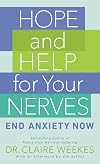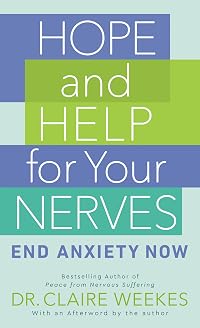
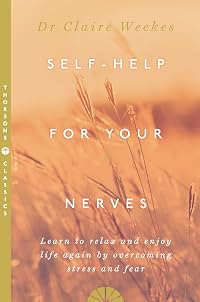
Hope and Help for Your Nerves
by Claire Weekes
On This Page
Description
Sweaty, trembling hands. Churning stomach. Headaches, sleeplessness, rapid heartbeat. All are common symptoms of nervous illness, or the panic state. During her long and accomplished career, Dr. Claire Weekes helped countless people overcome anxiety, fear, and frustration and lead happy, healthy lives. Based on the best-selling book of the same name, this eight-part original audio series is like a personal consultation with Dr. Weekes. Learn to recognize your own symptoms, rise above them, show more and relax. show lessTags
Recommendations




Member Reviews
I was given this book by a friend to use in my Little Free Library. However she suggested I read it because I am dealing with anxiety I developed during the pandemic. My friend is a retired psychotherapist. She said she skimmed parts of this book, but she thought it might help me.
Although this book is very dated, I enjoyed reading it. I especially liked that author suggested we deal with anxiety by focusing on our body reactions rather than on the fear which causes them. There are other parts of this book that deal with depression and agoraphobia, but the author’s approach to those problems also seem down to earth and doable.
I also like the idea the author presented of thoughts being bluffing. Scary thoughts are just that. Often they show more are worst case scenarios. Our thoughts must be called for that bluffing. What hasn’t happened yet is not reality. It is only a bluff which raises our anxiety level and causes us to panic.
I’m going to try some of the ideas presented in this book and feel that reading it was indeed helpful. show less
Although this book is very dated, I enjoyed reading it. I especially liked that author suggested we deal with anxiety by focusing on our body reactions rather than on the fear which causes them. There are other parts of this book that deal with depression and agoraphobia, but the author’s approach to those problems also seem down to earth and doable.
I also like the idea the author presented of thoughts being bluffing. Scary thoughts are just that. Often they show more are worst case scenarios. Our thoughts must be called for that bluffing. What hasn’t happened yet is not reality. It is only a bluff which raises our anxiety level and causes us to panic.
I’m going to try some of the ideas presented in this book and feel that reading it was indeed helpful. show less
I don't really know how to rate this book. On the one hand, the material and terminology suffers from being more than 50 years out-of-date. On the other hand, it's not entirely wrong. This book is more like looking at an evolutionary ancestor of current anxiety treatment books. Pretty good for the time, but not so great if looked at with current standards.
This book outlines treatment methods for "nervous illness," which today we'd call anxiety (including generalized anxiety disorder and panic disorder). Many of these treatment options still exist today under the guise of Cognitive Behavioral Therapy (CBT), Dialectical Behavioral Therapy (DBT) or Acceptance and Commitment Therapy (ACT). At the time this book was written, I'm assuming the show more treatment methods weren't so formally studied to warrant official names or acronyms, making them sound more like folksy advice or words of wisdom. These treatment methods consist of such things as mindfulness, cognitive defusion, radical acceptance, "riding the wave," reframing, relaxation (deep breathing, progressive muscle relaxation) and goal setting and achievement.
Some of the treatment methods in this book are outdated and probably not the greatest ideas anymore. These include heavy sedation (taking barbiturates continually to sleep for several days is one of the treatment suggestions for severe "nervous illness") as well as electroshock treatment before trying antidepressants. Of course, in the 1960s, SSRIs didn't exist, but at that time electroshock treatment wasn't as benign as it is today, so I don't know why it would be so casually suggested.
I found the depression section of this book particularly unhelpful, but being that this is a book about anxiety written in the 1960s, I'm not terribly surprised. While many of the above-mentioned treatment methods are very useful for depression, the author takes the view that depression is a result of emotional exhaustion, and will go away if the emotions are restored. She states that "[d]epression always passes because, as I have already explained, it is a state of emotional depletion, and as emotional reserves rebuild, spirits automatically rise." Which is totally untrue.
Additionally, I found it interesting that many of the "nervous illness" problems that she discusses in the context of housewives seem to be equivalent to Betty Friedan's "problem that has no name."
Finally, there was a brief (one side of a page) afterward to this book written in 1989. I was hoping it would discuss a bit of the changes in treatment methodology that had occurred in the past 30 years. However, it just goes on to mention the book and author's many accomplishments, and that antidepressant treatment is not helpful by itself. Technically true, but discounting SSRIs so quickly does a disservice to all of the people whom antidepressants help. show less
This book outlines treatment methods for "nervous illness," which today we'd call anxiety (including generalized anxiety disorder and panic disorder). Many of these treatment options still exist today under the guise of Cognitive Behavioral Therapy (CBT), Dialectical Behavioral Therapy (DBT) or Acceptance and Commitment Therapy (ACT). At the time this book was written, I'm assuming the show more treatment methods weren't so formally studied to warrant official names or acronyms, making them sound more like folksy advice or words of wisdom. These treatment methods consist of such things as mindfulness, cognitive defusion, radical acceptance, "riding the wave," reframing, relaxation (deep breathing, progressive muscle relaxation) and goal setting and achievement.
Some of the treatment methods in this book are outdated and probably not the greatest ideas anymore. These include heavy sedation (taking barbiturates continually to sleep for several days is one of the treatment suggestions for severe "nervous illness") as well as electroshock treatment before trying antidepressants. Of course, in the 1960s, SSRIs didn't exist, but at that time electroshock treatment wasn't as benign as it is today, so I don't know why it would be so casually suggested.
I found the depression section of this book particularly unhelpful, but being that this is a book about anxiety written in the 1960s, I'm not terribly surprised. While many of the above-mentioned treatment methods are very useful for depression, the author takes the view that depression is a result of emotional exhaustion, and will go away if the emotions are restored. She states that "[d]epression always passes because, as I have already explained, it is a state of emotional depletion, and as emotional reserves rebuild, spirits automatically rise." Which is totally untrue.
Additionally, I found it interesting that many of the "nervous illness" problems that she discusses in the context of housewives seem to be equivalent to Betty Friedan's "problem that has no name."
Finally, there was a brief (one side of a page) afterward to this book written in 1989. I was hoping it would discuss a bit of the changes in treatment methodology that had occurred in the past 30 years. However, it just goes on to mention the book and author's many accomplishments, and that antidepressant treatment is not helpful by itself. Technically true, but discounting SSRIs so quickly does a disservice to all of the people whom antidepressants help. show less
Dated but still helpful. I found the suggested exercises effective. Some of the stories were affirming, even with the 50's-60's style sexist assumptions behind them. .
Ratings
Members
- Recently Added By
Lists

Penguin Random House
458 works; 4 members
Author Information

12 Works 455 Members
Common Knowledge
- Original publication date
- 1969
- Epigraph
- Many of those who suffer from nervousness are persons of fine susceptibilities and delicate regard for honor, endowed with a feeling of duty and obligation toward others. Their nerves have tricked them, misled them.
W... (show all). R. HOUSTON - Dedication
- To the memory of my indomitable mother
- First words
- If you are reading this book because your nerves are in a bad way”, you are the very person for whom it has been written, and therefore I shall talk directly to you as if you were sitting beside me.
- Quotations
- In other words, long, anxious brooding on any difficult life situation may bring sensitization.
At least we have to admit that strong dislike of physical sensation is so close to fear that it can cause the same nervous reactions.
By your anxiety you are producing the very feelings you dislike so much.
The symptoms of this type of illness are always a reflection of your mood.
In fact, your heart is probably not working any harder than any other healthy heart. The difference is that you have become sensitized to its beating so that you feel each beat. And you remain sensitized to its beatin... (show all)g while you listen to and anxiously record each beat.
On the next occasion when you panic I want you to examine this feeling, describing it to yourself as it sweeps through you.
A healthy heart can tolerate a rate of over 200 beats per minute for hours, even days, without evidence of damage.
...sorrow at the loss of a loved one is mixed with the fear of facing the future alone.
Your own thoughts may bring this panic, or it may sweep over you with no apparent cause. If your thoughts are to blame, recognize that they are only thoughts, although, coming as they do so charged with fear, they may appear ... (show all)as monsters. Recognize that they are only thoughts and let them float away. Release them. Let them go. Do not clutch them. - Blurbers
- Ann Landers
Classifications
Statistics
- Members
- 208
- Popularity
- 157,066
- Reviews
- 3
- Rating
- (3.43)
- Languages
- English
- Media
- Paper, Audiobook, Ebook
- ISBNs
- 15
- ASINs
- 4