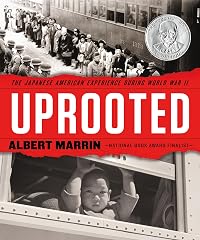
Uprooted: The Japanese American Experience During World War II
by Albert Marrin
On This Page
Description
A Publishers Weekly Best Book of the YearA Booklist Editor's Choice
On the 75th anniversary of the bombing of Pearl Harbor comes a harrowing and enlightening look at the internment of Japanese Americans during World War II— from National Book Award finalist Albert Marrin
Just seventy-five years ago, the American government did something that most would consider unthinkable today: it rounded up over 100,000 of its own citizens based on nothing more than their ancestry and, suspicious show more of their loyalty, kept them in concentration camps for the better part of four years.
How could this have happened? Uprooted takes a close look at the history of racism in America and carefully follows the treacherous path that led one of our nation’s most beloved presidents to make this decision. Meanwhile, it also illuminates the history of Japan and its own struggles with racism and xenophobia, which led to the bombing of Pearl Harbor, ultimately tying the two countries together.
Today, America is still filled with racial tension, and personal liberty in wartime is as relevant a topic as ever. Moving and impactful, National Book Award finalist Albert Marrin’s sobering exploration of this monumental injustice shines as bright a light on current events as it does on the past. show less
Tags
Recommendations






Member Reviews
This is an excellent, horrible look at a tremendously ugly time in US history. As he tells about the imprisonment of Japanese Americans during World War II, Marrin addresses the history of white supremacy in the US and especially in my current home state of California. I can't figure out why my country can mobilize within months of the attack at Pearl Harbor to imprison more than 100,000 citizens in concentration camps but we can't seem to distribute vaccines or masks in a fair and coordinated manner.
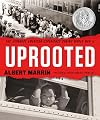
If I was looking only at access features, I would give Uprooted a higher rating. The table of contents and index are easy to navigate, and the illustrations and captions add depth and context. Especially with an emotionally charged subject, such as "The Japanese American Experience During World War II," photographs and other images are invaluable to help readers bridge experiences, developing empathy and understanding for the subject. Pronunciation guides immediately follow some Japanese words, and Marrin provides other brief explanations and definitions of unfamiliar concepts, events, and historical figures. Extensive footnotes and the accompanying notes are also user-friendly, as they provide inconspicuous yet accessible sources. show more "Further Reading" is posed here as "Some More Things to Read," which could be useful for anyone interested in researching the subject further, especially a student. The cover itself also eye-catching, with piercing, black and white images divided by the bold title, white on red background.
So much for the access features. Considering Uprooted's content, I am less impressed. As a student of Japanese and Asian studies, I was excited to crack open the cover and delve into the text. I wanted to learn more about the Japanese American experience in WWII, ashamed but duty-bound to know more about the hateful actions taken against innocent people. Although I went into the book without being completely ignorant of Japanese internment, I knew I was lacking in details. In this area, Marrin did not disappoint; I feel much more informed about how, when, and why Japanese Americans were viciously ripped from their homes and sent to live in concentration camps. However, my main complaint with Uprooted is that it seems to lack focus, which is strange, considering the title would suggest a very specific subject. Marrin wanders throughout the text, discussing a wide array of historical events that seem to have very little to do with Japanese Americans during World War II. Pages, whole chapters almost, are devoted to other aspects of history. To a an extent, I understand the need to develop context so that otherwise unfamiliar readers may have a more complete understanding. However, Marrin seems to go on tangents, and while these subjects are important in their own right, they are not exactly germane to this story. Likewise, incendiary remarks pepper the text, and again, although such comments deserve attention and consideration, such as calling President Abraham Lincoln a "white supremacist" (45), they also serve as a distraction and arguably detract from the main focus. show less
So much for the access features. Considering Uprooted's content, I am less impressed. As a student of Japanese and Asian studies, I was excited to crack open the cover and delve into the text. I wanted to learn more about the Japanese American experience in WWII, ashamed but duty-bound to know more about the hateful actions taken against innocent people. Although I went into the book without being completely ignorant of Japanese internment, I knew I was lacking in details. In this area, Marrin did not disappoint; I feel much more informed about how, when, and why Japanese Americans were viciously ripped from their homes and sent to live in concentration camps. However, my main complaint with Uprooted is that it seems to lack focus, which is strange, considering the title would suggest a very specific subject. Marrin wanders throughout the text, discussing a wide array of historical events that seem to have very little to do with Japanese Americans during World War II. Pages, whole chapters almost, are devoted to other aspects of history. To a an extent, I understand the need to develop context so that otherwise unfamiliar readers may have a more complete understanding. However, Marrin seems to go on tangents, and while these subjects are important in their own right, they are not exactly germane to this story. Likewise, incendiary remarks pepper the text, and again, although such comments deserve attention and consideration, such as calling President Abraham Lincoln a "white supremacist" (45), they also serve as a distraction and arguably detract from the main focus. show less
The book talks about the enslavement of Japanese Americans during World War II. It gives a thorough history of Chinese and Japanese cultures. It sets a good background of the Japanese Americans before telling about their confinement. It gives insight into the point of view of american citizens, organizations, government officials, and presidents. This book gives readers a glance at an important part of history. It is not common to see things against America in such a negative light. It is great to see factual information regardless how it makes the country look.
This book is definitely for a high school class. It is very deep when talking about the issue of racism, and what all the Japanese had to go through during World War 2. I think it would be best to read in a History class.
Ratings
Members
- Recently Added By
Lists

Robert F. Sibert Informational Book Medal
102 works; 1 member
Author Information

56+ Works 5,268 Members
Albert Marrin, professor emeritus of history at Yeshiva University in New York City
Awards and Honors
Awards
Distinctions
Classifications
Statistics
- Members
- 185
- Popularity
- 177,036
- Reviews
- 4
- Rating
- (3.67)
- Languages
- English
- Media
- Paper, Audiobook, Ebook
- ISBNs
- 16
- ASINs
- 2