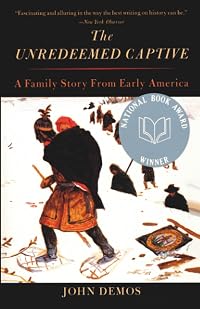
The Unredeemed Captive: A Family Story from Early America
by John Putnam Demos
On This Page
Description
"Early on the morning of February 29, 1704, before the settlers of Deerfield, Massachusetts, had stirred from their beds, a French and Indian war party opened fire, wielding hatchets and torches, on the lightly fortified town. What would otherwise have been a fairly commonplace episode of "Queen Anne's War" (as the War of the Spanish Succession was known in the colonies) achieved considerable notoriety in America and abroad. The reason: the Indians had managed to capture, among others, the show more eminent minister John Williams, his wife, Eunice Mather Williams, and their five children. This Puritan family par excellence, and more than a hundred of their good neighbors, were now at the mercy of "savages"--And the fact that these "savages" were French-speaking converts to Catholicism made the reversal of the rightful order of things no less shocking." "In The Unredeemed Captive, John Demos, Yale historian and winner of the Bancroft Prize for his book Entertaining Satan, tells the story of the minister's captured daughter Eunice, who was seven years old at the time of the Deerfield incident and was adopted by a Mohawk family living at a Jesuit mission-fort near Montreal. Two and a half years later, when Reverend Williams was released and returned to Boston amid much public rejoicing, Eunice remained behind - her Mohawk "master" unwilling to part with her. And so began a decades-long effort, alternately hopeful and demoralizing for her kin, to "redeem" her. Indeed, Eunice became a cause celebre across New England, the subject of edifying sermons, fervent prayers, and urgent envoys between the Massachusetts Bay Colony and New France. But somehow she always remained just out of reach - until eventually, her father's worst fears were confirmed: Eunice was not being held against her will. On the contrary, she had forgotten how to speak English, had married a young Mohawk man, and could not be prevailed upon to return to Deerfield." "Eunice's extraordinary and dramatic story speaks to broad, compelling themes that involve race, religion, the place of women in two societies, and, above all, contact between cultures ("Captivity, after all, meant 'contact' of a particularly vivid sort") and the crossing of cultural boundaries. For both colonists and Indians, the stakes were high in early-eighteenth-century America. Hence the boundaries were carefully patrolled: "To travel across them was costly and dangerous - and potentially transforming." The Unredeemed Captive traces just such a transformation - remarkable, profound, and uniquely American."--Jacket. show lessTags
Recommendations











Member Reviews
Impeccable scholarship, vital insights into culture conflicts of the past, and present.
This wonderful book is the best kind of popular history: uncompromising in the standards of its scholarship, yet accessible and fascinating to a broad, non-academic audience of readers interested in the nature of cultural identity, and clashing/co-existing societies. It tells the story of one family forcibly ruptured into two worlds, when an Indian raid carries off family members, including a seven-year-old daughter so thoroughly embedded in her new, Indian (sorry; the tribe are not native Americans but a Canadian offshoot of various native groups) world that by the time her "redemption" is possible, she no longer wishes to return to the world of her show more birth. Insights, and ironies abound. (Her Puritan family is more distressed at her succumbing to "Popery" than to nativism.) The author meticulously collates, and limits himself to, documented historical data, yet does not hesitate to draw broader, thoughtful conclusions, always delineating the border between provable fact and well-founded projection. This is a work of both socio-psychological depth, and tremendous historic integrity. Whether you come to the book for interesting historical fact, or for deep insight into the nature of cultural intersections and conflicts, you will be well rewarded. show less
This wonderful book is the best kind of popular history: uncompromising in the standards of its scholarship, yet accessible and fascinating to a broad, non-academic audience of readers interested in the nature of cultural identity, and clashing/co-existing societies. It tells the story of one family forcibly ruptured into two worlds, when an Indian raid carries off family members, including a seven-year-old daughter so thoroughly embedded in her new, Indian (sorry; the tribe are not native Americans but a Canadian offshoot of various native groups) world that by the time her "redemption" is possible, she no longer wishes to return to the world of her show more birth. Insights, and ironies abound. (Her Puritan family is more distressed at her succumbing to "Popery" than to nativism.) The author meticulously collates, and limits himself to, documented historical data, yet does not hesitate to draw broader, thoughtful conclusions, always delineating the border between provable fact and well-founded projection. This is a work of both socio-psychological depth, and tremendous historic integrity. Whether you come to the book for interesting historical fact, or for deep insight into the nature of cultural intersections and conflicts, you will be well rewarded. show less
John Demos is an historian of another age. He was trained during a time when historians were struggling to be recognized as more than mere stenographers of past events. As a result, narrative history was shoved aside in favor of a more (if not almost purely) analytical approach that stressed interpretation of the stories rather than the telling of them. This was unfortunate as he “had been drawn to history by the stories.” As the subtitle to this work suggests, however, he has come back to that love of story and expressed it through The Unredeemed Captive: A Story from Early America.
Demos’ work tells the story of the Williams family. Theirs is a story that was central to the history of colonial America. Settled in Deerfield on show more the Massachusetts frontier, John Williams (d. 1729), respected Puritan pastor and community leader, and his family struggled to build a life on the edge of the vast American wilderness. They faced hardships both environmental and physical. The greatest of these occurred 28 February 1704, when the French directed a raid against the community of Deerfield. The raiding party included French troops as well as a great number of Indian allies. Two of Williams’ children were killed outright; four others were captured along with him and his wife. His wife, Eunice, was killed along the way, but the others all survived the arduous trek to Canada. Over the course of almost three years all were ‘redeemed’ or returned to Massachusetts, except for the youngest daughter, also named Eunice. She chose to stay and make her life with the Mohawk family that had adopted her.
This book is ostensibly the story of the raid and capture, the redemption of John Williams and four of his children, and subsequent attempts to redeem Eunice. While focusing primarily on this one family, Demos managed also to tell the larger story of the early colonies. He used a wealth of primary sources, including letters, journals, public notices and legal records. In staying true to his narrative form, he weaves those into the story at times as if they were dialogue. This makes the story come alive in a way that reads much like decent fiction.
Demos does not shy away from the analytical, however. He goes beyond what is merely recorded in the sources to interpret the larger picture of colonial Massachusetts. One of the most salient examples is the third chapter, his study of Williams’ writings during and immediately after his captivity. Demos goes beyond the text in front of him and interprets them through a contextual filter. In so doing, he gives a much more intimate portrayal of Williams, while at the same time widening the scope to show Williams as a product of his time and place.
The second half of the book is taken up with Eunice’s life in Canada. After being adopted by a Catholic Mohawk family, she chose in turn to adopt their ways, language and religion. Eunice was baptized a Catholic (and rechristened Marguerite), much to the horror of her Puritan family that saw Catholicism as grievous sin. She married a Mohawk man and raised a family with him. John Williams never gave up his hope of redeeming her to her old family. Eunice never gave up her new family. In telling this part of the story, Demos relied on, admittedly scant, tribal records and personal papers. Yet he managed to recreate a realistic portrait of her community and family.
Demos managed to achieve his goals of telling a story and doing so from a point of view not wholly European. Through the life of John Williams, he was able to describe a larger colonial story. Through Eunice, he told the story through the eyes of those facing colonization. Through the French officials in Montreal and Quebec, Demos was able to add the additional voice of those North of the border. Unredeemed Captive is at once a story highly personal and yet hugely representative of early America. show less
Demos’ work tells the story of the Williams family. Theirs is a story that was central to the history of colonial America. Settled in Deerfield on show more the Massachusetts frontier, John Williams (d. 1729), respected Puritan pastor and community leader, and his family struggled to build a life on the edge of the vast American wilderness. They faced hardships both environmental and physical. The greatest of these occurred 28 February 1704, when the French directed a raid against the community of Deerfield. The raiding party included French troops as well as a great number of Indian allies. Two of Williams’ children were killed outright; four others were captured along with him and his wife. His wife, Eunice, was killed along the way, but the others all survived the arduous trek to Canada. Over the course of almost three years all were ‘redeemed’ or returned to Massachusetts, except for the youngest daughter, also named Eunice. She chose to stay and make her life with the Mohawk family that had adopted her.
This book is ostensibly the story of the raid and capture, the redemption of John Williams and four of his children, and subsequent attempts to redeem Eunice. While focusing primarily on this one family, Demos managed also to tell the larger story of the early colonies. He used a wealth of primary sources, including letters, journals, public notices and legal records. In staying true to his narrative form, he weaves those into the story at times as if they were dialogue. This makes the story come alive in a way that reads much like decent fiction.
Demos does not shy away from the analytical, however. He goes beyond what is merely recorded in the sources to interpret the larger picture of colonial Massachusetts. One of the most salient examples is the third chapter, his study of Williams’ writings during and immediately after his captivity. Demos goes beyond the text in front of him and interprets them through a contextual filter. In so doing, he gives a much more intimate portrayal of Williams, while at the same time widening the scope to show Williams as a product of his time and place.
The second half of the book is taken up with Eunice’s life in Canada. After being adopted by a Catholic Mohawk family, she chose in turn to adopt their ways, language and religion. Eunice was baptized a Catholic (and rechristened Marguerite), much to the horror of her Puritan family that saw Catholicism as grievous sin. She married a Mohawk man and raised a family with him. John Williams never gave up his hope of redeeming her to her old family. Eunice never gave up her new family. In telling this part of the story, Demos relied on, admittedly scant, tribal records and personal papers. Yet he managed to recreate a realistic portrait of her community and family.
Demos managed to achieve his goals of telling a story and doing so from a point of view not wholly European. Through the life of John Williams, he was able to describe a larger colonial story. Through Eunice, he told the story through the eyes of those facing colonization. Through the French officials in Montreal and Quebec, Demos was able to add the additional voice of those North of the border. Unredeemed Captive is at once a story highly personal and yet hugely representative of early America. show less
When forming the narrative of this book, historian John Demos, decided to focus on a single community and a single family to tell a story about the relationships between the New French and the New Englanders, the relationship between each of these groups with the local Native Americans, and how larger international conflicts effected the lives of everyone from Quebec and Montreal to Boston. The community the author chooses is the small frontier town of Deerfield, Massachusetts , and the family is that of Reverend John Williams.
In the early morning of February 29, 1704, a mixed force of nearly 50 French soldiers and officers and 200 "domiciled" Indians from the Abenaki, Huron, and Mohawk Iroquois tribes attacked Deerfield. The political show more aim was to capture someone valuable to trade for a prisoner the British were holding. In the resulting battle, 48 townspeople slain, 120 captives taken, and 140 survivors remained. In addition, not all of the captives survive the journey to Montreal, where most are "redeemed" and made prisoners of the French, or to assorted Indian villages north of Albany. Mr. Williams and three of his sons are redeemed immediately, one son and a daughter are taken to live in different tribal villages.
All of this occurs in the first chapter, the rest of the book focuses on broader themes, such as the meaning of redemption from the Indians to the descendents of the Puritans on the brink of the Great Awakening. Much of the New Englanders concern for their kin was not their physical safety, but the safety of their souls. The Jesuits had converted thousands of Indians to Catholicism, and the settlers were deathly afraid that the captured would be converted to evil popish ways and their souls lost forever. I had never realized that the majority of the Indian attackers were practicing Christians, that the majority of the captives never stayed in Indian villages, and that the British offered bounties for enemy scalps. My childhood history books seem to have gotten a few things wrong.
The book is an interesting introduction to the New England experience of the time and made me want to read the original source material. Especially since the author had the annoying habit of quoting words and phrases, so that each paragraph was a patchwork of tiny quotes (often single words) and his own words. I found it much harder to follow than if he had quoted larger sections of source material and then provided interpretation. The book is well-researched, however, and I learned a great deal. I did feel misled by the jacket flap, for the book is not the story of Eunice Williams, about whom very little is actually known, but the story of a much larger phenomena. show less
In the early morning of February 29, 1704, a mixed force of nearly 50 French soldiers and officers and 200 "domiciled" Indians from the Abenaki, Huron, and Mohawk Iroquois tribes attacked Deerfield. The political show more aim was to capture someone valuable to trade for a prisoner the British were holding. In the resulting battle, 48 townspeople slain, 120 captives taken, and 140 survivors remained. In addition, not all of the captives survive the journey to Montreal, where most are "redeemed" and made prisoners of the French, or to assorted Indian villages north of Albany. Mr. Williams and three of his sons are redeemed immediately, one son and a daughter are taken to live in different tribal villages.
All of this occurs in the first chapter, the rest of the book focuses on broader themes, such as the meaning of redemption from the Indians to the descendents of the Puritans on the brink of the Great Awakening. Much of the New Englanders concern for their kin was not their physical safety, but the safety of their souls. The Jesuits had converted thousands of Indians to Catholicism, and the settlers were deathly afraid that the captured would be converted to evil popish ways and their souls lost forever. I had never realized that the majority of the Indian attackers were practicing Christians, that the majority of the captives never stayed in Indian villages, and that the British offered bounties for enemy scalps. My childhood history books seem to have gotten a few things wrong.
The book is an interesting introduction to the New England experience of the time and made me want to read the original source material. Especially since the author had the annoying habit of quoting words and phrases, so that each paragraph was a patchwork of tiny quotes (often single words) and his own words. I found it much harder to follow than if he had quoted larger sections of source material and then provided interpretation. The book is well-researched, however, and I learned a great deal. I did feel misled by the jacket flap, for the book is not the story of Eunice Williams, about whom very little is actually known, but the story of a much larger phenomena. show less
i enjoyed it, but no as much as Indian Captive. There was just too little material to really get a sense of what it was like for the captive or her family. As a general history of the time and the relations between native americans and puritans-it was informative-but as a soi called micro-hostory I felt it was light
I've read this book three times and recommend it whenever the topic of colonial America comes up. This book leads to many, many other historical topics and got me started on one of my great interests: Deerfield, the 1704 Raid and the earlier, King Philips War.
In a word: magnificent. A fascianting and often poignant story of a family in very early 18th-century New England, specifically Massachusetts. In February of 1704, the hamlet of Deerfield was ambushed by a French/Native American raiding party. Some of the inhabitants were kiled, others were captured. This book is the story of that raid, as well as the story of colonial America, "where English, French and Indians faced one another across gulfs of culture and belief ..." Hugely recommended.
4900 The Unredeemed Captive A Family Story From Early America, by John Demos (read 29 Jan 2012) (Parkman Prize for 1995) This book won the 1995 Francis Parkman Prize, and is the 21st such winner I have read. It tells of the Feb 29, 1704, Indian raid on Deerfield, Mass. Numerous inhabitants of the town were taken by the Indians to Canada. Many of the captives returned to Massachusetts, but Eunice Williams, age 4, stayed with the Indians, despite her father's strenuous efforts to get her to come back. Eunice married an Indian man and became a Catholic. Her persistence in her Faith drove her bigoted father and brother frantic, but she resisted the blandishments of all who tried to get her to return. She lived till 1785, and did visit her show more relatives in New England several times. The historical and genealogical research which went into this fine book is exemplary, and while some ot the book gets a bit tiresome, with its extensive quoting of records, sermons, and letters--with poor spelling adding to the non-fun reading thereof-- the book ends strong and raises the interesting point that the people who founded Deerfield did of course take the land from the Indians. The book well deserved the Parkman Prize and anyone interested in early New England history will be enthralled at times by parts of the book. show less
Members
- Recently Added By
Author Information

13+ Works 2,671 Members
John Putnam Demos is Samuel Knight Professor of History, Yale University.
Awards and Honors
Series
Belongs to Publisher Series
Work Relationships
Inspired
Common Knowledge
- Original title
- The Unredeemed Captive: A Family Story from Early America
- Original publication date
- 1994
- People/Characters
- Reverend John Williams; Eunice Williams; Thaovenhosen
- Important places
- Massachusetts, USA
- Important events
- Queen Anne's War (1702-1713); Raid on Deerfield (1704-02-29)
- First words
- Where does the story begin?
- Last words
- (Click to show. Warning: May contain spoilers.)Was there not a kind of "redemption" here as well?
- Original language
- English
Classifications
- Genres
- History, Nonfiction, General Nonfiction, Biography & Memoir
- DDC/MDS
- 973.25 — History & geography History of North America United States Colonial period (1607-1775) Early French wars (1689-1732)
- LCC
- E197 .D46 — History of the United States United States Colonial history (1607-1775) By period 1689-1775 Queen Anne's War, 1702-1713
- BISAC
Statistics
- Members
- 1,185
- Popularity
- 21,064
- Reviews
- 10
- Rating
- (3.77)
- Languages
- English, French, Spanish
- Media
- Paper, Audiobook, Ebook
- ISBNs
- 13
- ASINs
- 7