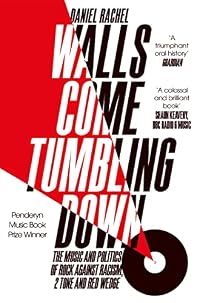
Walls Come Tumbling Down: The Music and Politics of Rock Against Racism, 2 Tone and Red Wedge
by Daniel Rachel
On This Page
Description
Walls Come Tumbling Down charts the pivotal period between 1976 and 1992 that saw politics and pop music come together for the first time in Britain's musical history; musicians and their fans suddenly became instigators of social change, and 'the political persuasion of musicians was as important as the songs they sang'. Through the voices of campaigners, musicians, artists and politicians, Daniel Rachel follows the rise and fall of three key movements of the time: Rock Against Racism, 2 show more Tone, and Red Wedge, revealing how they all shaped, and were shaped by, the music of a generation.Composed of interviews with over 150 of the key players at the time, Walls Come Tumbling Down is a fascinating, polyphonic and authoritative account of those crucial sixteen years in Britain's history. show lessTags
Recommendations

Member Reviews
This is, somewhat to my surprise, excellent. I went to quite a few of the early Rock Against Racism / Anti Nazi League gigs and protests, and have never really seen a good analysis of it. Daniel Rachel - perhaps because he's from that part of the world himself - rightly puts Birmingham at the forefront of the movement (those of us from the Midlands get a bit tired of Manchester always being portrayed as being at the centre of everything). The first RAR/ ANL gig I ever went to was in the basement of Digbeth Civic Hall - there was a revivalist church service going on in the main hall whose neatly suited ushers politely directed punks like us to the dingy hole below where we'd be more at home. Playing that day were UB40 - so many of them show more that they couldn't all fit on the stage - and a band called the Dum Dum Boys featuring a green haired drummer who later become Ranking Roger of The Beat. Later, we all piled on buses to protest a National Front march, and I had to ring my mother later that night to explain why I was in Leicester. Happy Days
I mention this to show that RAR/ ANL was all about earnest protesting there was a lot of hedonism too. And through the simple method of quoting snippets from interviews with bands, organisers, politicians and other interested parties, Rachel presents an absorbing oral history of the movement. The usual suspects come out of it well - Paul Weller, Billy Bragg, Jerry Dammers. But there is a lot of focus on the lesser lights, who were perhaps even more important; Steel Pulse, Misty in Roots, Matumbi, The Ruts, The Au Pairs. Its an excellent account, I only wish Rachel had included the boycott and picketing of Barbarella's nightclub in Birmingham (they were banning Sikhs on the excuse of a "no headgear" rule) but maybe that was ANL rather than RAR
I'd left the UK before the Red Wedge movement, so that's of slightly less interest to me, but it still excellently done, as is the section on Artists against Apartheid. None of the other movements for social change, may, in the end have achieved anything but in the end Nelson Mandela was freed show less
I mention this to show that RAR/ ANL was all about earnest protesting there was a lot of hedonism too. And through the simple method of quoting snippets from interviews with bands, organisers, politicians and other interested parties, Rachel presents an absorbing oral history of the movement. The usual suspects come out of it well - Paul Weller, Billy Bragg, Jerry Dammers. But there is a lot of focus on the lesser lights, who were perhaps even more important; Steel Pulse, Misty in Roots, Matumbi, The Ruts, The Au Pairs. Its an excellent account, I only wish Rachel had included the boycott and picketing of Barbarella's nightclub in Birmingham (they were banning Sikhs on the excuse of a "no headgear" rule) but maybe that was ANL rather than RAR
I'd left the UK before the Red Wedge movement, so that's of slightly less interest to me, but it still excellently done, as is the section on Artists against Apartheid. None of the other movements for social change, may, in the end have achieved anything but in the end Nelson Mandela was freed show less
Ratings
Members
- Recently Added By
Lists

Books Read in 2020
4,379 works; 124 members

Music Journalism and Biography
56 works; 1 member
Author Information
8 Works 211 Members
Daniel Rachel is a writer and a musician. He wrote his first song when he was sixteen and was the lead singer of Rachels Basement. A specialist in Forum Theatre direction, he lives in North London with his partner and three children. The Art of Noise is his first book.
Awards and Honors
Awards
Distinctions
The Guardian Book of the Day (2016-09-28)
Common Knowledge
- Dedication
- Dedicated to Allan Bowen,
tutor at Solihull VI Form College,
who validated the link between music,
politics and the ideological struggle. - First words
- On 5 August 1976, on stage at the Birmingham Odeon, a drunk Eric Clapton harangued an audience of 2,000 rock fans.
- Last words
- (Click to show. Warning: May contain spoilers.)Walls did come tumbling down.
- Blurbers
- Keaveney, Shaun; Bragg, Billy; Ross, Jonathan
Classifications
- Genres
- Music, Nonfiction, General Nonfiction, History
- DDC/MDS
- 780.941 — Arts & recreation Music Music Biography And History Europe British Isles -- Ireland & Scotland
- LCC
- ML3917 .G7 .R3 — Music Literature on music Literature on music Philosophical and societal aspects of music. Physics Social and political aspects of music
- BISAC
Statistics
- Members
- 39
- Popularity
- 742,689
- Reviews
- 1
- Rating
- (4.50)
- Languages
- English
- Media
- Paper, Ebook
- ISBNs
- 4
- ASINs
- 1