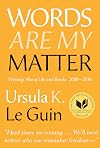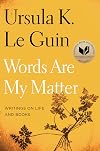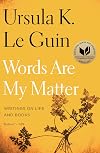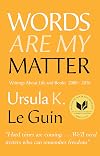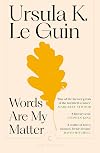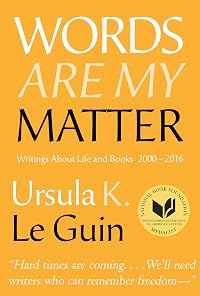
Words Are My Matter: Writings on Life and Books
by Ursula K. Le Guin
On This Page
Description
This collection of Ursula K. Le Guin's recent talks, essays, introductions is the best manual we have for exploring the worlds explored in recent fiction; the most useful guide to the country we're visiting, life.Tags
Recommendations

Member Recommendations

Member Reviews
”And though you’re usually alone when you read, you are in communion with another mind.”
I’ve never read Le Guin’s non-fiction before, so this collection of essays, talks, book reviews and diary entries was a lovely introduction.
It was like talking to a wise friend. We have talked about imagination, reading, protested against the arrogance that divides literature into realism/literary fiction and the ”garbage heap” of genre fiction. We have sighed over “messages” in books. I am not fond books that hit you on the head with their truths, only Le Guin puts it more eloquently. ”No matter how humble a spirit it’s offered in, a sermon is an act of aggression.”
“What It Was Like” is about what is was like before Roe show more vs Wade. This one broke my heart and I think about all the women of this world living under fundamentalist laws.
The essay about Ursula Le Guin’s childhood home, ”Living in the Work of Art” is touching and beautiful.
“Disappearing Grandmothers” - how women are still (just in more subtle ways than before) excluded from literary canon.
”Live or dead, male authors are discussed without mentioning that they are or were ugly or unattractive men, but the sin of not having a pretty face is held against women even when they are dead.”
The book reviews were a delight. She wrote wonderful and insightful things about Lem and his Solaris, Philip K. Dick, Jo Walton’s Among Others. Reviews about books I have not read were dangerously inspirational.
Listening to Le Guin’s voice is good for the soul.
A few more quotes:
”Fiction offers the best way of understanding people different from oneself, short of experience.”
”How to read a poem is aloud.”
”Fiction is invention, but it’s not lies.” show less
I’ve never read Le Guin’s non-fiction before, so this collection of essays, talks, book reviews and diary entries was a lovely introduction.
It was like talking to a wise friend. We have talked about imagination, reading, protested against the arrogance that divides literature into realism/literary fiction and the ”garbage heap” of genre fiction. We have sighed over “messages” in books. I am not fond books that hit you on the head with their truths, only Le Guin puts it more eloquently. ”No matter how humble a spirit it’s offered in, a sermon is an act of aggression.”
“What It Was Like” is about what is was like before Roe show more vs Wade. This one broke my heart and I think about all the women of this world living under fundamentalist laws.
The essay about Ursula Le Guin’s childhood home, ”Living in the Work of Art” is touching and beautiful.
“Disappearing Grandmothers” - how women are still (just in more subtle ways than before) excluded from literary canon.
”Live or dead, male authors are discussed without mentioning that they are or were ugly or unattractive men, but the sin of not having a pretty face is held against women even when they are dead.”
The book reviews were a delight. She wrote wonderful and insightful things about Lem and his Solaris, Philip K. Dick, Jo Walton’s Among Others. Reviews about books I have not read were dangerously inspirational.
Listening to Le Guin’s voice is good for the soul.
A few more quotes:
”Fiction offers the best way of understanding people different from oneself, short of experience.”
”How to read a poem is aloud.”
”Fiction is invention, but it’s not lies.” show less
This volume collects various bits and bobs of Ursula K. Le Guin's nonfiction writing from the last sixteen years, divided into four different sections: talks and essays of various sorts, introductions to republications of books, book reviews, and a journal from a week Le Guin spent at a rural writer's retreat.
The speeches and other essays are good, if an odd and inconsistent miscellany, ranging from two quick pages on Le Guin's experience getting an abortion before Roe v. Wade, to six pages about invented languages in fiction, to seven pages about genre fiction, to fifteen pages about the architect of the house she grew up in. What you get out of these will probably depend on your interest in the topics: I found that fifteen pages about show more an architect was more than I cared to read, for example, but loved Le Guin's various thoughts on genre. She's not a big fan of literary writers who borrow from speculative fiction at the same time they condescend about it, and this parody of their discourse was probably one of my favorite bits of the book:
my book Searoad [...] makes ironic use of some realist tropes—but of course I don't write Re-Fi [...]. Realism is for lazy-minded, semi-educated people whose atrophied imagination allows them only the most limited and conventional subject matter. Re-Fi is a repetitive genre written by unimaginative hacks who rely on mere mimesis. If they had any self-respect they'd be writing memoir, but they're too lazy to fact-check. Of course I never read Re-Fi. But the kids keep bringing home these garish realistic novels and talking about them, so I know that it's an incredibly narrow genre, completely centered on one species, full of worn-out clichés and predictable situations—the quest for the father, mother-bashing, obsessive male lust, dysfunctional suburban families, etc., etc. All it's good for is being made into mass-market movies.
The forewords, on the other hand, were tough going at times; if I've learned anything from reading this book and Neil Gaiman's The View from the Cheap Seats, it's that forewords stand on their own somewhat awkwardly, being designed to prime you to read a book you're not actually about to read. Some were interesting enough that I marked the books down to check out later, but I was relieved when I made it through them all.
The book reviews, though, made the whole book worth it. Le Guin is an incisive and intelligent reviewer, and I'd read one or two of these in The Guardian on-line, but most of them were new to me. Le Guin is skilled at identifying what kind of genre a work is operating in, and using that to say something interesting about the book. A good review should not only give you a sense of the work, but it should also say something that goes beyond the book-- without going so far beyond the book as to leave it behind-- and Le Guin achieves all that in these excellent little bits of criticism. She left me with a number of books I wanted to read because she made them sound good, ones she made me know I did not want to read, and ones I wanted to read because it sounded like they failed in interesting ways.
The journal was cute if somewhat insubstantial; despite being "of a writer's week" it's less about writing and more about bits of nature Le Guin notices at the retreat. I did like her observations about the trails at the retreat, and the behavior of rabbits. show less
The speeches and other essays are good, if an odd and inconsistent miscellany, ranging from two quick pages on Le Guin's experience getting an abortion before Roe v. Wade, to six pages about invented languages in fiction, to seven pages about genre fiction, to fifteen pages about the architect of the house she grew up in. What you get out of these will probably depend on your interest in the topics: I found that fifteen pages about show more an architect was more than I cared to read, for example, but loved Le Guin's various thoughts on genre. She's not a big fan of literary writers who borrow from speculative fiction at the same time they condescend about it, and this parody of their discourse was probably one of my favorite bits of the book:
my book Searoad [...] makes ironic use of some realist tropes—but of course I don't write Re-Fi [...]. Realism is for lazy-minded, semi-educated people whose atrophied imagination allows them only the most limited and conventional subject matter. Re-Fi is a repetitive genre written by unimaginative hacks who rely on mere mimesis. If they had any self-respect they'd be writing memoir, but they're too lazy to fact-check. Of course I never read Re-Fi. But the kids keep bringing home these garish realistic novels and talking about them, so I know that it's an incredibly narrow genre, completely centered on one species, full of worn-out clichés and predictable situations—the quest for the father, mother-bashing, obsessive male lust, dysfunctional suburban families, etc., etc. All it's good for is being made into mass-market movies.
The forewords, on the other hand, were tough going at times; if I've learned anything from reading this book and Neil Gaiman's The View from the Cheap Seats, it's that forewords stand on their own somewhat awkwardly, being designed to prime you to read a book you're not actually about to read. Some were interesting enough that I marked the books down to check out later, but I was relieved when I made it through them all.
The book reviews, though, made the whole book worth it. Le Guin is an incisive and intelligent reviewer, and I'd read one or two of these in The Guardian on-line, but most of them were new to me. Le Guin is skilled at identifying what kind of genre a work is operating in, and using that to say something interesting about the book. A good review should not only give you a sense of the work, but it should also say something that goes beyond the book-- without going so far beyond the book as to leave it behind-- and Le Guin achieves all that in these excellent little bits of criticism. She left me with a number of books I wanted to read because she made them sound good, ones she made me know I did not want to read, and ones I wanted to read because it sounded like they failed in interesting ways.
The journal was cute if somewhat insubstantial; despite being "of a writer's week" it's less about writing and more about bits of nature Le Guin notices at the retreat. I did like her observations about the trails at the retreat, and the behavior of rabbits. show less
Ursula K. Le Guin (1929-2018) had a chip on her shoulder, as becomes evident in her late-in-life collection of essays, speeches and reviews “Words Are My Matter” (2016).
Regarded as one of the best writers in the science fiction/fantasy genre, Le Guin's beef was getting stuck in that particular box and, worse, that that box has never been highly regarded in literary circles. The better literary publications and literary critics don't give much attention to fantasy and science fiction. Le Guin thought she deserved better, and she was probably right.
"The word genre came to imply something less, something inferior, and came to be commonly misused, not as a description, but as a negative value judgment," she said in a speech she gave in show more Seattle in 2004. "Most people now understand 'genre' to be an inferior form of fiction, defined by a label, while realistic fictions are simply called novels or literature."
She puts it more succinctly and sarcastically in an essay called "Le Guin's Hypothesis," "So. Literature is the serious stuff you have to read in college, and genre is what you read for pleasure, which is guilty." Similar comments pop up here and there throughout the book.
In that Seattle speech she said, "Some 'literary' novelists have performed amazing contortions to preserve their pure name from the faintest taint of genre pollution." In her book reviews she named names, including the likes of Margaret Atwood. Jose Saramago and Jeanette Winterson. About the latter, she complained, "Winterson is trying to keep her credits as a 'literary' writer even as she openly commits genre" in “The Stone Gods.” She lets H.G. Wells off the hook because he wrote his classic stories like “The Time Machine” before there even was a genre.
It is not clear whether Le Guin was really critical of those who "commit genre" without ever getting charged with the crime or simply envious of them. She got stuck in the genre ghetto and was never able to escape. show less
Regarded as one of the best writers in the science fiction/fantasy genre, Le Guin's beef was getting stuck in that particular box and, worse, that that box has never been highly regarded in literary circles. The better literary publications and literary critics don't give much attention to fantasy and science fiction. Le Guin thought she deserved better, and she was probably right.
"The word genre came to imply something less, something inferior, and came to be commonly misused, not as a description, but as a negative value judgment," she said in a speech she gave in show more Seattle in 2004. "Most people now understand 'genre' to be an inferior form of fiction, defined by a label, while realistic fictions are simply called novels or literature."
She puts it more succinctly and sarcastically in an essay called "Le Guin's Hypothesis," "So. Literature is the serious stuff you have to read in college, and genre is what you read for pleasure, which is guilty." Similar comments pop up here and there throughout the book.
In that Seattle speech she said, "Some 'literary' novelists have performed amazing contortions to preserve their pure name from the faintest taint of genre pollution." In her book reviews she named names, including the likes of Margaret Atwood. Jose Saramago and Jeanette Winterson. About the latter, she complained, "Winterson is trying to keep her credits as a 'literary' writer even as she openly commits genre" in “The Stone Gods.” She lets H.G. Wells off the hook because he wrote his classic stories like “The Time Machine” before there even was a genre.
It is not clear whether Le Guin was really critical of those who "commit genre" without ever getting charged with the crime or simply envious of them. She got stuck in the genre ghetto and was never able to escape. show less
A great collection of essays & book reviews, many of which (books reviewed) I've never read, in which Ursula K Le Guin manages to talk about imagination in ways that are smart, unsentimental and never cornball. These are prescient, as everything seems to be now, as the designer for this book must have realized when they excerpted "Hard times are coming... We'll need writers who can remember freedom," but none of these essays predict the future, they just demonstrate an extreme intuition for human beings & the things they do, including the fact that every book benefits from animals in it. "Then the dog showed up & I knew everything was all right."
I love how Le Guin writes. She isn't shy about opinionating. Certain themes recur throughout this book, notably that women don't get a fair shake as authors, and that 'genre' literature (fantasy, mystery, sci-fi, etc) is as much literature as is the realist canon. I've added Saramago to my reading list just from what she had to say about him in here. And other specific works as well.
https://nwhyte.livejournal.com/2903021.html
I found this collection of essays full of wisdom and wit, often making fun of people who deserve it. It made me feel like I was in conversation with a vastly intelligent and immensely compassionate old friend.
I found this collection of essays full of wisdom and wit, often making fun of people who deserve it. It made me feel like I was in conversation with a vastly intelligent and immensely compassionate old friend.
It was a pleasure discovering this selection of nonfiction (2000-2016) by Ursula K. LeGuin. Her writing is elegant and wonderfully insightful. Both the book reviews and book introductions give one much to digest and authors to anticipate. There is an underlying trace of bitterness regarding authors neglected through the limits of current publishing.
Members
- Recently Added By
Lists

Books Read in 2018
4,360 works; 110 members

Top Five Books of 2018
802 works; 265 members

Books Read in 2021
5,361 works; 113 members
Author Information

497+ Works 167,216 Members
Ursula K. Le Guin was born Ursula Kroeber in Berkeley, California on October 21, 1929. She received a bachelor's degree from Radcliffe College in 1951 and a master's degree in romance literature of the Middle Ages and Renaissance from Columbia University in 1952. She won a Fulbright fellowship in 1953 to study in Paris, where she met and married show more Charles Le Guin. Her first science-fiction novel, Rocannon's World, was published in 1966. Her other books included the Earthsea series, The Left Hand of Darkness, The Dispossessed: An Ambiguous Utopia, The Lathe of Heaven, Four Ways to Forgiveness, and The Telling. A Wizard of Earthsea received an American Library Association Notable Book citation, a Horn Book Honor List citation, and the Lewis Carroll Shelf Award in 1979. She received the Medal for Distinguished Contribution to American Letters in 2014. She also received the Nebula Award and the Hugo Award. She also wrote books of poetry, short stories collections, collections of essays, children's books, a guide for writers, and volumes of translation including the Tao Te Ching of Lao Tzu and selected poems by Gabriela Mistral. She died on January 22, 2018 at the age of 88. (Bowker Author Biography) show less
Some Editions
Awards and Honors
Awards
Distinctions
Common Knowledge
- Original publication date
- 2016
- Epigraph
- The Mind Is Still
The mind is still. The gallant books of lies
are never quite enough.
Ideas are a whirl of mazy flies
over the pigs' trough.
Words are my matter. I ... (show all)have chipped one stone
for thirty years and still it is not done,
that image of the thing I cannot see.
I cannot finish it and set it free,
transformed to energy.
I chip and stutter but I do not sing
the truth, like any bird.
Daily I come to Judgment stammering
the same half-word.
So what's the matter? I can understand
that stone is heavy in the hand.
Ideas flit like flies above the swill.
I crowd with other pigs to get my fill.
The mind is still.
(1977) - First words
- I seldom have as much pleasure in reading nonfiction as I do in a poem or a story.
- Quotations
- Please don't ask me where I get my ideas from. I have managed to keep the address of the company where I buy my ideas a secret all these years, and I'm not about to let people in on it now.
- Last words
- (Click to show. Warning: May contain spoilers.)Chau mi casita querida!
Classifications
- Genres
- Literature Studies and Criticism, Nonfiction
- DDC/MDS
- 818.5409 — Literature & rhetoric American literature in English American miscellaneous writings in English 20th Century 1945-1999
- LCC
- PS3562 .E42 .A6 — Language and Literature American literature American literature Individual authors 1961-
- BISAC
Statistics
- Members
- 604
- Popularity
- 48,348
- Reviews
- 13
- Rating
- (3.99)
- Languages
- English, Turkish
- Media
- Paper, Audiobook, Ebook
- ISBNs
- 13
- ASINs
- 3