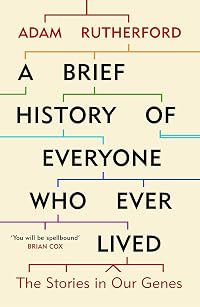
A Brief History of Everyone Who Ever Lived: The Human Story Retold Through Our Genes
by Adam Rutherford
On This Page
Description
In our unique genomes, every one of us carries the story of our species--births, deaths, disease, war, famine, migration, and a lot of sex. But those stories have always been locked away--until now. Who are our ancestors? Where did they come from? Geneticists have suddenly become historians, and the hard evidence in our DNA has blown the lid off what we thought we knew. Acclaimed science writer Adam Rutherford explains exactly how genomics is completely rewriting the human story--from show more 100,000 years ago to the present. A Brief History of Everyone Who Ever Lived will upend your thinking on Neanderthals, evolution, royalty, race, and even redheads. (For example, we now know that at least four human species once roamed the earth.) Plus, here is the remarkable, controversial story of how our genes made their way to the Americas--one that's still being written, as ever more of us have our DNA sequenced. Rutherford closes with "A Short Introduction to the Future of Humankind," filled with provocative questions that we're on the cusp of answering: Are we still in the grasp of natural selection? Are we evolving for better or worse? And . . . where do we go from here? show lessTags
Recommendations




Member Recommendations
Member Reviews
Really strong. Couldn't put it down at first. Got to around 92% before I flagged. This actually explained a few genetics concepts that I obviously hadn't fully "got" (during my, er... biology degree and project on genetics) so effectively that I'll be giving this to everyone as Christmas presents. Debunks racial "science", loads of interesting stuff on human origins (with the Neanderthals and Denisovans etc.), some history of science, and evolution. The only part I wasn't so sure of was the "defending science" bit at the end, but that's partly because I don't need convincing as I've seen evidence with my own eyes.
There was recently a trial* showing that teaching genetics before evolution improves understanding, and I think this book show more would serve very well as the general introduction a layperson needs to both get interested in the subject and lay a foundation for accurately comprehending how evolution works.
*Mead R, Hejmadi M, Hurst LD (2017) Teaching genetics prior to teaching evolution improves evolution understanding but not acceptance. PLoS Biol 15(5): e2002255. https://doi.org/10.1371/journal.pbio.2002255 show less
There was recently a trial* showing that teaching genetics before evolution improves understanding, and I think this book show more would serve very well as the general introduction a layperson needs to both get interested in the subject and lay a foundation for accurately comprehending how evolution works.
*Mead R, Hejmadi M, Hurst LD (2017) Teaching genetics prior to teaching evolution improves evolution understanding but not acceptance. PLoS Biol 15(5): e2002255. https://doi.org/10.1371/journal.pbio.2002255 show less
https://fromtheheartofeurope.eu/a-brief-history-of-everyone-who-ever-lived-by-ad...
A good summary of where we are with the study of human genes, genetics and genomes, a subject that I have thought about at great length during my genealogical investigations and also my previous pieces on Richard III and the most recent common ancestor. (Rutherford covers both of these topics in detail.) He goes into the very slender genetic basis for race, criminal disposition or many other characteristics that have been said to be biologically predetermined, and explains why it is More Complicated Than That.
In other words, my prejudices were reinforced, but authoritatively, and although the style gets a little too jocular in places for my taste, I still show more recommend it strongly. show less
A good summary of where we are with the study of human genes, genetics and genomes, a subject that I have thought about at great length during my genealogical investigations and also my previous pieces on Richard III and the most recent common ancestor. (Rutherford covers both of these topics in detail.) He goes into the very slender genetic basis for race, criminal disposition or many other characteristics that have been said to be biologically predetermined, and explains why it is More Complicated Than That.
In other words, my prejudices were reinforced, but authoritatively, and although the style gets a little too jocular in places for my taste, I still show more recommend it strongly. show less
A genetikával (és a természettudományok egyéb ágaival) a viszonyom olyan, mint a kaukázusi juhászkutyákkal: tisztelem, becsülöm őket, de tartsuk a távolságot. Ez a könyv viszont arra tett ígéretet, hogy az emberi történelmet fogja megvizslatni a genetika szemüvegén keresztül, ami elképesztően vonzó opciónak tűnt. Az első dolgok egyike, amit megtudtam belőle, az volt, hogy igazából ez a könyv nem is a genetikával foglalkozik, hanem a genomikával – vagyis nem magával a génnel, hanem az emberi DNS összességével. Aztán szembesülnöm kellett azzal is, hogy ha arra számítottam, majd kapok egy többé-kevésbé lineáris szöveget, ami az emberiség afrikai bölcsőjéből kiindulva egészen a show more jelenkorig végigvezet engem fajunk történelmén egy genetikus idegenvezetésével, akkor csalódnom kell. És mivel arra számítottam, picit csalódtam is. Merthogy ezek a fejezetek inkább ad hoc egymás mellé-mögé helyezett anekdotáknak tűntek arról, hogyan is látja egy genetikus a történelmi állításokat, és hogyan segíti tudományával ezen állítások bizonyítását vagy cáfolatát. Viszont amint ezt megemésztettem, elkezdtem fenemód élvezni a könyvet, mert Rutherford egyfelől marha szórakoztató pacák lehet, másfelől meg tényleg hihetetlenül izgalmas tudásmorzsák sorjáznak itt, adok is némi ízelítőt, természetesen a teljesség igénye nélkül:
a.) Tudtátok például, hogy Izland a genetikusok kedvenc országa? Olyan, mint egy genetikai laboratórium: kevés ember egy kis szigeten, akik sokáig szinte csak egymással párosodtak, ráadásul gyakorlatilag odaköltözésük óta folyamatosan dokumentálják genealógiájukat. Mire nem jók a Sagák!
b.) Vagy az megvan, hogy ha európai fehér emberek vagyunk, akkor minden bizonnyal alapból rokonai vagyunk Nagy Károlynak? Aminek a menőségét csak egészen picit csökkenti, hogy egyben mindenki másnak is, aki 1000 évvel ezelőtt Európában élt, és méltóztatott utódokat maga után hagyni.
c.) Én például azt sem tudtam, hogy a kínaiak, a japánok, meg egyáltalán a legtöbb ember nem tudja megemészteni a tejet. Ugyanis bennük nem alakult ki a laktóz felbontásáért felelős enzimet termelő gén – csak azoknál a kultúráknál, akik tejtermelő állatokat kezdtek el tartani. És ennek nincs 10.000 éve! Ennyi idő alatt kialakul egy komplett közösségben egy hasznos mutáció! Elképesztő. És szegény kínaiak! Feketén kell igyák a kávét.
d.) Amit Szendi Gábor mond a paleo genetikai alapjairól, az nettó hülyeség.
e.) Okulokután albinizmus. Mindenképpen le akartam írni, hogy okulokután albinizmus.
f.) Azt meg ugye eleve gondoltátok, hogy a rasszisták hülyék, de azt biztos nem, hogy a genetika atyja, Galton maga is akkora rasszista volt, mint egy tankhajó. Tulajdonképpen azért találta ki az összes genetikában még ma is használatos statisztikai módszert, hogy a saját faji előítéleteit alátámassza. Mák, hogy a tudománynak sikerült kitörnie az árnyékából.
g.) Amúgy meg az is szépen le van írva, hogy a rasszisták egészen pontosan miért hülyék. Nos, számos okból, de az egyik az, hogy Afrikából az emberi fajnak egy egészen elhanyagolható töredéke áramlott ki, hogy aztán kialakuljon belőlük mindenki, aki nem Afrikában él. Következésképpen ma genetikailag egy kongói és egy szomáliai között lényegesen több különbség van, mint egy japán meg egy svéd, vagy egy inuit és egy ausztrál bennszülött között – ilyen értelemben fekete és fehér (meg satöbbi) „fajról” beszélni egyszerűen tudatlanság.
De ami miatt végképp megbocsátottam a könyv által okozott enyhe csalódást (lásd fentebb), az a 263. oldalon található példa, ahol Rutherford olyan gyönyörűen elmagyarázza nekem, mi a gén, hogyan viszonyul a DNS-hez, és miért rohadt nehéz szakma az övé, hogy én abba egész egyszerűen beleborzongtam. Tessék becsámpázni egy könyvesboltba, és elolvasni azt a 3-4 oldalt, ha mást nem is. (Milyen rendes vagyok, nem is mondom, hogy tessék megvenni a könyvet. Bár nyilván nem haragudnék azért sem.)
Nagyon jó kis olvasmány volt, az a fajta könyv, amit az ember becsuk, és azt mondja: jé, már megint okosabb lettem egy szemernyivel. Rutherford interpretálásában a genomika valami csodálatosan összetett és izgalmas valami, az ember szinte elkezdi azt érezni, hogy pályát tévesztett. (Kivéve persze, ha eleve genetikus – akkor, remélem: nem.) Ugyanakkor soha egy percre sem szűnik meg tudomásunkra hozni, hogy a genetika csodálatos ugyan, hisz olyan dolog, ami e percben is formál és átformál minket – de nem varázsszer. Ami azt illeti, bizonytalan terra incognita inkább, ahol annak is örül a tudós, ha tudja valamiről, hogy nem tudja, mert az már egészen jó kiindulópont egy hipotézishez.
(Azért a könyvben picit sok az elütés, ezt meg kell jegyezzem. Nekem jobb korrektoraim vannak, mint az Akkord kiadónak.) show less
a.) Tudtátok például, hogy Izland a genetikusok kedvenc országa? Olyan, mint egy genetikai laboratórium: kevés ember egy kis szigeten, akik sokáig szinte csak egymással párosodtak, ráadásul gyakorlatilag odaköltözésük óta folyamatosan dokumentálják genealógiájukat. Mire nem jók a Sagák!
b.) Vagy az megvan, hogy ha európai fehér emberek vagyunk, akkor minden bizonnyal alapból rokonai vagyunk Nagy Károlynak? Aminek a menőségét csak egészen picit csökkenti, hogy egyben mindenki másnak is, aki 1000 évvel ezelőtt Európában élt, és méltóztatott utódokat maga után hagyni.
c.) Én például azt sem tudtam, hogy a kínaiak, a japánok, meg egyáltalán a legtöbb ember nem tudja megemészteni a tejet. Ugyanis bennük nem alakult ki a laktóz felbontásáért felelős enzimet termelő gén – csak azoknál a kultúráknál, akik tejtermelő állatokat kezdtek el tartani. És ennek nincs 10.000 éve! Ennyi idő alatt kialakul egy komplett közösségben egy hasznos mutáció! Elképesztő. És szegény kínaiak! Feketén kell igyák a kávét.
d.) Amit Szendi Gábor mond a paleo genetikai alapjairól, az nettó hülyeség.
e.) Okulokután albinizmus. Mindenképpen le akartam írni, hogy okulokután albinizmus.
f.) Azt meg ugye eleve gondoltátok, hogy a rasszisták hülyék, de azt biztos nem, hogy a genetika atyja, Galton maga is akkora rasszista volt, mint egy tankhajó. Tulajdonképpen azért találta ki az összes genetikában még ma is használatos statisztikai módszert, hogy a saját faji előítéleteit alátámassza. Mák, hogy a tudománynak sikerült kitörnie az árnyékából.
g.) Amúgy meg az is szépen le van írva, hogy a rasszisták egészen pontosan miért hülyék. Nos, számos okból, de az egyik az, hogy Afrikából az emberi fajnak egy egészen elhanyagolható töredéke áramlott ki, hogy aztán kialakuljon belőlük mindenki, aki nem Afrikában él. Következésképpen ma genetikailag egy kongói és egy szomáliai között lényegesen több különbség van, mint egy japán meg egy svéd, vagy egy inuit és egy ausztrál bennszülött között – ilyen értelemben fekete és fehér (meg satöbbi) „fajról” beszélni egyszerűen tudatlanság.
De ami miatt végképp megbocsátottam a könyv által okozott enyhe csalódást (lásd fentebb), az a 263. oldalon található példa, ahol Rutherford olyan gyönyörűen elmagyarázza nekem, mi a gén, hogyan viszonyul a DNS-hez, és miért rohadt nehéz szakma az övé, hogy én abba egész egyszerűen beleborzongtam. Tessék becsámpázni egy könyvesboltba, és elolvasni azt a 3-4 oldalt, ha mást nem is. (Milyen rendes vagyok, nem is mondom, hogy tessék megvenni a könyvet. Bár nyilván nem haragudnék azért sem.)
Nagyon jó kis olvasmány volt, az a fajta könyv, amit az ember becsuk, és azt mondja: jé, már megint okosabb lettem egy szemernyivel. Rutherford interpretálásában a genomika valami csodálatosan összetett és izgalmas valami, az ember szinte elkezdi azt érezni, hogy pályát tévesztett. (Kivéve persze, ha eleve genetikus – akkor, remélem: nem.) Ugyanakkor soha egy percre sem szűnik meg tudomásunkra hozni, hogy a genetika csodálatos ugyan, hisz olyan dolog, ami e percben is formál és átformál minket – de nem varázsszer. Ami azt illeti, bizonytalan terra incognita inkább, ahol annak is örül a tudós, ha tudja valamiről, hogy nem tudja, mert az már egészen jó kiindulópont egy hipotézishez.
(Azért a könyvben picit sok az elütés, ezt meg kell jegyezzem. Nekem jobb korrektoraim vannak, mint az Akkord kiadónak.) show less
DNA has been much in the new in the last couple of decades – questions about eg. the future of redheads or the existence of a ‘warrior’ gene and its recent use in court cases. Geneticist Adam Rutherford looks at these and many more issues in his fascinating and highly readable book A Brief History of Everyone Who Ever Lived. He talks about the Human Genome Project and its importance to science as well as the rise of genetic testing companies like 23 and Me (he had himself tested with mostly unsurprising results). He also writes about race which doesn’t exist and racism which does and how so many white supremacists are having their DNA tested to often disappointing (for them) results.
As is pointed out in the cover blurb to this show more book, the history of our species from its beginning to the present is written in our genes – an ‘epic poem in our cells’ – and Rutherford tells it very well, making it not only interesting but accessible to even those like me without a scientific background but with a curiousity to know more about who we are, where we came from, and where we are likely heading. As he shows, we have adapted genetically in wonderful ways that are ‘fit for purpose’ – anyone who may be hoping that we will eventually sprout wings so that we can fly without airline tickets is probably going to be disappointed. Most of all, he shows that our genes prove that we humans are unique and special just like all other species.
Thanks to Netgalley and The Experiment for the opportunity to read this book in exchange for an honest review show less
As is pointed out in the cover blurb to this show more book, the history of our species from its beginning to the present is written in our genes – an ‘epic poem in our cells’ – and Rutherford tells it very well, making it not only interesting but accessible to even those like me without a scientific background but with a curiousity to know more about who we are, where we came from, and where we are likely heading. As he shows, we have adapted genetically in wonderful ways that are ‘fit for purpose’ – anyone who may be hoping that we will eventually sprout wings so that we can fly without airline tickets is probably going to be disappointed. Most of all, he shows that our genes prove that we humans are unique and special just like all other species.
Thanks to Netgalley and The Experiment for the opportunity to read this book in exchange for an honest review show less
* I would like to thank NetGalley and the publisher for the opportunity to review a pre-publication copy of this book *
"This is a story about you". It's hard to think of a first sentence more likely to engage a reader and beguile them into a 400-page dissertation on DNA and evolution. It gets right to the point and demands attention.
Soon after, Adam Rutherford sums up human evolution as "one big million-year clusterf*ck", and you know that this is not going to be just any science book. And so it proves. A Brief History of Everyone Who Ever Lived is erudite and entertaining, informative and occasionally cerebral.
The book starts with the rise of hominids and the migrations of homo sapiens out of Africa, showing how DNA recovered from show more fossil finds enabled these migratory pathways to be better understood. For example, DNA has shown that India was settled from both the south and the north, but that both North and South America were settled from the north. Our DNA also shows that homo sapiens and neanderthals interbred.
Rutherford tackles the paradox of "family tree" thinking, which ultimately leads to a point where the number of putative ancestors exceeds the number of people on earth at the time. Oddly, this means that, around the time of Richard II, everybody in Europe was an ancestor of everybody with European descent today. We are apparently all descended from royalty and we all have Viking ancestry.
I found his account of the Hapsburg's inbreeding and the DNA identification of Richard III's remains really interesting, but Rutherford's most potent writing is on race, and he is abundantly clear that there is no genetic basis for the concept of "race". The genetic triggers for skin pigmentation are the same in African and Indian people, yet we perceive these people as being of different "races". The same goes for other characteristics that are used to label a person as being of a certain race. There is no gene for race, and only a tiny number of our 22,000 genes account for the physical differences that we typically use to distinguish between races. We are overwhelmingly more similar than different, wherever we are from.
While I did struggle with some of the concepts in this book, Rutherford's clear explanations and waspish humour kept me engaged throughout what was a fascinating read. show less
"This is a story about you". It's hard to think of a first sentence more likely to engage a reader and beguile them into a 400-page dissertation on DNA and evolution. It gets right to the point and demands attention.
Soon after, Adam Rutherford sums up human evolution as "one big million-year clusterf*ck", and you know that this is not going to be just any science book. And so it proves. A Brief History of Everyone Who Ever Lived is erudite and entertaining, informative and occasionally cerebral.
The book starts with the rise of hominids and the migrations of homo sapiens out of Africa, showing how DNA recovered from show more fossil finds enabled these migratory pathways to be better understood. For example, DNA has shown that India was settled from both the south and the north, but that both North and South America were settled from the north. Our DNA also shows that homo sapiens and neanderthals interbred.
Rutherford tackles the paradox of "family tree" thinking, which ultimately leads to a point where the number of putative ancestors exceeds the number of people on earth at the time. Oddly, this means that, around the time of Richard II, everybody in Europe was an ancestor of everybody with European descent today. We are apparently all descended from royalty and we all have Viking ancestry.
I found his account of the Hapsburg's inbreeding and the DNA identification of Richard III's remains really interesting, but Rutherford's most potent writing is on race, and he is abundantly clear that there is no genetic basis for the concept of "race". The genetic triggers for skin pigmentation are the same in African and Indian people, yet we perceive these people as being of different "races". The same goes for other characteristics that are used to label a person as being of a certain race. There is no gene for race, and only a tiny number of our 22,000 genes account for the physical differences that we typically use to distinguish between races. We are overwhelmingly more similar than different, wherever we are from.
While I did struggle with some of the concepts in this book, Rutherford's clear explanations and waspish humour kept me engaged throughout what was a fascinating read. show less
What an utterly fascinating book. I was engrossed. If you have any interest whatsoever in the topic of genetics and/or history, Rutherford gives a great intro to it and does so authoritatively as a respected geneticist but also entertainingly, with a light and humorous touch. He covers everything from Cro-Magnon vs. Neanderthals, what goes into an individual's own geneology, to why inbreeding is bad. He also matter-of-factly, and credibly, debunks some theories along the way.
One of the most fascinating bits was about Charles II, prince of Spain, who suffered from a laundry list of problems both mental and physical. Reason being, he was, like, PROFOUNDLY inbred, due to generations of arranged marriages and the rigid royal rules around show more that. Rutherford explains that out of about 256 ancestors he should have had, he only had 87 or something (mother is also his aunt, father is also a cousin, etc). I made up the numbers but it was something like that. Yep, ya need some genetic diversity in your gene pool!
Rutherford also get points for the audiobook narration. I tend to approach author self-read audiobooks with trepidation as they are often quite bad when compared with an actual professional voice actor. But his narration was wonderful, and he is up here with Neil Degrasse Tyson in that regard. Certainly with science books like these, there is an advantage in the author narrating as they know the material. Anyway. Terrific, fascinating nonfiction book. show less
One of the most fascinating bits was about Charles II, prince of Spain, who suffered from a laundry list of problems both mental and physical. Reason being, he was, like, PROFOUNDLY inbred, due to generations of arranged marriages and the rigid royal rules around show more that. Rutherford explains that out of about 256 ancestors he should have had, he only had 87 or something (mother is also his aunt, father is also a cousin, etc). I made up the numbers but it was something like that. Yep, ya need some genetic diversity in your gene pool!
Rutherford also get points for the audiobook narration. I tend to approach author self-read audiobooks with trepidation as they are often quite bad when compared with an actual professional voice actor. But his narration was wonderful, and he is up here with Neil Degrasse Tyson in that regard. Certainly with science books like these, there is an advantage in the author narrating as they know the material. Anyway. Terrific, fascinating nonfiction book. show less
Adam Rutherford gives us a fascinating tour of what genetics tells us about the history of our species, including the close relatives with whom we interbred, the Neanderthals and Denisovans.
New discoveries show the first H. Sapiens left Africa even earlier than we previously thought, and didn't always take the paths we assumed. Our DNA tells us a great deal about ourselves as a species, but not nearly as much as we like to imagine about ourselves. There just isn't that much diversity in the genome of H. Sapiens, and most of what there is, is among the peoples of Africa. The rest of us haven't been gone from Africa long enough, or separated from each other long enough, to produce that much genetic variation.
Experience and environment show more have far more to do with who we are as individuals than merely our genes, although some of that experience gets passed along to the next generation or two in the form of a relatively new discovery: epigenetics. Extreme or intense experiences, such as drought or famine, seem to affect how genes get activated and expressed in the next couple of generations after the one that experienced the stress.
The real secrets revealed by our genome are the secrets of our history as a species, including what we did when we met other members of genus homo who looked, and acted, "close enough." Specifically, there seems to have been an awful lot of sex, whether our ancestors met other H. Sapiens, or Neanderthals, or Denisovans (or possibly other close relatives that we're only just starting to discover.) We exchanged genes, and some of those "alien" genes are still in our genome.
In many ways, the most interesting aspect of this is what our genome tells us about the paths of human migration as H. Sapiens spread out from Africa, and Rutherford tells the story very well.
Recommended.
I bought this audiobook. show less
New discoveries show the first H. Sapiens left Africa even earlier than we previously thought, and didn't always take the paths we assumed. Our DNA tells us a great deal about ourselves as a species, but not nearly as much as we like to imagine about ourselves. There just isn't that much diversity in the genome of H. Sapiens, and most of what there is, is among the peoples of Africa. The rest of us haven't been gone from Africa long enough, or separated from each other long enough, to produce that much genetic variation.
Experience and environment show more have far more to do with who we are as individuals than merely our genes, although some of that experience gets passed along to the next generation or two in the form of a relatively new discovery: epigenetics. Extreme or intense experiences, such as drought or famine, seem to affect how genes get activated and expressed in the next couple of generations after the one that experienced the stress.
The real secrets revealed by our genome are the secrets of our history as a species, including what we did when we met other members of genus homo who looked, and acted, "close enough." Specifically, there seems to have been an awful lot of sex, whether our ancestors met other H. Sapiens, or Neanderthals, or Denisovans (or possibly other close relatives that we're only just starting to discover.) We exchanged genes, and some of those "alien" genes are still in our genome.
In many ways, the most interesting aspect of this is what our genome tells us about the paths of human migration as H. Sapiens spread out from Africa, and Rutherford tells the story very well.
Recommended.
I bought this audiobook. show less
Members
- Recently Added By
Lists

Top Five Books of 2018
802 works; 264 members

Our Genetic History (Michelle TBR)
5 works; 1 member
Science: Health & Medical
100 works; 1 member

TBR of Books I Don't Own
132 works; 1 member

Books That Changed Our Perspective
423 works; 168 members

Books Read in 2018
4,360 works; 110 members
Author Information

11+ Works 2,859 Members
Adam Rutherford, PhD, studied genetics at University College London and was part of a team that identified the first genetic cause of a form of childhood blindness. He has written and presented award-winning BBC programs and writes on science for the Guardian. His hook Creation was shortlisted for the Wellcome Book Prize.
Some Editions
Awards and Honors
Awards
Distinctions
Work Relationships
Common Knowledge
- Canonical title*
- Eine kurze Geschichte von jedem, der jemals gelebt hat. Was unsere Gene über uns verraten
- Original title
- A Brief History of Everyone who Ever Lived. The Stories in Our Genes
- Original publication date
- 2016
- People/Characters
- Richard III, King of England; Jack the Ripper; Charles II, King of Spain ('Charles the Hexed'); Charles Darwin; Francis Galton
- Important places
- Loschbour, Luxembourg; Iceland
- Important events
- Human Genome Project
- First words
- Science demands collaboration.
Author's note. - Quotations
- There are no lone geniuses, never evil geniuses, and very rarely any heretical geniuses. Almost all science is done by very ordinary people working in teams or in cahoots with others in similar or dissimilar fields, and they ... (show all)build knowledge on the shoulders of historical and contemporary giants, as Isaac Newton once suggested, parroting the words of the eleventh-century philosopher Bernard of Chartres, who was referencing the Greek myth of the temporarily blinded hunter Orion, who saw further by sitting a dwarf on his shoulders.
Author's note.
Species is a definition also riven with problems, but the most accepted form is that two species are defined as distinct when they are incapable of producing fertile offspring together. Zebroids, ligers, mules, hinnies, grola... (show all)r bears* are all relatively rare, relatively heathy hybrids. But none produce fertile offspring of their own. Soon, we shall see why this species definition for humans is not at all adequete.
*Zebra with any other equine animal; male lion with a lady tiger; jack donkey with a female horse; jenny donkey with a male horse; polar bear with a grizzly - rare but presumably utterly terrifying.
1. Horny and mobile.
Yet there is virtually no trace of the Danes in the British genome. [...] Their first interactions with the Brits were piratical parties, with assumed rape and pillage, yet the former left no genetic trace. Like the Romans be... (show all)fore them, it seems those Vikings wielded their power from above, absolute Cnuts and Haralds ruling from the top down, with no enduring relations with their subjects.
2. The first European union.
Rome petered out, and upon that rock Christianity grew.
2. The first European union. - Last words
- (Click to show. Warning: May contain spoilers.)An unchanging species is already extinct. As long as we keep making new ones, human beings most beautiful and most wonderful have been, and are being, evolved.
- Blurbers
- Cox, Brian; Dawkins, Richard; Hadfield, Chris; Ridley, Matt; Yong, Ed; Bryson, Bill (show all 9); Roberts, Alice; Frankopan, Peter; Marsh, Henry
- Original language
- English
*Some information comes from Common Knowledge in other languages. Click "Edit" for more information.
Classifications
- Genres
- Anthropology, Science & Nature, General Nonfiction, Nonfiction, History
- DDC/MDS
- 611.0181663 — Applied science & technology Medicine & health Human anatomy, cytology, histology Anatomy Theory of Anatomy Histology Cells Centrosome
- LCC
- QH445.2 .R88 — Science Natural history – Biology Biology (General) Genetics
- BISAC
Statistics
- Members
- 1,441
- Popularity
- 16,316
- Reviews
- 36
- Rating
- (4.08)
- Languages
- 13 — Dutch, English, Estonian, Finnish, French, German, Hungarian, Italian, Polish, Portuguese, Spanish, Swedish, Turkish
- Media
- Paper, Audiobook, Ebook
- ISBNs
- 36
- ASINs
- 11