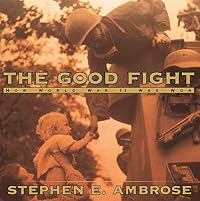
The Good Fight: How World War II Was Won
by Stephen E. Ambrose
On This Page
Description
A chronicle of World War II includes accounts of major events and personal anecdotes from soldiers in the field.Tags
Recommendations





Member Reviews
This book is intended for kids to teach them the basics of WWII in all of its theaters of engagement, though I learned some things from it myself... has maps of the various battles, landing stages and troop movement. Has a map as well of the concentration camps in Europe (the only one I could not find was Treblinka in Poland, but since the map was in German from 1945, it may have had another name in German, but the map cuts off part of Poland too....)
Excellent photographs throughout.
One thing I never knew was "Those (soldiers) who managed to live through the conflict in Europe and those still alive in the Pacific had been convinced that their next mission would be the invasion of Japan, where casualties numbering in the hundreds of show more thousands were expected. Men who later got an eighty to ninety-five percent disability from the government (for fighting in the other campaigns) had been listed as fit for combat in Japan." Incredible!
I enjoyed this book, not only for just looking at all the period photos, but learning bits of trivia (like that above) that I had been unaware of. Quite educational! show less
Excellent photographs throughout.
One thing I never knew was "Those (soldiers) who managed to live through the conflict in Europe and those still alive in the Pacific had been convinced that their next mission would be the invasion of Japan, where casualties numbering in the hundreds of show more thousands were expected. Men who later got an eighty to ninety-five percent disability from the government (for fighting in the other campaigns) had been listed as fit for combat in Japan." Incredible!
I enjoyed this book, not only for just looking at all the period photos, but learning bits of trivia (like that above) that I had been unaware of. Quite educational! show less
A fine historian assembles an extraordinary chronicle of WWII...noted for the young reader, I appreciate the no frills presentation of WWII history.
This is now a home reference book.
5 ★ 💕
This is now a home reference book.
5 ★ 💕
I'm not one who understands politics in the least, and I'm horrible with dates and names. This book is very good at laying things out "step-by-step". It has quick facts with statistics in different color boxes at the top of each left page. This would be a good one to have in a middle school or even high school (9th grade maybe?) classroom library or school library.
Ambrose presents a concise, readable chronicle of World War II through amazing photographs and research.
Short and informative with excellent flow charts...
I again would most likely use this in a 5th-7th grade class as an interactive read aloud to teach different vocabulary, have them be able to ask questions and would then assign questions for them to answer to reflect on what they learned.
Ratings
Members
- Recently Added By
Lists

The Story of the World: Activity Book Four: The Modern Age
333 works; 2 members
Author Information

71+ Works 43,708 Members
Historian Stephen E. Ambrose grew up in Wisconsin and attended the University of Wisconsin and the University of Louisiana. Ambrose is considered to be one of the foremost historical scholars of recent times and has been a professor for over three decades. He is also the founder and president of the National D-Day Museum in New Orleans. His works show more include D-Day: June 6, 1944: The Climactic Battle of World War II, Citizen Soldiers: The U. S. Army from Normandy Beaches to the Bulge to the Surrender of Germany, June 7, 1944-May 7, 1945, Band of Brothers: E Company, 506th Regiment, 101st Airborne from Normandy to Hitler's Eagle's Nest and Undaunted Courage: Meriwether Lewis, Thomas Jefferson and the Opening of the American West. Abrose served historical consultant on the motion picture Saving Private Ryan. (Bowker Author Biography) show less
Awards and Honors
Common Knowledge
- Canonical title
- The Good Fight: How World War II Was Won
- Original publication date
- 2001
- People/Characters
- Clement Attlee (Prime Minister); Pietro Badoglio (Marshall); Raymond O. Barton (Major General, US 4th Infantry Division); Rosina D. Bonavita (factory worker); Martin Bormann (Nazi official); Omar N. Bradley (show all 101); Simon Bolivar Buckner, Jr.; Emmet Burrows (Jim Burrows); Jack Chennault (son of Claire Lee Chennault); Chiang Kai-shek; Winston Churchill; Charles Collingwood; Robert Copeland; William Darby; Charles de Gaulle; Joe DeLisio; James H. Doolittle; Alex Drabnik; Raymond Dronne; Bruce Egger; Robert Eichelberger; Albert Einstein; Dwight D. Eisenhower; John Ford, film director (at the Battle of Midway); James Forrestal; Anne Frank; Otto Frank; Mitsuo Fuchida; Klaus Fuchs; Hermann Göring; Leslie R. Groves; William F. Halsey Jr. (Bull Halsey); William Hancock; Robert Healey; Ernest Hemingway; Lofton Henderson; Rudolf Hess; Hirohito, Emperor of Japan; Adolf Hitler; Courtney Hodges; Cordell Hull; Alfred Jodl; Ernst Kaltenbrunner; William R. Kane; Wilhelm Keitel; Husband E. Kimmel (Admiral); Ernest J. King; Weldon Kratzer; Jacques LeClerc; Curtis LeMay; William Lewis; Jack London; Douglas MacArthur; Raymond Malo; George C. Marshall; Anthony McAuliffe; George R. McBride; Marc Mitscher; Bernard Law Montgomery; Benito Mussolini; Chester W. Nimitz; Jesse Owens; Robert Oppenheimer; Arnold Parish; George S. Patton; James Pemberton; Philippe Pétain; Joe Petrenecsik; Ernie Pyle; Mike Ranney; William D. Robinson; Joseph J. Rochefort, Jr.; Franklin Delano Roosevelt; Joe Rosenthal; Ken Russell; Fritz Sauckel; Oskar Schindler; Milt Shenton; Walter Short; John R. Slaughter; Albert Speer; S. W. Sprindis; Joseph Stalin; Joseph Stilwell; Charles Sweeney; Paul Tibbets (Paul Warfield Tibbets, Jr.); Karl Timmermann; Hideki Tojo; Harry S. Truman; Lucian Truscott; General Ushijima; Alexander Vandegrift; Leo Van de Voort; Wernher von Braun; Dietrich von Choltitz; Joachim von Ribbentrop; Baldur von Schirach; Orde Wingate; Richard Winters; Isoroku Yamamoto; Morris Zimmerman
- Important events
- World War II (1939 | 1945); World War II, Pacific Theater (1941-12-07 | 1945-09-02); Attack on Pearl Harbor (1941-12-07); Doolittle Raid (1942-04-18); Battle of the Coral Sea (1942-05-04 | 1942-05-08); Battle of Midway (1942-06-04 | 1942-06-07) (show all 10); Battle of the Philippine Sea (1944-06-19 | 1944-06-20); Liberation of the Philippines (1944-10-20 | 1945-08-15); Battle of Leyte Gulf (1944-10-23 | 1944-10-26); Battle of the Bulge (1944 | 1945)
- Dedication
- To the grandchildren of the men and women who served in the U.S. armed forces in World War II.
- First words
- World War II (1939-1945) was the greatest catastrophe in history.
- Last words
- (Click to show. Warning: May contain spoilers.)Former Prime Minister Winston Churchill described the Marshall Plan as "the most unsordid act in history."
Classifications
Statistics
- Members
- 483
- Popularity
- 62,500
- Reviews
- 6
- Rating
- (4.53)
- Languages
- English
- Media
- Paper
- ISBNs
- 2