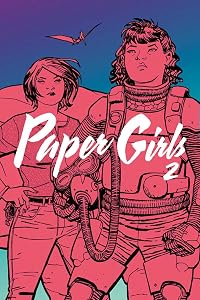
Paper Girls Volume 2
by Brian K. Vaughan (Writer), Cliff Chiang (Artist)
Paper Girls (Collections and Selections — 6-10 collected)
On This Page
Description
"After surviving the strangest night of their lives in the Cleveland suburb of Stony Stream, intrepid young newspaper deliverers Erin, Mac, and Tiffany find themselves launched from 1988 to a distant and terrifying future... the year 2016. What would you do if you were confronted by your 12-year-old self? 40-year-old newspaper reporter Erin Tieng is about to find out in this action-packed story about identity, mortality, and growing older in the 21st century"--Back cover.Tags
Recommendations





Member Reviews
The story is moving super-fast. I love that about it. :) From doppelgangers to gigantic maggots, riding dragons, to portals through folded space, we're firmly in a very different SF than what I'm used to.
And I love it.
Case in point: Multiple worlds theory is crap. There's only one time, one world, but it can be rewritten. Repeatedly. Chaotically. Catastrophically.
And it's a war between the adults and the kids. Only, no one seems to have their s*** together and the battle is raging on for 63k years and multiple clones are clogging the works and no one seems to care who gets killed because time is about to get re-written all over again.
.... and I know this sounds kinda funky. :) But the comic is pretty straightforward about all this and show more it's easy. :) It's the implications that are nuts. :)
And now I'm caught up and the next volume has been nommed for the Hugos in'18. Let's see if it's WORTHY. :) show less
And I love it.
Case in point: Multiple worlds theory is crap. There's only one time, one world, but it can be rewritten. Repeatedly. Chaotically. Catastrophically.
And it's a war between the adults and the kids. Only, no one seems to have their s*** together and the battle is raging on for 63k years and multiple clones are clogging the works and no one seems to care who gets killed because time is about to get re-written all over again.
.... and I know this sounds kinda funky. :) But the comic is pretty straightforward about all this and show more it's easy. :) It's the implications that are nuts. :)
And now I'm caught up and the next volume has been nommed for the Hugos in'18. Let's see if it's WORTHY. :) show less
Paper Girls 2 starts literally seconds after Paper Girls 1 ended carrying our adolescent heroines deeper into a confusing time travel story that has them meet alternate versions of themselves, learn things about their own future, try to puzzle out how time travel works on the fly, and figure out which side in what appears to be an intergenerational war they should align with. In this volume, Erin, MacKenzie, and Tiffany spend most of their time trying to figure out what happened to fellow paper girl KJ, and along the way find themselves forced to decide between two different versions of Erin from the future while running from giant-sized microbial monsters and the religious zealots from a future timeline who seem dead set on capturing show more the three girls for some unknown purpose. The story is inventive, beautifully drawn and colored, and full of characters that seem both approachable and heroic, and yet the whole remains just as baffling at the end of this volume as it did at the end of the first. Paper Girls is a story full of motion and action that, thus far, seems to be intentionally mystifying.
When writers try to tell stories involving central characters facing unknown foes who have unknown goals, they face the difficult task of keeping the reader engaged while also keeping the forces arrayed against the heroes mysterious and enigmatic. In Paper Girls, the four titular heroines are confronted with not one, but two time traveling factions, both of which thus far seem either unwilling or unable to explain who they are and what they are up to, and the end result is that there is really no way for the reader to get a handle on what either side wants, or even have any real idea of what is at stake in the conflict. This sort of hiding the ball storytelling can work, but at this point Vaughan is two volumes into the story and the reader pretty much has as little information about the two warring factions now as they had when they were first introduced in part one. To a certain extent, the reader can be pulled into the story due to the fact that the four youthful paper girls at the heart of the story are trying to survive amidst the chaos that swirls about them and navigate their way home, but that can only carry the narrative for so long. Without some information about who the large scale antagonists are and what they want, the story risks devolving into just a series of chase scenes punctuated by unexpected and unexplained things happening in the interstitial spaces between them.
Despite the annoyingly vague nature of the threats looming around them, the three paper girls at the core of this story are interesting enough as characters and are place in interesting enough situations to carry the book. There are two different alternate versions of Erin Teng in this volume - one from 2016 where Erin, MacKenzie, and Tiffany time-traveled to, and another from some presumably fat-future time sent back ostensibly to try to help the trio get to where they need to go. The 2016 Erin Teng is a grown woman, but one who is underemployed, single, and generally unhappy with her life. The interaction between the preteen Teng and the adult Teng fuels much of the story, as the adult Teng simultaneously wallows in regret and tries to put on a brave face for her younger iteration - with a lot of the tension arising as the older Teng tries to actually be an adult authority figure to the three younger girls. The far-future Teng is enigmatic through her entire appearance in the book even though she expresses herself in pretty much the most straightforward and direct manner one could every time she interacts with anyone else. As she is apparently from one of the two warring factions, she is fairly circumspect at actually passing on useful information, although it is revealed that she is a clone and that time travel somehow can be miscalibrated in such a way as to cause microscopic creatures to grow to Godzilla-like size. Much of the tension in the story revolves around a cryptic message that is presumably from the missing K.J., as the three papergirls trapped in 2016 must figure out who to trust and what course of action to take.
One of the more interesting subplots in the book involves MacKenzie, who separates from Erin Teng and older Erin Teng with Tiffany and sets out to find her own older self. When she arrives at her familiar childhood home, she is informed by the current residents that the previous occupants's daughter died from leukemia as a teenager. This, somewhat naturally, sets MacKenzie back a bit, as she assumes that this means she only has a few years to live. She cites back to the time-travelling teenagers of the first volume who said that no matter what twists and turns time-travel takes you on, when you reach your end, that's your end. The interesting thing about this subplot is that there are several assumptions in MacKenzie's line of thought that are not necessarily true: The time-travelers may not have been giving accurate information, either intentionally or inadvertently, there may have been another set of occupants in the house between 1988 and 2016, so the "daughter" referenced may not be MacKenzie, and so on. In the face of these various ambiguities, MacKenzie's certainty seems out of place, and for better or for worse the story telegraphs that MacKenzie's conclusions are almost certainly going to be shown to be incorrect.
As with the first volume, Paper Girls, Volume 2 is a visually stunning book. The artwork is quite good, but what really sets it apart from the pack is the coloring by Matt Wilson. While the color scheme is a bit more diverse than the CYMK palette used in the first volume, perhaps to reflect the fact that most of the action takes place in 2016 rather than 1988, the range of colors used is still fairly restricted, and this paradoxically makes the entire volume feel vibrant and lush.
At this point, Paper Girls is a flawed but still intriguing and ultimately promising series. The characters at the center of the story are all engaging, and their direct adventures are all exciting and interesting, but the seemingly intentional lack of explanation of the larger context in which their story is taking place is starting to become a drag on the ability of the story to hold a reader's interest. I remain hopeful that future volumes will rectify this situation, but unless Vaughan becomes a little less stingy with the background details and starts to fill in the larger canvas, this series runs the risk of devolving into nothing more than a series of disjointed-feeling chase scenes. The good parts of Paper Girls are very good, often borderline brilliant, and make the book worth reading, with the only caveat being that there seem to still be some missing colors in the painting.
This review has also been posted to my blog Dreaming About Other Worlds. show less
When writers try to tell stories involving central characters facing unknown foes who have unknown goals, they face the difficult task of keeping the reader engaged while also keeping the forces arrayed against the heroes mysterious and enigmatic. In Paper Girls, the four titular heroines are confronted with not one, but two time traveling factions, both of which thus far seem either unwilling or unable to explain who they are and what they are up to, and the end result is that there is really no way for the reader to get a handle on what either side wants, or even have any real idea of what is at stake in the conflict. This sort of hiding the ball storytelling can work, but at this point Vaughan is two volumes into the story and the reader pretty much has as little information about the two warring factions now as they had when they were first introduced in part one. To a certain extent, the reader can be pulled into the story due to the fact that the four youthful paper girls at the heart of the story are trying to survive amidst the chaos that swirls about them and navigate their way home, but that can only carry the narrative for so long. Without some information about who the large scale antagonists are and what they want, the story risks devolving into just a series of chase scenes punctuated by unexpected and unexplained things happening in the interstitial spaces between them.
Despite the annoyingly vague nature of the threats looming around them, the three paper girls at the core of this story are interesting enough as characters and are place in interesting enough situations to carry the book. There are two different alternate versions of Erin Teng in this volume - one from 2016 where Erin, MacKenzie, and Tiffany time-traveled to, and another from some presumably fat-future time sent back ostensibly to try to help the trio get to where they need to go. The 2016 Erin Teng is a grown woman, but one who is underemployed, single, and generally unhappy with her life. The interaction between the preteen Teng and the adult Teng fuels much of the story, as the adult Teng simultaneously wallows in regret and tries to put on a brave face for her younger iteration - with a lot of the tension arising as the older Teng tries to actually be an adult authority figure to the three younger girls. The far-future Teng is enigmatic through her entire appearance in the book even though she expresses herself in pretty much the most straightforward and direct manner one could every time she interacts with anyone else. As she is apparently from one of the two warring factions, she is fairly circumspect at actually passing on useful information, although it is revealed that she is a clone and that time travel somehow can be miscalibrated in such a way as to cause microscopic creatures to grow to Godzilla-like size. Much of the tension in the story revolves around a cryptic message that is presumably from the missing K.J., as the three papergirls trapped in 2016 must figure out who to trust and what course of action to take.
One of the more interesting subplots in the book involves MacKenzie, who separates from Erin Teng and older Erin Teng with Tiffany and sets out to find her own older self. When she arrives at her familiar childhood home, she is informed by the current residents that the previous occupants's daughter died from leukemia as a teenager. This, somewhat naturally, sets MacKenzie back a bit, as she assumes that this means she only has a few years to live. She cites back to the time-travelling teenagers of the first volume who said that no matter what twists and turns time-travel takes you on, when you reach your end, that's your end. The interesting thing about this subplot is that there are several assumptions in MacKenzie's line of thought that are not necessarily true: The time-travelers may not have been giving accurate information, either intentionally or inadvertently, there may have been another set of occupants in the house between 1988 and 2016, so the "daughter" referenced may not be MacKenzie, and so on. In the face of these various ambiguities, MacKenzie's certainty seems out of place, and for better or for worse the story telegraphs that MacKenzie's conclusions are almost certainly going to be shown to be incorrect.
As with the first volume, Paper Girls, Volume 2 is a visually stunning book. The artwork is quite good, but what really sets it apart from the pack is the coloring by Matt Wilson. While the color scheme is a bit more diverse than the CYMK palette used in the first volume, perhaps to reflect the fact that most of the action takes place in 2016 rather than 1988, the range of colors used is still fairly restricted, and this paradoxically makes the entire volume feel vibrant and lush.
At this point, Paper Girls is a flawed but still intriguing and ultimately promising series. The characters at the center of the story are all engaging, and their direct adventures are all exciting and interesting, but the seemingly intentional lack of explanation of the larger context in which their story is taking place is starting to become a drag on the ability of the story to hold a reader's interest. I remain hopeful that future volumes will rectify this situation, but unless Vaughan becomes a little less stingy with the background details and starts to fill in the larger canvas, this series runs the risk of devolving into nothing more than a series of disjointed-feeling chase scenes. The good parts of Paper Girls are very good, often borderline brilliant, and make the book worth reading, with the only caveat being that there seem to still be some missing colors in the painting.
This review has also been posted to my blog Dreaming About Other Worlds. show less
Enormous spoilers for Volume 1 below!
Erin, Mac, and Kimberley have been thrown into the future and arrived in 2016 where they almost immediately encounter Erin's older self. While they attempt to determine whether KJ is also in 2016 or if she's travelled elsewhere in time, new threats arrive that will have Erin questioning who she is, who she wants to become, and who to trust.
So. So. Good. Excellent sci-fi twists and more than one Erin makes for fascinating reading. The art is jaw-droppingly gorgeous in sections.The dirigible-esque time ship gets a beautiful two-page spread that made me say, "Wow." I'm definitely going to be racing through the next available volumes in my TBR stack.
Erin, Mac, and Kimberley have been thrown into the future and arrived in 2016 where they almost immediately encounter Erin's older self. While they attempt to determine whether KJ is also in 2016 or if she's travelled elsewhere in time, new threats arrive that will have Erin questioning who she is, who she wants to become, and who to trust.
So. So. Good. Excellent sci-fi twists and more than one Erin makes for fascinating reading. The art is jaw-droppingly gorgeous in sections.
Some comics read quickly because nothing happens in them. Paper Girls moves quickly, but because Brian K. Vaughan and Cliff Chiang construct the whole thing as non-stop action, each scene efficiently moving you into the next. Nothing feels wasted or padded; this comic just propels you along. You have no desire to linger because you always have to see what's next.
Paper Girls is clever and well put together. I wish I remembered the characters better (it's been a year since I read volume 1) as they'd kind of blended in my mind, but this volume does have a nice focus on Erin, as the girls travel from 1988 to 2016 and meet Erin's older self, now forty years old. It's an interesting balance of being able to follow what's happening to the show more girls, but the wider context of what's happening still being pretty obscure. I wish it felt like the girls were learning something; right now it seems like there's a simple action story and a big time travel story, but they don't quite go together.
There are some good jokes and some great character moments. Some bits will make you go all soft inside. I've like Cliff Chiang since his Green Arrow and Black Canary days, and this is some of his best work, slick and stylish and full of character. But as well put together as it is, I wish it lasted longer. show less
Paper Girls is clever and well put together. I wish I remembered the characters better (it's been a year since I read volume 1) as they'd kind of blended in my mind, but this volume does have a nice focus on Erin, as the girls travel from 1988 to 2016 and meet Erin's older self, now forty years old. It's an interesting balance of being able to follow what's happening to the show more girls, but the wider context of what's happening still being pretty obscure. I wish it felt like the girls were learning something; right now it seems like there's a simple action story and a big time travel story, but they don't quite go together.
There are some good jokes and some great character moments. Some bits will make you go all soft inside. I've like Cliff Chiang since his Green Arrow and Black Canary days, and this is some of his best work, slick and stylish and full of character. But as well put together as it is, I wish it lasted longer. show less
This has middle book syndrome. It's fun to watch the girls barrel through encounters with embiggened critters in 2016. Multiple factions start to come into focus. However, there's not much "there" there. I'd have been frustrated with most of these issues as individual comics.
That said, I got 6 volumes of Paper Girls via a Humble Bundle and I'm eager to continue with the story. Also bummed that the TV show only got one season.
That said, I got 6 volumes of Paper Girls via a Humble Bundle and I'm eager to continue with the story. Also bummed that the TV show only got one season.
Although some questions are still left unanswered, I found this volume to be a lot more cohesive than the first. It was fast-paced and entertaining throughout, and succeeded at leaving the reader wanting more. I not only enjoyed the plot line but the color scheme as well. The muted pastels and occasional bright pages are really lovely. I also loved the mention of current politics. And my favorite page was an illustration of Mac as she touches her own reflection, that of a skeletal her. It was spooky and rather poignant. I cannot wait for volume three.
The beginning of this book is where I really fell in love with this story. Our protagonists have been thrown through time, and they have to rely on an adult who both is and isn't one of them. Because this is their future, and this is where they grew up, it is hard to not find out more than they necessarily want.
I love that at one point, there are people from three time-lines all together, and while they all appear to be talking the same language, they really aren't. Because there is enough change, even within the one lifetime, that some things just count as nonsense.
I love that at one point, there are people from three time-lines all together, and while they all appear to be talking the same language, they really aren't. Because there is enough change, even within the one lifetime, that some things just count as nonsense.
Members
- Recently Added By
Lists

Graphic Novels
94 works; 6 members

Alternative Histories
6 works; 1 member

Books Read in 2017
4,249 works; 129 members

Science Fiction
72 works; 1 member

Books Read in 2020
4,379 works; 124 members
Author Information

Brian K. Vaughan, New York Times bestselling author, was born in 1976. He is a comic book and television writer, best known for the comic book series Y: The Last Man, Ex Machina, Runaways, Pride of Baghdad, and Saga. Vaughan was also a writer, story editor and producer of the television series Lost. He is currently the showrunner and executive show more producer of the TV series Under the Dome. Between 2005 and 2015, he was awarded eleven Eisner Awards, a Rave Award, and a Hugo Award. (Bowker Author Biography) show less

All Editions
Awards and Honors
Distinctions
Notable Lists
Series

Work Relationships
Is contained in
Common Knowledge
- Canonical title
- Paper Girls Volume 2
- Original title
- Paper Girls Vol. 2
- Alternate titles
- Paper Girls Volume 2; Paper Girls, Volume 2
- Original publication date
- 2016-12-06
- People/Characters
- Erin Tieng; MacKenzie Coyle; Tiffany Quilkin; Karina "KJ" J.
- First words
- Welcome back to "Coast to Coast AM" on the first day of June, 2016.
- Last words
- (Click to show. Warning: May contain spoilers.)We're alive.
- Original language
- English
- Disambiguation notice
- This volume collects issues #6-10 of the comic.
Classifications
- Genres
- Graphic Novels & Comics, Fiction and Literature, Teen
- DDC/MDS
- 741.5973 — Arts & recreation Drawing & decorative arts Drawing Comic books, graphic novels, fotonovelas, cartoons, caricatures, comic strips History, geographic treatment, biography North American United States (General)
- LCC
- PN6728 .P36 .V38 — Language and Literature Literature (General) Literature (General) Collections of general literature Comic books, strips, etc.
- BISAC
Statistics
- Members
- 1,278
- Popularity
- 19,128
- Reviews
- 55
- Rating
- (4.06)
- Languages
- 8 — English, French, German, Hungarian, Italian, Polish, Portuguese, Spanish
- Media
- Paper, Ebook
- ISBNs
- 15
- ASINs
- 3