
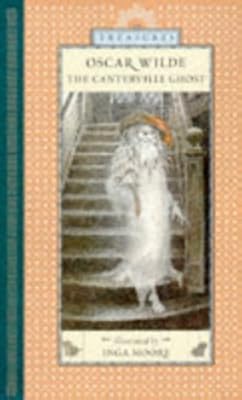
The Canterville Ghost
by Oscar Wilde 
On This Page
Description
Oscar Wilde's spooky tale of a genteel English ghost clashing with a brash American family is endearing, hilarious, and perfect reading for all ages Canterville Chase possesses all of the trappings of a standard haunted country house-including large suits of armor and Gothic paneled library walls. However, it soon becomes difficult to ignore the spooky signs that "Sir Simon" is haunting the house-the usual Halloween fare of rattling chains and bloodstains. Surprisingly, and hilariously, the show more Otises, a modern American family, refuse to be scared; despite all of Sir Simon's best flamboyant efforts and costume changes: stain remover is deployed to clean bloodstains and oil is applied to clanking chains. Instead, the poor revenant is faced with practical jokes from the two young twins in the family-and seeks solace by befriending 15-year-old Virginia instead. Told from the unusual point of view of the ghost rather than the haunted party, it bears the trademark Wildean moral message but the message is carried lightly in this entertaining, amusing, and heart-warming Christmas story. Two other Wilde short stories are included: "The Sphinx Without a Secret" and "Lord Arthur Saville's Crime.". show lessTags
Recommendations

























Member Recommendations
Member Reviews
Read: November 2017
Rating: 5/5 stars, best of 2017
I loved this odd, funny ghost story. A no-nonsense American family move into Canterville Chase; the centuries old home of Sir Simon Canterville - an evil man who murdered his wife and has haunted his descendants, as well as other visitors in the house, to the point of madness. The Americans refuse to put up with any of his antics - demanding he use oil to clean his rusty chains as not to disturb them, using a modern cleaning detergent to scrub his infamous bloodstain from the library floor, and even treating him as a source of entertainment as the young children of the family lay traps for him and attempt to scare him themselves.
Despite the humour, the ending of the story turns out to be show more quite sweet and poignant, leaving the reader feeling as though the story was more than just a funny joke. Thoroughly enjoyable, and free from Project Gutenberg so well worth downloading. show less
Rating: 5/5 stars, best of 2017
I loved this odd, funny ghost story. A no-nonsense American family move into Canterville Chase; the centuries old home of Sir Simon Canterville - an evil man who murdered his wife and has haunted his descendants, as well as other visitors in the house, to the point of madness. The Americans refuse to put up with any of his antics - demanding he use oil to clean his rusty chains as not to disturb them, using a modern cleaning detergent to scrub his infamous bloodstain from the library floor, and even treating him as a source of entertainment as the young children of the family lay traps for him and attempt to scare him themselves.
Despite the humour, the ending of the story turns out to be show more quite sweet and poignant, leaving the reader feeling as though the story was more than just a funny joke. Thoroughly enjoyable, and free from Project Gutenberg so well worth downloading. show less
A charming little story that pokes fun at class, nationality, horror tropes, and the Victorian Gothic. I fell in love with the quirky little family and the elegant, traditionalist ghost-- written as only Wilde could write. If you have 20 minutes on a rainy day, pour yourself warm glass of something (my choice is cocoa) and enjoy it!
In the 1880s, a wealthy American family buys a haunted English manor, couldn’t care less about the resident ghost, and offers him lubricant for his creaky chains instead.
👻 This was such a fun read! Sir Simon the ghost is deeply offended that this American family refuses to be scared,
and it’s hilarious! The clanking chains, the blood-curdling moans, the disguises (The Headless Earl, The Vampire Monk) … the whole theatrical bit is so Wilde!!
📖 It’s gothic fiction, satire, and late Victorian social commentary with a fairytale-ish HEA ending. Also prominent is the Anglo-American cultural tension. Lots of English vs. American woven throughout the story. Though to be fair, Wilde pokes fun at both sides.
🚩 Sir Simon isn’t show more exactly innocent. He murdered his wife (for not knowing cookery??) which tbh makes it a little hard to feel too sorry for him. But what his BILs did to him plus getting cursed into becoming a ghost … perhaps that’s punishment enough?
🎬 There’s a TV adaptation too, though it’s a bit cringe. Only worth watching for the ghost and his familiar, a mouse 😂
🖤 Anyway, The Canterville Ghost by Oscar Wilde is a short, fun read. And it’s free online. show less
👻 This was such a fun read! Sir Simon the ghost is deeply offended that this American family refuses to be scared,
and it’s hilarious! The clanking chains, the blood-curdling moans, the disguises (The Headless Earl, The Vampire Monk) … the whole theatrical bit is so Wilde!!
📖 It’s gothic fiction, satire, and late Victorian social commentary with a fairytale-ish HEA ending. Also prominent is the Anglo-American cultural tension. Lots of English vs. American woven throughout the story. Though to be fair, Wilde pokes fun at both sides.
🚩 Sir Simon isn’t show more exactly innocent. He murdered his wife (for not knowing cookery??) which tbh makes it a little hard to feel too sorry for him. But what his BILs did to him plus getting cursed into becoming a ghost … perhaps that’s punishment enough?
🎬 There’s a TV adaptation too, though it’s a bit cringe. Only worth watching for the ghost and his familiar, a mouse 😂
🖤 Anyway, The Canterville Ghost by Oscar Wilde is a short, fun read. And it’s free online. show less
Oscar Wilde's classic short story in which a family of Americans buy the Canterville estate and completely refuse to be terrified by the resident ghost, much to the ghost's chagrin.
Wilde's humour puts in an excellent showing here, in this amusing tale that pokes fun at both the English and Americans. Rupert Degas narrates brilliantly, managing a range of unique voices and accents for all of the characters. The only thing that kept this from being a full five star read is that the audio production used sound effects a little excessively for my tastes.
Wilde's humour puts in an excellent showing here, in this amusing tale that pokes fun at both the English and Americans. Rupert Degas narrates brilliantly, managing a range of unique voices and accents for all of the characters. The only thing that kept this from being a full five star read is that the audio production used sound effects a little excessively for my tastes.
In this terrific novella by Oscar Wilde, those brash Americans, the Otis family, refuse to do what the sensible British of good family do, and be scared to death or lose their sanity to a 300 year old ghost. Told in the witty, clever, tongue-in-cheek manner that is so typical of Oscar Wilde, I laughed aloud at several passages, especially one in which the American twins turn tails on the ghost and leave him shaking. The edition I had in hand had some marvelous illustrations done by Wallace Goldsmith in 1906. Sample below:
This story has languished on my TBR for far too long, but I needed a short read today and this was perfect to fill another Bingo slot. For some reason, I’ve read a lot of ghost stories this year, but none that was show more anything like this one. Depend on Wilde to find a way to make even a ghost story an original. show less
This story has languished on my TBR for far too long, but I needed a short read today and this was perfect to fill another Bingo slot. For some reason, I’ve read a lot of ghost stories this year, but none that was show more anything like this one. Depend on Wilde to find a way to make even a ghost story an original. show less
Gutenberg link here, for those wanting immediate (and free) gratification. Though I really don't like most of the illustrations in that version.
I can't remember when I first read this story, only that it was long ago, and that I've always thought it was an underrated work of Wilde's. Since I love ghost stories in general I was predisposed to like this one.
The story comes in two parts: the first where we're introduced to the family and then the ghost, and which contains a lot of humor and slapstick. The second part becomes poetic in its discussion of death, and a bit melodramatic in its ending.
Early in Chapter I, an example of the humor:
There are a lot of jabs at Americans here, but since the family is obviously A Type (father obsessed with Greek republicanism, mother into fashion and entertaining, twin sons constantly into mischief, etc.) it's pretty much standard comedy of the time. With a ghost thrown into the mix.
In Chapter V the descriptions and conversations become serious and poetic - the Ghost and Virginia have a conversation:
I'm sure there are many people who'd find the ending too hokey and sweet, but considering the level of comedy we started with, a sweet ending is rather surprising, and pulling off that tone next to humor rather fun to see. Wilde manages to pull it off, I think. show less
I can't remember when I first read this story, only that it was long ago, and that I've always thought it was an underrated work of Wilde's. Since I love ghost stories in general I was predisposed to like this one.
The story comes in two parts: the first where we're introduced to the family and then the ghost, and which contains a lot of humor and slapstick. The second part becomes poetic in its discussion of death, and a bit melodramatic in its ending.
Early in Chapter I, an example of the humor:
Suddenly Mrs. Otis caught sight of a dull red stain on the floor just by the fireplace, and, quiteshow more
unconscious of what it really signified, said to Mrs. Umney, "I am afraid something has been spilt there."The American family is very much an object of humor and here in particular is an example of their rampant consumerism - they always know the right product for the situation! It may be Oscar Wilde writing in 1906, but it's definitely a "surprise, it's product placement" joke. (There was a lot of product placement in short stories at the time, but not everyone was satirizing it.)
"Yes, madam," replied the old housekeeper in a low voice, "blood has been spilt on that spot."
"How horrid!" cried Mrs. Otis; "I don't at all care for blood-stains in a sitting-room. It must be removed at once."
The old woman smiled, and answered in the same low, mysterious voice, "It is the blood of Lady Eleanore de Canterville, who was murdered on that very spot by her own husband, Sir Simon de Canterville, in 1575. Sir Simon survived her nine years, and disappeared suddenly under very mysterious circumstances. His body has never been discovered, but his guilty spirit still haunts the Chase. The blood-stain has been much admired by tourists and others, and cannot be removed."
"That is all nonsense," cried Washington Otis; "Pinkerton's Champion Stain Remover and Paragon Detergent will clean it up in no time," and before the terrified housekeeper could interfere, he had fallen upon his knees, and was rapidly scouring the floor with a small stick of what looked like a black cosmetic. In a few moments no trace of the blood-stain could be seen.
"I knew Pinkerton would do it," he exclaimed, triumphantly, as he looked round at his admiring family; but no sooner had he said these words than a terrible flash of lightning lit up the sombre room, a fearful peal of thunder made them all start to their feet, and Mrs. Umney fainted.
There are a lot of jabs at Americans here, but since the family is obviously A Type (father obsessed with Greek republicanism, mother into fashion and entertaining, twin sons constantly into mischief, etc.) it's pretty much standard comedy of the time. With a ghost thrown into the mix.
In Chapter V the descriptions and conversations become serious and poetic - the Ghost and Virginia have a conversation:
"Far away beyond the pine-woods," he answered, in a low, dreamy voice, "there is a little garden. There the grass grows long and deep, there are the great white stars of the hemlock flower, there the nightingale sings all night long. All night long he sings, and the cold crystal moon looks down, and the yew-tree spreads out its giant arms over the sleepers."Very Victorian, very sentimental, but still quite well written.
Virginia's eyes grew dim with tears, and she hid her face in her hands.
"You mean the Garden of Death," she whispered.
"Yes, death. Death must be so beautiful. To lie in the soft brown earth, with the grasses waving above one's head, and listen to silence. To have no yesterday, and no to-morrow. To forget time, to forget life, to be at peace. You can help me. You can open for me the portals of death's house, for love is always with you, and love is stronger than death is."
I'm sure there are many people who'd find the ending too hokey and sweet, but considering the level of comedy we started with, a sweet ending is rather surprising, and pulling off that tone next to humor rather fun to see. Wilde manages to pull it off, I think. show less
I read one of Oscar Wilde's book as part of the Dead Writers Society Literary Birthday Challenge. I picked this story because I wanted something short that was not going to totally derail my other planned books to be read.
From start to finish this book was in equal turns funny and wistful at times.
We have an American family moving into an ancestral home of the Canterville's. The American family (named the Otis's) are warned about a ghost that haunts Canterville Chase and decidedly poo poos any warning.
One of my favorite scenes was earlier on when after coming across a blood stain on the floor, Washington Otis (younger son) promptly uses some Pinkerton's Champion Stain Remover and Paragon Detergent to get it out. Doing so causes the show more housekeeper to faint at the son's audacity to do this. After this the ghost decides that the Otis family has made an enemy of him and decides he will take matters into his own hands and do what he can to scare the family to death like he has other inhabitants of Canterville Chase.
All in all I found the entire story charming. There is very little character development in this story (it is only 67 pages) but the writing style and flow did keep me engaged. I would say that even though the book starts off silly as anything, it does manage to tug at your heart here and there. I am now wishing I shelled out some money to view the illustrations that were done for versions of this book.
The ending was very sweet and I liked it a lot. Just a short ghost story without any blood and gore. show less
From start to finish this book was in equal turns funny and wistful at times.
We have an American family moving into an ancestral home of the Canterville's. The American family (named the Otis's) are warned about a ghost that haunts Canterville Chase and decidedly poo poos any warning.
One of my favorite scenes was earlier on when after coming across a blood stain on the floor, Washington Otis (younger son) promptly uses some Pinkerton's Champion Stain Remover and Paragon Detergent to get it out. Doing so causes the show more housekeeper to faint at the son's audacity to do this. After this the ghost decides that the Otis family has made an enemy of him and decides he will take matters into his own hands and do what he can to scare the family to death like he has other inhabitants of Canterville Chase.
All in all I found the entire story charming. There is very little character development in this story (it is only 67 pages) but the writing style and flow did keep me engaged. I would say that even though the book starts off silly as anything, it does manage to tug at your heart here and there. I am now wishing I shelled out some money to view the illustrations that were done for versions of this book.
The ending was very sweet and I liked it a lot. Just a short ghost story without any blood and gore. show less
Members
- Recently Added By
Lists

Books I've Read More Than Once
602 works; 49 members

19th Century
190 works; 16 members

1001 Children's Books You Must Read Before You Grow Up
774 works; 100 members

Global Reads: Books Set in the United Kingdom and Ireland
109 works; 5 members
Out of Copyright
244 works; 14 members

Books Read in 2014
2,343 works; 89 members

Victorian Period
113 works; 10 members

Funny Classics
20 works; 2 members

Books Read in 2023
5,547 works; 145 members

1880s
14 works; 2 members

Ghosts
278 works; 18 members

Books Read in 2018
4,360 works; 110 members

Books Read in 2002
197 works; 7 members

Tagged 19th Century
104 works; 7 members

Books Read in 2024
4,623 works; 126 members

Ghost Stories That Thrill Us
256 works; 115 members
Author Information

1,762+ Works 120,827 Members
Flamboyant man-about-town, Oscar Wilde had a reputation that preceded him, especially in his early career. He was born to a middle-class Irish family (his father was a surgeon) and was trained as a scholarship boy at Trinity College, Dublin. He subsequently won a scholarship to Magdalen College, Oxford, where he was heavily influenced by John show more Ruskin and Walter Pater, whose aestheticism was taken to its radical extreme in Wilde's work. By 1879 he was already known as a wit and a dandy; soon after, in fact, he was satirized in Gilbert and Sullivan's Patience. Largely on the strength of his public persona, Wilde undertook a lecture tour to the United States in 1882, where he saw his play Vera open---unsuccessfully---in New York. His first published volume, Poems, which met with some degree of approbation, appeared at this time. In 1884 he married Constance Lloyd, the daughter of an Irish lawyer, and within two years they had two sons. During this period he wrote, among others, The Picture of Dorian Gray (1891), his only novel, which scandalized many readers and was widely denounced as immoral. Wilde simultaneously dismissed and encouraged such criticism with his statement in the preface, "There is no such thing as a moral or an immoral book. Books are well written or badly written. That is all." In 1891 Wilde published A House of Pomegranates, a collection of fantasy tales, and in 1892 gained commercial and critical success with his play, Lady Windermere's Fan He followed this comedy with A Woman of No Importance (1893), An Ideal Husband (1895), and his most famous play, The Importance of Being Earnest (1895). During this period he also wrote Salome, in French, but was unable to obtain a license for it in England. Performed in Paris in 1896, the play was translated and published in England in 1894 by Lord Alfred Douglas and was illustrated by Aubrey Beardsley. Lord Alfred was the son of the Marquess of Queensbury, who objected to his son's spending so much time with Wilde because of Wilde's flamboyant behavior and homosexual relationships. In 1895, after being publicly insulted by the marquess, Wilde brought an unsuccessful slander suit against the peer. The result of his inability to prove slander was his own trial on charges of sodomy, of which he was found guilty and sentenced to two years of hard labor. During his time in prison, he wrote a scathing rebuke to Lord Alfred, published in 1905 as De Profundis. In it he argues that his conduct was a result of his standing "in symbolic relations to the art and culture" of his time. After his release, Wilde left England for Paris, where he wrote what may be his most famous poem, The Ballad of Reading Gaol (1898), drawn from his prison experiences. Among his other notable writing is The Soul of Man under Socialism (1891), which argues for individualism and freedom of artistic expression. There has been a revived interest in Wilde's work; among the best recent volumes are Richard Ellmann's, Oscar Wilde and Regenia Gagnier's Idylls of the Marketplace , two works that vary widely in their critical assumptions and approach to Wilde but that offer rich insights into his complex character. (Bowker Author Biography) show less
Oscar Wilde has a Legacy Library. Legacy libraries are the personal libraries of famous readers, entered by LibraryThing members from the Legacy Libraries group.
Some Editions
Awards and Honors
Notable Lists
Series
Belongs to Publisher Series
Livro B (16)
dtv zweisprachig (Englisch)
El País Aventuras (38)
Tus libros (69)
dtv (9110)
insel taschenbuch (0344)
Insel-Bücherei (Nr. 1381)
Gallimard, Folio (674)
Work Relationships
Is contained in
Is retold in
Has the adaptation
Has as a student's study guide
Common Knowledge
- Canonical title
- The Canterville Ghost
- Original title
- The Canterville Ghost
- Original publication date
- 1887-02-23
- People/Characters
- Simon de Canterville (The Canterville Ghost); Hiram B. Otis; Virginia E. Otis; Washington Otis; Augustus Dampier; Lucretia R. Tappan Otis (show all 8); The Duke of Cheshire; Mrs Umney
- Important places
- Canterville Chase, England, UK
- Important events*
- O autor estudou o Espiritismo (filosofia religiosa criada por Allan Kardec) para escrever O Fantasma de Canterville. (filosofia religiosa criada por Allan Kardec)
- Related movies
- The Canterville Ghost (1944 | IMDb); The Canterville Ghost (1950 | IMDb); Robert Montgomery Presents (1950 | IMDb); BBC Sunday-Night Play (1960 | IMDb); The Canterville Ghost (1975 | IMDb); The Canterville Ghost (1985 | IMDb) (show all 13); The Canterville Ghost (1986 | IMDb); The Canterville Ghost (1988 | IMDb); The Canterville Ghost (1990 | IMDb); The Canterville Ghost (1996 | IMDb); The Canterville Ghost (1997 | IMDb); The Canterville Ghost (2001 | IMDb); The Canterville Ghost (2005 | IMDb)
- First words
- When Mr. Hiram B. Otis, the American Minister, bought Canterville Chase, every one told him he was doing a very foolish thing, as there was no doubt at all that the place was haunted.
- Quotations
- We have really everything in common with America nowadays except, of course, language.
- Last words
- (Click to show. Warning: May contain spoilers.)Virginia blushed.
- Original language
- English UK
- Canonical DDC/MDS
- 823.8
*Some information comes from Common Knowledge in other languages. Click "Edit" for more information.
Classifications
Statistics
- Members
- 2,761
- Popularity
- 6,637
- Reviews
- 101
- Rating
- (3.76)
- Languages
- 23 — Arabic, Catalan, Chinese, Czech, Danish, Dutch, English, French, German, Galician, Greek, Hungarian, Italian, Japanese, Lithuanian, Multiple languages, Norwegian (Bokmål), Norwegian, Polish, Russian, Spanish, Swedish, Portuguese (Portugal)
- Media
- Paper, Audiobook, Ebook
- ISBNs
- 505
- UPCs
- 3
- ASINs
- 97