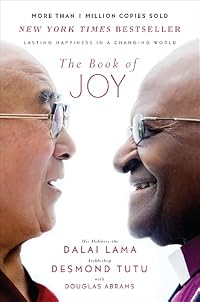
The Book of Joy: Lasting Happiness in a Changing World
by Dalai Lama, Douglas Carlton Abrams, Desmond Tutu
Global Icons (1)
On This Page
Description
Two leading spiritual masters share their wisdom about living with joy even in the face of adversity, sharing personal stories and teachings about the science of profound happiness and the daily practices that anchor their emotional and spiritual lives.Tags
Recommendations
















Member Reviews
A friend gave me ‘The Book of Joy’ as a birthday present and told me she had found it life-changing. I can certainly see why - it’s an extraordinary and moving book, and one that I immediately want to recommend to others. In a series of discussions, revolving around ways in which humanity can live joyfully, the Dalai Lama and Archbishop Desmond Tutu manage the feat of transcending religion to find an underlying spirituality. The recommending friend is Christian and found the book’s philosophy deeply appealing; I’m an atheist and so did I. I saw strong echoes with the Stoic philosophy of Epictetus ([b:Discourses, Fragments, Handbook|18189134|Discourses, Fragments, show more Handbook|Epictetus|https://images.gr-assets.com/books/1373585681s/18189134.jpg|45849302]) and the practise of mindfulness ([b:Mindfulness: A Practical Guide to Finding Peace in a Frantic World|11281104|Mindfulness A Practical Guide to Finding Peace in a Frantic World|Mark Williams|https://images.gr-assets.com/books/1347862381s/11281104.jpg|47822196]). Moreover, I appreciated that the wisdom of the two men was never abstract, but grounded in experience, practise, and their relationship. They have a truly lovely friendship and the dynamic between them gives the book a wonderful feeling of affection and humour. I found the comments on humour particularly striking, actually. It’s very important to be able to laugh at ourselves, at difficult situations, and at unfairness. As the book points out, humour is powerful against injustice, as it reveals the inherent absurdity and nonsense of discrimination. The quote that stuck with me most, though, is this one:
I think that encapsulates beautifully that hating people is pointless, as well as reminding me of my favourite line from [b:The Leopard|625094|The Leopard|Giuseppe Tomasi di Lampedusa|https://images.gr-assets.com/books/1376481466s/625094.jpg|1132275] by Giuseppe de Lampedusa: 'Nothing could be decently hated except eternity.' ‘The Book of Joy’ also has wise words about gratitude, humility, and forgiveness, amongst other topics. I found it a moving, thought-provoking, and life-affirming read. The chapter at the end about the birthday party made me cry. I used to meditate regularly and ‘The Book of Joy’ has inspired me to try it again. I already use the gratitude technique of writing down three good things about the day just before going to sleep, which is calming. In this world of relentless social media, 24 hour news, and constant pressure to compete and consume, this book is quietly radical as it promotes community, generosity, and compassion. I felt inspired to live better while reading it and really hope that such good intentions won’t be swept away by daily distractions. show less
”You must not hate those who do harmful things,” the Dalai Lama has explained. “The compassionate thing to do is everything you can to stop them.”
I think that encapsulates beautifully that hating people is pointless, as well as reminding me of my favourite line from [b:The Leopard|625094|The Leopard|Giuseppe Tomasi di Lampedusa|https://images.gr-assets.com/books/1376481466s/625094.jpg|1132275] by Giuseppe de Lampedusa: 'Nothing could be decently hated except eternity.' ‘The Book of Joy’ also has wise words about gratitude, humility, and forgiveness, amongst other topics. I found it a moving, thought-provoking, and life-affirming read. The chapter at the end about the birthday party made me cry. I used to meditate regularly and ‘The Book of Joy’ has inspired me to try it again. I already use the gratitude technique of writing down three good things about the day just before going to sleep, which is calming. In this world of relentless social media, 24 hour news, and constant pressure to compete and consume, this book is quietly radical as it promotes community, generosity, and compassion. I felt inspired to live better while reading it and really hope that such good intentions won’t be swept away by daily distractions. show less
What an eye-opening book. I grew up Buddhist and have always been a fan of the Dalai Lama and his wisdom. But I never knew much about Archbishop Desmond Tutu. But I definitely have a newfound respect for both of these amazing world leaders, who teach us how to be at peace with ourselves, and find happiness in a world full of suffering and negativity. Such inspiring stories of how these two men survived through apartheid and exile, and yet still remain positive and joyful.
These days, we're so focused on external stimuli...material goods, making more money, focusing on ourselves. And yet, we're more depressed than ever before, despite the façade of "having everything". They teach in this book that compassion is key, as is giving, even show more when we have nothing. The eight pillars of joy is something I'll definitely be remembering for a long, long time. And the guide on meditation at the end is just what I needed in these stressful times.
So even though we can't change what's going on around us, or how other people behave, we can change ourselves. And change comes from the inside, and changing our mindset. I've slowly been moving toward this change of mindset myself, and while it's not an overnight change, the words spoken in this book give you plenty to think about. Highly recommended, and I know I'll be referring to this book whenever I need a reminder! show less
These days, we're so focused on external stimuli...material goods, making more money, focusing on ourselves. And yet, we're more depressed than ever before, despite the façade of "having everything". They teach in this book that compassion is key, as is giving, even show more when we have nothing. The eight pillars of joy is something I'll definitely be remembering for a long, long time. And the guide on meditation at the end is just what I needed in these stressful times.
So even though we can't change what's going on around us, or how other people behave, we can change ourselves. And change comes from the inside, and changing our mindset. I've slowly been moving toward this change of mindset myself, and while it's not an overnight change, the words spoken in this book give you plenty to think about. Highly recommended, and I know I'll be referring to this book whenever I need a reminder! show less
What an eye-opening book. I grew up Buddhist and have always been a fan of the Dalai Lama and his wisdom. But I never knew much about Archbishop Desmond Tutu. But I definitely have a newfound respect for both of these amazing world leaders, who teach us how to be at peace with ourselves, and find happiness in a world full of suffering and negativity. Such inspiring stories of how these two men survived through apartheid and exile, and yet still remain positive and joyful.
These days, we're so focused on external stimuli...material goods, making more money, focusing on ourselves. And yet, we're more depressed than ever before, despite the façade of "having everything". They teach in this book that compassion is key, as is giving, even show more when we have nothing. The eight pillars of joy is something I'll definitely be remembering for a long, long time. And the guide on meditation at the end is just what I needed in these stressful times.
So even though we can't change what's going on around us, or how other people behave, we can change ourselves. And change comes from the inside, and changing our mindset. I've slowly been moving toward this change of mindset myself, and while it's not an overnight change, the words spoken in this book give you plenty to think about. Highly recommended, and I know I'll be referring to this book whenever I need a reminder! show less
These days, we're so focused on external stimuli...material goods, making more money, focusing on ourselves. And yet, we're more depressed than ever before, despite the façade of "having everything". They teach in this book that compassion is key, as is giving, even show more when we have nothing. The eight pillars of joy is something I'll definitely be remembering for a long, long time. And the guide on meditation at the end is just what I needed in these stressful times.
So even though we can't change what's going on around us, or how other people behave, we can change ourselves. And change comes from the inside, and changing our mindset. I've slowly been moving toward this change of mindset myself, and while it's not an overnight change, the words spoken in this book give you plenty to think about. Highly recommended, and I know I'll be referring to this book whenever I need a reminder! show less
What an eye-opening book. I grew up Buddhist and have always been a fan of the Dalai Lama and his wisdom. But I never knew much about Archbishop Desmond Tutu. But I definitely have a newfound respect for both of these amazing world leaders, who teach us how to be at peace with ourselves, and find happiness in a world full of suffering and negativity. Such inspiring stories of how these two men survived through apartheid and exile, and yet still remain positive and joyful.
These days, we're so focused on external stimuli...material goods, making more money, focusing on ourselves. And yet, we're more depressed than ever before, despite the façade of "having everything". They teach in this book that compassion is key, as is giving, even show more when we have nothing. The eight pillars of joy is something I'll definitely be remembering for a long, long time. And the guide on meditation at the end is just what I needed in these stressful times.
So even though we can't change what's going on around us, or how other people behave, we can change ourselves. And change comes from the inside, and changing our mindset. I've slowly been moving toward this change of mindset myself, and while it's not an overnight change, the words spoken in this book give you plenty to think about. Highly recommended, and I know I'll be referring to this book whenever I need a reminder! show less
These days, we're so focused on external stimuli...material goods, making more money, focusing on ourselves. And yet, we're more depressed than ever before, despite the façade of "having everything". They teach in this book that compassion is key, as is giving, even show more when we have nothing. The eight pillars of joy is something I'll definitely be remembering for a long, long time. And the guide on meditation at the end is just what I needed in these stressful times.
So even though we can't change what's going on around us, or how other people behave, we can change ourselves. And change comes from the inside, and changing our mindset. I've slowly been moving toward this change of mindset myself, and while it's not an overnight change, the words spoken in this book give you plenty to think about. Highly recommended, and I know I'll be referring to this book whenever I need a reminder! show less
What do you get if two Nobel Peace Prize winners meet up for a week and discuss life and meaning? This book! Hah. Here the Dalai Lama and Desmond Tutu discuss what makes life worth living, narrated by another schooled in modern psychology. I read about half - great life advice, but it seemed most was things you've heard before.
The Book of Joy: Finding Happiness in a Changing World is the product of a week-long series of discussions between His Holiness the Dalai Lama and Archbishop Desmond Tutu, facilitated by author Douglas Abrams, who has frequently collaborated with Archbishop Tutu. The meetings were held at the Dalai Lama’s residence-in-exile in Dharamsala, India. Much of the book is presented as dialogue between the Dalai Lama and Archbishop Tutu. Translation services for the Dalai Lama were provided by Thupten Jinpa, whose book A Fearless Heart I recently reviewed. The dialogues were easy to follow, with a beautiful simplicity underpinned by profound wisdom. The short chapters break the book into small tidbits that are manageable even if concentration show more is a challenge for the reader.
The photos included speak volumes. On the front cover is a close-up of the two grinning at each other. On the back cover is a shot of them busting a move. In the small photo on the book’s spine, the two are hand in hand. Abrams observed that “one of the most stunning aspects of the week was how much of it was spent laughing”
Despite practicing two different religions, there was much commonality between the two, which is a positive example in a world where too often religion is used as an excuse to divide people. What really stands out is their capacity for compassion, forgiveness, and joy despite the hardships that both they and their people have endured. In a modern world that seems plagued by intolerance and fanaticism, the Dalai Lama identifies education and wider contact as the key solutions, along with love, which “is really the practice at the core of all the world’s religions.”
Joy as described not as happiness but as something much deeper, a distinction that resonated with me (I recently blogged about my concerns regarding the idea of happiness). Archbishop Tutu said “Joy is much bigger than happiness. While happiness is often seen as being dependent on external circumstances, joy is not.” He described joy as arising from natural human weakness rather than despite it. The Dalai Lama finds joy in kindness and compassion, and remembering the interrelatedness and interdependence of all things.
The Dalai Lama likened mental health to immunity, an analogy that resonated with me: “If your mental health is sound, then when disturbances come, you will have some distress but quickly recover. If your mental health is not good, then small problems will cause you much suffering.” He suggested that stress and anxiety can arise from expectations of how life should be rather than acceptance that things are the way they are.
I was moved by Archbishop Tutu’s observation that “Resignation and cynicism are easier, more self-soothing postures that do not require the raw vulnerability and tragic risk of hope. To choose hope is to step firmly forward into the howling wind, baring one’s chest to the elements, knowing that, in time, the storm will pass.” Mental illness can make hope seem impossible sometimes, and it’s encouraging to see someone who demonstrates as much hope as Archbishop Tutu acknowledge how challenging it can be.
I’ve recently blogged (here and here) about trying to find forgiveness, and it was interesting to read the words of two leaders who believe so strongly in the power of forgiveness. The Dalai Lama emphasized the importance of differentiating between the actor and action, so it is the human being who committed the action that is being forgiven rather than the action itself. Archbishop Tutu stated that,“Without forgiveness we remain tethered to the person that harmed us. Until we can forgive [them], that person will hold the keys to our happiness, that person will be our own jailor. When we forgive, we take back control of our own fate and our feelings. We become our own liberator.” Archbishop Tutu has laid out a fourfold path of forgiveness, and has developed a Global Forgiveness Challenge at forgivenesschallenge.com.
Drawing together the elements of their discussions over the week, the Dalai Lama and Archbishop Tutu identified eight pillars of joy. Four involved the mind: perspective, humility, humour, and acceptance. The other four involved the heart: forgiveness, gratitude, compassion, and generosity. These pillars are all described as active rather than passive practices, and areas where people can grow and develop. While Christian and Buddhist examples are drawn on, the concepts are those that bring all us together as human beings rather than divide us. At the end of the book, there is a section devoted to meditative and other practices focused both inward and expanding outward in order to build joy.
This book is uplifting, with much attention given to our shared humanity. Joy is immediately apparent in the relationship between the Dalai Lama and the Archbishop and as a reader one can learn not only from what they have to say but how they relate to one another. The Book of Joy is well worth a read.
Originally published on Mental Health @ Home
https://mentalhealthathome.org/2018/02/28/book-review-the-book-of-joy/ show less
The photos included speak volumes. On the front cover is a close-up of the two grinning at each other. On the back cover is a shot of them busting a move. In the small photo on the book’s spine, the two are hand in hand. Abrams observed that “one of the most stunning aspects of the week was how much of it was spent laughing”
Despite practicing two different religions, there was much commonality between the two, which is a positive example in a world where too often religion is used as an excuse to divide people. What really stands out is their capacity for compassion, forgiveness, and joy despite the hardships that both they and their people have endured. In a modern world that seems plagued by intolerance and fanaticism, the Dalai Lama identifies education and wider contact as the key solutions, along with love, which “is really the practice at the core of all the world’s religions.”
Joy as described not as happiness but as something much deeper, a distinction that resonated with me (I recently blogged about my concerns regarding the idea of happiness). Archbishop Tutu said “Joy is much bigger than happiness. While happiness is often seen as being dependent on external circumstances, joy is not.” He described joy as arising from natural human weakness rather than despite it. The Dalai Lama finds joy in kindness and compassion, and remembering the interrelatedness and interdependence of all things.
The Dalai Lama likened mental health to immunity, an analogy that resonated with me: “If your mental health is sound, then when disturbances come, you will have some distress but quickly recover. If your mental health is not good, then small problems will cause you much suffering.” He suggested that stress and anxiety can arise from expectations of how life should be rather than acceptance that things are the way they are.
I was moved by Archbishop Tutu’s observation that “Resignation and cynicism are easier, more self-soothing postures that do not require the raw vulnerability and tragic risk of hope. To choose hope is to step firmly forward into the howling wind, baring one’s chest to the elements, knowing that, in time, the storm will pass.” Mental illness can make hope seem impossible sometimes, and it’s encouraging to see someone who demonstrates as much hope as Archbishop Tutu acknowledge how challenging it can be.
I’ve recently blogged (here and here) about trying to find forgiveness, and it was interesting to read the words of two leaders who believe so strongly in the power of forgiveness. The Dalai Lama emphasized the importance of differentiating between the actor and action, so it is the human being who committed the action that is being forgiven rather than the action itself. Archbishop Tutu stated that,“Without forgiveness we remain tethered to the person that harmed us. Until we can forgive [them], that person will hold the keys to our happiness, that person will be our own jailor. When we forgive, we take back control of our own fate and our feelings. We become our own liberator.” Archbishop Tutu has laid out a fourfold path of forgiveness, and has developed a Global Forgiveness Challenge at forgivenesschallenge.com.
Drawing together the elements of their discussions over the week, the Dalai Lama and Archbishop Tutu identified eight pillars of joy. Four involved the mind: perspective, humility, humour, and acceptance. The other four involved the heart: forgiveness, gratitude, compassion, and generosity. These pillars are all described as active rather than passive practices, and areas where people can grow and develop. While Christian and Buddhist examples are drawn on, the concepts are those that bring all us together as human beings rather than divide us. At the end of the book, there is a section devoted to meditative and other practices focused both inward and expanding outward in order to build joy.
This book is uplifting, with much attention given to our shared humanity. Joy is immediately apparent in the relationship between the Dalai Lama and the Archbishop and as a reader one can learn not only from what they have to say but how they relate to one another. The Book of Joy is well worth a read.
Originally published on Mental Health @ Home
https://mentalhealthathome.org/2018/02/28/book-review-the-book-of-joy/ show less
I added Book of Joy to my morning routine, reading a chapter a day. The book reports on a dialog between the Dalai Lama and Desmond Tutu, the Archbishop of South Africa. The explore the nature of joy and the obstacles to achieving joy. They also explore the Eight Pillars of Joy. The book concludes with an extensive description of their daily practices including specific types of prayer and meditation. Both men, despite their celebrity and spiritual achievements, see themselves as simple men trying to find the right path. Tutu expresses the Christian perspective but it is one of compassion and forgiveness. The Dalai Lama takes a similar, non-Christian approach as he forgives his Chinese persecutors.
The heart of the book is the show more relationship between two great spiritual leaders: they tease each other, laughing together, willing to explore new ideas, finding connections across their two religious traditions. Douglas Abrams, long time colleague of Desmond Tutu, facilitates the conversation and offers summaries and insights.
I was fortunate to hear the Dalai Lama speak some years ago. Despite the huge crowd, he was personable, the sense that he was speaking directly to you. I heard his voice once again in this book. show less
The heart of the book is the show more relationship between two great spiritual leaders: they tease each other, laughing together, willing to explore new ideas, finding connections across their two religious traditions. Douglas Abrams, long time colleague of Desmond Tutu, facilitates the conversation and offers summaries and insights.
I was fortunate to hear the Dalai Lama speak some years ago. Despite the huge crowd, he was personable, the sense that he was speaking directly to you. I heard his voice once again in this book. show less
Members
- Recently Added By
Lists

Black Authors
381 works; 32 members

Books Read in 2022
5,164 works; 113 members

Books Read 2025
70 works; 2 members

spirituality and self growth
84 works; 1 member
Author Information

1,137+ Works 42,567 Members
The exiled 14th Dalai Lama was born on July 6, 1935 to a peasant family living in a former Tibetan village. He was recognized as the reincarnation of the previous spiritual leader of his nation at the age of two and enthroned on February 22, 1940. In 1959 he and 100,000 followers fled the country following a failed revolt against the Communist show more Chinese forces that had occupied Tibet for almost a decade. Since that time, the Dalai Lama has met with numerous world leaders and U. N. officials in a tireless effort to free his country and preserve the traditional Tibetan way of life. He received the Nobel Peace Prize in 1989 and has been awarded honorary citizenships by many international cities and countries, as well as multiple honorary degrees and human rights awards. In 2007 the Dalai Lama received the United States Congressional Gold Medal. He has written many books and lectures around the world. His book, My Spiritual Journey, made the iBooks bestseller list in 2016. He is the author of the best seller, The Book of Joy: Lasting Happiness in a Changing World, with the Desmond Tutu and Douglas Carlton Abrams. (Bowker Author Biography) show less

12+ Works 3,505 Members

63+ Works 7,119 Members
Desmond Tutu was born October 7, 1931 in Klerksdorp, Transvaal, South Africa. He attended Johannesburg Bantu High School. After leaving school he trained first as a teacher at Pretoria Bantu Normal College and graduated in 1954 from the University of South Africa. After three years as a high school teacher he began to study theology, and was show more ordained as a priest in 1960. From 1962 to 1966 Tutu devoted his time to further theological study in England at King's College, eventually earning a Master's of Theology. From 1967 to 1972 he taught theology in South Africa before returning to England for three years as the assistant director of a theological institute in London. In 1975 he was appointed Dean of St. Mary's Cathedral in Johannesburg, the first black to hold that position. From 1976 to 1978 he was Bishop of Lesotho, and in 1978 became the first black General Secretary of the South African Council of Churches. Tutu won the Nobel Peace Prize on October 15, 1984 for his role in the opposition to apartheid in South Africa. He was then elected Archbishop of Cape Town in April of 1986, the highest position in the South African Anglican Church. Tutu is also an honorary doctor of various universities in the USA, Britain and Germany. He is the author of the best seller, The Book of Joy: Lasting Happiness in a Changing World, with the Dalai Lama XIV and Douglas Carlton Abrams. (Bowker Author Biography) show less
Awards and Honors
Series

Common Knowledge
- Canonical title*
- Glädje : konsten att finna lycka i en osäker tid
- People/Characters
- Desmond Tutu; Dalai Lama
- Important places
- Dharamsala, India
*Some information comes from Common Knowledge in other languages. Click "Edit" for more information.
Classifications
- Genres
- Religion & Spirituality, Nonfiction, General Nonfiction, Philosophy
- DDC/MDS
- 294.3 — Religion Other religions Buddhism/Hinduism Buddhism
- LCC
- BL65 .H36 .B78 — Philosophy, Psychology and Religion Religions. Mythology. Rationalism Religions. Mythology. Rationalism Philosophy of religion. Psychology of religion. Religion
- BISAC
Statistics
- Members
- 1,992
- Popularity
- 10,519
- Reviews
- 37
- Rating
- (4.24)
- Languages
- 8 — Dutch, English, Finnish, French, Hungarian, Russian, Spanish, Swedish
- Media
- Paper, Audiobook, Ebook
- ISBNs
- 31
- ASINs
- 5