On This Page
Description
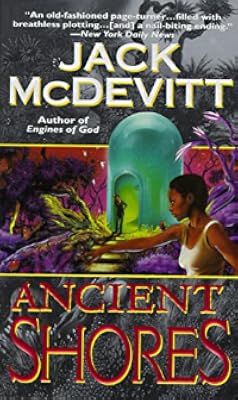
It turned up in a North Dakota wheat field: a triangle, like a shark's fin, sticking up from the black loam. Tom Lasker did what any farmer would have done. He dug it up. And discovered a boat, made of a fiberglass-like material with an utterly impossible atomic number. What it was doing buried under a dozen feet of prairie soil two thousand miles from any ocean, no one knew. True, Tom Lasker's wheat field had once been on the shoreline of a great inland sea, but that was a long time ago -- show more ten thousand years ago. A return to science fiction on a grand scale, reminiscent of the best of Heinlein, Simak, and Clarke, Ancient Shores is the most ambitious and exciting SF triumph of the decade, a bold speculative adventure that does not shrink from the big questions -- and the big answers. show lessTags
Recommendations












Member Reviews
Ancient Shores by Jack McDevitt
This 1996 novel by Jack McDevitt is an epic story of big ideas. The premise immediately captured my imagination. An alien artifact is found buried in North Dakota, and provides a clue which prompts the protagonists to excavate in another area where they uncover a portal leading to alien worlds. The first half of the book recounts the discovery and subsequent use of the portal and is permeated by a compelling sense of wonder, while at the same time being firmly grounded in a realistic setting. In the second half, the tension is maintained, but the focus is shifted to problems and conflicts caused by the psychological, social, economic and political ramifications of the world-changing find.
Readers who enjoy show more more action-oriented science fiction may find Ancient Shores a little slow, but I must say that I did not find it hard-going or plodding at any point, and I was always eager to get back to my reading of it.
As the plot builds to its climax, there are some slightly unlikely occurrences, but I am not inclined to find fault with these since they are, on the whole, woven seamlessly into a sufficiently strong story.
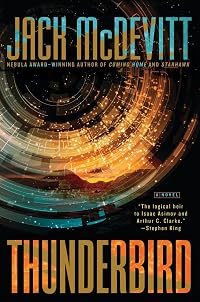
McDevitt writes quite succinctly, expresses all main points clearly, and succeeds in producing a modern story infused throughout with a Golden-Age ambience. I thoroughly enjoyed this one. I am now tempted to move directly on to reading the sequel, Thunderbird, which was published nearly twenty years later in 2015. show less
This 1996 novel by Jack McDevitt is an epic story of big ideas. The premise immediately captured my imagination. An alien artifact is found buried in North Dakota, and provides a clue which prompts the protagonists to excavate in another area where they uncover a portal leading to alien worlds. The first half of the book recounts the discovery and subsequent use of the portal and is permeated by a compelling sense of wonder, while at the same time being firmly grounded in a realistic setting. In the second half, the tension is maintained, but the focus is shifted to problems and conflicts caused by the psychological, social, economic and political ramifications of the world-changing find.
Readers who enjoy show more more action-oriented science fiction may find Ancient Shores a little slow, but I must say that I did not find it hard-going or plodding at any point, and I was always eager to get back to my reading of it.
As the plot builds to its climax, there are some slightly unlikely occurrences, but I am not inclined to find fault with these since they are, on the whole, woven seamlessly into a sufficiently strong story.
McDevitt writes quite succinctly, expresses all main points clearly, and succeeds in producing a modern story infused throughout with a Golden-Age ambience. I thoroughly enjoyed this one. I am now tempted to move directly on to reading the sequel, Thunderbird, which was published nearly twenty years later in 2015. show less
When you are turning the soil on your farm you expect to find rocks. Or some trash. What you do not expect is a yacht - complete with sails and rigging. And when the yacht leads to more artifact, everyone in the country start wondering what all that is - especially when it turns out that the boat is made from an element that cannot exist.
McDevitt constructs the novel around these discoveries - with the whole paranoia and craziness that it entails - all happening on a Native American land does not help matters much. The scientists have their own ideas of how to handle things but politics and economy get into the picture. That's a part of the story that SF authors do not cover that often - the story of how we discover things is always show more fascinating but what happens to humanity at the background is even more fascinating.
McDevitt chooses an interesting way to show us what is happening - introducing characters for a page or so and never mentioning them again; using newspapers' and books and TV segments to show what happens outside of the story. And all that adds up to a background that allows you to see what is really happening.
I am not sure how much I liked the end - it felt almost like deus ex machina - it was an interesting way to wrap things up but I wish that things were actually resolved inside of the novel, with everyone involved.
The novel blends a lot of social issues - from private property and race relationships to religion and beliefs (and both things are not the same thing). And under the whole story is another one - about responsibility and trust and who has the right to make decisions about something that influences humanity. show less
McDevitt constructs the novel around these discoveries - with the whole paranoia and craziness that it entails - all happening on a Native American land does not help matters much. The scientists have their own ideas of how to handle things but politics and economy get into the picture. That's a part of the story that SF authors do not cover that often - the story of how we discover things is always show more fascinating but what happens to humanity at the background is even more fascinating.
McDevitt chooses an interesting way to show us what is happening - introducing characters for a page or so and never mentioning them again; using newspapers' and books and TV segments to show what happens outside of the story. And all that adds up to a background that allows you to see what is really happening.
I am not sure how much I liked the end - it felt almost like deus ex machina - it was an interesting way to wrap things up but I wish that things were actually resolved inside of the novel, with everyone involved.
The novel blends a lot of social issues - from private property and race relationships to religion and beliefs (and both things are not the same thing). And under the whole story is another one - about responsibility and trust and who has the right to make decisions about something that influences humanity. show less
Fort Moxie lent itself to timelessness. There were no major renovation projects, no vast cultural shifts imposed by changing technology, no influxes of strangers, no social engineering. The town and the broad prairie in which it rested were caught in a kind of time warp.
A farmer works his land in the far reaches of North Dakota — just a few miles away from the Canadian border. Something pokes from the flat lands that he calls home. He lives in a large basin of prairie-land, farms and flat as far as the eye can see. “The plain stretched out forever.”
It’s manmade. Clearly not of the land. The farmer digs it up and finds that the cylinder is just the beginning. It’s connected to something even larger… a mast. Underneath is the show more rest of the sailboat. Buried in ground that’s been a prairie for millions of years.
The discovery of the sailboat is the launching point for Jack McDevitt’s short novel of first-contact, Ancient Shores, originally published in 1996. It’s a complex tale of humanity’s discovery that we’re not alone.
The cover of many newer copies of Ancient Shores and other McDevitt fare includes a quote from Stephen King referencing that McDevitt is “the logical heir to Isaac Asimov and Arthur C. Clarke.” I’m not sure if King’s quote planted the seed, but I see much of Clarke in Ancient Shores. McDevitt’s language is straightforward, spare in its characterizations and sparse in its exposition. It’s a complex tale told in simple terms. His themes are common (first contact, mysterious alien artifacts, the cultural and political reactions to alien discoveries), but not all are dealt with in the most common nor expected of ways.
Word of the farmer’s discovery spreads beyond the small towns of North Dakota and speculation broadens around the aliens and their advanced technologies. Scientists are unable to determine what the boat is made of, however it’s beyond human ability to manufacture. And as word leaks out, rumors of a super-material starts hitting the boardrooms of leading manufacturers… leading to a broader theme whole of economic impact and industrial collapse.
Two individuals orbit McDevitt’s plot, though I found them thin and largely unmemorable. Max Collingwood restores and sells military warplanes, and rather than developing Max’s internally driven motivations through action, McDevitt lays out his personality very clearly.
Max… had no taste for military life or for the prospect of getting shot at. His father, Colonel Maxwell E. Collingwood, USAF (retired), to his credit, tried to hide his disappointment in his only son. But it was there nonetheless, and Max had, on more than one occasion, overheard him wondering aloud.
April Cannon is a chemical scientist who first establishes that the material used to manufacture the boat didn’t come from any known process or chemical makeup. She’s single, Max is single and there’s a smidgen of a love connection, but like much of the characters that float around McDevitt’s story, it’s background hum to the ongoing alien mystery.
The Plains on which North Dakota sits “had been the basin for Lake Agassiz, the inland sea whose surface area had been broader than that of the modern Great Lakes combined. Agassiz. Long gone now.”
April and Max theorize that whomever left the boat must’ve been cruising Lake Agassiz. And who cruises without having a dock? So they search and dig and find a structure buried close to the edge of the ancient lake. The location is on the reservation of a Sioux tribe, which drives a key theme to the story… the inherent conflict and contradictions between the ancient world and the modern. And the rather clear analogy between the “discovered” becoming the “discoverer.”
Buried deep beneath the Sioux reservation, positioned precisely to have served as a dock for a sailing ship the size of what was discovered just a few miles away, sits The Roundhouse. The Roundhouse is actually a portal, or a stargate. With the proper pressure placed on one of a few symbols carved into the walls, a person or object is transferred (not unlike a Star Trek transporter) to a seemingly distant location. At first it’s a Cupola in an Eden-like jungle on the edge of a lake. Another symbol takes the traveler to a seemingly endless maze, confusing, unbalanced and with more than a hint of the travelers not being alone.
The mystery deepens when a ghost-like entity follows the travelers into our world, from somewhere through the Roundhouse. It affects people in different ways. Some turn angry, some feel an incredible “otherness” of being. The invisible force makes the rounds in North Dakota. Some people hear voices… hear their name being called.
Ancient Shores made me reflect on Carl Sagan’s Contact. The discovery of other beings is just the core of the story, around which its impact is explored to greater and lesser degrees. McDevitt prods into the societal, religious and economic impacts of the discovery. He delves more deeply into the political impact of the alien discovery, and the military and religious factors that drive a face off at the Roundhouse between the Sioux guardians and U.S. Government heavies. He incorporates interludes of how people are affected, and how the discovery is treated in the media. A scientist is interviewed on TV:
A long time ago somebody with advanced technology went sailing on Lake Agassiz. They tied up at least once to a tree or a pier.
I think if we accept the results of the analysis, we are forced to one of two conclusions. Either there were people living here at the end of the last ice ago who were technologically more advanced that we are… Or we have had visitors.
The story ends. Rather abruptly. The conclusion, within the context of this single volume, is satisfying enough. But there are no answers, no sweeping consequence that addresses the key questions: who are the intellectual beings that created the stargate and where have they gone. Ancient Shores is ripe for a sequel that has just arrived… fortunately for you reading this at a minimum of 19 years after Ancient Shores was originally published. Thunderbird was published just this month, and yes, it delves into the unanswered questions left on McDevitt’s ancient shores.
As a short preface to many chapters in the book, McDevitt quotes a poem from the fictional Walter Asquith, aptly named Ancient Shores. I made a note to review all of the appropriate chapter headings after I completed the book and compiled the poem for this review. I found it a solid conclusion and framework for McDevitt’s story.
…Glides through misty seas
With its cargo of time and space…
The distant roar of receding time…
This antique coast, Washed by time…
For the moonlit places where men once laughed
Are now but bones in the earth…
Shopkeepers, students, government officials, farmers,
Ordinary men and women, they came,
And were forever changed…
In all that vast midnight sea,
The light only drew us on…
The true power centers are not in the earth.
But in ourselves. show less
A farmer works his land in the far reaches of North Dakota — just a few miles away from the Canadian border. Something pokes from the flat lands that he calls home. He lives in a large basin of prairie-land, farms and flat as far as the eye can see. “The plain stretched out forever.”
It’s manmade. Clearly not of the land. The farmer digs it up and finds that the cylinder is just the beginning. It’s connected to something even larger… a mast. Underneath is the show more rest of the sailboat. Buried in ground that’s been a prairie for millions of years.
The discovery of the sailboat is the launching point for Jack McDevitt’s short novel of first-contact, Ancient Shores, originally published in 1996. It’s a complex tale of humanity’s discovery that we’re not alone.
The cover of many newer copies of Ancient Shores and other McDevitt fare includes a quote from Stephen King referencing that McDevitt is “the logical heir to Isaac Asimov and Arthur C. Clarke.” I’m not sure if King’s quote planted the seed, but I see much of Clarke in Ancient Shores. McDevitt’s language is straightforward, spare in its characterizations and sparse in its exposition. It’s a complex tale told in simple terms. His themes are common (first contact, mysterious alien artifacts, the cultural and political reactions to alien discoveries), but not all are dealt with in the most common nor expected of ways.
Word of the farmer’s discovery spreads beyond the small towns of North Dakota and speculation broadens around the aliens and their advanced technologies. Scientists are unable to determine what the boat is made of, however it’s beyond human ability to manufacture. And as word leaks out, rumors of a super-material starts hitting the boardrooms of leading manufacturers… leading to a broader theme whole of economic impact and industrial collapse.
Two individuals orbit McDevitt’s plot, though I found them thin and largely unmemorable. Max Collingwood restores and sells military warplanes, and rather than developing Max’s internally driven motivations through action, McDevitt lays out his personality very clearly.
Max… had no taste for military life or for the prospect of getting shot at. His father, Colonel Maxwell E. Collingwood, USAF (retired), to his credit, tried to hide his disappointment in his only son. But it was there nonetheless, and Max had, on more than one occasion, overheard him wondering aloud.
April Cannon is a chemical scientist who first establishes that the material used to manufacture the boat didn’t come from any known process or chemical makeup. She’s single, Max is single and there’s a smidgen of a love connection, but like much of the characters that float around McDevitt’s story, it’s background hum to the ongoing alien mystery.
The Plains on which North Dakota sits “had been the basin for Lake Agassiz, the inland sea whose surface area had been broader than that of the modern Great Lakes combined. Agassiz. Long gone now.”
April and Max theorize that whomever left the boat must’ve been cruising Lake Agassiz. And who cruises without having a dock? So they search and dig and find a structure buried close to the edge of the ancient lake. The location is on the reservation of a Sioux tribe, which drives a key theme to the story… the inherent conflict and contradictions between the ancient world and the modern. And the rather clear analogy between the “discovered” becoming the “discoverer.”
Buried deep beneath the Sioux reservation, positioned precisely to have served as a dock for a sailing ship the size of what was discovered just a few miles away, sits The Roundhouse. The Roundhouse is actually a portal, or a stargate. With the proper pressure placed on one of a few symbols carved into the walls, a person or object is transferred (not unlike a Star Trek transporter) to a seemingly distant location. At first it’s a Cupola in an Eden-like jungle on the edge of a lake. Another symbol takes the traveler to a seemingly endless maze, confusing, unbalanced and with more than a hint of the travelers not being alone.
The mystery deepens when a ghost-like entity follows the travelers into our world, from somewhere through the Roundhouse. It affects people in different ways. Some turn angry, some feel an incredible “otherness” of being. The invisible force makes the rounds in North Dakota. Some people hear voices… hear their name being called.
Ancient Shores made me reflect on Carl Sagan’s Contact. The discovery of other beings is just the core of the story, around which its impact is explored to greater and lesser degrees. McDevitt prods into the societal, religious and economic impacts of the discovery. He delves more deeply into the political impact of the alien discovery, and the military and religious factors that drive a face off at the Roundhouse between the Sioux guardians and U.S. Government heavies. He incorporates interludes of how people are affected, and how the discovery is treated in the media. A scientist is interviewed on TV:
A long time ago somebody with advanced technology went sailing on Lake Agassiz. They tied up at least once to a tree or a pier.
I think if we accept the results of the analysis, we are forced to one of two conclusions. Either there were people living here at the end of the last ice ago who were technologically more advanced that we are… Or we have had visitors.
The story ends. Rather abruptly. The conclusion, within the context of this single volume, is satisfying enough. But there are no answers, no sweeping consequence that addresses the key questions: who are the intellectual beings that created the stargate and where have they gone. Ancient Shores is ripe for a sequel that has just arrived… fortunately for you reading this at a minimum of 19 years after Ancient Shores was originally published. Thunderbird was published just this month, and yes, it delves into the unanswered questions left on McDevitt’s ancient shores.
As a short preface to many chapters in the book, McDevitt quotes a poem from the fictional Walter Asquith, aptly named Ancient Shores. I made a note to review all of the appropriate chapter headings after I completed the book and compiled the poem for this review. I found it a solid conclusion and framework for McDevitt’s story.
…Glides through misty seas
With its cargo of time and space…
The distant roar of receding time…
This antique coast, Washed by time…
For the moonlit places where men once laughed
Are now but bones in the earth…
Shopkeepers, students, government officials, farmers,
Ordinary men and women, they came,
And were forever changed…
In all that vast midnight sea,
The light only drew us on…
The true power centers are not in the earth.
But in ourselves. show less
My reactions to reading this novel in 1996. Spoilers follow.
I enjoyed this novel which reminded me of Clifford Simak’s Mastodonia and The Visitors (for its speculations on the public’s reactions to radically new technology) and his Way Station (an alien teleport device in a rural setting), McDevitt’s own The Hercules Text (for its speculation on what to do with advanced technical knowledge), and a little of George Zebrowski’s Stranger Suns (for its network of alien built – and abandoned – teleporters). Of course, the North Dakota setting appealed to me, but I also admired McDevitt’s sparse prose and many little throwaway scenes and characters which illustrated public phobias about the possible use of alien technology and, show more less so, the rational response that the technology will not only destroy some sectors of the economy but also create wealth and new opportunities.
he ending, where the attempted government destruction of the Roundhouse is thwarted by the physical presence of real intellectual celebrities (including Gregory Benford and Ursula K. Le Guin), is a bit touchy-feely but entirely plausible. The novel, coming from an ex-customs officer and naval officer, is a bit libertarian. A minor character called Harry Markowitz, economist, states “Sometimes the law is stupid”. The president – supposedly a man of integrity – is shown ordering the Roundhouse destruction for short term gain though he knows it's wrong. A gung ho US Marshall is willing to kill the Indian occupants of the Roundhouse just to occupy it – hardly good or legal lethal force policy.
On the other, the government is not a monolithic force. It is implied that Jason Fleury, presidential representative, organizes the public relations event that ends the novel. Then again McDevitt briefly shows, in a very sympathetic light (he doesn’t like his job but knows it's important in maintaining civilization), a tax collector. Perhaps it's more accurate to say McDevitt realistically presents characters who are sincere and have many different motives and goals and not stock villains. He also has an archaeologist angry that professional archaeologists are not excavating the Roundhouse.
As with The Hercules Text, McDevitt definitely leaves you wanting more and leaves many plot elements unexplored: Will the alien technology be exploited? If so, who gets the economic rights to it? What will the social effects be? What awaits on other worlds of the network of teleporters? Who built them are where they went? The novel, though, draws a lot of power from such mysteries. I also liked the Indian element with the Sioux viewing alien worlds as a place where the old way of life can be revived. However, at novel’s end, it is implied the Indians will let others into the alien world. How this reconciles with returning to a nomadic existence is one of the unexplained elements. I also liked the poetry of the fictitious poet Walter Asquith show less
I enjoyed this novel which reminded me of Clifford Simak’s Mastodonia and The Visitors (for its speculations on the public’s reactions to radically new technology) and his Way Station (an alien teleport device in a rural setting), McDevitt’s own The Hercules Text (for its speculation on what to do with advanced technical knowledge), and a little of George Zebrowski’s Stranger Suns (for its network of alien built – and abandoned – teleporters). Of course, the North Dakota setting appealed to me, but I also admired McDevitt’s sparse prose and many little throwaway scenes and characters which illustrated public phobias about the possible use of alien technology and, show more less so, the rational response that the technology will not only destroy some sectors of the economy but also create wealth and new opportunities.
he ending, where the attempted government destruction of the Roundhouse is thwarted by the physical presence of real intellectual celebrities (including Gregory Benford and Ursula K. Le Guin), is a bit touchy-feely but entirely plausible. The novel, coming from an ex-customs officer and naval officer, is a bit libertarian. A minor character called Harry Markowitz, economist, states “Sometimes the law is stupid”. The president – supposedly a man of integrity – is shown ordering the Roundhouse destruction for short term gain though he knows it's wrong. A gung ho US Marshall is willing to kill the Indian occupants of the Roundhouse just to occupy it – hardly good or legal lethal force policy.
On the other, the government is not a monolithic force. It is implied that Jason Fleury, presidential representative, organizes the public relations event that ends the novel. Then again McDevitt briefly shows, in a very sympathetic light (he doesn’t like his job but knows it's important in maintaining civilization), a tax collector. Perhaps it's more accurate to say McDevitt realistically presents characters who are sincere and have many different motives and goals and not stock villains. He also has an archaeologist angry that professional archaeologists are not excavating the Roundhouse.
As with The Hercules Text, McDevitt definitely leaves you wanting more and leaves many plot elements unexplored: Will the alien technology be exploited? If so, who gets the economic rights to it? What will the social effects be? What awaits on other worlds of the network of teleporters? Who built them are where they went? The novel, though, draws a lot of power from such mysteries. I also liked the Indian element with the Sioux viewing alien worlds as a place where the old way of life can be revived. However, at novel’s end, it is implied the Indians will let others into the alien world. How this reconciles with returning to a nomadic existence is one of the unexplained elements. I also liked the poetry of the fictitious poet Walter Asquith show less
Intriguing introduction focusing on ancient Earth's geography. McDevitt's depiction of the media circus around the discovery of ancient artifacts and the legal wrangling over them is extremely realistic. I really enjoyed the book but the ending disappointed somewhat, leaving a lot of unanswered questions for me. Unfortunately life is like that... and it must have been very tempting for McDevitt to tie it all together into a neat little package at the end.
Jack McDevitt is a pretty good writer. I’ve enjoyed a couple of his series. He’s thoughtful, has interesting ideas, and thinks big. But he has some weaknesses too. For one thing, many of his books border on boring. Not much happens. Compared to other sci fi books out there, his books are antiquated. I know they’re mysteries masquerading as sci fi, but God, they drag. By the time you’ve discovered the three or four major things/events in his books, you’ve read 400-500 pages and not much has actually happened. I’ve always thought his books could be cut in half (by page count) and still get his ideas across.
Ancient Shores is an example of McDevitt’s propensity for boredom. He tends to start slow and slowly work up to major show more points or events, but it usually takes half the book and I find I no longer have the patience with him that I once had. In this book, a farmer finds something unusual on his land. It’s a completely buried yacht, a ship we soon find out is made of material no one on Earth currently possesses in terms of the technology it would take to manufacture any of it. By the time I got to page 81, the boat has been pulled out of the ground and tourists are coming to look at it. The farmer’s friend and his scientist colleague who has made these secret discoveries are asking the local Native Americans to look over and possibly do some digging on their land.
Maybe that sounds like a lot to you, but trust me, it drags. Boy, does it drag. And I’m sorry, while finding an ancient buried yacht with futuristic technology is certainly sci fi, I like a little more diversity and action in most of my sci fi novels these days. For instance, I’ve been reading Alastair Reynolds, Thomas Harlan, John Barnes, and Peter Hamilton. There’s just so much more there. So, I gave/am giving up on this book before finishing it. I’ve started doing that recently because I’m no longer content to read hundreds of pages that don’t satisfy me when there are so many other books available that do. This book probably appeals to many people, especially those who like sci fi mysteries, but it’s too dull for me. Two stars and not recommended. show less
Ancient Shores is an example of McDevitt’s propensity for boredom. He tends to start slow and slowly work up to major show more points or events, but it usually takes half the book and I find I no longer have the patience with him that I once had. In this book, a farmer finds something unusual on his land. It’s a completely buried yacht, a ship we soon find out is made of material no one on Earth currently possesses in terms of the technology it would take to manufacture any of it. By the time I got to page 81, the boat has been pulled out of the ground and tourists are coming to look at it. The farmer’s friend and his scientist colleague who has made these secret discoveries are asking the local Native Americans to look over and possibly do some digging on their land.
Maybe that sounds like a lot to you, but trust me, it drags. Boy, does it drag. And I’m sorry, while finding an ancient buried yacht with futuristic technology is certainly sci fi, I like a little more diversity and action in most of my sci fi novels these days. For instance, I’ve been reading Alastair Reynolds, Thomas Harlan, John Barnes, and Peter Hamilton. There’s just so much more there. So, I gave/am giving up on this book before finishing it. I’ve started doing that recently because I’m no longer content to read hundreds of pages that don’t satisfy me when there are so many other books available that do. This book probably appeals to many people, especially those who like sci fi mysteries, but it’s too dull for me. Two stars and not recommended. show less
I don’t really do re-reads. There are so many stories out there to be read, so much to ingest, to devour. Re-reads, even of past favorites, take time away from that further expansion of the pleasure zone of the mind (I’d have left it to ‘expansion of the mind’, but I read more for pleasure than anything else).
And yet . . . here I am, having finished a re-read of ‘Ancient Shores’. By an author who I kind of stuck onto my ‘favorite’ list then onto my ‘annoyed me’ list (in this authors specific case, the promise inherent in his Academy series never actually got developed, despite the 7 books in the series, and the last one of them was a prequel that I neither liked, nor could fathom why it had been written; similarly, show more the concept of someone who digs into antiques, from a future perspective, so some of these antiques are from a future between our own time and his, or from our time, or from a time prior to the readers perspective is a very intriguing idea – and the first book promised something that was both slightly delivered and slightly sidetracked – my I kind of hate the lead protagonist in that Alex Benedict series, specifically because it isn’t Alex Benedict).
So, why the reread? Because one of the books I did love written by this author had a sequel. A sequel that appeared somewhere between 9 and 10 years after the first book appeared. It didn’t appear to be a very highly rated sequel, but still, it was there. And I had rather enjoyed Ancient Shores way back in 1996 when I’d read it. Heard to read ‘Thunderbird’ without rereading the book that came before it.
So . . . took me months, but I eventually caved and did a little reread. One thing I learned almost immediately – I had loved this book, the discovery of mysterious objects, the, um, stuff that unfolded . . . and I couldn’t remember a single bloody part of it. No no, I remembered that something got dug up by a famer in the Dakotas. A device that was both mysterious and allowedtravel between worlds . But beyond that I didn’t remember anything. No, I take that back, I did remember that the government had to be fought because it acted badly in this book .
There are no real ‘lead characters’, since things hopped around a lot, following a ton of people. But there were at least two that ‘close-ish’ to being the leads – April Cannon and Max something-or-other. I’d remembered the farmer, Tom Lasker, and the kid – his son, who had helped uncover the suspicious thingie that was buried on his land. I did not remember that the kid had no impact on the events. Nor that one of the two leads was a black woman (April), and the other was something of man who lived to run from danger, something of a coward (Max).
McDevitt isn’t always the best with character work, but he did a good job this time around. As much as I kind of grew to dislike Max, he was mostly full-formed. As was April. Heck, one of the problems I had with the book was that he was a little too detailed with minor characters of little importance. Boom – another character, has a very brief scene in the book, then gone. The reader, me, now knows more about that character than they had any desire to know. But bah, that’s life.
It was a good book. Interesting. Certain things that occurred seemed far-fetched ( (1) every bloody scientist was, even if somewhat cautious about things, were accepting of this alien find?; (2) every single bloody scientist could not stop saying stupid fucking things that drove people wild with fear; what the fuck was that about? Was someone actually slipping them money? Every bloody one of them seemed to just live to say (a) the technology is real; (b) it will be easy to reproduce; (c) it will drive every current technology out of existence. I mean, seriously, what the fuck was that about? Even the angry archaeologist who came to scream at them for not having an archaeologist involved seemed quite accepting of the fact that there was alien technology being dug up. So, why were all the scientist so single minded in accepting the findings (unreleatistic, that), while seemingly going out of their way to word things as ‘badly’ as possible – badly in terms of killing the economy? ). But despite those occasional moments of far-fetchedness, there was still a good deal of fun and excitement to be found in the book.
Now to see if I’ll actually go ahead and read the sequel. Now that I’ve gone to all this trouble to do a reread.
March 28 2016 show less
And yet . . . here I am, having finished a re-read of ‘Ancient Shores’. By an author who I kind of stuck onto my ‘favorite’ list then onto my ‘annoyed me’ list (in this authors specific case, the promise inherent in his Academy series never actually got developed, despite the 7 books in the series, and the last one of them was a prequel that I neither liked, nor could fathom why it had been written; similarly, show more the concept of someone who digs into antiques, from a future perspective, so some of these antiques are from a future between our own time and his, or from our time, or from a time prior to the readers perspective is a very intriguing idea – and the first book promised something that was both slightly delivered and slightly sidetracked – my I kind of hate the lead protagonist in that Alex Benedict series, specifically because it isn’t Alex Benedict).
So, why the reread? Because one of the books I did love written by this author had a sequel. A sequel that appeared somewhere between 9 and 10 years after the first book appeared. It didn’t appear to be a very highly rated sequel, but still, it was there. And I had rather enjoyed Ancient Shores way back in 1996 when I’d read it. Heard to read ‘Thunderbird’ without rereading the book that came before it.
So . . . took me months, but I eventually caved and did a little reread. One thing I learned almost immediately – I had loved this book, the discovery of mysterious objects, the, um, stuff that unfolded . . . and I couldn’t remember a single bloody part of it. No no, I remembered that something got dug up by a famer in the Dakotas. A device that was both mysterious and allowed
There are no real ‘lead characters’, since things hopped around a lot, following a ton of people. But there were at least two that ‘close-ish’ to being the leads – April Cannon and Max something-or-other. I’d remembered the farmer, Tom Lasker, and the kid – his son, who had helped uncover the suspicious thingie that was buried on his land. I did not remember that the kid had no impact on the events. Nor that one of the two leads was a black woman (April), and the other was something of man who lived to run from danger, something of a coward (Max).
McDevitt isn’t always the best with character work, but he did a good job this time around. As much as I kind of grew to dislike Max, he was mostly full-formed. As was April. Heck, one of the problems I had with the book was that he was a little too detailed with minor characters of little importance. Boom – another character, has a very brief scene in the book, then gone. The reader, me, now knows more about that character than they had any desire to know. But bah, that’s life.
It was a good book. Interesting. Certain things that occurred seemed far-fetched (
Now to see if I’ll actually go ahead and read the sequel. Now that I’ve gone to all this trouble to do a reread.
March 28 2016 show less
Members
- Recently Added By
Lists

Stephen King's 'On Writing' reading list
95 works; 4 members
Author Information

124+ Works 20,934 Members
Jack McDevitt (born 1935) is an American science fiction author whose novels frequently deal with attempts to make contact with alien races, and with archaeology or xenoarchaeology. He attended La Salle University, where a short story of his won the annual Freshman Short Story Contest and was published in the school's literary magazine, Four show more Quarters. He received a Master's degree in literature from Wesleyan University in 1971. Before becoming a full-time author, he was an English teacher, naval officer, Philadelphia taxi driver, customs officer and motivational trainer. His first published story was The Emerson Effect in The Twilight Zone Magazine in 1981. Two years later, he published his first novel, The Hercules Text, which won the Philip K. Dick Special Award. He won the 2006 Nebula Award for Best Novel for Seeker, the UPC International Prize for his novella Ships in the Night in 1991, and the John W. Campbell Memorial Award for best SF novel for Omega in 2003. (Bowker Author Biography) show less
Some Editions
Awards and Honors
Awards
Series

Belongs to Publisher Series
Bastei Science Fiction-Special (24235)
Common Knowledge
- Canonical title
- Ancient Shores
- Original title
- Ancient Shores
- Original publication date
- 1996-04
- Important places
- North Dakota, USA
- Epigraph
- Pretty, in amber, to observe the forms
Of hairs, or straws, or dirt, or grubs, or worms;
The things we know, are neither rich nor rare.
But wonder how the devil they got there.
~ Alexander Pople
An Epistle t... (show all)o Dr. Arbuthnot - Dedication
- For Roseanne and Ed Garrity, with whom I've always been able to think aloud.
- First words
- "If that ain't the damnedest thing," Tom Lasker had to raise his voice to be heard over the wind.
- Last words
- (Click to show. Warning: May contain spoilers.)He kissed her, long and deep and wet.
- Blurbers
- Swanwick, Michael; Kessel, John; Sawyer, Robert J.
Classifications
Statistics
- Members
- 1,024
- Popularity
- 25,469
- Reviews
- 27
- Rating
- (3.47)
- Languages
- 6 — Czech, English, French, German, Hungarian, Polish
- Media
- Paper, Ebook
- ISBNs
- 11
- ASINs
- 3