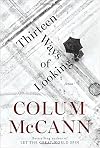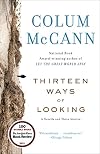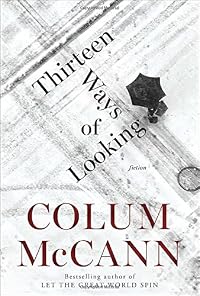
Thirteen Ways of Looking
by Colum McCann 
On This Page
Description
A story collection includes the title novella, in which an octogenarian retired judge's musings on his life are interrupted by police updates about his murder later that afternoon.Tags
Recommendations












Member Reviews
Perspective defines reality. Because perspectives vary so much between individuals and over time, objective definitions of reality can be illusive. Colum McCann explores these truisms in his new collection. The title story—actually a novella—uses Wallace Stevens’ 13 stanza poem, “Thirteen Ways of Looking at a Blackbird”, to remind us of the importance of perspective in defining reality. In thirteen chapters, we follow octogenarian, Peter Mendelssohn through his morning and lunch with his son at a posh Manhattan restaurant. With the deft use of memory and minor detail (“That little speck of blue on her wrist: such a perfect addition, like the wrongly tied knot on a Persian carpet.”), Mendelssohn reveals himself as a kind show more man. He is a retired judge and widower, who judges his situation and surroundings with good humor. The people who care for him are all minorities, but despite joking with them (He references aggressive drivers from NJ and the marginal driving skills of Asian immigrants by saying: “If you ever meet a Chinese man from New Jersey, buckle up.”), he is definitely not a racist. Without exception, he finds these people admirable and they find him endearing. After all, Mendelssohn himself was an immigrant, twice over. The plot turns on his son, Eliot, who has evolved from being a loving boy to a greedy, self-absorbed Wall Street moneyman, who is a racist and uses people. Mendelssohn is wrongly perceived as being linked with his son by one of the busboys in the restaurant and suffers dire consequences as a result. McCann skillfully uses the metaphor of closed circuit TV cameras like Stevens’ blackbirds to emphasize that even these devices have perspectives and may not always reliably represent reality. “More cameras in the city than birds in the sky.”
“What Time Is It Now, Where Are You?” explores—also in 13 chapters—the process of writing a story. The story the writer tells evolves into one where a woman Marine is alone on New Years Eve at an outpost in Afghanistan. Sandy Jewell longs to connect with her teenage stepson at midnight. As the narrative develops, the reader is introduced to the endless possibilities that are at the writer’s disposal to tell a story and how each may impact meaning. McCann wisely leaves the outcome of this one hanging. After all, he has made his point by then “The phone rings: it rings and rings and rings.”
In “Sh'khol”, Rebecca is working on a translation of an Arab Israeli’s story about a middle-aged couple whose two children die. McCann’s title comes from a word that Rebecca struggles to translate: Sh'khol = a parent who has lost a child. This soon becomes meaningful for Rebecca. The setting is an isolated house in Western Ireland at Christmas. She is there alone with her adopted 13-year-old son, Tomas, who is deaf and may be slightly retarded from the effects of fetal alcohol syndrome. Thrilled by her gift of a wetsuit, Tomas disappears on Christmas morning presumably to try out the suit in the sea. A fruitless search leaves Rebecca stricken with guilt and the reader totally engrossed. It is not possible to reveal the outcome of this story without spoiling it, but once again McCann expertly leaves the reader with much to consider regarding how his characters may be perceived.
The narrator of “Treaty” is Sister Beverly Clarke, an ageing Catholic nun who struggles with memories of having been tortured and raped in the jungle many years previously by Carlos, a Latin American revolutionary. When she sees him on a television news program transformed into a peace negotiator in London, she is shocked and decides that confronting him now may help her to overcome her trauma. She wonders how it is possible for a person to change their persona so radically. The final confrontation is remarkable in it understatement, but the resolution seems more firm than those in the other stories in the collection. McCann manages to expose the truth with just one word spoken in Spanish by Carlos. Unfortunately, repeating that word here would spoil the story. Once again, closed circuit cameras are used as a metaphor for objective reality here, but we realize that they cannot capture the reality of the confrontation. Instead they capture what can be seen and this is not the reality that Sister Clarke learns from Carlos’ single word.
Clearly, McCann is a master of his craft. These stories are well-written and suspenseful; the narratives are lyrical; few words carry immense meaning; the detail and depth are indeed remarkable. show less
“What Time Is It Now, Where Are You?” explores—also in 13 chapters—the process of writing a story. The story the writer tells evolves into one where a woman Marine is alone on New Years Eve at an outpost in Afghanistan. Sandy Jewell longs to connect with her teenage stepson at midnight. As the narrative develops, the reader is introduced to the endless possibilities that are at the writer’s disposal to tell a story and how each may impact meaning. McCann wisely leaves the outcome of this one hanging. After all, he has made his point by then “The phone rings: it rings and rings and rings.”
In “Sh'khol”, Rebecca is working on a translation of an Arab Israeli’s story about a middle-aged couple whose two children die. McCann’s title comes from a word that Rebecca struggles to translate: Sh'khol = a parent who has lost a child. This soon becomes meaningful for Rebecca. The setting is an isolated house in Western Ireland at Christmas. She is there alone with her adopted 13-year-old son, Tomas, who is deaf and may be slightly retarded from the effects of fetal alcohol syndrome. Thrilled by her gift of a wetsuit, Tomas disappears on Christmas morning presumably to try out the suit in the sea. A fruitless search leaves Rebecca stricken with guilt and the reader totally engrossed. It is not possible to reveal the outcome of this story without spoiling it, but once again McCann expertly leaves the reader with much to consider regarding how his characters may be perceived.
The narrator of “Treaty” is Sister Beverly Clarke, an ageing Catholic nun who struggles with memories of having been tortured and raped in the jungle many years previously by Carlos, a Latin American revolutionary. When she sees him on a television news program transformed into a peace negotiator in London, she is shocked and decides that confronting him now may help her to overcome her trauma. She wonders how it is possible for a person to change their persona so radically. The final confrontation is remarkable in it understatement, but the resolution seems more firm than those in the other stories in the collection. McCann manages to expose the truth with just one word spoken in Spanish by Carlos. Unfortunately, repeating that word here would spoil the story. Once again, closed circuit cameras are used as a metaphor for objective reality here, but we realize that they cannot capture the reality of the confrontation. Instead they capture what can be seen and this is not the reality that Sister Clarke learns from Carlos’ single word.
Clearly, McCann is a master of his craft. These stories are well-written and suspenseful; the narratives are lyrical; few words carry immense meaning; the detail and depth are indeed remarkable. show less
Beautiful writing, gripping stories, that of the nun confronting her abuser affected me deeply. A writer who captures his characters perfectly in the tiniest nuance, like the nun seeing her reflection in the theft prevention mirrors in the convenience store. Stunning.
---Dad, he says, with a kind swerve in his voice...
I can hear it -- that swerve nearly separating “Dad” into two syllables. That’s Colum McCann, whose lyrical stories practically read themselves.
Here he’s assembled a novella and three short stories, each of which explores looking through different perspectives. In the stories, there’s the mind of a writer as he creates and bends and prunes a story; a nun who catches sight of the man, now renown, who raped her decades before; and a translator’s struggle to find, in any language, an equivalent to the Hebrew word, “sh’khol” (a parent whose child has died), even as she deals with her own missing son. In the novella, a day in an octogenarian’s life is interpreted through show more the lenses of numerous surveillance cameras.
[The detectives] will comb through the [camera] images looking for any random detail [...] The more obscure the moment, the more valuable the knowledge. [...] They work in much the same way as poets: the search for a random word, at the right instance, making the poem itself so much more precise.
Again, that’s McCann, who excels at finding the telling detail. This shorter collection wasn’t as immersive as his 2009 Let the Great World Spin (ten stories linked through shared characters and a connection to Phillippe Petit’s 1974 high-wire walk between the World Trade Center’s Twin Towers). But like every McCann story I’ve read, these touch gently on important topics via memorable characters, and each was individually satisfying.
(Review based on an advance reading copy provided by the publisher.) show less
I can hear it -- that swerve nearly separating “Dad” into two syllables. That’s Colum McCann, whose lyrical stories practically read themselves.
Here he’s assembled a novella and three short stories, each of which explores looking through different perspectives. In the stories, there’s the mind of a writer as he creates and bends and prunes a story; a nun who catches sight of the man, now renown, who raped her decades before; and a translator’s struggle to find, in any language, an equivalent to the Hebrew word, “sh’khol” (a parent whose child has died), even as she deals with her own missing son. In the novella, a day in an octogenarian’s life is interpreted through show more the lenses of numerous surveillance cameras.
[The detectives] will comb through the [camera] images looking for any random detail [...] The more obscure the moment, the more valuable the knowledge. [...] They work in much the same way as poets: the search for a random word, at the right instance, making the poem itself so much more precise.
Again, that’s McCann, who excels at finding the telling detail. This shorter collection wasn’t as immersive as his 2009 Let the Great World Spin (ten stories linked through shared characters and a connection to Phillippe Petit’s 1974 high-wire walk between the World Trade Center’s Twin Towers). But like every McCann story I’ve read, these touch gently on important topics via memorable characters, and each was individually satisfying.
(Review based on an advance reading copy provided by the publisher.) show less
What to say? This story of an old man mulling his life and current situation was clever, and kept me reading, and had a reasonable resolution, but it was more like a puzzle to be solved than a satisfying read. As he did in Let the Great World Spin, he alternates point and time of view, so that part of the ending is telegraphed well in advance. I liked the use of Wallace Steven's '13 Ways of Looking at a Blackbird' poem to set off the chapters, but that's mostly because I love Stevens.
I grabbed this volume at the library because I had heard McCann speak last year and so was interested in the results he spoke of. There are several short stories in the volume that I might also read, but there's something about McCann's writing that floats show more away from me. Can't quite put my finger on it. Anyone else have a thought about his writing? show less
I grabbed this volume at the library because I had heard McCann speak last year and so was interested in the results he spoke of. There are several short stories in the volume that I might also read, but there's something about McCann's writing that floats show more away from me. Can't quite put my finger on it. Anyone else have a thought about his writing? show less
I can’t very well talk about my best books of the year until the year’s over, and I had one last book to finish up on the last day of 2015. So imagine my delight when I opened up Colum McCann’s Thirteen Ways of Looking this afternoon to find the collection’s second story beginning:
He had agreed in spring to write a short story for the New Year’s Eve edition of a newspaper magazine. An easy enough task, he thought at first. In late May he settled down to sketch out a few images that might work, but soon found himself struggling, adrift. For a couple of weeks in early summer he cast about, chased ideas and paragraphs, left a few hanging, found himself postponing the assignment, putting it to the back of his mind. Occasionally he show more pulled his notes out again, then abandoned them once more.
He wondered how he would ever push into the territory of a New Year’s Eve story—create a series of fireworks, perhaps, drop a mirrored ball in a city, or allow snow to slowly scatter across the face of a windowpane?
Descriptions of writers trying to write what we’re reading can be tiresome—hey, if we’re reading it, he wrote it, now, didn’t he? But McCann keeps his touch light, and besides, who can resist a metanarrative like that? The writer assembles his characters and the faint outlines of a plot, a Marine in Afghanistan calling home to South Carolina:
[S]he will simply pick up the phone, she will dial through, she will call her lover and her lover’s son, and she will simply say, “Happy New Year,” in the most ordinary way, and they will return the greeting, and life will go on, since this is what our New Year’s Eves are about, our connections, our bonds, no matter how inconsequential, and the story will be quiet and slip its way into its own new year.
And it does. Thirteen Ways of Looking is a tight and nicely realized collection—one novella and three short stories—and its small size means that McCann can play with a few themes at one time without the whole muddying to some shade of literary brown. There is, of course, the Wallace Stevens poem that gives the book and its opening novella their title, “Thirteen Ways of Looking at a Blackbird,” each stanza of which opens one of the novella’s 13 sections. There are also, literally, ways of looking: at someone, for someone, at a surveillance tape, through the scrim of memory, through the haze of old age. (“Oh, the mind itself is a deep, deep well. Lower me down and let me touch water,” intones the elderly gentleman around whom the title story centers.) And McCann offers a way of looking at loss as something that’s not a consummation but a refraction—how it can be given us, then taken away, then granted again.
There’s not a lot of joy in this collection—in an Author’s Note in the text and on his website, McCann discusses how the book was shaped by an assault in 2014, when he was attacked and injured on the street by a stranger. Yet it’s hopeful, in its way, by virtue of the fact that not one of these tales wraps up neatly. McCann’s resistance to any kind of tidy conclusion speaks to what is, often, better about life than fiction: anything can happen, and usually does. The story doesn’t end just because the page count is finite, and there’s always room for the unexpected.
It’s a good thought for the new year, and Thirteen Ways of Looking was a good book to ring out the old one. “How do we look out into the dark?” McCann asks the apocryphal New Year’s Eve piece’s readers. That’s a good question for pretty much any night of the year, and a good reason to keep reading. show less
He had agreed in spring to write a short story for the New Year’s Eve edition of a newspaper magazine. An easy enough task, he thought at first. In late May he settled down to sketch out a few images that might work, but soon found himself struggling, adrift. For a couple of weeks in early summer he cast about, chased ideas and paragraphs, left a few hanging, found himself postponing the assignment, putting it to the back of his mind. Occasionally he show more pulled his notes out again, then abandoned them once more.
He wondered how he would ever push into the territory of a New Year’s Eve story—create a series of fireworks, perhaps, drop a mirrored ball in a city, or allow snow to slowly scatter across the face of a windowpane?
Descriptions of writers trying to write what we’re reading can be tiresome—hey, if we’re reading it, he wrote it, now, didn’t he? But McCann keeps his touch light, and besides, who can resist a metanarrative like that? The writer assembles his characters and the faint outlines of a plot, a Marine in Afghanistan calling home to South Carolina:
[S]he will simply pick up the phone, she will dial through, she will call her lover and her lover’s son, and she will simply say, “Happy New Year,” in the most ordinary way, and they will return the greeting, and life will go on, since this is what our New Year’s Eves are about, our connections, our bonds, no matter how inconsequential, and the story will be quiet and slip its way into its own new year.
And it does. Thirteen Ways of Looking is a tight and nicely realized collection—one novella and three short stories—and its small size means that McCann can play with a few themes at one time without the whole muddying to some shade of literary brown. There is, of course, the Wallace Stevens poem that gives the book and its opening novella their title, “Thirteen Ways of Looking at a Blackbird,” each stanza of which opens one of the novella’s 13 sections. There are also, literally, ways of looking: at someone, for someone, at a surveillance tape, through the scrim of memory, through the haze of old age. (“Oh, the mind itself is a deep, deep well. Lower me down and let me touch water,” intones the elderly gentleman around whom the title story centers.) And McCann offers a way of looking at loss as something that’s not a consummation but a refraction—how it can be given us, then taken away, then granted again.
There’s not a lot of joy in this collection—in an Author’s Note in the text and on his website, McCann discusses how the book was shaped by an assault in 2014, when he was attacked and injured on the street by a stranger. Yet it’s hopeful, in its way, by virtue of the fact that not one of these tales wraps up neatly. McCann’s resistance to any kind of tidy conclusion speaks to what is, often, better about life than fiction: anything can happen, and usually does. The story doesn’t end just because the page count is finite, and there’s always room for the unexpected.
It’s a good thought for the new year, and Thirteen Ways of Looking was a good book to ring out the old one. “How do we look out into the dark?” McCann asks the apocryphal New Year’s Eve piece’s readers. That’s a good question for pretty much any night of the year, and a good reason to keep reading. show less
Thirteen Ways of Looking, Colum McCann
Thirteen ways of looking is a keeper! I wish I could assign 10 stars to this book of four short stories. The writing is lyrical with clean lines and no wasted words as they slip from the page and gently wrap the reader inside each tale. The author’s expert use of puns adds wit to the otherwise often sober narratives. All the scenes unfold without extreme graphic descriptions, even when sex and torture are involved, making it easy to read and absorb, as well as enabling the reader to get the point without the foul language and excessive detail of some of today’s novels. All of the stories involve the watching eyes of a camera or of a person, or of the blackbird; the eyes of a bird see more show more clearly than a human’s.
The first story, which takes its name from the title and a poem, 13 Ways of Looking at a Blackbird, by Wallace Stevens, is the longest. Each scene in the story begins with a stanza from the poem, which in an online analysis is explained to mean a view seen from 13 different vantage points. In each scene, Mendelssohn looked back at his life from different moments and thought about their meaning, not knowing that this would be his last day to ponder. Peter Mendelssohn, and elderly Jew, an octogenarian, former judge and formerly happily married family man, was lunching with his son who was obnoxious and rude, spoiled by his success, and with far different values than his father. Peter was growing frail with age; Elliot was growing more arrogant. One represented an age gone by and the other the one coming of age. As Mendelssohn’s thoughts emerged and he tried to make sense of the world around him, even as his memory sometimes failed him, he began to better appreciate the life he was living. Mendelssohn, a widower, still yearned for the company of his wife, Eileen. He was a lonely man who found solace in his routine, but he enjoyed his companionship with his live in housekeeper and caregiver, whom he was beginning to realize he might not treat well enough. She was, after all, kinder and more concerned about him than his own son. When Mendelssohn was murdered, the eyes of the video cameras which usually saw more than the human eye, actually saw less because of a snowstorm. How did Peter die? The story concerned itself with the contemplation of a life, about the different ways to view things; the camera’s sharper view and ultimately, the world view.
In the story, What Time Is It Now, Where you are?, a writer is facing a deadline for a story to appear in a New Year’s Eve edition. He writes about Sally, a female soldier who sits high on a hilltop in Afghanistan. It is New Year’s Eve, and she is watching the barren landscape, searching for the enemy. The night sky is dark, her loneliness for family deep; the danger is out there, but it seems minimal. In the midst of this timeworn place, enmeshed in war, she thinks of her family at home and waits impatiently to call them at midnight with her SAT phone. She has taken the watch to allow everyone else to celebrate, albeit without her. It is a story within a story, his story of his writer’s block, as he struggles to find a theme, and then it is the magnetic story he settles on about the lonely soldier, far from home, on New Years’ Eve. The ending leaves the reader wondering what the New Year will bring.
In Sh’Khol, the tension grows slowly but surely. A 13-year old boy, Tomas, goes missing. He was deaf and emotionally and mentally disabled. His divorced parents had adopted him when he was 6-years old, from Vladivostok. He is now 13. He is away with his mom, Rebecca Marcus, vacationing in an Irish beach town when he disappears on Christmas day. The search for him is riveting as all eyes wander the landscape, hoping, even after several days, that he will be found. The ending leaves the reader with many unanswered questions to think about especially about how the eyes of each individual viewed the disappearance through a different lens. The meaning of Sh’Khol is interesting. It is translated loosely as bereavement, but in Hebrew it usually means the premature loss of someone due to war or terrorism.
Treaty is about a heinous unsolved crime involving the rape, torture and kidnapping of a Maryknoll nun, by a paramilitary group near Puerto Boyacá, in Columbia. When 76 year old Beverly was in her twenties, she was captured by rebel soldiers and held prisoner for six months. She bears the mental and physical scars of the brutality. Now years later, she has been told by the order to go to a seaside town on Long Island to relax because she is elderly, overly stressed and sleeps poorly. While there, she watches a Spanish language station with two of the other Sisters in her order; suddenly, she sees a face that is familiar and unsettling. It is the face of the revolutionary who kidnapped her decades ago. She wonders how he morphed into a diplomat involved in peace talks, from the scruffy brutal man he once was when she was his prisoner. She must find him and confront him, but when she does, it is an odd confrontation, and the eyes of the video camera once again play a role, but in this case, it does not conceal the evidence of a crime, but reveals it. Will she ever reveal it publicly? Should she seek revenge?
There are many common threads in this book worthy of intense discussions. All of the women play different, important roles. Video cameras play important roles as eye witnesses. All of the stories are set in cold places. Good judgment and misjudgments are common themes. The characters are larger than their superficial descriptions. Peter looks back on his life, Sally, the soldier, contemplates the life she is missing, Rebecca regrets some parts of her life and Sister Beverly is guilty and ashamed about hers. The eye of humans, the lens of the camera and the dark eyes of the blackbird are at work in each story, in some capacity, as they bear witness to events. All of the stories are open ended with unresolved questions for the reader to ponder.
After the book ends, there is a brief paragraph in which the author explains that he believes every writer’s work is somewhat autobiographical. He had been mugged (like Peter) and beaten into unconsciousness when he went to the aid of a woman. He had to decide whether revenge was the appropriate response for the victim of a crime. show less
Thirteen ways of looking is a keeper! I wish I could assign 10 stars to this book of four short stories. The writing is lyrical with clean lines and no wasted words as they slip from the page and gently wrap the reader inside each tale. The author’s expert use of puns adds wit to the otherwise often sober narratives. All the scenes unfold without extreme graphic descriptions, even when sex and torture are involved, making it easy to read and absorb, as well as enabling the reader to get the point without the foul language and excessive detail of some of today’s novels. All of the stories involve the watching eyes of a camera or of a person, or of the blackbird; the eyes of a bird see more show more clearly than a human’s.
The first story, which takes its name from the title and a poem, 13 Ways of Looking at a Blackbird, by Wallace Stevens, is the longest. Each scene in the story begins with a stanza from the poem, which in an online analysis is explained to mean a view seen from 13 different vantage points. In each scene, Mendelssohn looked back at his life from different moments and thought about their meaning, not knowing that this would be his last day to ponder. Peter Mendelssohn, and elderly Jew, an octogenarian, former judge and formerly happily married family man, was lunching with his son who was obnoxious and rude, spoiled by his success, and with far different values than his father. Peter was growing frail with age; Elliot was growing more arrogant. One represented an age gone by and the other the one coming of age. As Mendelssohn’s thoughts emerged and he tried to make sense of the world around him, even as his memory sometimes failed him, he began to better appreciate the life he was living. Mendelssohn, a widower, still yearned for the company of his wife, Eileen. He was a lonely man who found solace in his routine, but he enjoyed his companionship with his live in housekeeper and caregiver, whom he was beginning to realize he might not treat well enough. She was, after all, kinder and more concerned about him than his own son. When Mendelssohn was murdered, the eyes of the video cameras which usually saw more than the human eye, actually saw less because of a snowstorm. How did Peter die? The story concerned itself with the contemplation of a life, about the different ways to view things; the camera’s sharper view and ultimately, the world view.
In the story, What Time Is It Now, Where you are?, a writer is facing a deadline for a story to appear in a New Year’s Eve edition. He writes about Sally, a female soldier who sits high on a hilltop in Afghanistan. It is New Year’s Eve, and she is watching the barren landscape, searching for the enemy. The night sky is dark, her loneliness for family deep; the danger is out there, but it seems minimal. In the midst of this timeworn place, enmeshed in war, she thinks of her family at home and waits impatiently to call them at midnight with her SAT phone. She has taken the watch to allow everyone else to celebrate, albeit without her. It is a story within a story, his story of his writer’s block, as he struggles to find a theme, and then it is the magnetic story he settles on about the lonely soldier, far from home, on New Years’ Eve. The ending leaves the reader wondering what the New Year will bring.
In Sh’Khol, the tension grows slowly but surely. A 13-year old boy, Tomas, goes missing. He was deaf and emotionally and mentally disabled. His divorced parents had adopted him when he was 6-years old, from Vladivostok. He is now 13. He is away with his mom, Rebecca Marcus, vacationing in an Irish beach town when he disappears on Christmas day. The search for him is riveting as all eyes wander the landscape, hoping, even after several days, that he will be found. The ending leaves the reader with many unanswered questions to think about especially about how the eyes of each individual viewed the disappearance through a different lens. The meaning of Sh’Khol is interesting. It is translated loosely as bereavement, but in Hebrew it usually means the premature loss of someone due to war or terrorism.
Treaty is about a heinous unsolved crime involving the rape, torture and kidnapping of a Maryknoll nun, by a paramilitary group near Puerto Boyacá, in Columbia. When 76 year old Beverly was in her twenties, she was captured by rebel soldiers and held prisoner for six months. She bears the mental and physical scars of the brutality. Now years later, she has been told by the order to go to a seaside town on Long Island to relax because she is elderly, overly stressed and sleeps poorly. While there, she watches a Spanish language station with two of the other Sisters in her order; suddenly, she sees a face that is familiar and unsettling. It is the face of the revolutionary who kidnapped her decades ago. She wonders how he morphed into a diplomat involved in peace talks, from the scruffy brutal man he once was when she was his prisoner. She must find him and confront him, but when she does, it is an odd confrontation, and the eyes of the video camera once again play a role, but in this case, it does not conceal the evidence of a crime, but reveals it. Will she ever reveal it publicly? Should she seek revenge?
There are many common threads in this book worthy of intense discussions. All of the women play different, important roles. Video cameras play important roles as eye witnesses. All of the stories are set in cold places. Good judgment and misjudgments are common themes. The characters are larger than their superficial descriptions. Peter looks back on his life, Sally, the soldier, contemplates the life she is missing, Rebecca regrets some parts of her life and Sister Beverly is guilty and ashamed about hers. The eye of humans, the lens of the camera and the dark eyes of the blackbird are at work in each story, in some capacity, as they bear witness to events. All of the stories are open ended with unresolved questions for the reader to ponder.
After the book ends, there is a brief paragraph in which the author explains that he believes every writer’s work is somewhat autobiographical. He had been mugged (like Peter) and beaten into unconsciousness when he went to the aid of a woman. He had to decide whether revenge was the appropriate response for the victim of a crime. show less
It seemed ridiculous to read this latest Colum McCann book first, when I've meant to read Let The Great World Spin for years, but it was so good that I can't regret it, and now maybe I'll be motivated to take on that earlier, longer work. The novella and three short stories in Thirteen Ways of Looking each deliver their heartbreak slowly, and refuse to yield the tidy resolution or bad guy comeuppance that one might naturally crave. They are, nonetheless, eminently satisfying for the complete small portraits that they are, and the linguistically dazzling way that McCann paints them. I am in awe, and also still chewing on aspects of the structure and layers of meaning that McCann scatters like breadcrumbs throughout.
Members
- Recently Added By
Lists

Top Five Books of 2016
795 works; 228 members

Five star books
1,755 works; 108 members

Kirkus Starred Fiction Reviews of Books Published in 2015
310 works; 6 members
Books Read in 2015
3,299 works; 129 members

Books Read in 2024
4,623 works; 126 members

Top Five Books of 2024
795 works; 264 members
Author Information

23+ Works 14,333 Members
Irish writer Colum McCann was born near Dublin in 1965 and graduated from the University of Texas with a B.A. degree. He has worked as a newspaper journalist in Ireland and written several short stories and bestselling novels. The short film of Everything in this Country Must was nominated for an Academy Award in 2005. McCann's work has appeared show more in publications including The New York Times, The Atlantic Monthly, GQ, The Irish Times, La Repubblica, Die Zeit, Paris Match, the Guardian, and the Independent. He has won numerous awards, such as a Pushcart Prize, the Rooney Prize, the Irish Novel of the Year Award, and the 2002 Ireland Fund of Monaco Princess Grace Memorial Literary Award. In 2009 McCann was inducted into the Irish arts association Aosdana. He teaches in the Master of Fine Arts Creative Writing program at New York's Hunter College. (Bowker Author Biography) show less
Colum McCann is a LibraryThing Author, an author who lists their personal library on LibraryThing.
Awards and Honors
Awards
Distinctions
Notable Lists
Common Knowledge
- Canonical title
- Thirteen Ways of Looking
- Original title
- Thirteen Ways of Looking
- Original publication date
- 2015; 2016 (dutch) (dutch)
- Dedication*
- Voor Lisa, Jackie, Mike en Karen.
Voor al diegenen die blijven bouwen aan Narrative 4.
Ter nagedachtenis aan mijn vader, Sean McCann. - First words
- De eerste is boven in een mahoniehouten boekenkast verborgen en bestrijkt de hele ruimte van de kamer waarin hij op een royaal tweepersoonsbed tussen een hoop kussens ligt te slapen.
Among twenty snowy mountains,
The only moving thing
Was the eye of the blackbird.
The first is hidden high in a mahogany bookcase. It shows the full expanse of the room where he lies sleeping on a quee... (show all)nsize bed among a heap of pillows. -Chapter 1 - Last words*
- (Click to show. Warning: May contain spoilers.)Ze pakt de deurknop, zet de kraag van haar jas op tegen de kou en stapt de straat op, de harde vrije val van de regen in.
- Original language*
- Engels
- Canonical DDC/MDS
- 823.914
- Canonical LCC
- PR6063.C335
*Some information comes from Common Knowledge in other languages. Click "Edit" for more information.
Classifications
Statistics
- Members
- 633
- Popularity
- 45,754
- Reviews
- 49
- Rating
- (4.15)
- Languages
- 7 — Danish, Dutch, English, French, German, Italian, Spanish
- Media
- Paper, Audiobook, Ebook
- ISBNs
- 34
- ASINs
- 5