On This Page
Description
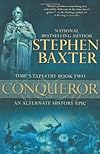
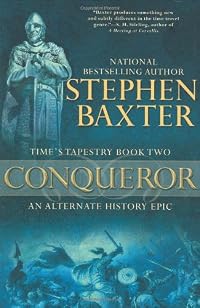
The second novel in Stephen Baxter's Time's Tapestry series.Inscribed in Latin, the ancient scroll known as The Prophecy has remained in the hands of a single family for generations, revealing secrets about the world to come, and guiding them to wealth and power...
Three centuries have passed since Rome fell, as foretold by The Prophecy—which is now in the hands of a young girl who lives disguised as a boy among the monks on the isle of Lindisfarne. When the Vikings come, deliberately show more destroying the final copies of the scroll, it will still live on—in the memory of one family. And when William of Normandy, whom history will call the Conqueror, rises to power, once more the fate of the land rests on actions inspired by the ancient words.
But as time passes, memories dim—and the surviving member of the family struggles to understand his heritage before all knowledge of the future will be lost to the past...
From the Paperback edition.. show less
Tags
Recommendations




















Member Reviews
So now we are into the second part of Baxter's 'Time's Tapestry' sequence, and the action moves on to the Anglo-Saxon period immediately before the Norman Conquest. At first, I was wondering quite how well this was going to work, with the absence of any major historical figures in the first part of the book until we reach 1066, a year of three Kings. Well, in fact it moves ahead surprisingly well, with the new prophecy revealed at the end of 'Emperor' tying the different plot strands together effectively. This book also retains the great sense of place, with the architectural wonders of the Roman world still being revisited over the succeeding ages, and their decay and changing use pointed out.
Baxter keeps throwing hints into this book show more about one of his future projects, the Northland sequence that starts with 'Bronze Spring'. He also writes enough about the prophecy to give the reader doubts as to whether he is about to take us down an alternate history path or not; indeed, in the last third of the book, one of the main protagonists is trying very hard to bring about a different outcome to events, with the vision of a great counter-factual future history of an England tied into a northern league of explorers and traders, and there is the odd point where it almost looks as though he might bring it off. He doesn't, of course; we have a Prologue in Westminster Abbey at the coronation of William I on Christmas Day 1066 to show that the course of our history remains unperturbed. But just occasionally, the reader might be forgiven for thinking we are going to go that way...
The historical background is well drawn; the account of the battle of Stamford Bridge in particular has a great immediacy about it. It should be noted that many of his characters lead nasty, brutish and short lives, and Baxter does not shy from the violence of the times, often in considerable detail. And the attitudes of his medieval characters are properly depicted without any attempt to redraw them in modern terms; for example, when Harold is tricked into swearing allegiance to William, Duke of Normandy on a holy relic, he is told "An oath achieved under duress is not binding" but no-one believes that and they continue to act accordingly. Today, we would accept that argument; in the eleventh century, no-one did.
At the same time, there are nods to the values of future years; after all, the original prophecy in 'Emperor' spoke of "life, liberty and the pursuit of happiness", and the brigandage of the Normans is shown against the proto-democratic institutions of the Norsemen and the Anglo-Saxons. There is no doubt that Baxter considers that the Norman Conquest set the scene for the following thousand years of the British class system, and some of the characters view the coming fight against the Normans as one for the survival of a way of life. There are those today who would happily turn back the clock to pre-Norman methods of governance.
The onward progression of the story of the prophecy and the Weaver, the invisible force who may (or may not) be sending these prophecies, has a major diversion signalled; the next prophecy is revealed in advance of the ending of the book, and it takes a rather different form to those we have already seen. I shall look forward to tackling the next in the sequence. show less
Baxter keeps throwing hints into this book show more about one of his future projects, the Northland sequence that starts with 'Bronze Spring'. He also writes enough about the prophecy to give the reader doubts as to whether he is about to take us down an alternate history path or not; indeed, in the last third of the book, one of the main protagonists is trying very hard to bring about a different outcome to events, with the vision of a great counter-factual future history of an England tied into a northern league of explorers and traders, and there is the odd point where it almost looks as though he might bring it off. He doesn't, of course; we have a Prologue in Westminster Abbey at the coronation of William I on Christmas Day 1066 to show that the course of our history remains unperturbed. But just occasionally, the reader might be forgiven for thinking we are going to go that way...
The historical background is well drawn; the account of the battle of Stamford Bridge in particular has a great immediacy about it. It should be noted that many of his characters lead nasty, brutish and short lives, and Baxter does not shy from the violence of the times, often in considerable detail. And the attitudes of his medieval characters are properly depicted without any attempt to redraw them in modern terms; for example, when Harold is tricked into swearing allegiance to William, Duke of Normandy on a holy relic, he is told "An oath achieved under duress is not binding" but no-one believes that and they continue to act accordingly. Today, we would accept that argument; in the eleventh century, no-one did.
At the same time, there are nods to the values of future years; after all, the original prophecy in 'Emperor' spoke of "life, liberty and the pursuit of happiness", and the brigandage of the Normans is shown against the proto-democratic institutions of the Norsemen and the Anglo-Saxons. There is no doubt that Baxter considers that the Norman Conquest set the scene for the following thousand years of the British class system, and some of the characters view the coming fight against the Normans as one for the survival of a way of life. There are those today who would happily turn back the clock to pre-Norman methods of governance.
The onward progression of the story of the prophecy and the Weaver, the invisible force who may (or may not) be sending these prophecies, has a major diversion signalled; the next prophecy is revealed in advance of the ending of the book, and it takes a rather different form to those we have already seen. I shall look forward to tackling the next in the sequence. show less
As a friend of ancient Rome, I read and liked the previous book of the series, the Emperor. In comparison, I must say that this book was something of a disappointment. This might be purely due to the fact that IMO, the medieval British Isles can't compete with ancient Rome. However, I also felt that the plot was crawling on very slowly, and since my primary interest in reading this book was to find out what happens next in the long term and not reading about the thoughts of some generic medieval monk or viking, I felt very bored at times.
In short, I still want to know how it all ends and for that reason I will probably wade through the next volume, but now I will be more prepared for the tedium.
In short, I still want to know how it all ends and for that reason I will probably wade through the next volume, but now I will be more prepared for the tedium.
Enjoyable reading. It's not typical Baxter, but he does provide interesting insights into the dynamics of history. The setting is well researched and he pilot is not bad too. I learned something and will seek the next book in the series.
Ratings
Members
- Recently Added By
Author Information

260+ Works 43,820 Members
Some Editions
Awards and Honors
Awards
Series


Work Relationships
Is contained in
Common Knowledge
- Canonical title
- Conqueror
- Original publication date
- 2007-02
- People/Characters
- William the Conqueror; Harold II Godwinson; Harald Hardrada; Alfred
- Important places
- Lindisfarne, Northumberland, England, UK
- First words
- After a year of total war, Lunden was an angry city.
- Last words
- (Click to show. Warning: May contain spoilers.)As the stink of burning filled the church, as the fighting ontinued amid cries of anger and fear, the archbishop anointed the Bastard's brow with sacred oil, and lowered the crown of England onto his head.
Classifications
Statistics
- Members
- 288
- Popularity
- 110,522
- Reviews
- 3
- Rating
- (3.63)
- Languages
- English, German
- Media
- Paper, Ebook
- ISBNs
- 9
- ASINs
- 4