On This Page
Description
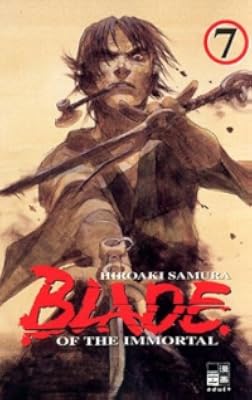
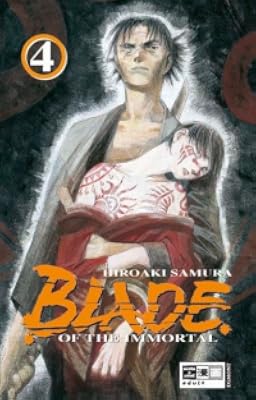
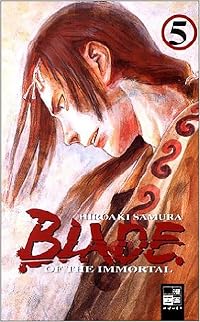
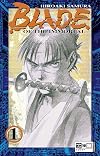
To end his eternal suffering, he must slay one thousand enemies! Manji, a ronin warrior of feudal Japan, has been cursed with immortality. To rid himself of this curse and end his life of misery, he must slay one thousand evil men! His quest begins when a young girl seeks his help in taking revenge on her parents' killers...and his quest won't end until the blood of a thousand has spilled!Tags
Recommendations
Member Recommendations

Member Reviews
This is the ultra-violent but superbly drawn first part of a multiple samurai manga series which first appeared from 1994 in Japan and then was reproduced by Dark Horse Manga in the West from 1997.
The introduction in the Western Edition provides useful background on why Hiroaki Samura's graphic novel of a ronin who must kill a thousand evil men to regain his mortality is important - because of the use of street language within the conventions of the samurai traditions.
The introduction, naturally enough, explains to a Western adolscent audience why the East Asian use of the swastika, an essential part of the identity of the 'hero' Manji is not to be confused with its use by Western national socialists.
As to the graphic design, the show more brutal bloodletting and even semi-perversion (and association of violence with sexual rapacity) will not please those of a gentle disposition but some of the single full page depictions, of a violence that is fast yet stylized, are undoubtedly impressive - the nearest graphic equivalent to the swift motion captured in a samurai movie. This is definitely not 'nice' but it is art. show less
The introduction in the Western Edition provides useful background on why Hiroaki Samura's graphic novel of a ronin who must kill a thousand evil men to regain his mortality is important - because of the use of street language within the conventions of the samurai traditions.
The introduction, naturally enough, explains to a Western adolscent audience why the East Asian use of the swastika, an essential part of the identity of the 'hero' Manji is not to be confused with its use by Western national socialists.
As to the graphic design, the show more brutal bloodletting and even semi-perversion (and association of violence with sexual rapacity) will not please those of a gentle disposition but some of the single full page depictions, of a violence that is fast yet stylized, are undoubtedly impressive - the nearest graphic equivalent to the swift motion captured in a samurai movie. This is definitely not 'nice' but it is art. show less
Well done, I guess, but not really my thing. The details of the cynical antihero's curse of immortality are sort of novel (body parts made out of "blood worms", and the requirement that he find and kill exactly one thousand bad guys) but the fight scenes fall into a predictable pattern: bad guy chops off hero's arms/legs/liver, not realizing he's immortal; bad guy chuckles and turns to go; hero gets up and kills him. Also, samurai intrigue for its own sake (renegades from Sword School X form Sword School Y to wipe out all the other sword schools, etc.) is possibly even sillier than superhero intrigue. The art is lovely, although the very gory violence is stylized in a way that just looks odd to me: for instance, people don't just get show more stabbed or sliced by swords, they get sliced in half effortlessly as if they were made out of Jello. show less
Blade of the Immortal is the very first manga that I've read. I picked it up upon the recommendation of one of my very favorite people at one of my very favorite comic stores. This first collection compiled by Dark Horse consists of the first six issues of the comic series.
Manji is a rather bad-ass samurai who has been cursed with immortality after killing a hundred innocent people at the orders of his boss. He still feels pain, and, given the types of wounds he manages to procure, this can be quite excruciating. In order to repent for his past misdeeds, he makes a deal with the eight-hundred year old nun who infected him with kessen-chū, the sacred bloodworms that keep him alive and heal his wounds: He will kill one thousand evil men, show more and only then will he be allowed to die.
A young girl named Rin is alerted to Manji's existence, and newly formed vow, by the nun. She is the sole survivor of her family's massacre. Her father, a skilled swordsman and leader of a respected dōjō, is slain by a newly instituted rebel school. Seeking revenge, Rin convinces Manji to serve as her bodyguard in her quest.
The art is absolutely fantastic. It is exceptionally violent, extraordinarily graphic, but intensely beautiful and gorgeously penciled. Unfortunately, because of the way comic was adapted for English readers, some of the art is inconsistent (For example, Manji has a bad eye which is sometimes shown on his left side, and sometimes on his right.) The story is at times rather disturbing, but it is not without humor. This first volume makes for a strong introduction and includes a glossary and an interview with the creator. While I'm not quite hooked on the series yet, I'm pretty sure I will be very soon.
Experiments in Reading show less
Manji is a rather bad-ass samurai who has been cursed with immortality after killing a hundred innocent people at the orders of his boss. He still feels pain, and, given the types of wounds he manages to procure, this can be quite excruciating. In order to repent for his past misdeeds, he makes a deal with the eight-hundred year old nun who infected him with kessen-chū, the sacred bloodworms that keep him alive and heal his wounds: He will kill one thousand evil men, show more and only then will he be allowed to die.
A young girl named Rin is alerted to Manji's existence, and newly formed vow, by the nun. She is the sole survivor of her family's massacre. Her father, a skilled swordsman and leader of a respected dōjō, is slain by a newly instituted rebel school. Seeking revenge, Rin convinces Manji to serve as her bodyguard in her quest.
The art is absolutely fantastic. It is exceptionally violent, extraordinarily graphic, but intensely beautiful and gorgeously penciled. Unfortunately, because of the way comic was adapted for English readers, some of the art is inconsistent (For example, Manji has a bad eye which is sometimes shown on his left side, and sometimes on his right.) The story is at times rather disturbing, but it is not without humor. This first volume makes for a strong introduction and includes a glossary and an interview with the creator. While I'm not quite hooked on the series yet, I'm pretty sure I will be very soon.
Experiments in Reading show less
These people--even the protagonists Rin and Manji--are insane and ruthless.
Too little or shallow character motivations and plot holes. Yaobikuni's motivations to give Manji the kessen-chu aren't shown. The question as to what method to use to figure out who the truly evil ones are was completely dropped. It wasn't shown that Sori felt guilty and used the excuse to pay Rin for X because he could've simply taken X.
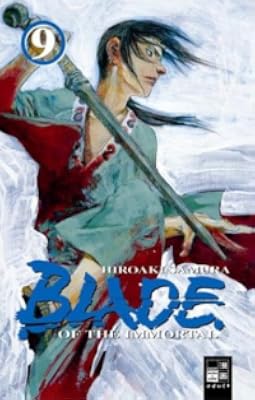
Manji is immortal. This quality has presented fine opportunities with which to train his vast weaponry arsenal, not to mention the regeneration of body parts when necessary. When he meets a Rin, young girl bent on the revenge of her raped and slain family, he allows himself to be hired as her bodyguard in her quest to kill the leader of this vicious band of renegade, lawless non-samurai. An epic tale that takes many twists and turns as we follow these characters through deep friendships and enemyships alike. Action and unprecedented suspense fill this series, and particularly the final installments, as the government captures Manji and attempts to create an army of immortals based on the experiementation of his body.

Re-reading in advance of the Movie coming out in November. There is so much great decapitation. I'd also forgotten how often the idiosyncrasies in the US edition cause Manji's missing eye to switch back and forth.
Meh. Interesting story, but the main character is not that liable. The translation to slang and immoral swearing does not fit the setting very well.
Members
- Recently Added By
Lists
Manga & Comic Read in 2012
10 works; 1 member
Author Information
Some Editions
Awards and Honors
Awards
Notable Lists
Series
Work Relationships
Is contained in
Common Knowledge
- Canonical title
- Blade of the Immortal, Book 01: Blood of a Thousand
- Original title
- 無限の住人 1
- Original publication date
- 1994-09-22
- People/Characters
- Manji; Rin Asano; Kagehisa Anotsu; Sabato Kuro
- Important places
- Japan
- Related movies
- Mugen no Juunin (2008 | IMDb)
- Original language
- Japanese
Classifications
- Genre
- Graphic Novels & Comics
- DDC/MDS
- 741.5952 — Arts & recreation Drawing & decorative arts Drawing Comic books, graphic novels, fotonovelas, cartoons, caricatures, comic strips History, geographic treatment, biography Asian Japanese
- LCC
- PN6790 .J33 .S26613 — Language and Literature Literature (General) Literature (General) Collections of general literature Comic books, strips, etc.
- BISAC
Statistics
- Members
- 581
- Popularity
- 50,444
- Reviews
- 13
- Rating
- (3.92)
- Languages
- 7 — English, French, German, Japanese, Norwegian (Bokmål), Croatian, Spanish
- Media
- Paper, Ebook
- ISBNs
- 16
- UPCs
- 3
- ASINs
- 3