On This Page
Description
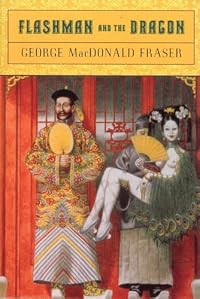
In 1860, while China seethes through the bloodiest civil war in history, and the British and French armies hack their way to the heart of the Forbidden City, Flash Harry hoodwinks them all.Tags
Recommendations






Member Recommendations
Member Reviews
Despite being one of the more taut and focused Flashman adventures, Flashman and the Dragon took a little while to win me over, but by the end I found it as enchanting as any I have read. There's no point going over what I've already said ad nauseam in my other reviews; this eighth book in the series remains as thrilling an adventure, rip-roaring a comedy, rich a story and accurate a history as any of the previous seven. And Flashman is still an absolutely devious scoundrel and magnificent bastard, as Irish Nolan finds out to his cost.
Of these fine qualities, I feel Fraser's historical research warrants the greatest praise. With the possible exception of Flashman and the Great Game, which taught me more about the Indian Mutiny than any show more history book ever could, Flashman and the Dragon is the most illuminating book of the series, bringing to the fore the fascinating events of the Taiping Rebellion. What is doubly valuable about the Flashman books as historical fiction is that they cover less well-known, yet still important, events in history. I knew only a little about the Taiping Rebellion before reading Flashman and the Dragon, yet now I feel I could give a good stab at bluffing my way through Mastermind with it as my chosen topic. Towards the end of the book, there's even an eloquent historical analysis of the looting and destruction of the Summer Palace which manages to be extremely informative and melancholy whilst never losing the general rhythm and tone of the story. By this point, I had the sense that I'd been reading something truly special, even by Fraser's lofty standards.
I think perhaps the reason it took me longer to warm to Dragon's charms was because, in the period Fraser is describing, China was like another planet completely. Consequently, Fraser delights in describing all the various wonders of Imperial China, which slows the pace down a tad and draws attention away from the scoundrel acts of Flashman himself. This is not a criticism as such, for the reader delights in reading it (there are some truly beautiful passages of prose) and we get a real sense of the otherworldly nature of the country as it was in 1860. Elsewhere, I found that the humour was often subtler than in previous instalments; for me, the heartiest chuckles came from little snarky asides in the dialogue rather than the more overt shamelessness of Flash's actions. Overall, Flashman is just an excellent companion; I'd say without a doubt his voice, as wrought by Fraser, is the finest example of first-person prosing there is. It is conversational and amiable, making it accessible, yet allows for the sort of waxing lyrical I allude to above without any of it seeming out of place. I remain, as ever, truly staggered by Fraser's writing and lament that his books are not read more widely. If I had my way, there'd be a permanent statue of Flashman on the Fourth Plinth of Trafalgar Square, with a bevy of lovingly-sculpted stone beauties writhing at his feet. show less
Of these fine qualities, I feel Fraser's historical research warrants the greatest praise. With the possible exception of Flashman and the Great Game, which taught me more about the Indian Mutiny than any show more history book ever could, Flashman and the Dragon is the most illuminating book of the series, bringing to the fore the fascinating events of the Taiping Rebellion. What is doubly valuable about the Flashman books as historical fiction is that they cover less well-known, yet still important, events in history. I knew only a little about the Taiping Rebellion before reading Flashman and the Dragon, yet now I feel I could give a good stab at bluffing my way through Mastermind with it as my chosen topic. Towards the end of the book, there's even an eloquent historical analysis of the looting and destruction of the Summer Palace which manages to be extremely informative and melancholy whilst never losing the general rhythm and tone of the story. By this point, I had the sense that I'd been reading something truly special, even by Fraser's lofty standards.
I think perhaps the reason it took me longer to warm to Dragon's charms was because, in the period Fraser is describing, China was like another planet completely. Consequently, Fraser delights in describing all the various wonders of Imperial China, which slows the pace down a tad and draws attention away from the scoundrel acts of Flashman himself. This is not a criticism as such, for the reader delights in reading it (there are some truly beautiful passages of prose) and we get a real sense of the otherworldly nature of the country as it was in 1860. Elsewhere, I found that the humour was often subtler than in previous instalments; for me, the heartiest chuckles came from little snarky asides in the dialogue rather than the more overt shamelessness of Flash's actions. Overall, Flashman is just an excellent companion; I'd say without a doubt his voice, as wrought by Fraser, is the finest example of first-person prosing there is. It is conversational and amiable, making it accessible, yet allows for the sort of waxing lyrical I allude to above without any of it seeming out of place. I remain, as ever, truly staggered by Fraser's writing and lament that his books are not read more widely. If I had my way, there'd be a permanent statue of Flashman on the Fourth Plinth of Trafalgar Square, with a bevy of lovingly-sculpted stone beauties writhing at his feet. show less
The recent death of George McDonald Fraser has brought a close (maybe permanent, maybe not?) to this delightful series of books. I have had the pleasure of following this series every since the release of the first book back in the sixties. The Flashman novels combine history (including substantial endnotes) with sex, action, adventure and the secret pleasure of enjoying the exploits of one of the most notoriously popular non-politically correct characters of 20th Century literature. Flashman is a womanizer, a coward, a scoundrel and a cheat, but in the novels, which are all narrated by Flashman himself, he is utterly honest with his readers. He is a man not proud of his faults, but certainly unabashed about them.
The Flashman novels show more could be dismissed as sensationalized light reading , but Fraser cleverly tied his character into most of the major events of the last sixty years of the nineteenth century, a Victorian Zelig or Forrest Gump. Flashman casually mentions this minor detail or that simple observation, then Fraser in his assumed role as editor of the Flashman papers meticulously explains in the endnotes how these mentions by Flashman confirm the truth of his narrative, since only if Flashman was there could he have known about this fact or that. Fraser's endnotes also round out the historic details of the narrative, giving background and elaboration to the history-as-I-lived-it tales told by Flashman. It all works wonderfully, even if you somewhat suspect that some details are being outrageously fabricated.
I very strongly recommend these books to anyone who has an interest in history and is willing to keep an open mind towards the womanizing and the language (the n-word appears quite a bit, but completely in character for Flashman). I would suggest the best way to read them is in order of publication. This doesn't follow Flashman's own life chronology, but the books published later often make reference to previous editions of the "Flashman Papers" and so is more fun for the reader to follow. show less
The Flashman novels show more could be dismissed as sensationalized light reading , but Fraser cleverly tied his character into most of the major events of the last sixty years of the nineteenth century, a Victorian Zelig or Forrest Gump. Flashman casually mentions this minor detail or that simple observation, then Fraser in his assumed role as editor of the Flashman papers meticulously explains in the endnotes how these mentions by Flashman confirm the truth of his narrative, since only if Flashman was there could he have known about this fact or that. Fraser's endnotes also round out the historic details of the narrative, giving background and elaboration to the history-as-I-lived-it tales told by Flashman. It all works wonderfully, even if you somewhat suspect that some details are being outrageously fabricated.
I very strongly recommend these books to anyone who has an interest in history and is willing to keep an open mind towards the womanizing and the language (the n-word appears quite a bit, but completely in character for Flashman). I would suggest the best way to read them is in order of publication. This doesn't follow Flashman's own life chronology, but the books published later often make reference to previous editions of the "Flashman Papers" and so is more fun for the reader to follow. show less
Necessary disclaimer: I am a huge fan of the Flashman series and George Macdonald Fraser (check out his McAuslan in the Rough). I've now read eight of the Flashman books (in chronological order 1-4, 7-8, 10 & 12). Nonetheless, I struggled to fully enjoy Flashman and the Dragon - in large part because of its questionable historical accuracy.
Having narrowly escaped personal disaster whilst running 'opium' to Canton, Harry Flashman finds himself unhappily engaged in the British service on a couple of errands as an intelligence officer. First, Harry sails up to Nanking where he meets the leader of the Taiping Rebellion, a Chinese gentleman claiming to be the younger brother of Jesus Christ. Along the way he manages a vigorous romp or two show more with Triad bandit leader Szu-zhan.
After another miraculous escape, Harry heads north with Lord Elgin and the closing chapter of the Second Opium War. Flashy again manages to get himself captured. This time he's imprisoned in the Forbidden City where the Lady Yehonala (better known as the Dragon Lady or Dowager Empress Ci Xi) makes a nocturnal visit - just to have a peek at the barbarian - with predictable results. Harry escapes one final time and arrives back in 'Pekin' in time to witness the final negotiations to end the war and then the release of Harry Parkes as well as the discovery of a number of murdered British prisoners. Elgin decides to burn down the imperial Summer Palace as payback.
All well and good for a typical Flashman tale, but I found myself distracted by the grotesque way in which the book portrays the Chinese and the Manchu. This distraction came not not only from Flashman's 'papers, but also to the end notes. I expect Harry to express broadly, if cynical, pro-British Empire 19th century views, but expect a little more intellectual honesty from Fraser.
The Chinese and Manchu are presented without exception - either singly or in combination - as devious, deceitful, sexual deviants, weak, opium-addled, and immune to normal human feelings of honor and shame. While the story does hit many of the historical highlights, the record is so grossly distorted that the reader will be forgiven for not recognizing that the Second Opium War was started by the British on a pretext in order to open yet more Chinese ports to more foreign trade, including the importation of opium, and otherwise extend its influence.
The burning of the Summer Palace is presented as an act of British restraint. The reader would never guess that the propriety of this act was hotly disputed between Gladstone and Palmserton and derided by Victor Hugo (not to mention the Chinese and Manchu reaction). Lady Yehonala is falsely portrayed as a wanton sex- and opium-fiend. According to the end notes, Fraser based his story in part on the thoroughly discredited forger and con man Edmund Backhouse. See Hugh Trevor-Roper's Hermit of Peking: The Hidden Life of Sir Edmund Backhouse (History & Politics) and Sterling Seagrave's Dragon Lady: The Life and Legend of the Last Empress of China (published after Flashman).
Learning history from Harry Flashman should be undertaken with great care. Perhaps the better approach is to avoid taking the history too seriously and read them for the pro-imperial but humorous tales of the delightfully detestable Flashy. Flashman and the Dragon is best read as an entertaining period piece reflecting the prejudices of an earlier era. show less
Having narrowly escaped personal disaster whilst running 'opium' to Canton, Harry Flashman finds himself unhappily engaged in the British service on a couple of errands as an intelligence officer. First, Harry sails up to Nanking where he meets the leader of the Taiping Rebellion, a Chinese gentleman claiming to be the younger brother of Jesus Christ. Along the way he manages a vigorous romp or two show more with Triad bandit leader Szu-zhan.
After another miraculous escape, Harry heads north with Lord Elgin and the closing chapter of the Second Opium War. Flashy again manages to get himself captured. This time he's imprisoned in the Forbidden City where the Lady Yehonala (better known as the Dragon Lady or Dowager Empress Ci Xi) makes a nocturnal visit - just to have a peek at the barbarian - with predictable results. Harry escapes one final time and arrives back in 'Pekin' in time to witness the final negotiations to end the war and then the release of Harry Parkes as well as the discovery of a number of murdered British prisoners. Elgin decides to burn down the imperial Summer Palace as payback.
All well and good for a typical Flashman tale, but I found myself distracted by the grotesque way in which the book portrays the Chinese and the Manchu. This distraction came not not only from Flashman's 'papers, but also to the end notes. I expect Harry to express broadly, if cynical, pro-British Empire 19th century views, but expect a little more intellectual honesty from Fraser.
The Chinese and Manchu are presented without exception - either singly or in combination - as devious, deceitful, sexual deviants, weak, opium-addled, and immune to normal human feelings of honor and shame. While the story does hit many of the historical highlights, the record is so grossly distorted that the reader will be forgiven for not recognizing that the Second Opium War was started by the British on a pretext in order to open yet more Chinese ports to more foreign trade, including the importation of opium, and otherwise extend its influence.
The burning of the Summer Palace is presented as an act of British restraint. The reader would never guess that the propriety of this act was hotly disputed between Gladstone and Palmserton and derided by Victor Hugo (not to mention the Chinese and Manchu reaction). Lady Yehonala is falsely portrayed as a wanton sex- and opium-fiend. According to the end notes, Fraser based his story in part on the thoroughly discredited forger and con man Edmund Backhouse. See Hugh Trevor-Roper's Hermit of Peking: The Hidden Life of Sir Edmund Backhouse (History & Politics) and Sterling Seagrave's Dragon Lady: The Life and Legend of the Last Empress of China (published after Flashman).
Learning history from Harry Flashman should be undertaken with great care. Perhaps the better approach is to avoid taking the history too seriously and read them for the pro-imperial but humorous tales of the delightfully detestable Flashy. Flashman and the Dragon is best read as an entertaining period piece reflecting the prejudices of an earlier era. show less
Our intrepid hero, Harry Flashman, is back for volume eight of the Flashman Papers, a narrative of the life and times of one of the most ne’er-do-well wastrels to ever grace the pages of a published autobiography.
The first five Flashman novels were presented in chronological order. This “packet”, like its two immediate predecessors, acts to fill in a previous “gap” in the Flashman timeline. From a chronological standpoint, the adventures of this novel immediately follow those contained in Flashman and the Great Game, wherein we left Flashman in the wake of heroic deeds committed in the course of quelling the great Indian Mutiny. After a brief stint in British occupied Hong Kong, Harry believes himself to be on the verge of a show more return to merry old England and the bosom of his lovely wife Elspeth, only to be drafted into further military service as an intelligence officer in the service of a dangerous diplomatic adventure.
As in the previous Flashman novels, our Harry is revealed as the premier coward and opportunist of his era; faults which he quite willingly admits and even boasts of. Much as a prior day Forrest Gump, he has a way of finding himself among the most powerful and famous personages of his era, as he takes part in the great events of the period, in this case, first hand experience in the Taiping Rebellion and Opium Wars of the mid-19th century, including an audience with the Chinese Emperor.
Aside from uproarious fun and games, the Flashman series is set against historical events and actually serves as an educational experience. On to volume nine of the Flashman Papers. show less
The first five Flashman novels were presented in chronological order. This “packet”, like its two immediate predecessors, acts to fill in a previous “gap” in the Flashman timeline. From a chronological standpoint, the adventures of this novel immediately follow those contained in Flashman and the Great Game, wherein we left Flashman in the wake of heroic deeds committed in the course of quelling the great Indian Mutiny. After a brief stint in British occupied Hong Kong, Harry believes himself to be on the verge of a show more return to merry old England and the bosom of his lovely wife Elspeth, only to be drafted into further military service as an intelligence officer in the service of a dangerous diplomatic adventure.
As in the previous Flashman novels, our Harry is revealed as the premier coward and opportunist of his era; faults which he quite willingly admits and even boasts of. Much as a prior day Forrest Gump, he has a way of finding himself among the most powerful and famous personages of his era, as he takes part in the great events of the period, in this case, first hand experience in the Taiping Rebellion and Opium Wars of the mid-19th century, including an audience with the Chinese Emperor.
Aside from uproarious fun and games, the Flashman series is set against historical events and actually serves as an educational experience. On to volume nine of the Flashman Papers. show less
Flashman in China; interesting for giving a serious defense of the decision to loot and destroy the Summer Palace (as an appropriate punishment for torturing to death British captives --it was felt this wold hurt the Chinese more than simply executing the Chjinese officials who had ordeed the killings); it also has an encounter with the imperial concubine who would live to become the Dowager Empress "Old Buddha" Yehonala
As always, the Flashman books are class publications. Flashman himself is an entertaining protagonist and his historical perspectives are highly informative.
I did find the frequency with which he was captured degraded my enjoyment of the tale. The descriptions of torture and degradation were informative, but made for less enjoyable reading.
Overall, well worth continuing with the rest of the series, but I don’t need to retain or revisit this particular story.
I did find the frequency with which he was captured degraded my enjoyment of the tale. The descriptions of torture and degradation were informative, but made for less enjoyable reading.
Overall, well worth continuing with the rest of the series, but I don’t need to retain or revisit this particular story.
I Don't Like Flashman, and Yet I Keep Coming Back
"Flashman and the Dragon" is in the same vain of the rest of George MacDonald Fraser's Flashman books. The reader who has enjoyed Flashman in the past will certainly enjoy following Flashman on his journey through China, hacking and flubbing his way through the Taiping Rebellion. Like many of our favorite British heroes, Flashman also enjoys his fair share of women during his adventures.
I don't know what it is that attracts me to the Flashman books. For me, they are a chore to read. The paragraphs drag on, geography is never fully fleshed out, and the character himself is an absolute reprobate. He is sexist and racist and incredibly unlikeable. Nevertheless, I've plowed my way through show more three of his adventures by now. I really can't put my finger on what I like about it. Any body care to help me? show less
"Flashman and the Dragon" is in the same vain of the rest of George MacDonald Fraser's Flashman books. The reader who has enjoyed Flashman in the past will certainly enjoy following Flashman on his journey through China, hacking and flubbing his way through the Taiping Rebellion. Like many of our favorite British heroes, Flashman also enjoys his fair share of women during his adventures.
I don't know what it is that attracts me to the Flashman books. For me, they are a chore to read. The paragraphs drag on, geography is never fully fleshed out, and the character himself is an absolute reprobate. He is sexist and racist and incredibly unlikeable. Nevertheless, I've plowed my way through show more three of his adventures by now. I really can't put my finger on what I like about it. Any body care to help me? show less
Members
- Recently Added By
Published Reviews
ThingScore 100
With this episode, he is whirled up in the hellish carnage of the Taiping Revolt. In this, the bloodiest civil war in human history, China convulsed itself in an attempt to throw off the "foreign devils." Great Britain's prized opium trade -- the greatest narcotics scandal of all time -- was at stake. Human life was not so much cheap as barely reckoned at all. Flashman goes through the whole show more blood-bolted affair with his bowels like water, but he never loses his faculty for description...
There is a chapter in this book which I would select from a strong field as being exemplary. It recounts Lord Elgin's decision in 1860 to raze the SummerPalace at Peking, and it depicts the manner in which the order was carried out. The SummerPalace was not just a building. It was a gorgeous landscaped park of over 200 temples and great houses. Contemporary accounts of it and its contents show it to have been the summit of Manchu taste and civilization, perhaps unequalled in history. The pages which describe the actual desecration -- while Elgin read Darwin and Trollope in his tent -- are vivid, moving and awful. They promote Fraser well out of the thriller class and into the ranks of historical novelists. show less
There is a chapter in this book which I would select from a strong field as being exemplary. It recounts Lord Elgin's decision in 1860 to raze the SummerPalace at Peking, and it depicts the manner in which the order was carried out. The SummerPalace was not just a building. It was a gorgeous landscaped park of over 200 temples and great houses. Contemporary accounts of it and its contents show it to have been the summit of Manchu taste and civilization, perhaps unequalled in history. The pages which describe the actual desecration -- while Elgin read Darwin and Trollope in his tent -- are vivid, moving and awful. They promote Fraser well out of the thriller class and into the ranks of historical novelists. show less
added by SnootyBaronet
Lists

Historical Fiction
889 works; 90 members
Author Information

48+ Works 19,651 Members
Author George MacDonald Fraser was born April 2, 1925 in Carlisle. He was refused entrance to the medical faculty of Glasgow University, so he joined the army in 1943. He served as an infantryman with the 17th Indian Division of the XIVth Army in Burma, a lance corporal and was commissioned in the Gordon Highlanders. After the war, he became a show more sports reporter with the Carlisle Journal; and during this time, he met and married Kathleen Hetherington, a reporter from another paper. He worked as a reporter and sub-editor on the Cumberland News and then moved to Glasgow, in 1953, where he worked at the Glasgow Herald as a features editor and deputy editor. Fraser's first novel was "Flashman" (1969), which was followed by nine sequels, so far, that deal with different venues of the 19th century ranging from Russia, Borneo and China to the Great Plains of the America West. Some of the other titles in the Flashman Papers are "Royal Flash" (1970), "Flashman in the Great Game" (1975), "Flashman and the Redskins" (1982), and "Flashman and the Angel of the Lord" (1994). Some of his non-fiction work includes "The Steel Bonnets" (1971), which is a factual study of the Anglo-Scottish border thieves in the seventeenth century, and "Quartered Safe Out Here" (1992). Fraser has also written a number of screenplays that include "The Three Musketeers" (1973), "Royal Flash" (1975), "Octopussy" (1983), and "Return of the Musketeers" (1989). He has also written a series of short stories about Private McAuslan whose titles include "The General Danced at Dawn" (1970), "McAuslan in the Rough" (1974), and "The Sheik and the Dustbin and other McAuslan Stories" (1988). He died of cancer on January 2, 2008. (Bowker Author Biography) show less
Some Editions
Series

Work Relationships
Is contained in
Flashman Series 11 Books /Royal Flash/Flashman/Flashmans Lady the Great Game/At the Charge/Flash for Freedom/Angel of the Lord/Redskins/The Dragon/The Tiger/Mountain Light by George MacDonald Fraser
Common Knowledge
- Canonical title
- Flashman and the Dragon
- Original title
- Flashman and the Dragon
- Original publication date
- 1985
- People/Characters
- Harry Paget Flashman; Mrs. Phoebe Carpenter; Fred T. Ward; Midshipman Jack Fisher, RN; Harry Parkes, Esq., H.M. Commissioner at Canton; An-yet-heh (show all 18); Sir James Hope Grant; Szu-Shan; Lee Hsiu-Chen; Hung Jen-kan; Hung Hsiu-Chuan; Lord Elgin; Prince I; Sang-kol-in-sen; Yehonala Tzu-Hsi, Imperial Concubine Yi; Garnet Wolseley (Garnet Joseph Wolseley); Charles George Gordon; Frederick Townsend Ward
- Important places
- China; Hong Kong; Canton, China; Shanghai, China; Nanking, China; Peking, China
- Important events
- Taiping Rebellion
- Dedication
- For Ka't-lin
a memento of the Pearl River and Tuah Bee - First words
- It is now twenty years since the Flashman Papers, the memoirs of the notorious Rugby School bully who became a Victorian hero, were found in a Leicestershire saleroom. (Explanatory Note)
Old Professor Flashy's fir... (show all)st law of economics is that the time to beware of a pretty woman is not when you're flush of cash (well, you know what she's after, and what's a bankroll more or less?), but when you're short of the scratch, and she offers to set you right. - Quotations
- When the guns haven't come up, and your cavalry's checked by close country or tutti-putti, and you're waiting in the hot, dusty hush for the faint rumble of impi or harka over the skyline and know they're twenty to your one -... (show all)- well, that's when you realize that it all hangs on that double line of yokels and town scruff with their fifty rounds a man and an Enfield bayonet. Kitchener himself may have placed 'em just so, with D'Israeli's sanction, The Times' blessing, and the Queen waving 'em good-bye -- but now it's their grip on the stock, and their eye on the backsight, and if they break, you're done. Haven't I stood shivering behind 'em often enough, wishing I could steal a horse from somewhere?
- Last words
- (Click to show. Warning: May contain spoilers.)"Enjoying your drink?"
[With words apparently failing their author for once, the eighth packet of the Flashman Papers ends here.] - Original language
- English UK
Classifications
Statistics
- Members
- 999
- Popularity
- 26,026
- Reviews
- 14
- Rating
- (3.95)
- Languages
- Danish, English, German, Spanish
- Media
- Paper, Audiobook, Ebook
- ISBNs
- 21
- ASINs
- 14