On This Page
Description
Fiction. Thriller. Historical Fiction. Humor (Fiction.) HTML:“Hilariously funny.”—The New York Times Book Review“Great dirty fun!”—Grand Rapids Press
“The most entertaining anti-hero in a long time… Moves from one ribald and deliciously corrupt episode to the next… Wonderful and scandalous.”—Publishers Weekly
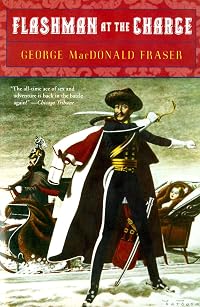
The fourth volume of memoirs in which Harry Flashman confronts destiny with Lord Cardigan and the Light Brigade. Part of the Flashman series, show more comprising Flashman, Royal Flash, and Flash for Freedom, among others, which explores the successful though scandalous later career of the bully in Tom Brown's School Days.. show less
Tags
Recommendations






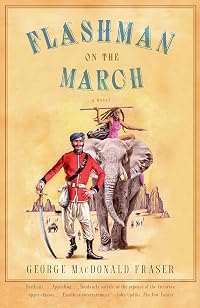
Member Recommendations

Stepn Absorbing and amusing.
Member Reviews
Here I was again, with my essentials trapped in the mangle, and devil a thing to do but grin and bear it." (pg. 288).
Flashman at the Charge, the fourth novel of the Flashman Papers, is perhaps the best in the series since the first, 1969's Flashman. This is in large part because, of the four books I have so far read, it is the one which is most similar to that uproariously entertaining debut.
As much as I loved Royal Flash and Flash for Freedom!, the second and third books respectively, I often thought our lovable old Flashy was not able to cut loose as much as he was in his romps through India and Afghanistan in the first book and now, one can add, through Central Asia in the fourth book. In the second and third books, he was often in show more thrall to one force or another (Bismarck and his minions in Royal Flash, the slavers in Flash for Freedom!) and had to keep his head down. Of course, Flashy needs no incentive to keep his head down, and both Flashman and Flashman at the Charge have him, at various points, in chains and/or at the mercy of some bloodthirsty savages or in some other sticky situation. But the essential quality is that in these latter two books I've mentioned, Flashman is trying to keep up appearances, rather than, as in the other two books, operating under a pseudonym.
You see, in the first book, the whole joke was that no matter how cowardly or selfish Flashman behaved, he always emerged to be (wrongly) thought of as a hero and upstanding gentleman. And it is this quality which Flashman at the Charge returns to, as we begin in 1854 with Flashman trying to avoid being posted to the Crimea, where war with Russia is about to break out. Flashman, because of his heroics in the first book, is seen by the British public and the establishment as 'the Hector of Afghanistan' (pg. 41), and Flash ruefully notes that "one of the difficulties of being a popular hero... is that it's difficult to wriggle out of sight when the bugle blows." (pg. 12). Consequently, he is bundled off to the Crimea (after an entertaining back-and-forth with his one-of-a-kind wife, Elspeth) and takes part (most reluctantly, fans of the Flashman Papers will no doubt understand) in the Battle of Balaclava. He is involved in the three most well-known engagements of this battle - the Thin Red Line, the Charge of the Heavy Brigade and the Charge of the Light Brigade - and comes through with 'new laurels', as he puts it on page 104, despite trying throughout to shamelessly wriggle, cheat and lie his way out of any sort of active participation.
It is here in the Crimea that the novel's strong historical authenticity and research (one of the Flashman Papers' most under-appreciated qualities) is most prevalent, and author George MacDonald Fraser, an avid historian, has a lot to say on the Crimean War and on the Battle of Balaclava - particularly that infamous engagement in Tennyson's 'valley of death'. He also, in footnote 41, has some rather interesting stuff to say about Russian imperialism and how, in contrast to 'the much-abused Western colonial powers', that country still holds an 'iron grip' on its colonies. Fraser was referring to the Cold War-era USSR but it is a salient point even today in 2014, 41 years after Fraser wrote it and 160 years after the story is set. As I write this, the wreckage of Flight MH17 is still strewn over the sunflower fields of the eastern Ukraine, an unfortunate consequence of Russia's attempts to strong-arm the Ukrainians in the Crimea. This is the immediacy of history which is not often understood by people who aren't quite as enamoured with the subject as I am: Fraser could draw parallels between events in his day and in Flashman's day, and I can draw parallels between their days and mine.
But, as Flashman himself suggests on page 60, the book is not about the war but about him; the Crimea is, "as far as my Russian adventure is concerned... really just an unpleasant prelude." (pg. 136). For you see, Flashman's acts at Balaclava lead him through Russia and Central Asia and, whilst I won't spoil any plot developments here, this is the most entertaining part of the novel. Flashman on the frontier, in the wild, engaging with tribes and trying to save his own sorry hide while ensuring others have theirs skinned: this is where the best qualities of the first Flashman were to be found, and Flashman at the Charge returns to this for another bountiful harvest. In the later chapters of Flashman at the Charge, old Flashy is at his most shameless yet, which of course is a riot to read. The whole bit with Valla in the sled is Flashman at his most knavish best (sleep tight, Valla!), and the bits where Flash deadpans that wolves don't eat bread (they don't even look at it, you know) and notes the use of a kitten as a pimp had me crying with laughter. It is always entertaining when you're with Flashman (just ask poor Willy, who got his arse painted black), and Flashman at the Charge has him at his shameless and roguish best. It is fully in keeping with Flash's earlier memoirs, "as fine a record of knavery, cowardice and fleeing for cover as you'll find outside the covers of Hansard." (pp11-12).
Put simply, if you've enjoyed the Flashman Papers so far, you'll love Flashman at the Charge. Flashy's shamelessness never ceases to astound and by the fourth book the Flashman universe has been developed to a sufficient extent to allow for knowing and winking references to previous books - yet another reward for readers who have already been amply rewarded for their time with another great read. And whilst by this point readers can discern certain elements of a story which Fraser always uses - a Flashman formula, if you will - there's nothing wrong with that. There's nothing wrong with sticking to a formula if what you are making is pure gold.
"You may think it strange, knowing me, that even in the hellish mess I found myself, with the shadow of horrible death hanging over me, I could think ahead so clearly. Well, it wasn't that I'd grown any braver as I got older - the reverse, if anything - but I'd learned, since my early days, that there's no point in wasting your wits and digestion blubbering over evil luck and folly and lost opportunities. I'll admit, when I thought how close I'd been to winning clear, I could have torn my hair - but there it was. However fearful my present predicament, however horrid the odds and dangers ahead, they'd get no better with being fretted over. It ain't always easy, if your knees knock as hard as mine, but you must remember the golden rule: when the game's going against you, stay calm - and cheat." (pp232-3).
(Addendum:- I'm putting this here because I don't know where to fit it in the above review without disrupting the flow. I just want to point out that whilst Flashman is a shameless sexist and racist, Fraser's characters are not sexist or racist caricatures. His women and his non-white characters (and his white ones, for that matter) are all well-drawn, fully-realised characters. One passage which stood out for me was on pages 268-9, where Flashman suggests that three diverse characters he has met over the course of the book - a British cavalry officer, a Russian count and a Central Asian bandit/rebel - are very similar and "would have got on like a house on fire." I mention this because the Flashman books can be a hard sell sometimes because they occasionally seem to revel in the sexism and racism, and this was one of the things I felt uncomfortable about when reading the first Flashman book. The passage cited above shows that there's more to it than meets the eye. In Flashman's world, everyone's a bastard, regardless of sex or skin colour.)" show less
Flashman at the Charge, the fourth novel of the Flashman Papers, is perhaps the best in the series since the first, 1969's Flashman. This is in large part because, of the four books I have so far read, it is the one which is most similar to that uproariously entertaining debut.
As much as I loved Royal Flash and Flash for Freedom!, the second and third books respectively, I often thought our lovable old Flashy was not able to cut loose as much as he was in his romps through India and Afghanistan in the first book and now, one can add, through Central Asia in the fourth book. In the second and third books, he was often in show more thrall to one force or another (Bismarck and his minions in Royal Flash, the slavers in Flash for Freedom!) and had to keep his head down. Of course, Flashy needs no incentive to keep his head down, and both Flashman and Flashman at the Charge have him, at various points, in chains and/or at the mercy of some bloodthirsty savages or in some other sticky situation. But the essential quality is that in these latter two books I've mentioned, Flashman is trying to keep up appearances, rather than, as in the other two books, operating under a pseudonym.
You see, in the first book, the whole joke was that no matter how cowardly or selfish Flashman behaved, he always emerged to be (wrongly) thought of as a hero and upstanding gentleman. And it is this quality which Flashman at the Charge returns to, as we begin in 1854 with Flashman trying to avoid being posted to the Crimea, where war with Russia is about to break out. Flashman, because of his heroics in the first book, is seen by the British public and the establishment as 'the Hector of Afghanistan' (pg. 41), and Flash ruefully notes that "one of the difficulties of being a popular hero... is that it's difficult to wriggle out of sight when the bugle blows." (pg. 12). Consequently, he is bundled off to the Crimea (after an entertaining back-and-forth with his one-of-a-kind wife, Elspeth) and takes part (most reluctantly, fans of the Flashman Papers will no doubt understand) in the Battle of Balaclava. He is involved in the three most well-known engagements of this battle - the Thin Red Line, the Charge of the Heavy Brigade and the Charge of the Light Brigade - and comes through with 'new laurels', as he puts it on page 104, despite trying throughout to shamelessly wriggle, cheat and lie his way out of any sort of active participation.
It is here in the Crimea that the novel's strong historical authenticity and research (one of the Flashman Papers' most under-appreciated qualities) is most prevalent, and author George MacDonald Fraser, an avid historian, has a lot to say on the Crimean War and on the Battle of Balaclava - particularly that infamous engagement in Tennyson's 'valley of death'. He also, in footnote 41, has some rather interesting stuff to say about Russian imperialism and how, in contrast to 'the much-abused Western colonial powers', that country still holds an 'iron grip' on its colonies. Fraser was referring to the Cold War-era USSR but it is a salient point even today in 2014, 41 years after Fraser wrote it and 160 years after the story is set. As I write this, the wreckage of Flight MH17 is still strewn over the sunflower fields of the eastern Ukraine, an unfortunate consequence of Russia's attempts to strong-arm the Ukrainians in the Crimea. This is the immediacy of history which is not often understood by people who aren't quite as enamoured with the subject as I am: Fraser could draw parallels between events in his day and in Flashman's day, and I can draw parallels between their days and mine.
But, as Flashman himself suggests on page 60, the book is not about the war but about him; the Crimea is, "as far as my Russian adventure is concerned... really just an unpleasant prelude." (pg. 136). For you see, Flashman's acts at Balaclava lead him through Russia and Central Asia and, whilst I won't spoil any plot developments here, this is the most entertaining part of the novel. Flashman on the frontier, in the wild, engaging with tribes and trying to save his own sorry hide while ensuring others have theirs skinned: this is where the best qualities of the first Flashman were to be found, and Flashman at the Charge returns to this for another bountiful harvest. In the later chapters of Flashman at the Charge, old Flashy is at his most shameless yet, which of course is a riot to read. The whole bit with Valla in the sled is Flashman at his most knavish best (sleep tight, Valla!), and the bits where Flash deadpans that wolves don't eat bread (they don't even look at it, you know) and notes the use of a kitten as a pimp had me crying with laughter. It is always entertaining when you're with Flashman (just ask poor Willy, who got his arse painted black), and Flashman at the Charge has him at his shameless and roguish best. It is fully in keeping with Flash's earlier memoirs, "as fine a record of knavery, cowardice and fleeing for cover as you'll find outside the covers of Hansard." (pp11-12).
Put simply, if you've enjoyed the Flashman Papers so far, you'll love Flashman at the Charge. Flashy's shamelessness never ceases to astound and by the fourth book the Flashman universe has been developed to a sufficient extent to allow for knowing and winking references to previous books - yet another reward for readers who have already been amply rewarded for their time with another great read. And whilst by this point readers can discern certain elements of a story which Fraser always uses - a Flashman formula, if you will - there's nothing wrong with that. There's nothing wrong with sticking to a formula if what you are making is pure gold.
"You may think it strange, knowing me, that even in the hellish mess I found myself, with the shadow of horrible death hanging over me, I could think ahead so clearly. Well, it wasn't that I'd grown any braver as I got older - the reverse, if anything - but I'd learned, since my early days, that there's no point in wasting your wits and digestion blubbering over evil luck and folly and lost opportunities. I'll admit, when I thought how close I'd been to winning clear, I could have torn my hair - but there it was. However fearful my present predicament, however horrid the odds and dangers ahead, they'd get no better with being fretted over. It ain't always easy, if your knees knock as hard as mine, but you must remember the golden rule: when the game's going against you, stay calm - and cheat." (pp232-3).
(Addendum:- I'm putting this here because I don't know where to fit it in the above review without disrupting the flow. I just want to point out that whilst Flashman is a shameless sexist and racist, Fraser's characters are not sexist or racist caricatures. His women and his non-white characters (and his white ones, for that matter) are all well-drawn, fully-realised characters. One passage which stood out for me was on pages 268-9, where Flashman suggests that three diverse characters he has met over the course of the book - a British cavalry officer, a Russian count and a Central Asian bandit/rebel - are very similar and "would have got on like a house on fire." I mention this because the Flashman books can be a hard sell sometimes because they occasionally seem to revel in the sexism and racism, and this was one of the things I felt uncomfortable about when reading the first Flashman book. The passage cited above shows that there's more to it than meets the eye. In Flashman's world, everyone's a bastard, regardless of sex or skin colour.)" show less
The recent death of George McDonald Fraser has brought a close (maybe permanent, maybe not?) to this delightful series of books. I have had the pleasure of following this series every since the release of the first book back in the sixties. The Flashman novels combine history (including substantial endnotes) with sex, action, adventure and the secret pleasure of enjoying the exploits of one of the most notoriously popular non-politically correct characters of 20th Century literature. Flashman is a womanizer, a coward, a scoundrel and a cheat, but in the novels, which are all narrated by Flashman himself, he is utterly honest with his readers. He is a man not proud of his faults, but certainly unabashed about them.
The Flashman novels show more could be dismissed as sensationalized light reading , but Fraser cleverly tied his character into most of the major events of the last sixty years of the nineteenth century, a Victorian Zelig or Forrest Gump. Flashman casually mentions this minor detail or that simple observation, then Fraser in his assumed role as editor of the Flashman papers meticulously explains in the endnotes how these mentions by Flashman confirm the truth of his narrative, since only if Flashman was there could he have known about this fact or that. Fraser's endnotes also round out the historic details of the narrative, giving background and elaboration to the history-as-I-lived-it tales told by Flashman. It all works wonderfully, even if you somewhat suspect that some details are being outrageously fabricated.
I very strongly recommend these books to anyone who has an interest in history and is willing to keep an open mind towards the womanizing and the language (the n-word appears quite a bit, but completely in character for Flashman). I would suggest the best way to read them is in order of publication. This doesn't follow Flashman's own life chronology, but the books published later often make reference to previous editions of the "Flashman Papers" and so is more fun for the reader to follow. show less
The Flashman novels show more could be dismissed as sensationalized light reading , but Fraser cleverly tied his character into most of the major events of the last sixty years of the nineteenth century, a Victorian Zelig or Forrest Gump. Flashman casually mentions this minor detail or that simple observation, then Fraser in his assumed role as editor of the Flashman papers meticulously explains in the endnotes how these mentions by Flashman confirm the truth of his narrative, since only if Flashman was there could he have known about this fact or that. Fraser's endnotes also round out the historic details of the narrative, giving background and elaboration to the history-as-I-lived-it tales told by Flashman. It all works wonderfully, even if you somewhat suspect that some details are being outrageously fabricated.
I very strongly recommend these books to anyone who has an interest in history and is willing to keep an open mind towards the womanizing and the language (the n-word appears quite a bit, but completely in character for Flashman). I would suggest the best way to read them is in order of publication. This doesn't follow Flashman's own life chronology, but the books published later often make reference to previous editions of the "Flashman Papers" and so is more fun for the reader to follow. show less
Our intrepid hero, Harry Flashman, is back for volume four of the Flashman Papers, a narrative of the life and times of one of the most ne’er-do-well wastrels to ever grace the pages of a published autobiography.
This installment picks up where the third volume left off; Flashman is comfortably ensconced in London society with his beautiful vacuous (and wealthy) wife Elspeth. He has structured a plan to avoid the increasing threat of hostilities between England and Russia by arranging for assignment in the Ordnance department, a largely administrative staffing.
Unfortunately, our intrepid hero has come to the attention of his superiors and largely on the strength of his Kabul fame (see the original Flashman) been assigned as military show more tutor to one of the Queen’s own nephews, an assignment that requires his attendance in the Crimean theater, with predictably disastrous consequences.
As in the previous Flashman novels, our Harry is revealed as the premier coward and opportunist of his era; faults which he quite willingly admits and even boasts of. Much as a prior day Forrest Gump, he has a way of finding himself among the most powerful and famous personages of his era, as he takes part in the great events of the period, in this instance, the infamous Charge of the Light Brigade. From Flash:
“You know, the advantage to being a wicked bastard is that everyone pesters the Lord on your behalf; if volume of prayers from my saintly enemies means anything, I’ll be saved when the Archbishop of Canterbury is damned. It’s a comforting thought.”
From the disaster at Balaclava, Flashy is propelled through seemingly nonstop adventure, first as a Russian prisoner of war, and then, upon escape, as a brother in arms among the barbarian hordes of the Russian steppes. Uproariously funny and entertaining, this installment is every bit the equal of its predecessors. show less
This installment picks up where the third volume left off; Flashman is comfortably ensconced in London society with his beautiful vacuous (and wealthy) wife Elspeth. He has structured a plan to avoid the increasing threat of hostilities between England and Russia by arranging for assignment in the Ordnance department, a largely administrative staffing.
Unfortunately, our intrepid hero has come to the attention of his superiors and largely on the strength of his Kabul fame (see the original Flashman) been assigned as military show more tutor to one of the Queen’s own nephews, an assignment that requires his attendance in the Crimean theater, with predictably disastrous consequences.
As in the previous Flashman novels, our Harry is revealed as the premier coward and opportunist of his era; faults which he quite willingly admits and even boasts of. Much as a prior day Forrest Gump, he has a way of finding himself among the most powerful and famous personages of his era, as he takes part in the great events of the period, in this instance, the infamous Charge of the Light Brigade. From Flash:
“You know, the advantage to being a wicked bastard is that everyone pesters the Lord on your behalf; if volume of prayers from my saintly enemies means anything, I’ll be saved when the Archbishop of Canterbury is damned. It’s a comforting thought.”
From the disaster at Balaclava, Flashy is propelled through seemingly nonstop adventure, first as a Russian prisoner of war, and then, upon escape, as a brother in arms among the barbarian hordes of the Russian steppes. Uproariously funny and entertaining, this installment is every bit the equal of its predecessors. show less
Our favorite coward Harry Flashman manages to survive the Charge of the Light Brigade, imprisonment, escape and several more battles to save the British Empire, all the while coming across as a hero despite his best efforts to be otherwise. Confirming, at last, that he is a cuckold, he doesn't neglect the ladies from England to Russia to Afghanistan. Don't ever go for a sleigh ride with him.
Another adventure of coward and cad Flashman, now a colonel. He takes part (by mistake) in one of the most famous military incidents of all time, the Charge of the Light Brigade. Subsequently captured, he accidentally saves the Empire from the Russians.
Discovering Flashman has been my highlight for 2010.
Fraser’s skills as a novelist and historian is such that he created a character who remains ultimately likeable, despite his treatment of women. There have been many such men in life – why not in art?
Flashman’s account of the charge of the Light Brigade, and the bungling of the Crimean episode is entirely plausible. His portrait of Russia and her people is entirely grim and cruel, but perhaps understandably coloured by his long imprisonment and experiences in that country. On his return to more familiar territory in Afghanistan, we see Flashy take on the hero’s role with uncharacteristic willingness.
Fraser’s skills as a novelist and historian is such that he created a character who remains ultimately likeable, despite his treatment of women. There have been many such men in life – why not in art?
Flashman’s account of the charge of the Light Brigade, and the bungling of the Crimean episode is entirely plausible. His portrait of Russia and her people is entirely grim and cruel, but perhaps understandably coloured by his long imprisonment and experiences in that country. On his return to more familiar territory in Afghanistan, we see Flashy take on the hero’s role with uncharacteristic willingness.
In the fourth installment the year is now 1854 and this time Flashy has been appointed as special guardian to Prince William of Celle during the Crimean War. His son, Harry Albert Victor (aka "Havvy") is five years old. I don't think I am giving anything away when I say Flashman is taken prisoner and makes an interesting deal with his captor. The outcome of that deal is not revealed in Flashman at the Charge. Maybe in the next installment?
George MacDonald Fraser calls himself the "editor" of this packet of papers and admits he only corrected spelling and added necessary footnotes (and there are a lot of them, as always). I have to admit, I'm still not used to the downright silliness of Fraser's writing. Case in point - in the heat of show more battle Flashman has gas, "I remember, my stomach was asserting itself again, and I rode yelling with panic and farting furiously at the same time" (p 105). What I liked the best about this set of papers is that there is someone who sees through Flashman's cowardice (finally!). show less
George MacDonald Fraser calls himself the "editor" of this packet of papers and admits he only corrected spelling and added necessary footnotes (and there are a lot of them, as always). I have to admit, I'm still not used to the downright silliness of Fraser's writing. Case in point - in the heat of show more battle Flashman has gas, "I remember, my stomach was asserting itself again, and I rode yelling with panic and farting furiously at the same time" (p 105). What I liked the best about this set of papers is that there is someone who sees through Flashman's cowardice (finally!). show less
Members
- Recently Added By
Lists

Historical Fiction
889 works; 91 members

A Good Read (Radio 4)
287 works; 1 member

THE WAR ROOM
813 works; 24 members
Author Information

48+ Works 19,721 Members
Author George MacDonald Fraser was born April 2, 1925 in Carlisle. He was refused entrance to the medical faculty of Glasgow University, so he joined the army in 1943. He served as an infantryman with the 17th Indian Division of the XIVth Army in Burma, a lance corporal and was commissioned in the Gordon Highlanders. After the war, he became a show more sports reporter with the Carlisle Journal; and during this time, he met and married Kathleen Hetherington, a reporter from another paper. He worked as a reporter and sub-editor on the Cumberland News and then moved to Glasgow, in 1953, where he worked at the Glasgow Herald as a features editor and deputy editor. Fraser's first novel was "Flashman" (1969), which was followed by nine sequels, so far, that deal with different venues of the 19th century ranging from Russia, Borneo and China to the Great Plains of the America West. Some of the other titles in the Flashman Papers are "Royal Flash" (1970), "Flashman in the Great Game" (1975), "Flashman and the Redskins" (1982), and "Flashman and the Angel of the Lord" (1994). Some of his non-fiction work includes "The Steel Bonnets" (1971), which is a factual study of the Anglo-Scottish border thieves in the seventeenth century, and "Quartered Safe Out Here" (1992). Fraser has also written a number of screenplays that include "The Three Musketeers" (1973), "Royal Flash" (1975), "Octopussy" (1983), and "Return of the Musketeers" (1989). He has also written a series of short stories about Private McAuslan whose titles include "The General Danced at Dawn" (1970), "McAuslan in the Rough" (1974), and "The Sheik and the Dustbin and other McAuslan Stories" (1988). He died of cancer on January 2, 2008. (Bowker Author Biography) show less
Some Editions
Series

Work Relationships
Common Knowledge
- Canonical title
- Flashman at the Charge
- Original title
- Flashman at the Charge
- Original publication date
- 1973
- People/Characters
- Harry Paget Flashman; Harry "Scud" East; James Thomas Brudenell, 7th Earl of Cardigan; George Charles Bingham, 3rd Earl of Lucan; FitzRoy James Henry Somerset, 1st Baron Raglan; Louis Edward Nolan (show all 12); Count Nicholas Pavlovitch Ignatieff; Colonel Count Pencherjevsky; Valentina "Valla" Pencherjevsky; Yakub Beg; Izzat Kutebar; the Silk One
- Important places
- Balaclava, Crimea; Crimea; London, England, UK
- Important events
- Crimean War (1853 | 1856); Siege of Sebastopol (1854 | 1855); Battle of Balaclava (1854-10-25); Charge of the Light Brigade (1854-10-25)
- Dedication
- For "Ekaterin",
rummy champion of Samarkand - First words
- When the Flashman Papers, that vast personal memoir describing the adult career of the notorious bully of Tom Brown's Schooldays, came to light some years ago, it was at once evident that new and remarkable material was goin... (show all)g to be added to Victorian history.
The moment after Lew Nolan wheeled his horse away and disappeared over the edge of the escarpment with Raglan's message tucked away in his gauntlet, I knew I was for it. - Quotations
- You know, the advantage to being a wicked bastard is that everyone pesters the Lord on your behalf; if volume of prayers from my saintly enemies means anything, I'll be saved when the Archbishop of Canterbury is damned. It's... (show all) a comforting thought.
- Last words
- (Click to show. Warning: May contain spoilers.)‘... Have you anything to declare?’
- Original language
- English UK
Classifications
Statistics
- Members
- 1,271
- Popularity
- 19,292
- Reviews
- 21
- Rating
- (4.17)
- Languages
- Danish, English, German, Spanish
- Media
- Paper, Audiobook, Ebook
- ISBNs
- 24
- ASINs
- 21