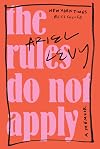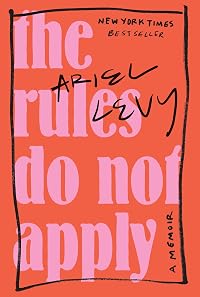
The Rules Do Not Apply: A Memoir
by Ariel Levy
On This Page
Description
NEW YORK TIMES BESTSELLER • “This Year’s Must-Read Memoir” (W magazine) about the choices a young woman makes in her search for adventure, meaning, and loveNAMED ONE OF THE BEST BOOKS OF THE YEAR BY
Vogue • Time • Esquire • Entertainment Weekly • The Guardian • Harper’s Bazaar • Library Journal • NPR
All her life, Ariel Levy was told that she was too fervent, too forceful, too much. As a young woman, she decided that becoming a writer would perfectly channel her show more strength and desire. She would be a professional explorer—“the kind of woman who is free to do whatever she chooses.” Levy moved to Manhattan to pursue her dream, and spent years of adventure, traveling all over the world writing stories about unconventional heroines, following their fearless examples in her own life.
But when she experiences unthinkable heartbreak, Levy is forced to surrender her illusion of control. In telling her story, Levy has captured a portrait of our time, of the shifting forces in American culture, of what has changed and what has remained. And of how to begin again.
Praise for The Rules Do Not Apply
“Unflinching and intimate, wrenching and revelatory, Ariel Levy’s powerful memoir about love, loss, and finding one’s way shimmers with truth and heart on every page.”—Cheryl Strayed
“Every deep feeling a human is capable of will be shaken loose by this profound book. Ariel Levy has taken grief and made art out of it.”—David Sedaris
“Beautifully crafted . . . This book is haunting; it is smart and engaging. It was so engrossing that I read it in a day.”—The New York Times Book Review
“Levy’s wise and poignant memoir is the voice of a new generation of women, full of grit, pathos, truth, and inspiration. Being in her presence is energizing and ennobling. Reading her deep little book is inspiring.”—San Francisco Book Review
“Levy has the rare gift of seeing herself with fierce, unforgiving clarity. And she deploys prose to match, raw and agile. She plumbs the commotion deep within and takes the measure of her have-it-all generation.”—The Atlantic
“Cheryl Strayed meets a Nora Ephron movie. You’ll laugh, ugly cry, and finish it before the weekend’s over.”—theSkimm. show less
Tags
Recommendations











Member Recommendations

JuliaMaria Alkoholismus in einer lesbische Lebensgemeinschaft

Member Reviews
(57) This woman can write. I don't really read the New Yorker (heaven forfend!) but it is clear that Levy is a keen observer of character and cultural phenomena and reports it with sharp wit and a gimlet eye. This is yet another memoir of a fairly young person writing their 'life story.' Did people who used to write autobiographies say 50-100 years ago write them in their 30's? I think its a product of the navel gazing blog writing society we live in that think their experiences so unique and fabulous regardless of their relative lack of perspective. Anyway, Ariel does not get the exciting wonderful life she thought she deserved based on her chutzpah and smarts.
I read this really quickly - it was engaging and felt real. She has a knack show more for description that makes the narrative pointed and compelling. And she indeed acknoledges her sense of entitlement and her poor decision-making that was making me eye-roll for much of the book. And the best line of (paraphrasing) "thinking the rules don't apply to you is the sign of a visionary. It is also however, a sign of narcissistic personality disorder." She doesn't come right out and label herself with narcissism - but it is implied and therefore (for me) forgiven.
So I liked this. I am sorry for what happened to her and I wish her well. I hope her new adventure went well. If I liked reading magazine articles I would look up hers. She is a hell of a writer. show less
I read this really quickly - it was engaging and felt real. She has a knack show more for description that makes the narrative pointed and compelling. And she indeed acknoledges her sense of entitlement and her poor decision-making that was making me eye-roll for much of the book. And the best line of (paraphrasing) "thinking the rules don't apply to you is the sign of a visionary. It is also however, a sign of narcissistic personality disorder." She doesn't come right out and label herself with narcissism - but it is implied and therefore (for me) forgiven.
So I liked this. I am sorry for what happened to her and I wish her well. I hope her new adventure went well. If I liked reading magazine articles I would look up hers. She is a hell of a writer. show less
Often times, the books that capture my attention and hold it are the ones that expose the messiness of life. Not revel in it, per se, but shines a light on complexity, nuance, failures, obtuseness, denial, and all the things that make us fallible humans. This book has that in spades. The carefree and untethered glee of the early 20s when the world was uncomplicated and wide open. The settling down and finding new ways of engaging in the world into one's 30s. The mistakes and hubris of thinking that everything will work out fine. The painful lessons learned when that is not the case- in the worst ways possible. It all felt very familiar and yet deeper.
I am always drawn to complicated women in books and Ariel is that. As is her spouse and show more life. But this memoir is written with what appears to be unflinching honesty. As in life, there are no heroes- only people struggling to make it- love, career, motherhood, family, money, etc.
I recommend this book to anyone who may need to find comfort in tragic loss, who is grappling with messy lives, or someone whose life may be too buttoned up and they want to voyeuristically experience freedom free of similar consequences. Fans of well-written memoirs may also like this book. I also think this may be relevant for Gen X women, as it seems to resonate with a lot of the contradictions we may be feeling and experiencing now.
I'd like to thank Random House and Netgalley for the review copy in exchange for an honest review. show less
I am always drawn to complicated women in books and Ariel is that. As is her spouse and show more life. But this memoir is written with what appears to be unflinching honesty. As in life, there are no heroes- only people struggling to make it- love, career, motherhood, family, money, etc.
I recommend this book to anyone who may need to find comfort in tragic loss, who is grappling with messy lives, or someone whose life may be too buttoned up and they want to voyeuristically experience freedom free of similar consequences. Fans of well-written memoirs may also like this book. I also think this may be relevant for Gen X women, as it seems to resonate with a lot of the contradictions we may be feeling and experiencing now.
I'd like to thank Random House and Netgalley for the review copy in exchange for an honest review. show less
This memoir is deeply personal as Ariel Levy traces her relationship with the woman she married and her deep desire to be a mother - both of which imploded in quick succession. A successful writer for the New Yorker, Ariel traveled the world in pursuit of her journalism and put off motherhood until her late thirties. Then, her pregnancy ended dramatically while on a trip to Mongolia, an event that opened a deep emotional wound. A touching and heartbreaking read and one that I wish I could hand to several people in my life.
“At night I sat on my couch and sobbed so hard I screamed—on the couch the baby’s father and I had picked out together at a fancy store after I got my first book deal, when we were just becoming friends. When I was young. When I had no idea that all over the city, all over the world, there were people walking around sealed in their own universes of loss, independent solar systems of suffering closed off from the regular world…”
For me, like Ariel, it has often been easy to believe subconsciously that my life is destined to turn out well, to be devoid of true calamity or lasting disappointment. Intellectually, of course, that’s obviously ridiculous. But there’s a wide gap between knowing that failure is possible and truly show more feeling that failure is possible. It’s a great privilege to be allowed to reach adulthood without bridging that gap, but it’s certainly jarring when experiences finally force you across it.
I appreciated Ariel’s candid discussion of her life, even if - or because - it doesn’t always paint her in the most flattering light. show less
For me, like Ariel, it has often been easy to believe subconsciously that my life is destined to turn out well, to be devoid of true calamity or lasting disappointment. Intellectually, of course, that’s obviously ridiculous. But there’s a wide gap between knowing that failure is possible and truly show more feeling that failure is possible. It’s a great privilege to be allowed to reach adulthood without bridging that gap, but it’s certainly jarring when experiences finally force you across it.
I appreciated Ariel’s candid discussion of her life, even if - or because - it doesn’t always paint her in the most flattering light. show less
Ariel is a well-known journalist who has always believed things would go her way. Her memoir starts out by announcing that she has lost her spouse, child, and home and as a reader, I felt compelled to find out what happened to her? Why do we do this...to find out how we can keep tragedy from happening to us? As a cautionary tale? Ariel posits that we all do this to objectify and understand tragedy, to create the illusion that we would never let it happen to us. Ariel is, therefore, shocked when a series of unexpected events wrecks havoc on her life plan.
At times, Ariel is not a likable character. She cheats on her wife, she isn't there for her wife in her treatment for alcoholism, she is frequently irresponsible, etc. However, in show more telling her story, Ariel is also self-effacing and able to identify her own narcissistic idealism. The climax and greatest tragedy of Ariel's life story, however, is breathtaking and so sad that I cried in empathy for her. Wow, so heartbreaking. How do you move on (no spoilers)?
I thought this was a very well-written memoir and I would love to read more by Ariel. It was a very quick read and I was disappointed it ended so quickly. I thought it made for an interesting book club discussion about how we walk through life assuming we are exempt from tragedy, until, of course, it happens to us. show less
At times, Ariel is not a likable character. She cheats on her wife, she isn't there for her wife in her treatment for alcoholism, she is frequently irresponsible, etc. However, in show more telling her story, Ariel is also self-effacing and able to identify her own narcissistic idealism. The climax and greatest tragedy of Ariel's life story, however, is breathtaking and so sad that I cried in empathy for her. Wow, so heartbreaking. How do you move on (no spoilers)?
I thought this was a very well-written memoir and I would love to read more by Ariel. It was a very quick read and I was disappointed it ended so quickly. I thought it made for an interesting book club discussion about how we walk through life assuming we are exempt from tragedy, until, of course, it happens to us. show less
This is an exceptional memoir by an exceptional writer. I was amazed by many of the comments here. People are so hateful. Apparently if you are white, financially comfortable and educated you are not allowed to feel pain. This woman lost a child and was left by her alcoholic spouse in the space of a week. Her grief is raw and fierce, and fully analyzed. That is what we do, smart women, we analyze. And Levy doesn't shift the blame to others. She doesn't ask for sympathy. She find the humor when it is there. She takes full responsibility, more responsibility than rightly sits on her shoulders, for everyone's choices.
There is some beautiful work here about the biologically determined love for a child that grows within us as a child grows, show more about the price of having it all, and about defining oneself as a professional, a hard charger, when maintaining that status takes precedence over the needs of our family. How do we define ourselves as women, what is biological and what has been scripted for us, and can we ever truly succeed as individuals if we don't push past those limits? In the end, I think Levy acknowledges that after a lifetime of believing that the rules did not apply to her, that in fact many of them do. That is a tough reality to come to peace with for women like Levy, smart, competitive, focused on doing great things.
I wavered between a 4 and a 5 star rating and went with the later for several reasons. Perhaps most troubling was the way Levy skips over parts that she is not willing to think about, reverting to third person, or broad generalizations about how people feel or what they do in certain circumstances. Those sections are almost shocking the many times they are sandwiched between brutal and specific confessions and deep and meaty personal growth. I still enjoyed the hell out of this book, but I could see clear as day how it could have been even better if she had been more consistent in her analysis, so a high 4 it is. show less
There is some beautiful work here about the biologically determined love for a child that grows within us as a child grows, show more about the price of having it all, and about defining oneself as a professional, a hard charger, when maintaining that status takes precedence over the needs of our family. How do we define ourselves as women, what is biological and what has been scripted for us, and can we ever truly succeed as individuals if we don't push past those limits? In the end, I think Levy acknowledges that after a lifetime of believing that the rules did not apply to her, that in fact many of them do. That is a tough reality to come to peace with for women like Levy, smart, competitive, focused on doing great things.
I wavered between a 4 and a 5 star rating and went with the later for several reasons. Perhaps most troubling was the way Levy skips over parts that she is not willing to think about, reverting to third person, or broad generalizations about how people feel or what they do in certain circumstances. Those sections are almost shocking the many times they are sandwiched between brutal and specific confessions and deep and meaty personal growth. I still enjoyed the hell out of this book, but I could see clear as day how it could have been even better if she had been more consistent in her analysis, so a high 4 it is. show less
When Ariel Levy was interviewing to be a New Yorker writer, the editor asked her "what would aliens think about Earth if all they had was the New Yorker?" and she said "They'd think we weren't very interested in sex."* And the messy, unpredictable, complex, irrational, attached, risky parts of life are the parts that Levy herself is very interested in. The book is an enjoyable autobiography, a romp through paths less taken, and then things go wrong, and then she realizes that having only taken paths less taken she has no map to get back from where she is.
Except that makes it seems more coherent than it actually is. What it is is an engaging memoir of a somewhat bohemian life. What it tries to be is a map for getting out of trouble. But show more the trouble she's in is really just bad luck. She emphasizes how the worst bad luck of all really was just bad luck; but the thing about bad luck is there's nothing to learn from it, other than "be true to yourself", and that doesn't seem like a problem she's had.
I love the question about this elsewhere on Goodreads: "When I got to the end of the book I felt like I was missing something. Is there a sequel?" Because in terms of the hero's journey, this takes us three-quarters of the way through; or, in terms of Dan Harmon's story circle, we don't get all the way to where the hero returns, having changed. Levy observes her life compellingly, but it's not clear what she's learned from it.
It's a fast read, it's enjoyable, and I hope things work out for her. But it feels like a work in progress.
* Because this review is not for publication in the New Yorker I don't have to fact check it, and because the book's been e-returned to the e-library I can't, but some parts of this anecdote are true. show less
Except that makes it seems more coherent than it actually is. What it is is an engaging memoir of a somewhat bohemian life. What it tries to be is a map for getting out of trouble. But show more the trouble she's in is really just bad luck. She emphasizes how the worst bad luck of all really was just bad luck; but the thing about bad luck is there's nothing to learn from it, other than "be true to yourself", and that doesn't seem like a problem she's had.
I love the question about this elsewhere on Goodreads: "When I got to the end of the book I felt like I was missing something. Is there a sequel?" Because in terms of the hero's journey, this takes us three-quarters of the way through; or, in terms of Dan Harmon's story circle, we don't get all the way to where the hero returns, having changed. Levy observes her life compellingly, but it's not clear what she's learned from it.
It's a fast read, it's enjoyable, and I hope things work out for her. But it feels like a work in progress.
* Because this review is not for publication in the New Yorker I don't have to fact check it, and because the book's been e-returned to the e-library I can't, but some parts of this anecdote are true. show less
Members
- Recently Added By
Lists

Penguin Random House
458 works; 4 members

Books Read in 2017
4,249 works; 130 members
Author Information

3+ Works 2,573 Members
Ariel Levy is an American journalist and writer, born in 1974. She is a graduate of Wesleyan University. Before becoming a writer, she worked for Planned Parenthood and New York magazine. In 2008, she became a staff writer for The New Yorker. Her essay, The Lesbian Bride's Handbook, was published in The Best American Essays 2008. She is the author show more of two books, Female Chauvinist Pigs: Women and the Rise of Raunch Culture, and The Rules Do Not Apply: a Memoir. (Bowker Author Biography) show less
Awards and Honors
Distinctions
Common Knowledge
- Canonical title*
- Gegen alle Regeln
- Original title
- The Rules Do Not Apply
- Original publication date
- 2017
- Important places
- North America
- Dedication*
- For AEN & EJJS
- First words*
- Do you ever talk to yourself?
- Last words*
- (Click to show. Warning: May contain spoilers.)Nature. Mother Nature. She is free to do whatever she chooses.
- Blurbers
- Strayed, Cheryl; Sedaris, David; Dunham, Lena; Bloom, Amy; Bechdel, Alison; Steinke, René
*Some information comes from Common Knowledge in other languages. Click "Edit" for more information.
Classifications
- Genres
- Biography & Memoir, Nonfiction, LGBTQ+, General Nonfiction, Sexuality and Gender Studies
- DDC/MDS
- 305.30973 — Society, government, & culture Social sciences, sociology & anthropology Social group - Age, Gender, Ethnicity People by gender or sex Biography and History by Region North America
- LCC
- CT275 .L3777 .A3 — Auxiliary Sciences of History Biography Biography National biography
- BISAC
Statistics
- Members
- 776
- Popularity
- 35,991
- Reviews
- 47
- Rating
- (3.58)
- Languages
- 6 — Czech, Dutch, English, German, Italian, Swedish
- Media
- Paper, Audiobook, Ebook
- ISBNs
- 22
- ASINs
- 4