On This Page
Description
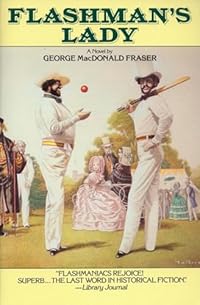
When his beautiful and brainless wife Elizabeth is abducted from Singapore by a half-breed ex-Etonian millionaire, Harry Flashman sets out on an odyssey of reluctant pursuit.Tags
Recommendations










Member Reviews
This is the sixth book featuring Flashman, the cowardly bully from Tom Brown's Schooldays who grows up to become an unlikely (and undeserving) hero of the British Empire in the 19th century. By now many of the jokes and situations have become familiar and though the locales are still exotic and unfamiliar, that's not necessarily enough to make up for a certain staleness in the tale. I suspect that the rest of the Flashman books are probably best read with lengthy intervals in between to combat over-familiarity. Still, this outing does have some transcendent moments, including what must be one of the most hilarious cricket matches set to paper as Flashman needs to beat his nemesis in a one-on-one cricket match on whose outcome his wife's show more reputation depends, while at the same time he must lose it if he is to stay on the right side of a dangerous match-fixing loan shark. show less
I must admit, I was a tad nervous about this one. I've loved all of the Flashman Papers that I've read so far, but I'd heard a bit of naysaying about this one. And, to be sure, the cricket stuff at the start of the book is rather unwelcome unless you have an actual interest in the sport (I don't). Author George MacDonald Fraser is a bit indulgent of his love for the sport here (in the first appendix, he describes it as perhaps the subtlest and most refined outdoor sport ever devised" (pg. 353)) and he doesn't really make much of an attempt to explain its rules or its terminology to the uninitiated reader. Consequently, we get sentences like "I've seen Mynn bowl to five slips and three long-stops, and his deliveries going over 'em all, show more first bounce right down to Lord's gate" (pg. 14) and "what kind of odds could he hope to get on my losing my wicket, for after all, I batted well down the list, and might easily carry my bat through the hand?" (pg. 57), which might as well be written in Hindi for all they mean to me. Nevertheless, the single-wicket match between Flashman and Solomon was surprisingly gripping – Fraser's such a great writer he can even make cricket interesting! – and all the cricket stuff does manage to set up the rest of the story well.
And what a good rest of the story it is, with Flashy globetrotting and getting into all sorts of scrapes with the usual rabble: pirates, head-hunters, mad monarchs and, of course, the obligatory bevy of beauties. It's the mad monarch here who deserves particular mention: Queen Ranavalona of Madagascar, a real-life nutjob tyrant (once again, Fraser's historical research comes up trumps) of whom Flash wryly notes: "She was quite mad, of course, and behaved like Messalina and Attila the Hun, either of whom would have taken one look at her and written to The Times, protesting." (pp239-40). The whole story is the same quality of ripping adventure one has come to expect from the Flashman novels and my early doubts about Flashman's Lady were well and truly conquered.
The best thing about the novel, however, is the 'Lady' of its title, for this is the one book (so far - I can't yet comment on subsequent books) where we really get to spend a considerable amount of time with Flashman's enigmatic and idiotic wife Elspeth. Her diary extracts – published at the end of each of Flashy's chapters – are a real treat as she offers up her own take on the events Flash has been regaling us with. (Her interpretation of Flashman's encounter with Mrs. Lade on pages 68-9 was particularly amusing.) There is a notable ambiguity in her extracts and her actions, and it is to the credit of Fraser's writing that, even with all the words expended on her, we still aren't quite sure whether she is an innocent simpleton or, as Flashman suspects, a randy little harlot with "a hearty appetite for the two-backed game", who "in my absence [had] been rolling the linen with any chap who'd come handy" (pg. 23). The dynamic between Flashman and Elspeth has always been enjoyable, but whereas in previous books it would only be expressed in bookend chapters – between which Flash would go off gallivanting in India or some other place – here, Fraser mines all that gold to novel length, giving Flashman's Lady a uniquely special place in the Flashman oeuvre.
"I felt my eyes sting, and I lifted her chin with my hand.
"Old girl," says I, "you're a trump."" (pg. 332)" show less
And what a good rest of the story it is, with Flashy globetrotting and getting into all sorts of scrapes with the usual rabble: pirates, head-hunters, mad monarchs and, of course, the obligatory bevy of beauties. It's the mad monarch here who deserves particular mention: Queen Ranavalona of Madagascar, a real-life nutjob tyrant (once again, Fraser's historical research comes up trumps) of whom Flash wryly notes: "She was quite mad, of course, and behaved like Messalina and Attila the Hun, either of whom would have taken one look at her and written to The Times, protesting." (pp239-40). The whole story is the same quality of ripping adventure one has come to expect from the Flashman novels and my early doubts about Flashman's Lady were well and truly conquered.
The best thing about the novel, however, is the 'Lady' of its title, for this is the one book (so far - I can't yet comment on subsequent books) where we really get to spend a considerable amount of time with Flashman's enigmatic and idiotic wife Elspeth. Her diary extracts – published at the end of each of Flashy's chapters – are a real treat as she offers up her own take on the events Flash has been regaling us with. (Her interpretation of Flashman's encounter with Mrs. Lade on pages 68-9 was particularly amusing.) There is a notable ambiguity in her extracts and her actions, and it is to the credit of Fraser's writing that, even with all the words expended on her, we still aren't quite sure whether she is an innocent simpleton or, as Flashman suspects, a randy little harlot with "a hearty appetite for the two-backed game", who "in my absence [had] been rolling the linen with any chap who'd come handy" (pg. 23). The dynamic between Flashman and Elspeth has always been enjoyable, but whereas in previous books it would only be expressed in bookend chapters – between which Flash would go off gallivanting in India or some other place – here, Fraser mines all that gold to novel length, giving Flashman's Lady a uniquely special place in the Flashman oeuvre.
"I felt my eyes sting, and I lifted her chin with my hand.
"Old girl," says I, "you're a trump."" (pg. 332)" show less
The recent death of George McDonald Fraser has brought a close (maybe permanent, maybe not?) to this delightful series of books. I have had the pleasure of following this series every since the release of the first book back in the sixties. The Flashman novels combine history (including substantial endnotes) with sex, action, adventure and the secret pleasure of enjoying the exploits of one of the most notoriously popular non-politically correct characters of 20th Century literature. Flashman is a womanizer, a coward, a scoundrel and a cheat, but in the novels, which are all narrated by Flashman himself, he is utterly honest with his readers. He is a man not proud of his faults, but certainly unabashed about them.
The Flashman novels show more could be dismissed as sensationalized light reading , but Fraser cleverly tied his character into most of the major events of the last sixty years of the nineteenth century, a Victorian Zelig or Forrest Gump. Flashman casually mentions this minor detail or that simple observation, then Fraser in his assumed role as editor of the Flashman papers meticulously explains in the endnotes how these mentions by Flashman confirm the truth of his narrative, since only if Flashman was there could he have known about this fact or that. Fraser's endnotes also round out the historic details of the narrative, giving background and elaboration to the history-as-I-lived-it tales told by Flashman. It all works wonderfully, even if you somewhat suspect that some details are being outrageously fabricated.
I very strongly recommend these books to anyone who has an interest in history and is willing to keep an open mind towards the womanizing and the language (the n-word appears quite a bit, but completely in character for Flashman). I would suggest the best way to read them is in order of publication. This doesn't follow Flashman's own life chronology, but the books published later often make reference to previous editions of the "Flashman Papers" and so is more fun for the reader to follow. show less
The Flashman novels show more could be dismissed as sensationalized light reading , but Fraser cleverly tied his character into most of the major events of the last sixty years of the nineteenth century, a Victorian Zelig or Forrest Gump. Flashman casually mentions this minor detail or that simple observation, then Fraser in his assumed role as editor of the Flashman papers meticulously explains in the endnotes how these mentions by Flashman confirm the truth of his narrative, since only if Flashman was there could he have known about this fact or that. Fraser's endnotes also round out the historic details of the narrative, giving background and elaboration to the history-as-I-lived-it tales told by Flashman. It all works wonderfully, even if you somewhat suspect that some details are being outrageously fabricated.
I very strongly recommend these books to anyone who has an interest in history and is willing to keep an open mind towards the womanizing and the language (the n-word appears quite a bit, but completely in character for Flashman). I would suggest the best way to read them is in order of publication. This doesn't follow Flashman's own life chronology, but the books published later often make reference to previous editions of the "Flashman Papers" and so is more fun for the reader to follow. show less
One of the better Flashman books, with Flashy genuinely seeking to rescue his wife, whom he genuinely does love (and vice versa) though neither is remotely faithful to the other
Our intrepid hero, Harry Flashman, is back for volume six of the Flashman Papers, a narrative of the life and times of one of the most ne’er-do-well wastrels to ever grace the pages of a published autobiography.
Heretofore, the adventures of Flashman have been presented in chronological order. With this installment, however, a previous “gap”, between the years 1842-1845 is “filled in” by the contents hereof, which consists of adventures in Borneo and Madagascar.
As in the previous Flashman novels, our Harry is revealed as the premier coward and opportunist of his era; faults which he quite willingly admits and even boasts of. Much as a prior day Forrest Gump, he has a way of finding himself among the most powerful and famous show more personages of his era, as he takes part in the great events of the period.
I was somewhat put off by the first 100 pages of this work, which dealt to a great degree with the sport of cricket. Only passingly familiar with the game, the blizzard of cricket terms and descriptions of cricket action left me at something of a loss. Much can be discerned through context, but some simply flew over my head. In any event, after the cricket action we’re back to standard Flashman fare, as he undergoes numerous adventures in an attempt to rescue his silly wife, Elspeth, who has been kidnapped by pirates of the South China Sea with stops in Singapore, Borneo and Madagascar. He does so not so much as a result of the love he holds for his wife, as much as the embarrassment and ruin he would suffer should he fail to do so.
Aside from uproarious fun and games, the Flashman series is set against historical events and actually serves as an educational experience. On to volume seven of the Flashman Papers. show less
Heretofore, the adventures of Flashman have been presented in chronological order. With this installment, however, a previous “gap”, between the years 1842-1845 is “filled in” by the contents hereof, which consists of adventures in Borneo and Madagascar.
As in the previous Flashman novels, our Harry is revealed as the premier coward and opportunist of his era; faults which he quite willingly admits and even boasts of. Much as a prior day Forrest Gump, he has a way of finding himself among the most powerful and famous show more personages of his era, as he takes part in the great events of the period.
I was somewhat put off by the first 100 pages of this work, which dealt to a great degree with the sport of cricket. Only passingly familiar with the game, the blizzard of cricket terms and descriptions of cricket action left me at something of a loss. Much can be discerned through context, but some simply flew over my head. In any event, after the cricket action we’re back to standard Flashman fare, as he undergoes numerous adventures in an attempt to rescue his silly wife, Elspeth, who has been kidnapped by pirates of the South China Sea with stops in Singapore, Borneo and Madagascar. He does so not so much as a result of the love he holds for his wife, as much as the embarrassment and ruin he would suffer should he fail to do so.
Aside from uproarious fun and games, the Flashman series is set against historical events and actually serves as an educational experience. On to volume seven of the Flashman Papers. show less
A slightly more thoughtful Flashy in this book, perhaps? It includes excerpts from his wife's diary, showing things from her perspective, usually different from his. Indeed the whole interplay between Flashman and his wife is interesting, as is the way Fraser portrays her. Cricket is a thread which is woven throughout the story, which can only be a good thing, of course.
If you are keeping track we are now ten years into the biography of Harry Flashman. This is the sixth packet of papers and introduces events between 1842 - 1845 which were previously missing in earlier manuscripts. Like an earlier packet, this installment was edited by Flashman's sister-in-law, Grizel de Rothschild and includes journal entries from Fashman's wife Elspeth. I think it's hysterical that Grizel cleaned up his "rough" language but left in his exploits with other women (because Flashman always gets his girl, whether she be an African queen or his own lovely wife). And speaking of Elspeth, Flashman has to turn his attention to her (more than normal) when she is kidnapped by a pirate who wants her for himself. Along the way (by show more way of Madagascar), Flashman is held captive by the ruthless Queen Ranavalona and forced to be her love slave (but of course). show less
Members
- Recently Added By
Lists

Historical Fiction
889 works; 90 members

Best Antiheroes and Antiheroines
119 works; 7 members
Author Information

48+ Works 19,651 Members
Author George MacDonald Fraser was born April 2, 1925 in Carlisle. He was refused entrance to the medical faculty of Glasgow University, so he joined the army in 1943. He served as an infantryman with the 17th Indian Division of the XIVth Army in Burma, a lance corporal and was commissioned in the Gordon Highlanders. After the war, he became a show more sports reporter with the Carlisle Journal; and during this time, he met and married Kathleen Hetherington, a reporter from another paper. He worked as a reporter and sub-editor on the Cumberland News and then moved to Glasgow, in 1953, where he worked at the Glasgow Herald as a features editor and deputy editor. Fraser's first novel was "Flashman" (1969), which was followed by nine sequels, so far, that deal with different venues of the 19th century ranging from Russia, Borneo and China to the Great Plains of the America West. Some of the other titles in the Flashman Papers are "Royal Flash" (1970), "Flashman in the Great Game" (1975), "Flashman and the Redskins" (1982), and "Flashman and the Angel of the Lord" (1994). Some of his non-fiction work includes "The Steel Bonnets" (1971), which is a factual study of the Anglo-Scottish border thieves in the seventeenth century, and "Quartered Safe Out Here" (1992). Fraser has also written a number of screenplays that include "The Three Musketeers" (1973), "Royal Flash" (1975), "Octopussy" (1983), and "Return of the Musketeers" (1989). He has also written a series of short stories about Private McAuslan whose titles include "The General Danced at Dawn" (1970), "McAuslan in the Rough" (1974), and "The Sheik and the Dustbin and other McAuslan Stories" (1988). He died of cancer on January 2, 2008. (Bowker Author Biography) show less
Some Editions
Awards and Honors
Series

Belongs to Publisher Series
Work Relationships
Common Knowledge
- Canonical title
- Flashman's Lady
- Original publication date
- 1977
- People/Characters
- Harry Paget Flashman; Elspeth Morrison; John Morrison; Tom Brown; Sulieman Usman; Fuller Pilch (show all 22); Alfred Mynn; Nicholas Felix; Richard Harris Barham; Henry Keppel; James Brooke; Angela Burdett-Coutts; Charles Anthoni Johnson Brooke; Jean Laborde; Ranavolana I; Radama II of Madagascar; Rakota; Fankanonikaka; Paitingi Ali; Whampoa; Daedalus Tighe; Catchick Moses
- Important places
- Eton College, Eton, Berkshire, England, UK; Singapore; Sarawak, Borneo; Borneo; Madagascar
- Dedication
- For K, 6
- First words
- So they're talking about amending the leg-before-wicket rule again.
- Last words
- (Click to show. Warning: May contain spoilers.)It would be pleasant to think that Mr. Fankanonikaka, at least, was spared to continue his devoted service to his queen and country.
- Original language
- English, UK
Classifications
- Genres
- Fiction and Literature, General Fiction, Historical Fiction
- DDC/MDS
- 823.914 — Literature & rhetoric English & Old English literatures English fiction 1900- 1901-1999 1945-1999
- LCC
- PZ4 .F8418 — Language and Literature Fiction and juvenile belles lettres Fiction and juvenile belles lettres Fiction in English
- BISAC
Statistics
- Members
- 1,179
- Popularity
- 21,079
- Reviews
- 15
- Rating
- (3.92)
- Languages
- 6 — Danish, English, German, Italian, Russian, Spanish
- Media
- Paper, Audiobook, Ebook
- ISBNs
- 34
- ASINs
- 17